



Artificial Intelligence In Construction Market Size 2025-2029
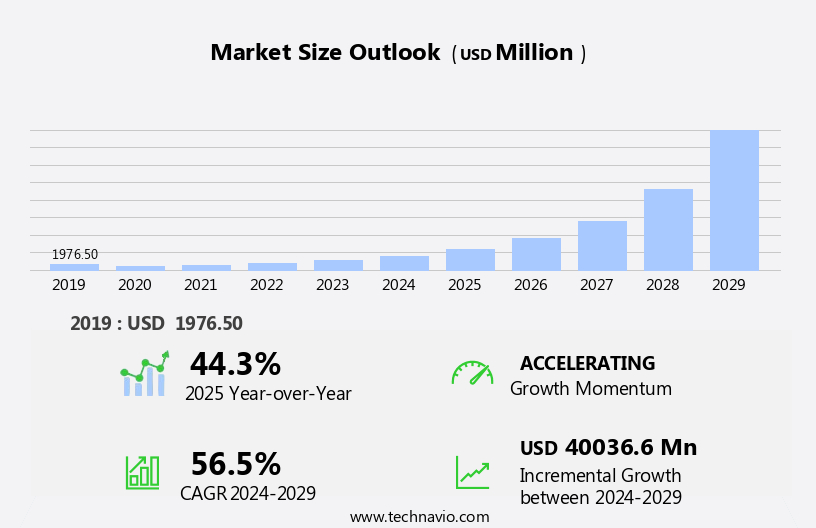
The artificial intelligence (AI) in construction market size is forecast to increase by USD 40.04 billion, at a CAGR of 56.5% between 2024 and 2029.
- The market is experiencing significant growth, driven by the increasing demand for data integration and visual analytics in the industry. Construction projects are becoming increasingly complex, and AI solutions offer the ability to automatically update and build projects, streamlining processes and improving efficiency. However, the implementation of AI in construction faces a notable challenge: the lack of a skilled workforce capable of developing and refining AI algorithms. Additionally, AI-powered design tools, structural analysis software, and building information modeling enable high-efficiency planning and collaboration.
- Companies seeking to capitalize on this market's potential must focus on addressing this challenge while continuing to innovate and offer advanced AI solutions to meet the evolving needs of the construction industry. This shortage of expertise may hinder the market's growth and necessitates strategic partnerships and collaborations between industry players and educational institutions to foster talent development. Building managers use sensors, drones, and virtual reality goggles to monitor and manage facilities post-construction.
What will be the Size of the Artificial Intelligence (AI) In Construction Market during the forecast period?
Get Key Insights on Market Forecast (PDF)
Request Free Sample
- The artificial intelligence (AI) market in construction is continually evolving, with smart construction solutions gaining traction across various sectors. Autonomous robots, building information modeling, and deep learning technologies are transforming business models, addressing safety concerns, and enhancing efficiency. For instance, an early mover in the industry reported a 15% increase in productivity by implementing an AI-powered robot for pouring concrete on a large-scale project. The construction industry is expected to grow by 6% annually, driven by automation, learning algorithms, and real-time interactions between computer systems and primary participants. Machine learning models also play a crucial role in predictive analytics for project timelines and budgets.
- Autonomous robots and drones are streamlining repetitive tasks such as grading plans, notifications, and change orders. Building information modeling and facial recognition systems are enabling real-time safety monitoring, risk mitigation, and problem-solving. Deep learning and machine learning algorithms are optimizing production costs, asset management, and schedule risks. However, challenges persist, including potential safety issues, labor shortages, and expensive errors. AI in construction is not without its open issues, such as the integration of AI with human workforces, safety systems, and the economic cycles. Industry growth in generative AI for construction is expected to reach 20% annually, with applications ranging from structural analysis and risk assessment to prefabrication planning, resource allocation, project scheduling, and digital twin technology.
How is this Artificial Intelligence (AI) In Construction Industry segmented?
The artificial intelligence (AI) in construction industry research report provides comprehensive data (region-wise segment analysis), with forecasts and estimates in "USD million" for the period 2025-2029, as well as historical data from 2019-2023 for the following segments.
- Component
- Software
- Services
- Hardware
- End-user
- Large enterprises
- SMEs
- Type
- Machine learning
- Computer vision
- NLP
- Geography
- North America
- US
- Canada
- Europe
- France
- Germany
- Italy
- UK
- APAC
- China
- India
- Japan
- Rest of World (ROW)
- North America
By Component Insights
The Software segment is estimated to witness significant growth during the forecast period. The AI in construction market is experiencing significant growth, with the software segment currently dominating the global industry in terms of size. In 2024, this segment accounted for a substantial market share. Factors fueling this segment's expansion include globalization, IT integration in the construction sector for decision-making, and the adoption of machine learning platforms, text analytics, robotic process automation, image and video analysis, deep learning, and speech recognition. The increasing demand for software-based AI solutions is driven by the rise in construction activities and the implementation of advanced technologies in emerging economies like China, India, Brazil, Indonesia, and Mexico. Generative design software and building performance evaluation tools facilitate carbon footprint reduction, aligning with industry sustainability goals.
The services segment in the global AI in construction market is expected to register high growth during the forecast period. The exponential growth of this segment can be attributed to the professional services provided by companies engaged in the global AI in construction market, as well as the large volumes of data generated from devices installed for IoT data collection. The demand for low-cost IT solutions is increasing at an exponential rate in certain countries, such as India, Brazil, and China, due to tight budgets for IT services for construction. The key strategy adopted by construction companies is to considerably reduce the total cost of ownership of IT solutions. As a result, the adoption of emerging technologies such as cloud computing is rapidly increasing. In countries such as the US, India, China, and Japan, SaaS-based AI solutions are used in many departments (such as finance, surveying, and raw material supply) in the construction sector.
Companies offering AI software solutions cater to organizations' needs in project management, predictive risk management, schedule management, and supply chain management applications. By 2026, the industry is projected to grow by 18% in size. This growth is attributed to the continuous integration of AI technologies in the construction sector and the increasing demand for efficient and cost-effective solutions. AI is transforming the industry, from autonomous robots to deep learning, and from safety monitoring to project delivery. Despite challenges, the potential benefits of AI in construction are significant, with the potential to improve efficiency, reduce costs, and enhance safety. Construction simulation software enables more accurate project planning, while energy performance metrics and data analytics platforms optimize building designs for energy efficiency.
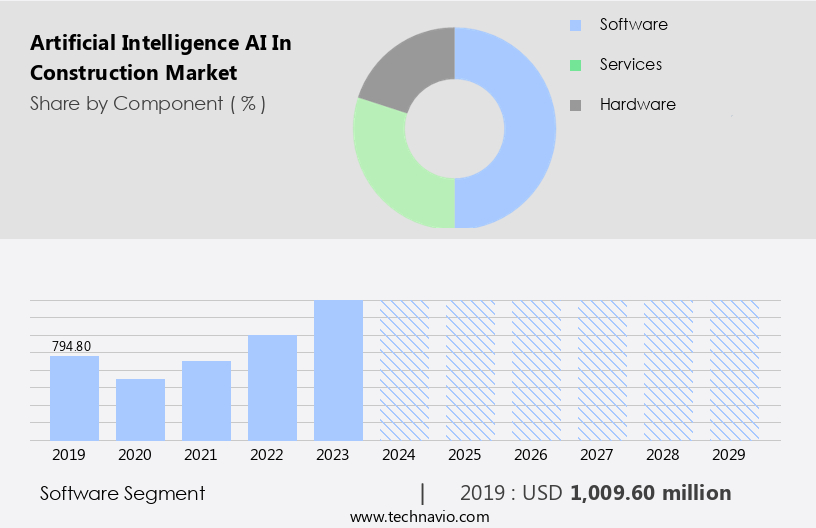
The Software segment was valued at USD 1.01 billion in 2019 and showed a gradual increase during the forecast period.
AI technologies are also addressing safety concerns, with sensors and cameras monitoring worksites for hazards and accidents. Deep neural networks are analyzing historical data to prevent cost overruns and improve quality. Virtual reality goggles are enabling designers to visualize designs in real-time, while reinforcement learning is optimizing contract types and sequences of activities. In the preconstruction phases, AI is streamlining requests for information, bidding, and design alternatives. During construction, AI is addressing productivity issues, weather patterns, and construction errors. Post-construction, AI is optimizing building operations, maintenance, and financing. The AI market in construction is continuously unfolding, with ongoing activities and evolving patterns. Cloud-based collaboration tools foster seamless project coordination, and waste management strategies minimize environmental impact.
In resource management, construction activity data combined with AI and big data allows companies to process a massive amount of data and forecast building costs more accurately. Cost risk assessments ensure subsegments of projects remain on budget, minimizing the risk of delays. Off-site construction supported by automation reduces the load on human workers and addresses the shortage highlighted by industry bodies such as the Associated Builders and Contractors. AI also finds applications beyond construction logistics detecting structural disease in buildings, enhancing maintenance planning, and enabling the better design of buildings to improve efficiency and sustainability. In parallel, the integration of AI in plumbing, mechanical, and architecture domains fosters a seamless workflow from design to completion.
Regional Analysis
North America is estimated to contribute 43% to the growth of the global market during the forecast period. Technavio's analysts have elaborately explained the regional trends and drivers that shape the market during the forecast period.
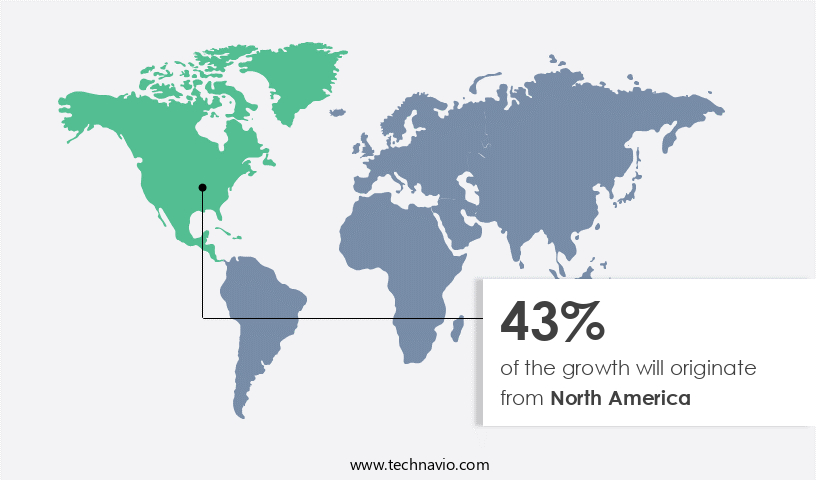
See How artificial intelligence (AI) in construction market Demand is Rising in North America Request Free Sample
The AI in construction market in North America is experiencing significant growth, with adoption rates increasing by 21% in 2021. This trend is expected to continue, with industry experts projecting a 17% increase in market size by 2025. The US and Canada, with their advanced economies and high infrastructure development rates, are major contributors to this expansion. Notable projects, such as the construction of the Mexico City New International Airport, have adopted construction management software solutions, further fueling market growth. The North American construction industry's technological maturity, spanning sectors like oil and gas, manufacturing, building, and mining, accelerates the adoption of AI technologies. The region's commitment to innovation, as demonstrated by global conferences, product launches, and exhibitions, underscores the market's continuous evolution.
The Artificial Intelligence (AI) in Construction Market is rapidly transforming the way projects are planned, executed, and monitored. Through AI products and services, companies are reimagining business model transformation to address industry challenges such as workforce shortage, cost and schedule overruns, and low productivity. In project planning, project timelines are optimized with planned start and end dates, considering contract type, sequence of activities, and grading plan. Using generative design, AI integrates architecture, mechanical, and plumbing plans to create a better design of buildings. These solutions leverage pattern recognition, statistical techniques, and learning algorithm models that analyze previous projects and inputs to assign a risk score for potential delays or budget excesses.
On construction sites, general contractors and skilled labor collaborate with advanced technologies. Robotics such as Spot the Dog, mini-robots, and bricklaying systems are deployed for bricklaying, demolition, and off-site construction, reducing dependence on the human workforce and enhancing safety. Onsite cameras, mobile devices, and drone videos capture real time site data, while security sensors and Internet of Things devices monitor safety hazards and prevent worksite injuries. Building managers and supervisors can make informed decisions with AI-driven insights. AI extends into predictive safety management by analyzing accident records and detecting safety hazards using Artificial Neural Networks and deep neural network architectures. Predictive maintenance for construction equipment is minimizing downtime and maximizing productivity, while AI-powered risk assessment in construction is helping to identify potential hazards and prevent accidents.
Market Dynamics
Our researchers analyzed the data with 2024 as the base year, along with the key drivers, trends, and challenges. A holistic analysis of drivers will help companies refine their marketing strategies to gain a competitive advantage.
What are the key market drivers leading to the rise in the adoption of Artificial Intelligence (AI) In Construction Industry?
- The rise in demand for data integration and visual analytics solutions is the primary market driver, as organizations seek to effectively manage and gain insights from growing volumes of complex data. The construction industry is facing growing data complexities, making it challenging to deploy and maintain reliable data interfaces. In response, enterprises worldwide are adopting data integration solutions, integrating AI technology into their construction processes. AI in construction enables real-time data analysis, facilitating informed decision-making and data transformation.
- For instance, a leading construction firm reported a 10% increase in project efficiency after implementing an AI solution for predictive maintenance. The construction AI market is expected to grow significantly, with industry experts projecting a 25% increase in AI adoption by 2025. These advancements will revolutionize the industry, streamlining operations, improving productivity, and enhancing overall project outcomes. This technology bridges the gap between businesses and IT, allowing companies to understand their processes and monitor project performance. Moreover, AI-powered products are being introduced by market players to enhance analytics capabilities.
What are the market trends shaping the Artificial Intelligence (AI) In Construction Industry?
- The automatic updating and building of projects is becoming increasingly mandatory in the current market trend. This professional practice ensures efficiency and staying current with industry developments. Artificial Intelligence (AI) is revolutionizing the construction industry by streamlining project portfolio management processes. Intelligent scheduling tools, integrated into AI systems, enhance productivity by automating the creation and updating of project schedules. These tools reference predefined process libraries for optimal output and suggest missing processes for creation.
- One notable example of AI's impact is a 15% increase in project efficiency observed in a major construction firm after implementing AI-driven project portfolio management tools. By automating repetitive tasks and optimizing processes, AI enables professionals to focus on more strategic aspects of project management, ultimately improving overall project outcomes. Additionally, AI identifies necessary skills for tasks and checks resource availability. According to recent studies, the global construction AI market is expected to grow by over 20% in the next few years.
What challenges does the Artificial Intelligence (AI) In Construction Industry face during its growth?
- The absence of a sufficiently skilled workforce poses a significant challenge to the development and growth of the AI algorithm industry. The Artificial Intelligence (AI) market in construction faces impeded growth due to the scarcity of technical expertise among end-users. End-user companies implementing AI on their construction IT platforms require a comprehensive understanding of AI software functionality and regular infrastructure updates for seamless operations. However, in developing countries, the reluctance to learn and adopt new technologies deters many from integrating AI into their systems.
- According to recent industry reports, the global construction AI market is projected to expand by over 20% in the next five years, indicating growing recognition and adoption of AI technologies in the sector. For instance, a leading construction firm reported a 30% increase in project efficiency after implementing AI-powered scheduling and planning tools. The absence of skilled operators and proper training significantly impacts the execution of large-scale automation, necessitating substantial time, resources, and budget for successful implementation. To bridge this gap, companies must provide both online and offline training and consultation services to maximize end-users' benefits from AI.
Exclusive Customer Landscape
The artificial intelligence (AI) in construction market forecasting report includes the adoption lifecycle of the market, covering from the innovator's stage to the laggard's stage. It focuses on adoption rates in different regions based on penetration. Furthermore, the artificial intelligence (AI) in construction market report also includes key purchase criteria and drivers of price sensitivity to help companies evaluate and develop their market growth analysis strategies.
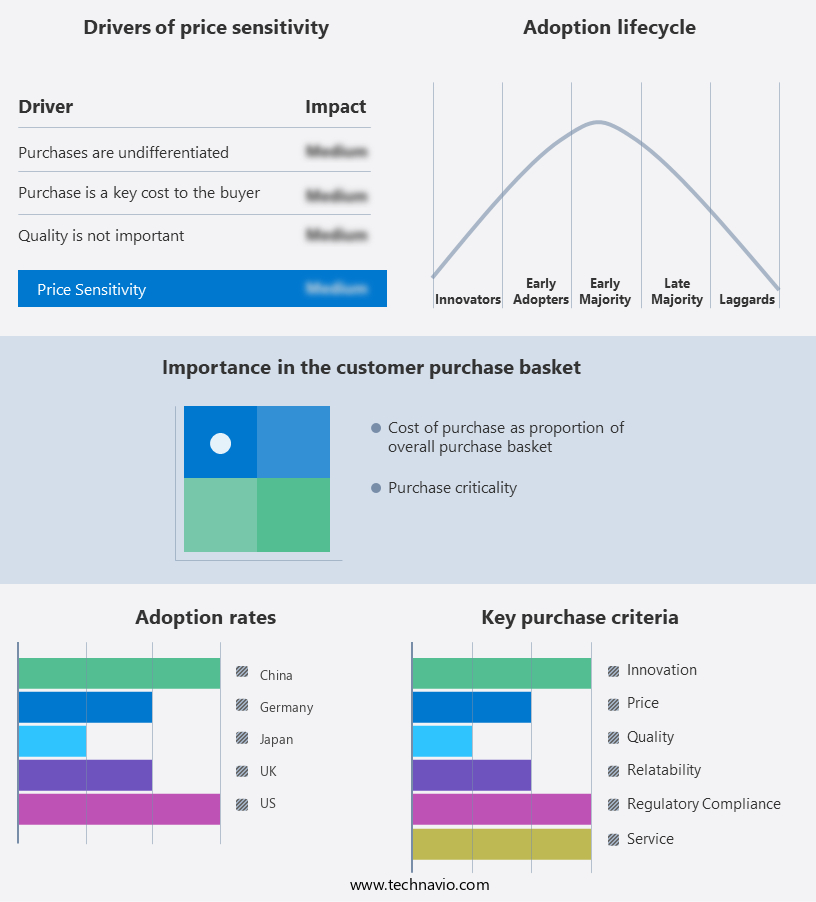
Customer Landscape
Key Companies & Market Insights
Companies are implementing various strategies, such as strategic alliances, artificial intelligence (AI) in construction market forecast, partnerships, mergers and acquisitions, geographical expansion, and product/service launches, to enhance their presence in the industry.
ALICE Technologies - The company's Alice software leverages artificial intelligence to enhance resource planning in the construction industry, optimizing operations for improved efficiency and productivity.
The industry research and growth report includes detailed analyses of the competitive landscape of the market and information about key companies, including:
- ALICE Technologies
- Amazon.com Inc.
- Autodesk Inc.
- Bentley Systems Inc.
- Buildots Ltd
- Customindz Inc.
- Dassault Systemes SE
- Doxel Inc.
- eSUB Inc.
- Intel Corp.
- International Business Machines Corp.
- Microsoft Corp.
- NVIDIA Corp.
- Oracle Corp.
- PTC Inc.
- SAP SE
- Siemens AG
- The Access Group
- TUV SUD AG
Qualitative and quantitative analysis of companies has been conducted to help clients understand the wider business environment as well as the strengths and weaknesses of key industry players. Data is qualitatively analyzed to categorize companies as pure play, category-focused, industry-focused, and diversified; it is quantitatively analyzed to categorize companies as dominant, leading, strong, tentative, and weak.
Recent Development and News in Artificial Intelligence (AI) In Construction Market
- In January 2024, Autodesk, a leading design software company, announced the launch of its new AI-powered construction tool, BIM 360 Design, which uses machine learning algorithms to automate design tasks and improve collaboration between architects, engineers, and construction professionals (Autodesk Press Release, 2024).
- In March 2024, Skanska, a global construction firm, partnered with Microsoft to implement AI and IoT technologies on its construction sites, aiming to enhance productivity, reduce costs, and improve safety (Skanska Press Release, 2024).
- In May 2024, Procore, a construction management software provider, raised USD 150 million in a funding round led by Tiger Global Management, bringing its total valuation to USD 8 billion (Procore Press Release, 2024). This investment will be used to expand its AI capabilities and enhance its platform for the construction industry.
- In February 2025, the European Union passed the Digital Construction Alliance (DCA) regulation, which mandates the adoption of AI and digital technologies in all public construction projects starting from 2026 (EU Press Release, 2025). This initiative is expected to accelerate the adoption of AI in the European construction market.
Research Analyst Overview
- The construction industry continues to embrace artificial intelligence (AI) technology, transforming various sectors through enhanced design, financing, procurement, bidding, and asset management processes. AI's integration in construction is a dynamic and evolving market activity, with safety measures and production cost savings being significant drivers. For instance, AI-powered data triangulation in engineering projects has led to a 15% reduction in rework, improving overall project efficiency. Executives and workers alike anticipate that AI will revolutionize business models, optimizing construction sites and addressing labor shortages. Deep learning models for structural analysis and AI-powered environmental impact assessment are enabling more informed decisions regarding design and construction.
- According to statistics, the global construction AI market is expected to grow by over 20% in the next five years, underscoring its increasing importance in project lifecycles. Early movers in AI adoption are reaping the benefits, streamlining operations and ensuring safety concerns are addressed effectively. By leveraging AI-powered systems in designing, monitoring, and operational management, the Artificial Intelligence (AI) in Construction Market is redefining how projects are executed. With continuous innovation in AI products and services and accelerated business model transformation, the sector is poised for unprecedented growth and efficiency.
Dive into Technavio's robust research methodology, blending expert interviews, extensive data synthesis, and validated models for unparalleled Artificial Intelligence (AI) In Construction Market insights. See full methodology.
|
Market Scope |
|
|
Report Coverage |
Details |
|
Page number |
224 |
|
Base year |
2024 |
|
Historic period |
2019-2023 |
|
Forecast period |
2025-2029 |
|
Growth momentum & CAGR |
Accelerate at a CAGR of 56.5% |
|
Market growth 2025-2029 |
USD 40.04 billion |
|
Market structure |
Fragmented |
|
YoY growth 2024-2025(%) |
44.3 |
|
Key countries |
US, China, UK, Germany, Canada, Japan, India, Saudi Arabia, France, and Italy |
|
Competitive landscape |
Leading Companies, Market Positioning of Companies, Competitive Strategies, and Industry Risks |
What are the Key Data Covered in this Artificial Intelligence (AI) In Construction Market Research and Growth Report?
- CAGR of the Artificial Intelligence (AI) In Construction industry during the forecast period
- Detailed information on factors that will drive the growth and forecasting between 2025 and 2029
- Precise estimation of the size of the market and its contribution of the industry in focus to the parent market
- Accurate predictions about upcoming growth and trends and changes in consumer behaviour
- Growth of the market across North America, Europe, APAC, Middle East and Africa, and South America
- Thorough analysis of the market's competitive landscape and detailed information about companies
- Comprehensive analysis of factors that will challenge the artificial intelligence (AI) in construction market growth of industry companies
We can help! Our analysts can customize this artificial intelligence (AI) in construction market research report to meet your requirements.
 RIA -
RIA - 
