


Cell And Gene Therapy Market Size 2024-2028
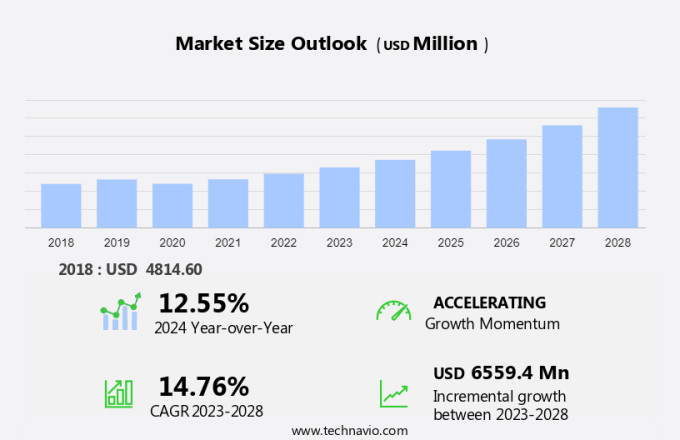
The cell and gene therapy market size is forecast to increase by USD 6.56 billion at a CAGR of 14.76% between 2023 and 2028. The market is experiencing significant growth due to the increasing prevalence of chronic diseases, leading to a swell in demand for innovative treatments. This includes both cell replacement and gene augmentation therapies. Strategic alliances between industry players and academic institutions are driving advancements in biomanufacturing and single-use technology, streamlining production processes and reducing costs. However, high costs and the failure rate in clinical trials remain challenges, necessitating continued investment in research and development to ensure the long-term success of this rapidly evolving industry. Apheresis technology, which enables the selective removal of specific cells from the bloodstream, is a critical component of cell culture and gene therapy, enabling the collection and processing of therapeutic cells. The clinical pipeline for cell and gene therapies is strong, with numerous potential treatments in various stages of development.
Market Segmentation
The market research report provides comprehensive data (region-wise segment analysis), with forecasts and estimates in "USD million" for the period 2024-2028, as well as historical data from 2018-2022 for the following segments.
- Type
- Cell therapy
- Gene therapy
- Geography
- North America
- US
- Europe
- Germany
- UK
- Asia
- China
- Japan
- Rest of World (ROW)
- North America
By Type Insights
The cell therapy segment is estimated to witness significant growth during the forecast period. Cell therapy represents a cutting-edge treatment modality where living cells are administered to patients to address various health conditions. This therapeutic approach utilizes both autologous and allogeneic cells. The market for cell therapy is experiencing significant growth due to its potential for personalized medicine. Companies are developing cell therapy products from diverse cell lines, including stem cells, to cater to the increasing demand for novel treatments for chronic diseases. The therapeutic potential of these products is driving intense research and collaboration with regulatory bodies to advance human clinical trials. The focus on pluripotent and multipotent cells is particularly noteworthy, as these cells hold immense promise for the development of innovative cell therapy solutions in fields such as hematology, ophthalmology, and neurological disorders.

Get a glance at the market share of various segments Request Free Sample
The cell therapy segment accounted for USD 2.83 billion in 2018 and showed a gradual increase during the forecast period.
Regional Insights
North America is estimated to contribute 41% to the growth of the global market during the forecast period. Technavio's analysts have elaborately explained the regional trends and drivers that shape the market during the forecast period.

For more insights on the market share of various regions Request Free Sample
The North American region is anticipated to lead the market due to substantial investment in research and development (R&D) initiatives, particularly in the United States. With hundreds of clinical trials underway in North America, primarily in the US, to address conditions such as cancer, HIV/AIDS, neurological disorders, and cardiovascular diseases, this region holds significant potential. The prevalence of cancer in North America is high, resulting in a considerable number of deaths. This disease incidence has risen significantly in various North American countries over the years. In the field of cell and gene therapy, two distinct yet interconnected approaches are gaining traction: gene therapy and cell therapy. Gene therapy involves introducing new genetic material into cells to correct or prevent disease, while cell therapy utilizes live cells to treat or repair damaged tissues. Both approaches hold immense promise in treating various diseases, including hematological disorders and ophthalmological conditions.
Our researchers analyzed the data with 2023 as the base year, along with the key drivers, trends, and challenges. A holistic analysis of drivers will help companies refine their marketing strategies to gain a competitive advantage.
The market is experiencing significant growth due to the increasing prevalence of various diseases such as infectious diseases, oncological disorders, cardiovascular diseases, genetic disorders, and rare diseases. This market encompasses advanced targeted therapies, including gene therapy and cell therapy, which offer promising solutions for neurology, rare hematology, oncology, ophthalmology, and neurological disorders. Gene therapy involves using genes to treat or prevent diseases by introducing new genetic material into cells. Technologies like gene silencing, gene augmentation, and CRISPR are revolutionizing gene therapy by providing precise and effective methods for treating genetic disorders. Cell therapy, on the other hand, involves using living cells to treat or replace damaged cells or tissues.
This therapy is particularly useful in hematology, where cell replacement therapies are used to treat various blood disorders. Single-use technology is gaining popularity in cell therapy due to its ease of use, cost-effectiveness, and reduced risk of contamination. Biomanufacturing and apheresis are crucial components of the market. Biomanufacturing enables the large-scale production of therapeutic proteins, viral vectors, and cells, while apheresis facilitates the separation and collection of cells from the bloodstream, making it possible to isolate and purify therapeutic cells for use in various applications. Overall, the market holds immense potential for transforming healthcare and improving patient outcomes in various therapeutic areas.
Key Market Drivers
- Rising Prevalence of Chronic Diseases: The global burden of chronic diseases continues to increase, creating a significant unmet medical need.
- Advancements in Biotechnology: Breakthroughs in biotechnology, such as CRISPR-Cas9 gene editing technology, have opened up new avenues for therapeutic interventions.
- Increased Investment: Significant investments from both public and private sectors are driving the development of cell and gene therapies.
Emerging Market Trends
- Personalized Medicine: The ability to tailor treatments to individual patients' genetic makeup is a major trend in cell and gene therapy.
- Combination Therapies: Combining cell and gene therapies with other modalities, such as immunotherapy, is emerging as a promising approach.
- Regulatory Landscape: Clear and efficient regulatory frameworks are essential to accelerate the development and commercialization of cell and gene therapies.
Market Challenges and Opportunities
- High Cost of Development: The development of cell and gene therapies is a complex and expensive process, requiring substantial investments.
- Manufacturing Challenges: Scaling up the manufacturing of cell and gene therapies to meet commercial demand remains a significant hurdle.
- Regulatory Hurdles: Navigating the regulatory landscape can be time-consuming and costly, particularly for novel therapies.
Exclusive Customer Landscape
The market forecasting report includes the adoption lifecycle of the market, covering from the innovator's stage to the laggard's stage. It focuses on adoption rates in different regions based on penetration. Furthermore, the report also includes key purchase criteria and drivers of price sensitivity to help companies evaluate and develop their market growth analysis strategies.

Customer Landscape
Key Companies & Market Insights
Companies are implementing various strategies, such as strategic alliances, partnerships, mergers and acquisitions, geographical expansion, and product/service launches, to enhance their presence in the market.
Biogen Inc.: The company offers cell and gene theraputic solutions named cotoretigene toliparvovec, a gene therapy for patients with X-linked retinitis pigmentosa that is associated with progressive vision loss as the light-sensing cells of the retina gradually deteriorate.
The market research and growth report includes detailed analyses of the competitive landscape of the market and information about key companies, including:
- Alnylam Pharmaceuticals Inc.
- Amgen Inc.
- bluebird bio Inc.
- Bristol Myers Squibb Co.
- Castle Creek Biosciences Inc.
- CORESTEM Inc.
- Cytori Therapeutics Inc.
- Dendreon Pharmaceuticals LLC
- Ferring BV
- Gilead Sciences Inc.
- Helixmith Co. Ltd.
- Human Stem Cells Institute
- JCR Pharmaceticals Co. Ltd.
- Kolon TissueGene Inc.
- Novartis AG
- Orchard Therapeutics Plc
- Pfizer Inc.
- Sibiono GeneTech Co. Ltd.
- Vericel Corp.
Qualitative and quantitative analysis of companies has been conducted to help clients understand the wider business environment as well as the strengths and weaknesses of key market players. Data is qualitatively analyzed to categorize companies as pure play, category-focused, industry-focused, and diversified; it is quantitatively analyzed to categorize companies as dominant, leading, strong, tentative, and weak.
Research Analyst Overview
The market is experiencing significant growth due to the increasing prevalence of various diseases, including infectious diseases, oncological disorders, cardiovascular diseases, genetic disorders, and rare diseases. In the field of oncology and hematology, advanced targeted therapies such as gene therapy, cell therapy, gene editing, and T-cell receptor therapy are showing promising results in treating cancer and hematological disorders. Oligonucleotides, zinc fingers, and viral transfection are key technologies used in gene therapy. Gene therapy and cell therapy are also being explored for neurological disorders, hepatology, ophthalmology, and other chronic diseases.
Additionally, single-use technology, apheresis, and biomanufacturing are essential in the production of allogeneic cell solutions and autologous cell products. The clinical pipeline for these therapies is vital, with numerous clinical study protocols underway, and regulatory approvals being granted. Gene therapy and cell therapy hold immense potential in treating mitochondrial genetics, sickle cell anemia, rare genetic disorders, and other diseases. The market is expected to grow significantly in the coming years, driven by the increasing demand for effective treatments for various chronic and genetic conditions.
|
Market Scope |
|
|
Report Coverage |
Details |
|
Page number |
151 |
|
Base year |
2023 |
|
Historic period |
2018-2022 |
|
Forecast period |
2024-2028 |
|
Growth momentum & CAGR |
Accelerate at a CAGR of 14.76% |
|
Market growth 2024-2028 |
USD 6.56 billion |
|
Market structure |
Fragmented |
|
YoY growth 2023-2024(%) |
12.55 |
|
Regional analysis |
North America, Europe, Asia, and Rest of World (ROW) |
|
Performing market contribution |
North America at 41% |
|
Key countries |
US, Germany, UK, China, and Japan |
|
Competitive landscape |
Leading Companies, Market Positioning of Companies, Competitive Strategies, and Industry Risks |
|
Key companies profiled |
Alnylam Pharmaceuticals Inc., Amgen Inc., Biogen Inc., bluebird bio Inc., Bristol Myers Squibb Co., Castle Creek Biosciences Inc., CORESTEM Inc., Cytori Therapeutics Inc., Dendreon Pharmaceuticals LLC, Ferring BV, Gilead Sciences Inc., Helixmith Co. Ltd., Human Stem Cells Institute, JCR Pharmaceticals Co. Ltd., Kolon TissueGene Inc., Novartis AG, Orchard Therapeutics Plc, Pfizer Inc., Sibiono GeneTech Co. Ltd., and Vericel Corp. |
|
Market dynamics |
Parent market analysis, market growth inducers and obstacles, market forecast, fast-growing and slow-growing segment analysis, COVID-19 impact and recovery analysis and future consumer dynamics, market condition analysis for the forecast period |
|
Customization purview |
If our market report has not included the data that you are looking for, you can reach out to our analysts and get segments customized. |
What are the Key Data Covered in this Market Research and Growth Report?
- CAGR of the market during the forecast period
- Detailed information on factors that will drive the market growth and forecasting between 2024 and 2028
- Precise estimation of the size of the market and its contribution of the market in focus to the parent market
- Accurate predictions about upcoming market growth and trends and changes in consumer behaviour
- Growth of the market across North America, Europe, Asia, and Rest of World (ROW)
- Thorough analysis of the market's competitive landscape and detailed information about companies
- Comprehensive analysis of factors that will challenge the growth of market companies
We can help! Our analysts can customize this market research report to meet your requirements. Get in touch