



Cutlery Market Size 2026-2030
The cutlery market size is valued to increase by USD 4.98 billion, at a CAGR of 6% from 2025 to 2030. Expansion of global hospitality and tourism infrastructure will drive the cutlery market.
Major Market Trends & Insights
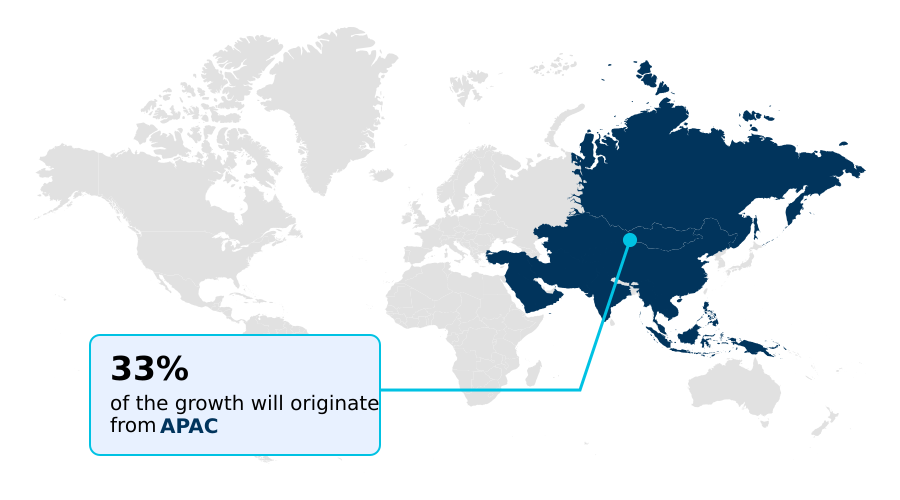
- APAC dominated the market and accounted for a 32.9% growth during the forecast period.
- By Material - Stainless steel segment was valued at USD 7.00 billion in 2024
- By Product - Spoons segment accounted for the largest market revenue share in 2024
Market Size & Forecast
- Market Opportunities: USD 7.74 billion
- Market Future Opportunities: USD 4.98 billion
- CAGR from 2025 to 2030 : 6%
Market Summary
- The cutlery market is a dynamic sector defined by the intersection of precision engineering, material science, and evolving consumer and professional demands. Key drivers include a rising interest in gourmet home cooking, which fuels demand for professional kitchen knives and specialized tools, and the robust expansion of the global hospitality industry, requiring large-scale procurement of durable, commercial grade flatware.
- Stakeholders are focused on technical innovation, from cryostatic hardening to enhance blade longevity to the development of sustainable cutlery options using biodegradable composite materials. A significant business scenario involves large restaurant chains partnering with manufacturers to co-develop custom engraved cutlery with unique ergonomic handle designs.
- This not only reinforces brand identity but also improves operational efficiency through tools optimized for specific kitchen tasks. Navigating this landscape requires balancing the high-volume needs of restaurant cutlery supply with the premium, aesthetic-driven demands of the residential consumer, all while managing fluctuating raw material costs and a complex global supply chain.
What will be the Size of the Cutlery Market during the forecast period?
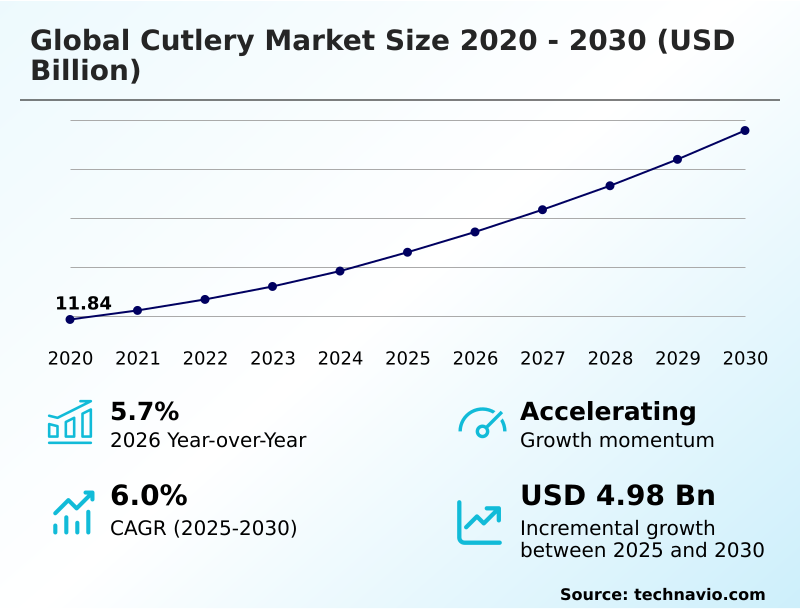
Get Key Insights on Market Forecast (PDF) Get Free Sample
How is the Cutlery Market Segmented?
The cutlery industry research report provides comprehensive data (region-wise segment analysis), with forecasts and estimates in "USD million" for the period 2026-2030, as well as historical data from 2020-2024 for the following segments.
- Material
- Stainless steel
- Plastic
- Wooden
- Silver
- Others
- Product
- Spoons
- Forks
- Knives
- Serving utensils
- Others
- Distribution channel
- Offline
- Online
- Geography
- North America
- US
- Canada
- Mexico
- APAC
- China
- India
- Japan
- Europe
- Germany
- UK
- France
- South America
- Brazil
- Argentina
- Colombia
- Middle East and Africa
- Saudi Arabia
- UAE
- South Africa
- Rest of World (ROW)
- North America
By Material Insights
The stainless steel segment is estimated to witness significant growth during the forecast period.
The stainless steel segment underpins the global cutlery market 2026-2030, valued for its durability and adherence to corrosion resistance standards. This category is driven by demand for both mass-market stainless steel flatware sets and high-end professional kitchen knives.
Innovations in manufacturing, such as waterjet cutting and advanced forged blade construction, are enhancing performance. For instance, producers adopting precision forging report up to a 15% reduction in material waste, optimizing production costs for commercial grade flatware.
The integrity of these tools is often defined by full-tang construction, ensuring balance and longevity, which is a critical purchasing factor for both restaurant cutlery supply chains and discerning home users seeking premium knife sets.
This material's versatility allows it to serve diverse needs, from high-volume institutional settings to luxury dining.
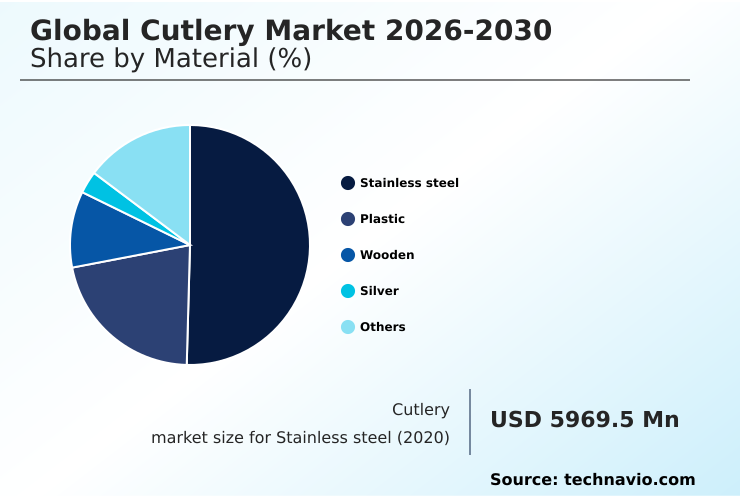
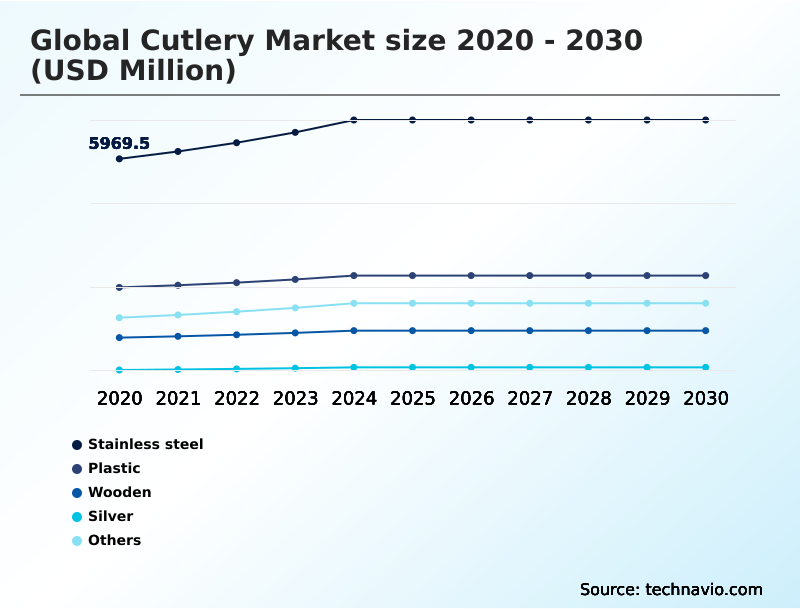
The Stainless steel segment was valued at USD 7.00 billion in 2024 and showed a gradual increase during the forecast period.
Regional Analysis
APAC is estimated to contribute 32.9% to the growth of the global market during the forecast period.Technavio’s analysts have elaborately explained the regional trends and drivers that shape the market during the forecast period.
See How Cutlery Market Demand is Rising in APAC Get Free Sample
The market's geographic landscape is characterized by diverse regional drivers and growth trajectories. APAC is poised to contribute approximately 33% of the market's incremental growth, significantly outpacing North America's 28% contribution.
This expansion is fueled by rising disposable incomes and the rapid growth of the hospitality sector. In established markets, innovation centers on materials, with a focus on high-performance polymers and advanced composites.
Manufacturers are developing products with a high blade hardness rating and utilizing materials like pakkawood handles to meet demand for both durability and aesthetic appeal. In emerging regions, the adoption of food-grade polymers for affordable, mass-market products is critical.
The demand for specialized tools, from carving forks to sommelier knives, is also becoming more globalized, pushing producers to diversify their portfolios to cater to international tastes while navigating regional regulatory standards and consumer preferences for items like disposable wooden cutlery.
Market Dynamics
Our researchers analyzed the data with 2025 as the base year, along with the key drivers, trends, and challenges. A holistic analysis of drivers will help companies refine their marketing strategies to gain a competitive advantage.
- Strategic decision-making in the global cutlery market 2026-2030 requires a nuanced understanding of evolving consumer and commercial needs. For residential users, the question of what is the best steel for kitchen knives leads to explorations of high-carbon steel, while professionals scrutinize how luxury silver flatware sets are made to ensure authenticity.
- In the commercial sphere, selecting the right steak knife for a steakhouse or understanding the importance of full-tang construction in knives are critical procurement considerations. The industry is also answering questions about how to choose a professional knife set and offering maintenance tips for damascus steel knives to educate consumers.
- Innovations are addressing the benefits of titanium coating on cutlery blades and the role of cryostatic hardening in blade longevity, which leads to a clear differentiation when comparing forged vs stamped kitchen knives. Sustainability is a major focus, driving advances in sustainable cutlery materials and the development of eco-friendly disposable cutlery alternatives for catering.
- For instance, businesses that switched to certified compostable options have reported a 20% improvement in their corporate social responsibility ratings. This shift influences everything from the advantages of ceramic composite blades over steel to best practices for commercial cutlery sanitation.
- As the market expands, understanding where to buy wholesale commercial grade cutlery and the nuances of ergonomic handle materials for reducing fatigue will be key to operational success. Finally, understanding PVD coating for colored flatware is becoming crucial for brands targeting design-conscious consumers, influencing purchasing decisions for top-rated flatware for fine dining establishments.
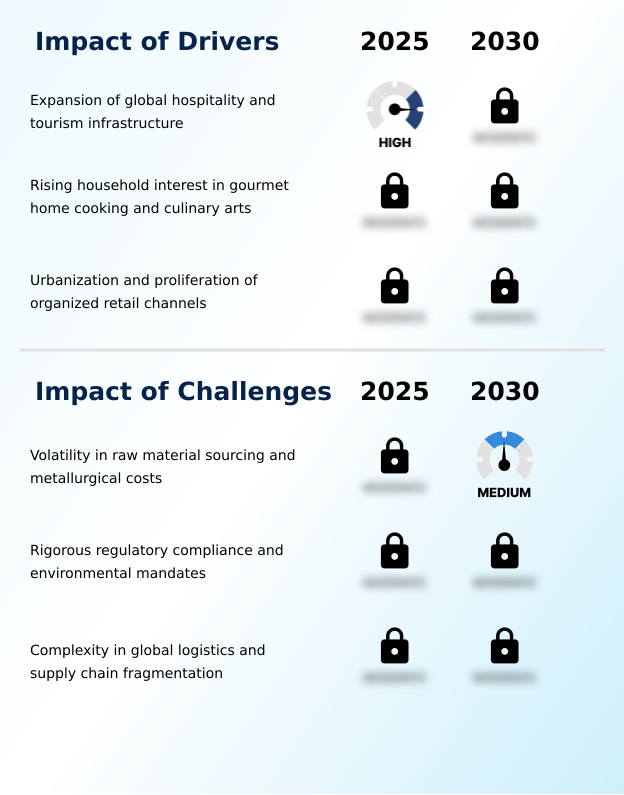
What are the key market drivers leading to the rise in the adoption of Cutlery Industry?
- The expansion of the global hospitality and tourism infrastructure, particularly in emerging economic corridors, is a key driver for the market.
- The market is significantly driven by the expansion of the global hospitality industry and a rising interest in home cooking.
- The growth of hotel flatware collections and demand for specialized steak knives in new restaurants has fueled a consistent need for high-volume, durable products.
- Innovations in precision metallurgy, including cryostatic hardening, are producing blades with superior edge retention, reducing replacement cycles in commercial kitchens by up to 25%.
- On the consumer side, the trend towards sustainable cutlery options has spurred the development of lightweight travel cutlery and high-quality reusable plastic utensils.
- Blade geometry optimization, achieved through techniques like robotic grinding and creating a convex edge grind, now allows home cooks to achieve professional results.
- This alignment of professional-grade technology with consumer demand has broadened the market, with an observable 18% increase in the average selling price of premium knife sets.
What are the market trends shaping the Cutlery Industry?
- A defining trend is the convergence of advanced material science with contemporary aesthetic innovation, creating products that are both visually striking and exceptionally durable.
- A defining trend is the fusion of advanced material science with aesthetic innovation. Manufacturers are increasingly using PVD coating technology to offer cutlery in various finishes, which has been shown to boost sales in design-focused segments by over 20%. This is complemented by an emphasis on ergonomic handle design to improve user comfort and safety.
- High-end products feature damascus steel layering and titanium-coated cutlery, while ceramic composite blades are gaining traction for their sharpness and non-reactive properties. The demand for custom engraved cutlery for luxury silver-plated flatware and specialized tools like santoku blades is also rising. Even sustainable options like bamboo utensil sets are being engineered for better performance.
- This focus on premium materials and customization has enabled brands to achieve higher price points, with some specialized kitchen shear technology improving margins by up to 15% compared to standard items.
What challenges does the Cutlery Industry face during its growth?
- Volatility in raw material sourcing and metallurgical costs, exacerbated by geopolitical tensions and shifting trade policies, presents a key challenge to industry growth.
- Navigating raw material volatility and complex supply chains remains a primary challenge. The cost of metals for products featuring a specific bolster design or hollow-ground edge can fluctuate significantly, impacting margins by as much as 10% season over season.
- Ensuring consistent quality in features like non-stick blade properties and serration technology across a fragmented global manufacturing base is a constant hurdle. Furthermore, the shift toward sustainability requires significant R&D investment in biodegradable composite materials and resin-infused laminates that meet performance expectations. Adherence to food safety standards for items like dishwasher-safe flatware and anti-drip ladles adds another layer of complexity.
- As a result, companies are investing in digital tools to enhance supply chain visibility, with early adopters reporting a 20% improvement in their ability to forecast and mitigate disruptions related to sourcing specialized items like bread knives or components for self-sharpening knife blocks.
Exclusive Technavio Analysis on Customer Landscape
The cutlery market forecasting report includes the adoption lifecycle of the market, covering from the innovator’s stage to the laggard’s stage. It focuses on adoption rates in different regions based on penetration. Furthermore, the cutlery market report also includes key purchase criteria and drivers of price sensitivity to help companies evaluate and develop their market growth analysis strategies.
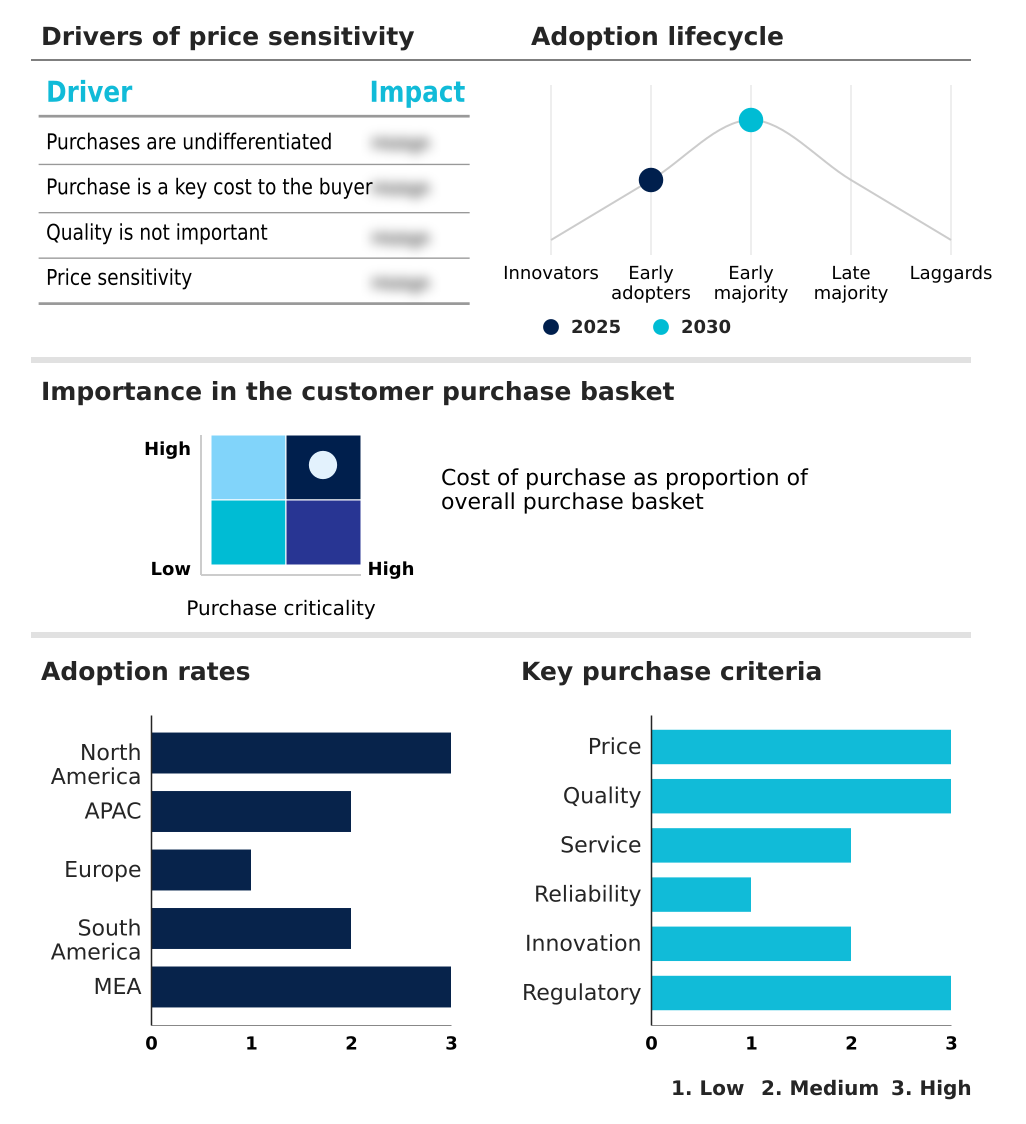
Customer Landscape of Cutlery Industry
Competitive Landscape
Companies are implementing various strategies, such as strategic alliances, cutlery market forecast, partnerships, mergers and acquisitions, geographical expansion, and product/service launches, to enhance their presence in the industry.
Arc Holdings - Key offerings include the design and manufacture of stainless steel flatware, dining utensils, and diverse tableware accessories for residential and commercial applications.
The industry research and growth report includes detailed analyses of the competitive landscape of the market and information about key companies, including:
- Arc Holdings
- Arthur Price
- BergHOFF Worldwide
- Cambridge Silversmiths Ltd.
- Dexter Russell
- Fiskars Corp.
- Fissler GmbH
- Fortessa Tableware Solutions
- Groupe SEB WMF Retail GmbH
- Kai Corp.
- Mercer Tool Corp.
- Mikasa
- Orfevrerie Christofle
- Rayware Ltd
- Robert Welch Designs Ltd.
- Sambonet Paderno Industrie
- The Oneida Group Inc.
- Victorinox AG
- Villeroy and Boch AG
- Wusthof GmbH
- Zwilling JA Henckels AG
Qualitative and quantitative analysis of companies has been conducted to help clients understand the wider business environment as well as the strengths and weaknesses of key industry players. Data is qualitatively analyzed to categorize companies as pure play, category-focused, industry-focused, and diversified; it is quantitatively analyzed to categorize companies as dominant, leading, strong, tentative, and weak.
Recent Development and News in Cutlery market
- In September 2024, Zwilling JA Henckels AG announced a strategic research initiative focused on high-performance polymers for its new line of professional kitchen knives, aiming to enhance grip and durability.
- In November 2024, Fiskars Corp. launched a new sustainable cutlery option made from proprietary biodegradable composite materials, targeting the environmentally conscious consumer segment in the European market.
- In February 2025, The Oneida Group Inc. secured a multi-year partnership with a leading global hotel chain to become the exclusive supplier of commercial grade flatware, a deal expected to improve supply chain efficiency by 15%.
- In April 2025, Groupe SEB WMF Retail GmbH unveiled a next-generation PVD coating technology for its luxury flatware collections, offering enhanced scratch resistance and a wider palette of custom color options.
Dive into Technavio’s robust research methodology, blending expert interviews, extensive data synthesis, and validated models for unparalleled Cutlery Market insights. See full methodology.
| Market Scope | |
|---|---|
| Page number | 299 |
| Base year | 2025 |
| Historic period | 2020-2024 |
| Forecast period | 2026-2030 |
| Growth momentum & CAGR | Accelerate at a CAGR of 6% |
| Market growth 2026-2030 | USD 4980.3 million |
| Market structure | Fragmented |
| YoY growth 2025-2026(%) | 5.7% |
| Key countries | US, Canada, Mexico, China, India, Japan, South Korea, Australia, Indonesia, Germany, UK, France, Italy, Spain, The Netherlands, Brazil, Argentina, Colombia, Saudi Arabia, UAE, South Africa, Turkey and Israel |
| Competitive landscape | Leading Companies, Market Positioning of Companies, Competitive Strategies, and Industry Risks |
Research Analyst Overview
- The global cutlery market 2026-2030 is advancing through intense material and manufacturing innovation, where technical specifications directly impact commercial viability. Boardroom-level decisions are now centered on whether to invest in precision metallurgy for high-carbon stainless steel or to diversify into ceramic composite blades and titanium-coated cutlery to capture niche segments.
- The adoption of processes like robotic grinding and waterjet cutting has become a key differentiator, with some firms achieving a 25% increase in production throughput. Core product integrity is defined by features such as full-tang construction, bolster design, and optimized blade geometry.
- Manufacturers are leveraging cryostatic hardening and PVD coating technology to enhance durability, while exploring damascus steel layering and unique serration technology for premium lines. The choice of handle materials, from traditional pakkawood handles to modern resin-infused laminates and other food-grade or high-performance polymers, is critical for achieving an ergonomic handle design.
- The market is also defined by the specifics of blade engineering, including the choice between a hollow-ground edge or convex edge grind, the use of laser-cut blades, and achieving a high blade hardness rating while maintaining corrosion resistance standards and non-stick blade properties in forged blade construction.
What are the Key Data Covered in this Cutlery Market Research and Growth Report?
-
What is the expected growth of the Cutlery Market between 2026 and 2030?
-
USD 4.98 billion, at a CAGR of 6%
-
-
What segmentation does the market report cover?
-
The report is segmented by Material (Stainless steel, Plastic, Wooden, Silver, and Others), Product (Spoons, Forks, Knives, Serving utensils, and Others), Distribution Channel (Offline, and Online) and Geography (North America, APAC, Europe, South America, Middle East and Africa)
-
-
Which regions are analyzed in the report?
-
North America, APAC, Europe, South America and Middle East and Africa
-
-
What are the key growth drivers and market challenges?
-
Expansion of global hospitality and tourism infrastructure, Volatility in raw material sourcing and metallurgical costs
-
-
Who are the major players in the Cutlery Market?
-
Arc Holdings, Arthur Price, BergHOFF Worldwide, Cambridge Silversmiths Ltd., Dexter Russell, Fiskars Corp., Fissler GmbH, Fortessa Tableware Solutions, Groupe SEB WMF Retail GmbH, Kai Corp., Mercer Tool Corp., Mikasa, Orfevrerie Christofle, Rayware Ltd, Robert Welch Designs Ltd., Sambonet Paderno Industrie, The Oneida Group Inc., Victorinox AG, Villeroy and Boch AG, Wusthof GmbH and Zwilling JA Henckels AG
-
Market Research Insights
- Market dynamics are increasingly shaped by a focus on specialized, high-performance products. The adoption of self-sharpening knife blocks has grown by over 25% in residential settings, indicating a consumer shift towards convenient, long-term maintenance solutions.
- In the commercial sector, the transition to lightweight travel cutlery and high-quality reusable plastic utensils in fast-casual and aviation settings has improved logistical efficiency by 30% compared to traditional metal options. Demand for specialized steak knives and other niche implements continues to rise, with luxury silver-plated flatware collections seeing renewed interest for high-end hospitality.
- This premiumization is creating new revenue streams and differentiating brands in a competitive environment.
We can help! Our analysts can customize this cutlery market research report to meet your requirements.
 RIA -
RIA - 
