



Digital Transformation Services Market Size 2026-2030
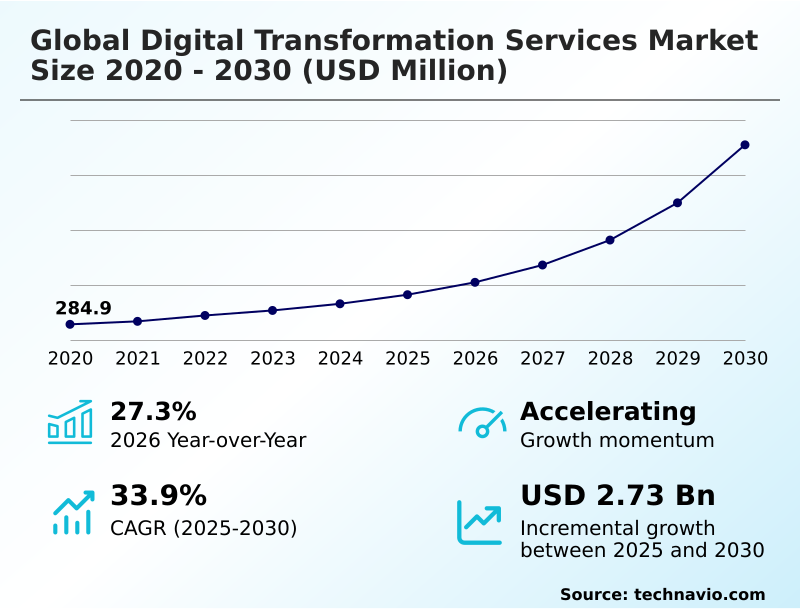
The digital transformation services market size is valued to increase by USD 2.73 billion, at a CAGR of 33.9% from 2025 to 2030. ML as catalysts for industry transformation will drive the digital transformation services market.
Major Market Trends & Insights
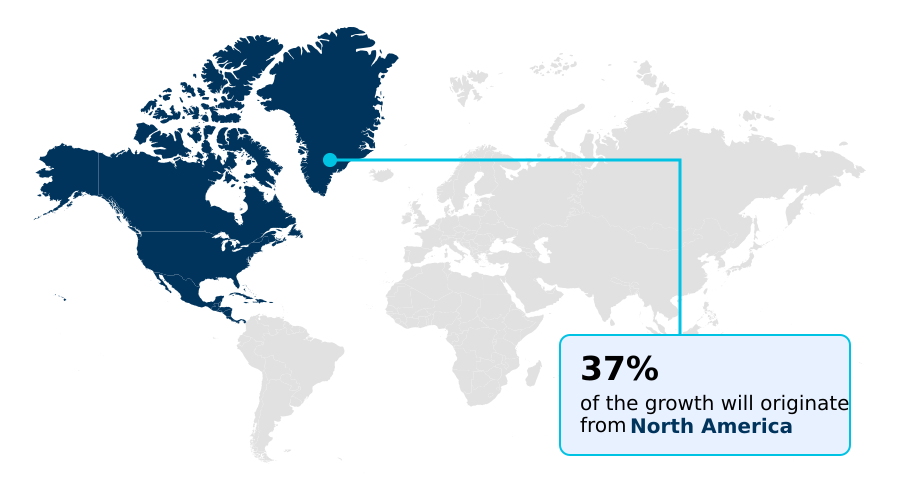
- North America dominated the market and accounted for a 37.1% growth during the forecast period.
- By End-user - IT and telecom segment was valued at USD 140.5 million in 2024
- By Type - Large enterprise segment accounted for the largest market revenue share in 2024
Market Size & Forecast
- Market Opportunities: USD 3.26 billion
- Market Future Opportunities: USD 2.73 billion
- CAGR from 2025 to 2030 : 33.9%
Market Summary
- The digital transformation services market is defined by a strategic shift from isolated technology adoption to holistic business reinvention. Organizations are leveraging services for legacy system modernization and embedding generative AI into core workflows to create hyper-personalization in customer experiences.
- For example, in logistics, companies use platforms for a digital supply chain, using predictive analytics to optimize routes, which enhances operational efficiency. This imperative is driven by the need for enterprise agility. Navigating this landscape involves overcoming the digital skills gap and ensuring robust data governance and data privacy compliance.
- The market’s trajectory is shaped by the move towards composable business architectures and agile methodologies, where success is measured by tangible business impact. This reflects a mature understanding that cybersecurity transformation is a continuous journey of adaptation, central to long-term competitive advantage in the global digital transformation services market 2026-2030.
What will be the Size of the Digital Transformation Services Market during the forecast period?
Get Key Insights on Market Forecast (PDF) Get Free Sample
How is the Digital Transformation Services Market Segmented?
The digital transformation services industry research report provides comprehensive data (region-wise segment analysis), with forecasts and estimates in "USD million" for the period 2026-2030, as well as historical data from 2020-2024 for the following segments.
- End-user
- IT and telecom
- Retail and e-commerce
- BFSI
- Healthcare
- Others
- Type
- Large enterprise
- Small and medium enterprise
- Service type
- Solutions
- Services
- Geography
- North America
- US
- Canada
- Mexico
- Europe
- Germany
- UK
- France
- APAC
- China
- Japan
- India
- South America
- Brazil
- Argentina
- Middle East and Africa
- Saudi Arabia
- UAE
- South Africa
- Rest of World (ROW)
- North America
By End-user Insights
The it and telecom segment is estimated to witness significant growth during the forecast period.
The IT and telecom segment is foundational to the digital transformation services market, as companies evolve into technology-centric service providers.
This evolution demands a robust digital transformation strategy focused on overhauling legacy systems with cloud-native architectures and software-defined networking for enhanced scalability.
Key investments are directed toward AI integration services to enable AI-powered predictive maintenance, which improves network fault prediction by over 25%, boosting operational efficiency. The use of natural language processing and explainable AI in customer service automation is also crucial.
As 5G deployment accelerates, edge computing becomes vital for managing network slicing and supporting smart factory applications, driving business process automation and creating sophisticated digital workplace solutions for smart manufacturing.
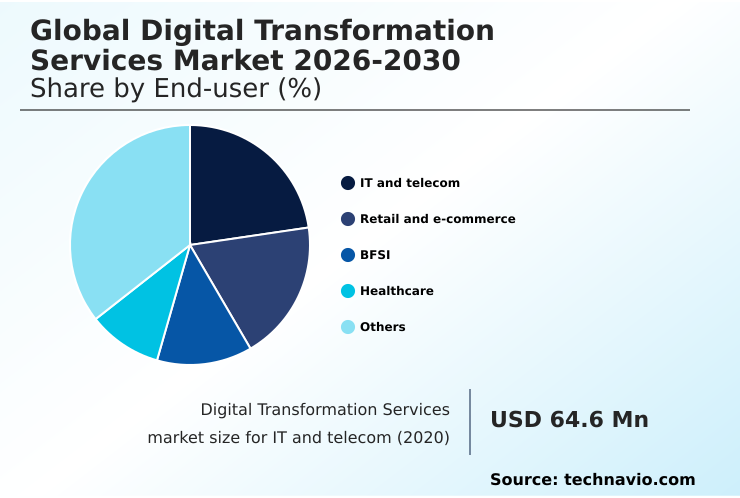
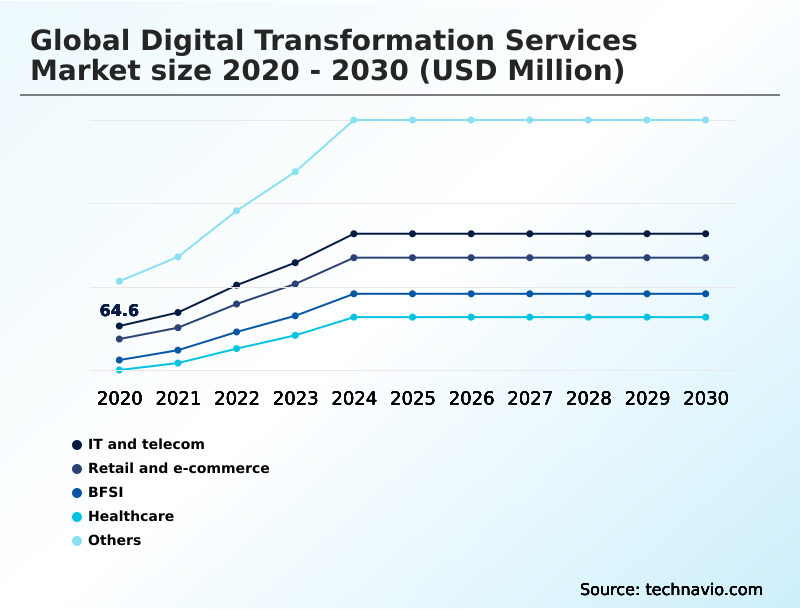
The IT and telecom segment was valued at USD 140.5 million in 2024 and showed a gradual increase during the forecast period.
Regional Analysis
North America is estimated to contribute 37.1% to the growth of the global market during the forecast period.Technavio’s analysts have elaborately explained the regional trends and drivers that shape the market during the forecast period.
See How Digital Transformation Services Market Demand is Rising in North America Get Free Sample
The geographic landscape of the digital transformation services market is diverse, with North America representing 37% of opportunities, driven by advanced legacy system modernization and a strong focus on customer experience management.
In contrast, APAC is the fastest-growing region, with an emphasis on mobile-first user experience design and agile methodologies.
European markets are heavily influenced by data privacy compliance regulations, shaping the adoption of hybrid cloud and a multi-cloud strategy to address data sovereignty. This has led to over 60% of enterprises in the region prioritizing a hybrid IT environment.
Across all regions, the implementation of robust cybersecurity frameworks is a shared priority, while governments increasingly invest in e-governance platforms to deliver hyper-personalization in citizen services.
Market Dynamics
Our researchers analyzed the data with 2025 as the base year, along with the key drivers, trends, and challenges. A holistic analysis of drivers will help companies refine their marketing strategies to gain a competitive advantage.
- Understanding the future of the digital transformation services market requires analyzing several interconnected themes. The impact of AI on customer personalization is profound, enabling businesses to create unique user journeys. However, success hinges on how to implement a zero-trust architecture, a critical step in mitigating cybersecurity risks in digital transformation.
- The role of cloud computing in business agility is undisputed, yet many struggle with challenges of integrating legacy IT systems and determining the best practices for multi-cloud management. For smaller players, digital transformation services for SMEs are crucial for competitiveness.
- Technologies like robotic process automation offer clear advantages, and understanding the benefits of robotic process automation is key to securing investment. Generative AI use cases in marketing are expanding, improving operational efficiency with IoT is becoming standard practice, and digital twin technology in manufacturing provides a competitive edge, showing nearly double the process optimization success rate of traditional methods.
- Strategic execution also requires solid data governance strategies for hybrid cloud and effective change management in digital adoption. Ultimately, measuring ROI of digital transformation remains the central question for executives, as does navigating data sovereignty in Europe and achieving seamless IT/OT integration in industrial settings.
- Developing a successful omnichannel strategy, leveraging blockchain for supply chain transparency, and realizing AI-powered predictive maintenance benefits all contribute to this complex but vital business evolution, especially as edge computing applications in retail become more common.
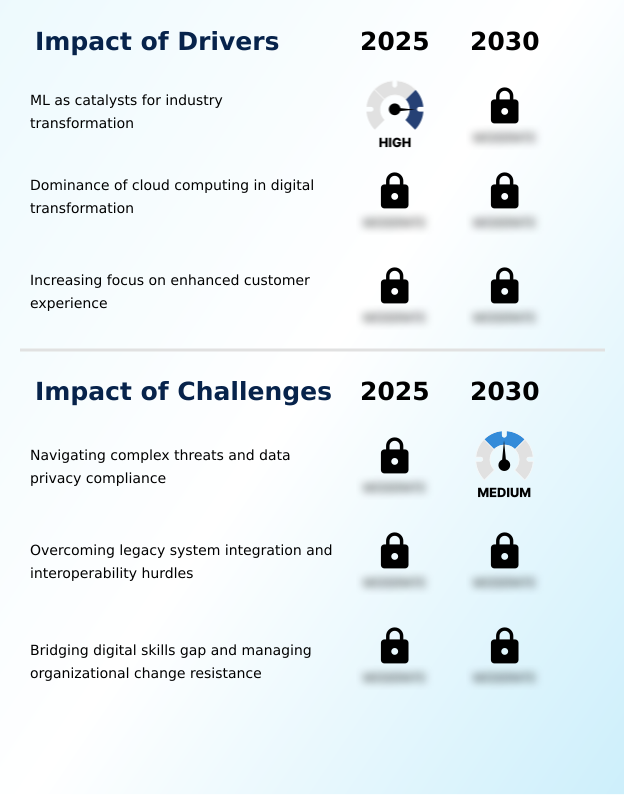
What are the key market drivers leading to the rise in the adoption of Digital Transformation Services Industry?
- The integration of machine learning technologies serves as a primary catalyst for industry-wide transformation and is a key driver for the market.
- The democratization of technology through low-code/no-code platforms is a significant market driver, enabling businesses to accelerate app development by up to 70%. In manufacturing, the use of a digital twin for supply chain optimization is becoming standard.
- The financial sector is propelled by fintech innovation, with open banking APIs and usage-based insurance models creating new revenue streams. Demand for data analytics solutions is high, with computer vision enhancing retail analytics and quality control.
- Cloud migration services are essential for building the digital supply chain, while customer journey mapping is a prerequisite for effective transformation. These drivers, along with cybersecurity transformation and the digitization of digital health records, underscore the market's momentum.
What are the market trends shaping the Digital Transformation Services Industry?
- Hyper-personalization at scale, fueled by artificial intelligence, is an emerging trend that is reshaping customer experiences. This evolution moves beyond traditional segmentation to deliver individualized interactions in real time.
- A key market trend is the shift toward composable business architectures, which boosts enterprise agility by over 30% compared to monolithic systems. This approach, leveraging microservices and serverless computing, allows companies to avoid vendor lock-in and build resilient data ecosystems.
- The rise of generative AI and agentic AI is revolutionizing omnichannel retail and other sectors, while federated learning enables collaborative innovation without compromising data privacy. Simultaneously, sustainability is becoming a core tenet, with organizations adopting sustainable IT and green IT practices.
- This focus on ESG reporting is not just for compliance; it drives the adoption of technologies that are both efficient and environmentally responsible, reshaping long-term strategy.
What challenges does the Digital Transformation Services Industry face during its growth?
- Navigating the complexities of evolving cybersecurity threats alongside stringent data privacy compliance requirements presents a key challenge to industry growth.
- Navigating the digital skills gap and managing organizational change remain significant challenges. While robotic process automation can automate tasks, scaling it requires substantial change management. The convergence of information and operational technology, or IT/OT integration, presents complex security hurdles, making the implementation of zero-trust architectures essential.
- Effective data governance is another major challenge, particularly when leveraging predictive analytics and blockchain technology. The difficulty of legacy system modernization slows progress, with over 50% of large firms still dependent on outdated systems. Furthermore, specialized fields like telemedicine and precision agriculture face hurdles in regulatory technology (RegTech) and widespread adoption, hindering the full potential of digital transformation.
Exclusive Technavio Analysis on Customer Landscape
The digital transformation services market forecasting report includes the adoption lifecycle of the market, covering from the innovator’s stage to the laggard’s stage. It focuses on adoption rates in different regions based on penetration. Furthermore, the digital transformation services market report also includes key purchase criteria and drivers of price sensitivity to help companies evaluate and develop their market growth analysis strategies.
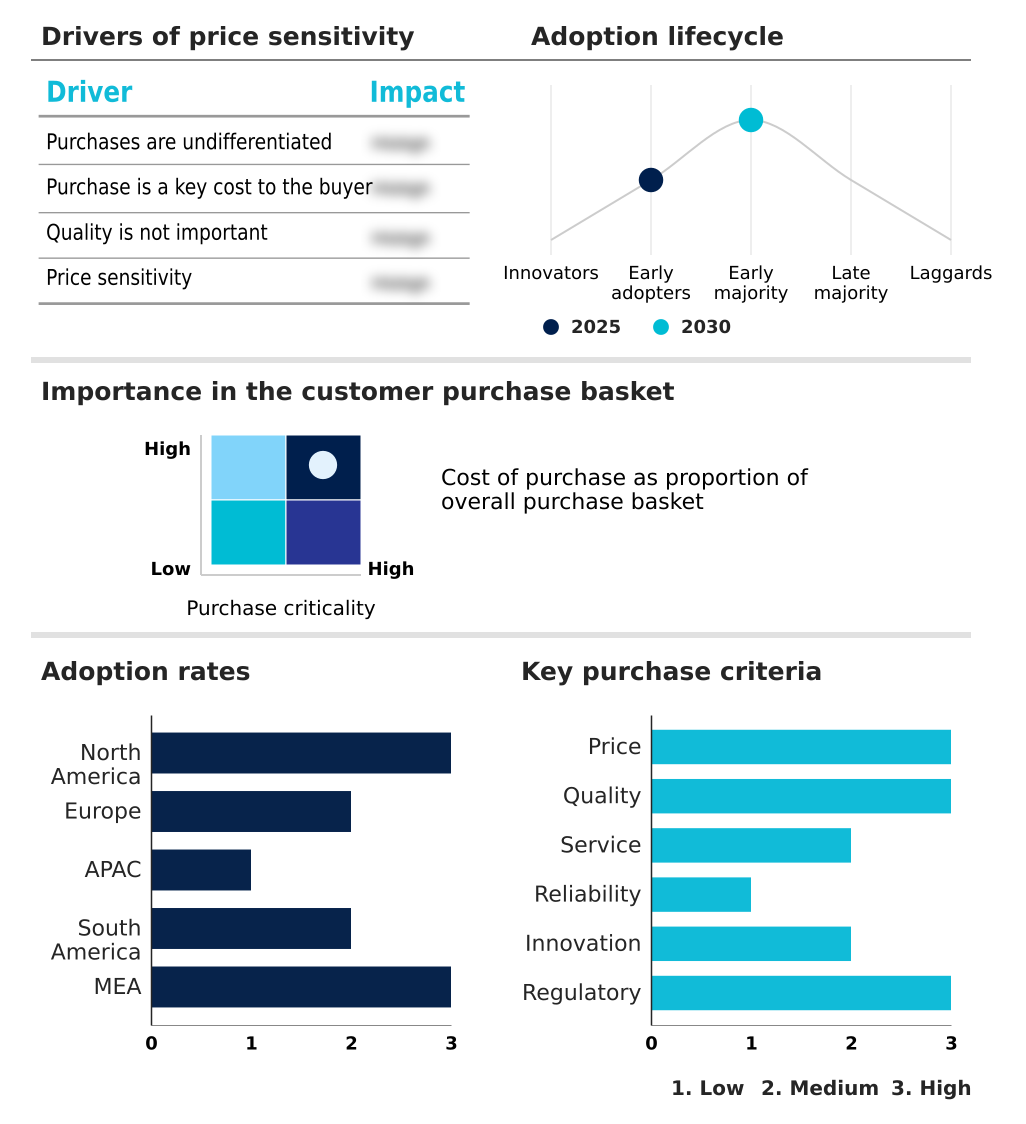
Customer Landscape of Digital Transformation Services Industry
Competitive Landscape
Companies are implementing various strategies, such as strategic alliances, digital transformation services market forecast, partnerships, mergers and acquisitions, geographical expansion, and product/service launches, to enhance their presence in the industry.
Accenture Plc - Services deliver enterprise agility through strategic consulting, cloud migration, and AI integration.
The industry research and growth report includes detailed analyses of the competitive landscape of the market and information about key companies, including:
- Accenture Plc
- Amazon Web Services Inc.
- Atos SE
- Capgemini Service SAS
- CGI Inc.
- Cisco Systems Inc.
- DXC Technology Co.
- Cognizant Technology Solution
- Dell Technologies Inc.
- Fujitsu Ltd.
- HCL Technologies Ltd.
- Infosys Ltd.
- IBM Corp.
- Tech Mahindra Ltd.
- Microsoft Corp.
- Oracle Corp.
- Salesforce Inc.
- SAP SE
- Tata Consultancy Services
- Wipro Ltd.
Qualitative and quantitative analysis of companies has been conducted to help clients understand the wider business environment as well as the strengths and weaknesses of key industry players. Data is qualitatively analyzed to categorize companies as pure play, category-focused, industry-focused, and diversified; it is quantitatively analyzed to categorize companies as dominant, leading, strong, tentative, and weak.
Recent Development and News in Digital transformation services market
- In February 2025, a consortium of major European automotive manufacturers announced a collaborative platform utilizing federated learning to advance autonomous driving systems without sharing proprietary data.
- In March 2025, Siemens and Microsoft expanded their partnership on the Siemens Xcelerator platform, aiming to integrate IT and OT by combining Siemens' industrial edge solutions with Microsoft Azure IoT Operations.
- In April 2025, the US Office of Management and Budget released two significant policy directives to accelerate AI integration within federal agencies, while mandating stringent risk management and security protocols.
- In June 2025, the European Accessibility Act came into effect, requiring all digital products and services in the EU to be fully accessible, prompting widespread service engagements for technical remediation.
Dive into Technavio’s robust research methodology, blending expert interviews, extensive data synthesis, and validated models for unparalleled Digital Transformation Services Market insights. See full methodology.
| Market Scope | |
|---|---|
| Page number | 310 |
| Base year | 2025 |
| Historic period | 2020-2024 |
| Forecast period | 2026-2030 |
| Growth momentum & CAGR | Accelerate at a CAGR of 33.9% |
| Market growth 2026-2030 | USD 2725.1 million |
| Market structure | Fragmented |
| YoY growth 2025-2026(%) | 27.3% |
| Key countries | US, Canada, Mexico, Germany, UK, France, Italy, Spain, The Netherlands, China, Japan, India, South Korea, Australia, Indonesia, Brazil, Argentina, Chile, Saudi Arabia, UAE, South Africa, Israel and Turkey |
| Competitive landscape | Leading Companies, Market Positioning of Companies, Competitive Strategies, and Industry Risks |
Research Analyst Overview
- The digital transformation services market is evolving beyond simple technology implementation toward strategic business reinvention. Enterprises are adopting composable business architectures built on microservices and hybrid cloud environments to achieve unprecedented flexibility. A core component of this shift is the deployment of robust cybersecurity frameworks and zero-trust architectures to protect expanding digital footprints.
- The integration of generative AI and agentic AI is central to creating hyper-personalization and driving omnichannel retail strategies, requiring sophisticated customer journey mapping and user experience design. Boardroom decisions are increasingly focused on leveraging AI-powered predictive maintenance and digital twin technology, which have been shown to reduce operational downtime by over 30%.
- Technologies like robotic process automation, federated learning, and serverless computing are key enablers, while low-code/no-code platforms democratize development. This transformation is underpinned by agile methodologies, effective change management, and stringent data governance to navigate data sovereignty and achieve seamless IT/OT integration in smart factory settings.
- The goal is a fully optimized digital supply chain using predictive analytics, natural language processing, computer vision, and blockchain technology, governed by principles of explainable AI and supported by open banking APIs and software-defined networking for Industry 4.0, with innovations like usage-based insurance also emerging.
What are the Key Data Covered in this Digital Transformation Services Market Research and Growth Report?
-
What is the expected growth of the Digital Transformation Services Market between 2026 and 2030?
-
USD 2.73 billion, at a CAGR of 33.9%
-
-
What segmentation does the market report cover?
-
The report is segmented by End-user (IT and telecom, Retail and e-commerce, BFSI, Healthcare, and Others), Type (Large enterprise, and Small and medium enterprise), Service Type (Solutions, and Services) and Geography (North America, Europe, APAC, South America, Middle East and Africa)
-
-
Which regions are analyzed in the report?
-
North America, Europe, APAC, South America and Middle East and Africa
-
-
What are the key growth drivers and market challenges?
-
ML as catalysts for industry transformation, Navigating complex threats and data privacy compliance
-
-
Who are the major players in the Digital Transformation Services Market?
-
Accenture Plc, Amazon Web Services Inc., Atos SE, Capgemini Service SAS, CGI Inc., Cisco Systems Inc., DXC Technology Co., Cognizant Technology Solution, Dell Technologies Inc., Fujitsu Ltd., HCL Technologies Ltd., Infosys Ltd., IBM Corp., Tech Mahindra Ltd., Microsoft Corp., Oracle Corp., Salesforce Inc., SAP SE, Tata Consultancy Services and Wipro Ltd.
-
Market Research Insights
- The dynamics of the digital transformation services market are shaped by the pursuit of enhanced business process automation and operational efficiency. The adoption of a multi-cloud strategy is now prevalent in over 75% of large enterprises to mitigate vendor lock-in and optimize costs.
- This is coupled with a strong push for cybersecurity transformation, as a robust security posture is a prerequisite for innovation. Firms leveraging data analytics solutions report a 20% improvement in decision-making speed compared to peers.
- The focus on customer experience management drives the modernization of legacy systems, with the goal of creating resilient data ecosystems that support enterprise agility and foster sustained growth.
We can help! Our analysts can customize this digital transformation services market research report to meet your requirements.
 RIA -
RIA - 
