


Disodium Inosinate Market Size 2024-2028
The disodium inosinate market size is forecast to increase by USD 591.3 million at a CAGR of 5.08% between 2023 and 2028.
- Disodium inosinate, a flavor enhancer derived from bacterial fermentation of inosine and inosine monophosphate, plays a significant role in the food industry. Its umami taste, similar to monosodium glutamate (MSG), enhances the savory flavors of various foods, particularly in savory snacks, soups, and processed meats. The market for disodium inosinate is driven by the increasing demand for ingredients and flavor enhancers in processed food. Additionally, the growing trend towards nutraceuticals, which offer health benefits, is fueling the market's growth.
- However, stringent food safety regulations and guidelines pose challenges to market growth. Sucrose, animal sources, tapioca starch, and other excipients are commonly used in the production of disodium inosinate.
What will be the Size of the Disodium Inosinate Market During the Forecast Period?

- Disodium inosinate is a flavor enhancer widely used in various industries, including food and pharmaceuticals. This white granular or powder substance is derived from the fermentation process of animal sources, such as fish, including sardines and anchovies, and sugar. The production of disodium inosinate involves bacterial fermentation, where specific bacteria are used as the catalyst to convert inosine monophosphate into inosinate. This process results in the formation of disodium inosinate and disodium guanylate, two essential umami taste enhancers. Disodium inosinate is renowned for its umami flavor enhancing properties, which is a savory, meaty, and delicious taste that is increasingly popular in culinary trends.
- In addition, Umami, the fifth basic taste, adds depth and complexity to various dishes, making it an essential ingredient in the food industry. Fish, particularly those rich in inosine monophosphate, such as sardines and anchovies, are the primary animal sources for disodium inosinate production. However, some manufacturers also use tapioca starch as a plant-based alternative, making it suitable for vegetarian and vegan consumers. Disodium inosinate is widely used in snacks, soups, sauces, and processed foods to enhance the savory taste. Its application in the food industry is vast due to its ability to improve the overall taste profile and palatability of various dishes.
How is this Disodium Inosinate Industry segmented and which is the largest segment?
The disodium inosinate industry research report provides comprehensive data (region-wise segment analysis), with forecasts and estimates in "USD million" for the period 2024-2028, as well as historical data from 2018-2022 for the following segments.
- Application
- Food and beverage
- Pharmaceutical
- Cosmetics
- Others
- Geography
- North America
- US
- APAC
- China
- Europe
- Germany
- UK
- France
- South America
- Middle East and Africa
- North America
By Application Insights
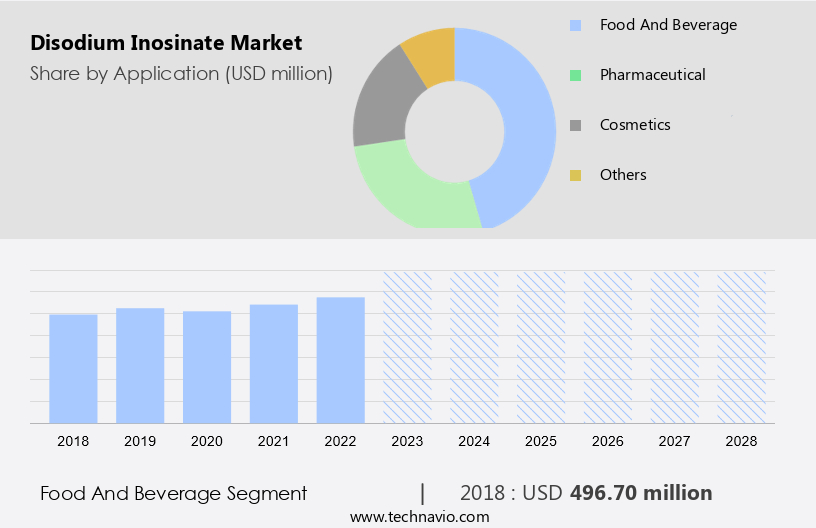
- The food and beverage segment is estimated to witness significant growth during the forecast period.
Disodium inosinate is a popular flavor enhancer in the food and beverage industry, adding a savory or meaty taste to various foods. This ingredient is commonly used in conjunction with monosodium glutamate (MSG) in the production of processed foods, such as potato chips, canned soups, and dairy products. Disodium inosinate enhances the umami flavor, which is the savory or delicious taste, by approximately 50%. With the rising preference for processed foods and the need to enhance their flavors, the demand for disodium inosinate is anticipated to grow during the forecast period. This flavor enhancer is primarily produced through bacterial fermentation, using animal sources or tapioca starch as raw materials.
Get a glance at the Disodium Inosinate Industry report of share of various segments Request Free Sample
The food and beverage segment was valued at USD 496.70 million in 2018 and showed a gradual increase during the forecast period.
Regional Analysis
- North America is estimated to contribute 33% to the growth of the global market during the forecast period.
Technavio's analysts have elaborately explained the regional trends and drivers that shape the market during the forecast period.

For more insights on the market share of various regions, Request Free Sample
The market in North America is experiencing significant growth due to the increasing popularity of savory flavors in processed foods. Umami taste, derived from this ingredient, is a key trend in the culinary world, driving demand for food grade Disodium Inosinate. This market expansion can be attributed to the rising preference for convenience foods, particularly in the US, Canada, and Mexico. With the increasing number of working professionals and nuclear families, there is a growing demand for ready-to-eat (RTE) processed foods, such as pasta, pizzas, burgers, and snacks. Animal source and plant source Disodium Inosinate are used extensively in the production of these foods.
Market Dynamics
Our disodium inosinate market researchers analyzed the data with 2023 as the base year, along with the key drivers, trends, and challenges. A holistic analysis of drivers will help companies refine their marketing strategies to gain a competitive advantage.
What are the key market drivers leading to the rise in adoption of Disodium Inosinate Industry?
Increasing demand for ingredients and flavor enhancers in processed food is the key driver of the market.
- The global market for Disodium Inosinate, a flavor enhancer commonly used in processed foods, is experiencing significant growth. This is primarily due to the increasing consumption of convenience and processed foods in developing economies, such as China and India, where economic growth and rising disposable incomes are driving demand. Additionally, the food and beverage sector, particularly the food processing industry, is expanding in developed economies, leading to increased production of processed foods and subsequently, higher demand for food additives like Disodium Inosinate. This flavor enhancer is produced through a fermentation process using bacteria, with sugar fermentation being a common method.
- Moreover, sardines and anchovies are often used as carbon sources during this process. The resulting product, Inosine, is then treated with phosphoryl chloride to produce Disodium Inosinate. However, overconsumption of this additive can lead to behavioral problems, including attention deficit disorders and lethargy. It is essential to use Disodium Inosinate in moderation to avoid potential health risks. The market is expected to continue growing due to the increasing demand for processed foods and the expanding food and beverage sector. However, it is crucial to ensure the safe and responsible use of this additive to mitigate potential health concerns.
What are the market trends shaping the Disodium Inosinate Industry?
Growing demand for nutraceuticals is the upcoming trend in the market.
- Disodium inosinate is a significant component in the nutraceutical ingredients market, catering primarily to the production of supplements and functional food additives. These ingredients offer additional health advantages beyond basic nutritional requirements. The global demand for disodium inosinate is escalating due to the growing health consciousness among consumers, driven by the fast-paced lifestyle of people worldwide. This ingredient is employed extensively in the pharmaceutical sector for the prevention of metabolic disorders.
- Moreover, in the nutraceutical industry, disodium inosinate is utilized in the manufacture of various dietary and health supplements, available in pill, powder, or capsule form. Quality control testing is essential in the production process to ensure the accuracy of calibration needs using advanced techniques such as spectrophotometry and chromatography. Certified reference materials are indispensable for maintaining consistency and reliability in the chemicals market. Disodium inosinate's value-added applications extend to nutrient premixes, further emphasizing its importance in the nutrition sectors.
What challenges does Disodium Inosinate Industry face during the growth?
Stringent food safety regulations and guidelines is a key challenge affecting the industry growth.
- The market is subject to rigorous regulations in the food industry to guarantee the safety and appropriate quantity of flavors, preventing potential health hazards for consumers. These regulations include sleep disorders such as insomnia, numbness, paralysis, seizures, sciatica, slurred speech, chills, shakes, gastrointestinal issues like diarrhea, nausea, stomach cramps, and rectal bleeding.
- Moreover, compliance with these regulations may pose challenges for food flavor manufacturers, requiring them to maintain consistent quality while producing various flavor types. In the US, the Food and Drug Administration (FDA) enforces these regulations. Ensuring adherence to these guidelines is crucial for market growth, as it maintains consumer trust and confidence in the food industry. The FDA's regulations promote a safer and healthier food supply, ultimately benefiting both manufacturers and consumers.
Exclusive Customer Landscape
The disodium inosinate market forecasting report includes the adoption lifecycle of the market, covering from the innovator's stage to the laggard's stage. It focuses on adoption rates in different regions based on penetration. Furthermore, the market report also includes key purchase criteria and drivers of price sensitivity to help companies evaluate and develop their market growth analysis strategies.

Customer Landscape
Key Companies & Market Insights
Companies are implementing various strategies, such as strategic alliances, market forecast, partnerships, mergers and acquisitions, geographical expansion, and product/service launches, to enhance their presence in the industry.
The disodium inosinate industry research and growth report includes detailed analyses of the competitive landscape of the market and information about key companies, including:
- ATAMAN Kimya AS
- Fengchen Group Co. Ltd.
- Foodchem International Corporation
- Meihua Holdings Group Co. Ltd.
- Merck KGaA
- National Analytical Corp.
- Shaanxi Dideu Medichem Co. Ltd.
- SINOFI INGREDIENTS
- Toronto Research Chemicals Inc.
- Wuxi Accobio Biotech Inc.
Qualitative and quantitative analysis of companies has been conducted to help clients understand the wider business environment as well as the strengths and weaknesses of key industry players. Data is qualitatively analyzed to categorize companies as pure play, category-focused, industry-focused, and diversified; it is quantitatively analyzed to categorize companies as dominant, leading, strong, tentative, and weak.
Research Analyst Overview
Disodium inosinate, a flavor enhancer derived from bacterial fermentation, plays a significant role in enhancing savory flavors in various food and drink applications. This ingredient, which contains nucleotides such as inosine and guanylate, contributes to the umami taste, often described as a savory or meaty flavor. The production process involves the fermentation of animal sources like fish, such as sardines and anchovies, or plant sources like tapioca starch and sucrose. Disodium inosinate is widely used in the food industry, particularly in processed foods, snacks, and regional cuisines. It is also utilized in the pharmaceutical and nutraceutical sectors, where it is available in both food grade and pharmaceutical grade.
Furthermore, the increasing urbanization and changing lifestyles have led to a higher demand for convenient and savory food options, driving the growth of the market. In addition to food applications, disodium inosinate is also used in cosmetics and beauty products for its skincare benefits. However, consumer health consciousness has led to concerns regarding potential side effects, such as increased heartbeat, tingling, coldness, and gastrointestinal problems. It is essential to ensure proper quality control testing through techniques like spectrophotometry and chromatography to maintain the safety and efficacy of disodium inosinate. The market is part of the larger chemicals market, which includes additives, nutrient premixes, and value-added solutions for various industries. The market is expected to grow due to the increasing demand for savory flavors in food and drinks, as well as the expanding use of disodium inosinate in other sectors like cosmetics and pharmaceuticals.
|
Disodium Inosinate Market Scope |
|
|
Report Coverage |
Details |
|
Page number |
135 |
|
Base year |
2023 |
|
Historic period |
2018-2022 |
|
Forecast period |
2024-2028 |
|
Growth momentum & CAGR |
Accelerate at a CAGR of 5.08% |
|
Market growth 2024-2028 |
USD 591.3 million |
|
Market structure |
Concentrated |
|
YoY growth 2023-2024(%) |
4.84 |
|
Key countries |
US, China, Germany, UK, and France |
|
Competitive landscape |
Leading Companies, Market Positioning of Companies, Competitive Strategies, and Industry Risks |
What are the Key Data Covered in this Market Research and Growth Report?
- CAGR of the Disodium Inosinate industry during the forecast period
- Detailed information on factors that will drive the market growth and forecasting between 2024 and 2028
- Precise estimation of the size of the market and its contribution of the industry in focus to the parent market
- Accurate predictions about upcoming market growth and trends and changes in consumer behaviour
- Growth of the market across North America, APAC, Europe, South America, and Middle East and Africa
- Thorough analysis of the market's competitive landscape and detailed information about companies
- Comprehensive analysis of factors that will challenge the growth of industry companies
We can help! Our analysts can customize this market research report to meet your requirements. Get in touch
 RIA -
RIA - 
