


Embedded Computer Market Size 2026-2030
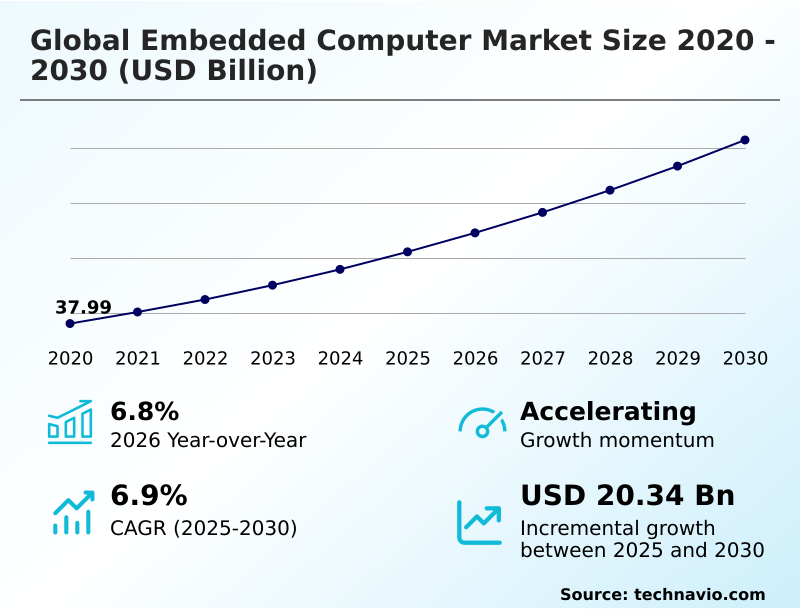
The embedded computer market size is valued to increase by USD 20.34 billion, at a CAGR of 6.9% from 2025 to 2030. Proliferation of IoT and shift toward edge computing will drive the embedded computer market.
Major Market Trends & Insights
- Europe dominated the market and accounted for a 35.4% growth during the forecast period.
- By Product - COMs segment was valued at USD 18.55 billion in 2024
- By End-user - Industrial automation segment accounted for the largest market revenue share in 2024
Market Size & Forecast
- Market Opportunities: USD 33.37 billion
- Market Future Opportunities: USD 20.34 billion
- CAGR from 2025 to 2030 : 6.9%
Market Summary
- The embedded computer market is experiencing a profound transformation, driven by the convergence of industrial digitalization and pervasive connectivity. This evolution extends far beyond mere processing power, focusing instead on creating intelligent, autonomous systems capable of real-time decision-making at the network's edge.
- A key driver is the integration of artificial intelligence and machine learning, which necessitates a shift towards heterogeneous computing architectures that combine general-purpose CPUs with specialized graphics processing units and neural processing units. For example, a modern manufacturing facility might deploy machine vision systems powered by ruggedized designs to perform high-speed quality inspections.
- These systems use edge ai platforms to analyze video streams locally, identifying defects with an accuracy unachievable by human operators and reducing reliance on cloud processing, thereby minimizing latency and bandwidth costs.
- However, this increased sophistication introduces challenges, including escalating design complexity, fundamental constraints of power consumption and thermal management, and critical security imperatives to protect connected devices from cyber threats.
- The industry's trajectory is toward creating more integrated, power-efficient, and secure system-on-chip solutions that can manage these competing demands while enabling the next wave of intelligent, connected applications across automotive, medical, and industrial sectors.
What will be the Size of the Embedded Computer Market during the forecast period?
Get Key Insights on Market Forecast (PDF) Get Free Sample
How is the Embedded Computer Market Segmented?
The embedded computer industry research report provides comprehensive data (region-wise segment analysis), with forecasts and estimates in "USD million" for the period 2026-2030, as well as historical data from 2020-2024 for the following segments.
- Product
- COMs
- SBCs
- Stand-alone boards
- End-user
- Industrial automation
- Military and defense
- Medical
- Communication
- Others
- Cpu architecture
- x86
- ARM
- PowerPC
- Others
- Geography
- Europe
- Germany
- UK
- France
- APAC
- China
- Japan
- India
- North America
- US
- Canada
- Mexico
- Middle East and Africa
- Saudi Arabia
- UAE
- South Africa
- South America
- Brazil
- Argentina
- Rest of World (ROW)
- Europe
By Product Insights
The coms segment is estimated to witness significant growth during the forecast period.
Market segmentation by product highlights the strategic importance of modular and integrated solutions.
The computer-on-modules segment, based on the system-on-module concept, allows for accelerated product development and straightforward upgrade paths, a key advantage in markets like medical technology that require long product lifecycles.
Utilizing pre-certified modules can shorten the design-in phase by up to 50%.
In contrast, single-board computers offer a complete, cost-effective solution on a single board, popular in applications from education to light industrial use, supported by extensive software development kits and embedded linux development communities.
Stand-alone boards cater to traditional industrial needs, offering stability and extensive I/O for applications requiring robust, long-lasting performance, such as asset tracking solutions and legacy system integration.
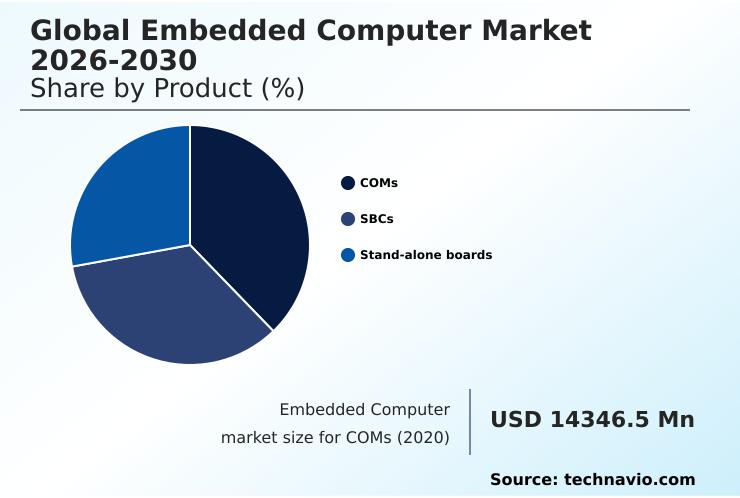
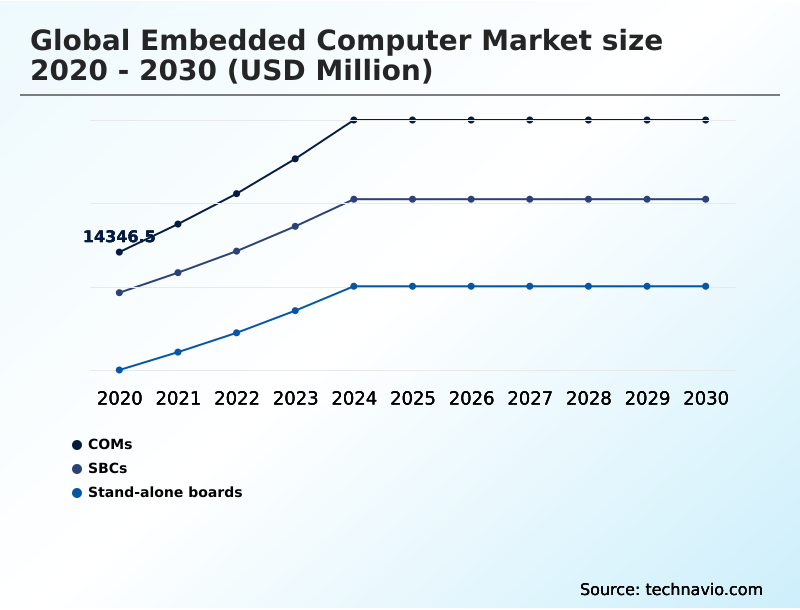
The COMs segment was valued at USD 18.55 billion in 2024 and showed a gradual increase during the forecast period.
Regional Analysis
Europe is estimated to contribute 35.4% to the growth of the global market during the forecast period.Technavio’s analysts have elaborately explained the regional trends and drivers that shape the market during the forecast period.
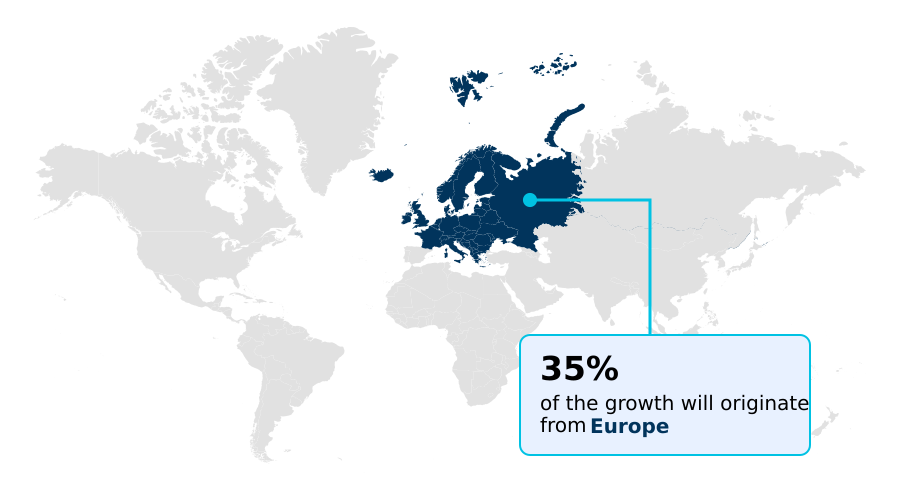
See How Embedded Computer Market Demand is Rising in Europe Get Free Sample
Regional dynamics define market opportunities, with APAC leading in manufacturing scale and market expansion, driven by consumer electronics and the adoption of smart city technologies.
North America is a hub for innovation in telecommunications infrastructure and advanced data acquisition systems, with significant investment in domestic semiconductor capabilities. The region's focus on R&D has resulted in a 20% year-over-year increase in patent filings for embedded AI.
Europe excels in creating high-reliability automotive embedded systems and platforms for industrial automation, where adherence to stringent regulatory standards is paramount.
Demand in these regions for sophisticated human-machine interfaces and remote device management platforms is growing, driven by the need for enhanced operational control and efficiency.
Market Dynamics
Our researchers analyzed the data with 2025 as the base year, along with the key drivers, trends, and challenges. A holistic analysis of drivers will help companies refine their marketing strategies to gain a competitive advantage.
- Strategic decision-making in the embedded computer market involves navigating a complex web of trade-offs. The fundamental choice of x86 vs arm for industrial automation hinges on balancing legacy software support against power efficiency. Similarly, engineers must constantly weigh power consumption vs performance in embedded systems, a critical factor for both battery-powered IoT devices and thermally constrained industrial PCs.
- The process for managing design complexity in soc development has become a core competency, as platforms now integrate diverse processing elements. This necessitates sophisticated software development for heterogeneous computing.
- For applications demanding high reliability, such as in military and defense or medical devices, the focus shifts to sourcing ruggedized computer for military and defense and achieving functional safety certification for medical devices.
- The question of choosing coms vs sbcs for new product design depends on factors like scalability, development speed, and total cost of ownership, with system-on-module carrier board design offering modularity. Implementing robust security, including a secure boot implementation in iot devices and adhering to iot gateway security best practices and cybersecurity standards for connected vehicles, is no longer optional.
- This adds overhead, as development cycles for systems requiring long-term availability for industrial pcs are often 50% longer than consumer-grade products due to rigorous validation. Other critical considerations include thermal design for fanless embedded computers, hardware acceleration for edge ai inference, optimizing latency in real-time operating systems, and upgrading legacy systems with modular computers.
- The integration of fpgas in embedded vision systems and multi-gigabit ethernet for industrial networks further illustrates the specialized knowledge required for high-speed data acquisition in embedded systems.
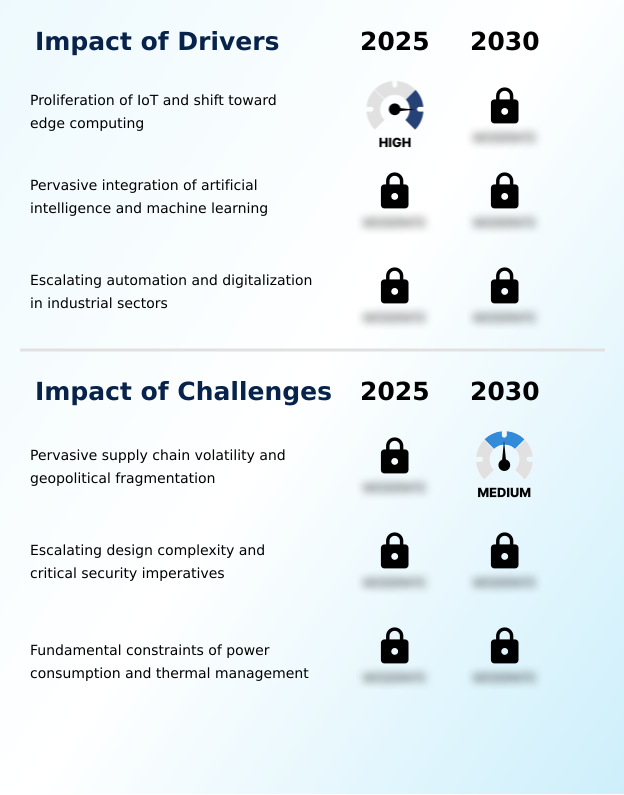
What are the key market drivers leading to the rise in the adoption of Embedded Computer Industry?
- The proliferation of IoT devices and the corresponding strategic architectural shift toward edge computing are the primary drivers propelling market expansion.
- The expansion of IoT, coupled with the shift to edge computing, is a primary market driver. This creates demand for intelligent iot gateway devices and edge ai platforms capable of real-time processing and predictive maintenance analytics.
- The migration of AI workloads to the edge unlocks new services, with on-device machine vision systems improving defect detection in manufacturing by 35%.
- This requires a new class of industrial automation computers with hardware acceleration to handle neural network inference efficiently.
- The digitalization of industry, or Industry 4.0, serves as another foundational driver, fueling the need for ruggedized designs and time-sensitive networking to create interconnected and data-driven production environments. This ensures the long-term availability of stable, high-value systems.
What are the market trends shaping the Embedded Computer Industry?
- The market is increasingly defined by the ascendancy of heterogeneous computing architectures. This paradigm shift integrates specialized processors to optimize performance and power efficiency for diverse workloads.
- A dominant trend is the move toward heterogeneous computing, where a system-on-chip integrates specialized processing units for maximum efficiency. This embedded system design approach combines graphics processing units and field-programmable gate arrays to handle diverse workloads, from medical imaging processing to advanced driver-assistance systems.
- The convergence of functional safety and hardware-based cybersecurity is another critical development, particularly for mission-critical applications in aerospace and automotive sectors. This has led to the adoption of features like redundant cores and secure boot processes, with certified systems reducing failure rates by over 25%.
- Furthermore, the standardization of high-speed i/o interfaces like pci express and multi-gigabit ethernet is essential for enabling the low-latency communication needed in modern industrial control systems, increasing data throughput by 60%.
What challenges does the Embedded Computer Industry face during its growth?
- Pervasive supply chain volatility, compounded by geopolitical fragmentation, presents a significant and persistent challenge to market stability and long-term growth.
- A fundamental challenge is managing power consumption management and thermal management solutions in increasingly compact and powerful devices. The trade-off between performance and heat dissipation requires advanced passive cooling systems and complex firmware development to prevent thermal throttling, which can degrade performance by up to 30% in high-load scenarios.
- Escalating design complexity and the imperative for robust security present another hurdle. Integrating multiple processors within a single device complicates validation, while the need for features like trusted execution environments adds an estimated 15% to development costs.
- This is particularly acute in safety-critical systems, where achieving certification is a non-negotiable and costly requirement for market entry, demanding extensive expertise in both mechatronics integration and cybersecurity.
Exclusive Technavio Analysis on Customer Landscape
The embedded computer market forecasting report includes the adoption lifecycle of the market, covering from the innovator’s stage to the laggard’s stage. It focuses on adoption rates in different regions based on penetration. Furthermore, the embedded computer market report also includes key purchase criteria and drivers of price sensitivity to help companies evaluate and develop their market growth analysis strategies.
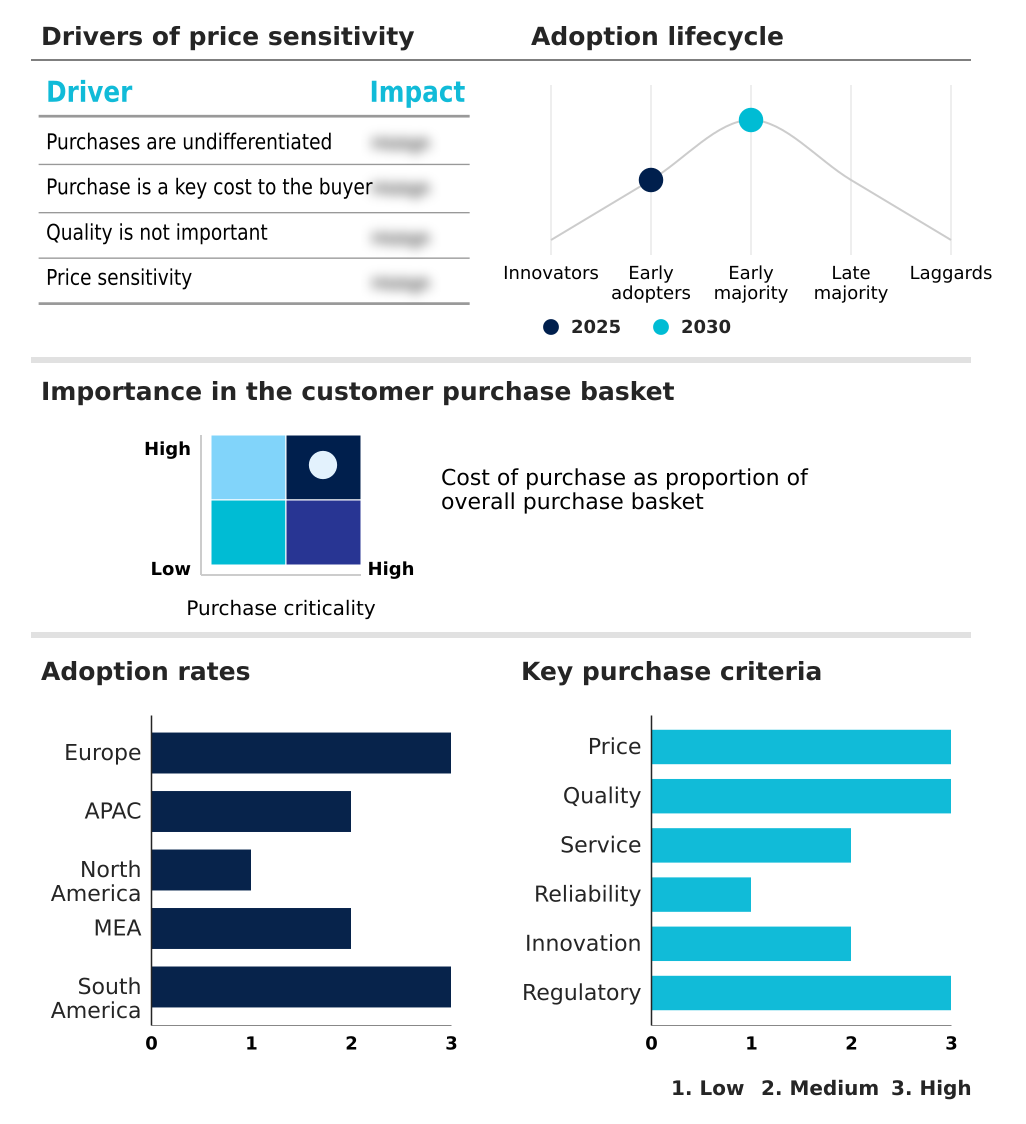
Customer Landscape of Embedded Computer Industry
Competitive Landscape
Companies are implementing various strategies, such as strategic alliances, embedded computer market forecast, partnerships, mergers and acquisitions, geographical expansion, and product/service launches, to enhance their presence in the industry.
AAEON Technology Inc. - Provides a comprehensive range of industrial automation computers, edge AI systems, and single-board computers tailored for diverse IoT and embedded design-in services.
The industry research and growth report includes detailed analyses of the competitive landscape of the market and information about key companies, including:
- AAEON Technology Inc.
- ADLINK Technology Inc.
- Advantech Co. Ltd.
- American Portwell Technology
- Axiomtek Co. Ltd.
- congatec GmbH
- Curtiss Wright Corp.
- DFI Inc.
- Digi International Inc.
- EUROTECH Spa
- IEI Integration Corp.
- Intel Corp.
- Kontron AG
- Lanner Electronics Inc.
- NVIDIA Corp.
- Raspberry Pi
- Toradex AG
- VIA TECHNOLOGIES Inc.
Qualitative and quantitative analysis of companies has been conducted to help clients understand the wider business environment as well as the strengths and weaknesses of key industry players. Data is qualitatively analyzed to categorize companies as pure play, category-focused, industry-focused, and diversified; it is quantitatively analyzed to categorize companies as dominant, leading, strong, tentative, and weak.
Recent Development and News in Embedded computer market
- In September, 2024, NVIDIA Corp. announced the expansion of its Jetson platform with a new series of functional safety certified modules, specifically targeting Level 3 autonomous driving systems and collaborative robotics.
- In November, 2024, Advantech Co. Ltd. partnered with a leading 5G chipset provider to launch a new line of industrial IoT gateways featuring integrated 5G NR connectivity, designed to support massive machine-type communications and ultra-reliable low-latency applications.
- In February, 2025, Intel Corp. completed its acquisition of a fabless semiconductor startup specializing in ultra-low-power neural processing units, a strategic move to bolster its edge AI portfolio for battery-operated devices.
- In May, 2025, The European Commission announced the final draft of its 'Cyber Resilience Act for Industrial Systems,' mandating hardware-based cybersecurity features, including secure boot and trusted execution environments, for all critical infrastructure control systems sold within the EU starting in 2028.
Dive into Technavio’s robust research methodology, blending expert interviews, extensive data synthesis, and validated models for unparalleled Embedded Computer Market insights. See full methodology.
| Market Scope | |
|---|---|
| Page number | 314 |
| Base year | 2025 |
| Historic period | 2020-2024 |
| Forecast period | 2026-2030 |
| Growth momentum & CAGR | Accelerate at a CAGR of 6.9% |
| Market growth 2026-2030 | USD 20335.0 million |
| Market structure | Fragmented |
| YoY growth 2025-2026(%) | 6.8% |
| Key countries | Germany, UK, France, Italy, Spain, The Netherlands, China, Japan, India, South Korea, Australia, Indonesia, US, Canada, Mexico, Saudi Arabia, UAE, South Africa, Israel, Turkey, Brazil, Argentina and Chile |
| Competitive landscape | Leading Companies, Market Positioning of Companies, Competitive Strategies, and Industry Risks |
Research Analyst Overview
- The embedded computer market is undergoing a strategic pivot from general-purpose processing to highly specialized, workload-optimized solutions. This shift is most evident in the move toward heterogeneous computing, a design philosophy that integrates various co-processors like graphics processing units and dedicated neural processing units onto a single system-on-chip.
- This trend has profound boardroom implications, forcing a re-evaluation of R&D budgets to account for more complex hardware and software co-design, particularly for new edge ai platforms. The decision to adopt these architectures impacts long-term product roadmaps, requiring a commitment to new software ecosystems and engineering skill sets.
- While increasing complexity, this approach delivers tangible performance benefits; for instance, integrated ai accelerators can execute real-time processing tasks for machine vision systems up to 10 times faster than traditional CPUs alone.
- Consequently, competitive differentiation now hinges less on raw clock speed and more on the efficiency and performance of the entire system, encompassing computer-on-modules, single-board computers, and advanced i/o, including pci express and time-sensitive networking for industrial automation computers and iot gateway devices.
- This evolution necessitates a deep understanding of functional safety and hardware-based cybersecurity to deliver reliable, ruggedized designs with robust power consumption management.
What are the Key Data Covered in this Embedded Computer Market Research and Growth Report?
-
What is the expected growth of the Embedded Computer Market between 2026 and 2030?
-
USD 20.34 billion, at a CAGR of 6.9%
-
-
What segmentation does the market report cover?
-
The report is segmented by Product (COMs, SBCs, and Stand-alone boards), End-user (Industrial automation, Military and defense, Medical, Communication, and Others), CPU Architecture (x86, ARM, PowerPC, and Others) and Geography (Europe, APAC, North America, Middle East and Africa, South America)
-
-
Which regions are analyzed in the report?
-
Europe, APAC, North America, Middle East and Africa and South America
-
-
What are the key growth drivers and market challenges?
-
Proliferation of IoT and shift toward edge computing, Pervasive supply chain volatility and geopolitical fragmentation
-
-
Who are the major players in the Embedded Computer Market?
-
AAEON Technology Inc., ADLINK Technology Inc., Advantech Co. Ltd., American Portwell Technology, Axiomtek Co. Ltd., congatec GmbH, Curtiss Wright Corp., DFI Inc., Digi International Inc., EUROTECH Spa, IEI Integration Corp., Intel Corp., Kontron AG, Lanner Electronics Inc., NVIDIA Corp., Raspberry Pi, Toradex AG and VIA TECHNOLOGIES Inc.
-
Market Research Insights
- The market's dynamics are shaped by a relentless drive for efficiency and intelligence in connected devices. The adoption of advanced automotive embedded systems has led to a 30% reduction in response times for safety-critical functions, while new industrial control systems now offer predictive maintenance analytics that can lower unplanned downtime by over 40%.
- This progress is facilitated by sophisticated software development kits that abstract hardware complexity, enabling faster firmware development. As smart city technologies become more widespread, the focus on remote device management and low-latency communication intensifies, with some IoT deployments demonstrating a 25% decrease in operational costs through optimized energy usage and asset tracking solutions.
- The challenge remains to balance these performance gains with the demands of long-term availability and robust security protocols.
We can help! Our analysts can customize this embedded computer market research report to meet your requirements.
 RIA -
RIA - 
