


Embedded Software Market Size 2025-2029
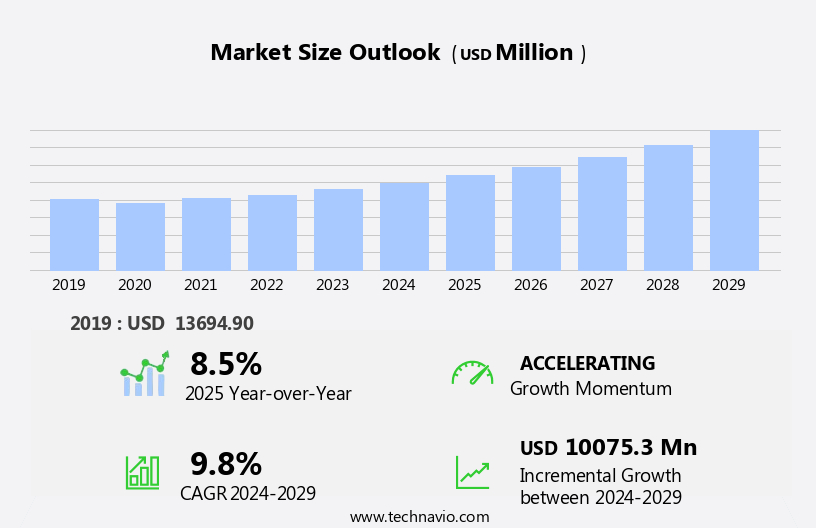
The embedded software market size is forecast to increase by USD 10.08 billion at a CAGR of 9.8% between 2024 and 2029.
- The market is experiencing significant growth, driven primarily by its high adoption in the semiconductor industry. This trend is expected to continue as embedded software becomes increasingly integral to the development of advanced electronic systems. Another key driver is the emergence of embedded software in in-vehicle infotainment systems, which is transforming the automotive industry and creating new opportunities for market participants. However, the market is not without challenges. Data security and privacy concerns are becoming increasingly important, as the use of embedded software expands into areas such as healthcare and finance.
- Companies seeking to capitalize on market opportunities must prioritize addressing these challenges through robust security measures and transparent data handling practices. Additionally, staying abreast of emerging technologies and trends, such as the Internet of Things (IoT) and edge computing, will be crucial for staying competitive in this dynamic market.
What will be the Size of the Embedded Software Market during the forecast period?
- The market encompasses various applications, including arm processors, medical imaging, smart cities, and industrial control systems. The development process often follows a waterfall model, ensuring integration testing and formal verification are integral parts of the cycle. Model-based design and agile methodologies are also gaining popularity, enabling seamless integration of sensor fusion, digital signal processing, and image processing. Cloud-based development and cellular connectivity are driving trends, allowing for remote diagnostics and firmware updates. In turn, this enhances the functionality of smart homes, autonomous vehicles, and industrial systems. Software quality assurance practices, such as unit testing, system testing, and performance testing, are crucial to maintaining reliability and security.
- Data encryption is essential for securing sensitive information in applications like medical imaging and industrial control systems. Advanced techniques like model-based design and formal verification aid in enhancing software quality and reducing errors. Sensor fusion, a key component in smart cities and autonomous vehicles, relies on the integration of multiple data sources to provide accurate and reliable information. This, in turn, necessitates rigorous testing, including stress testing and code coverage, to ensure optimal performance and functionality. In summary, the market is characterized by continuous innovation and the integration of advanced technologies, driving the need for robust testing methodologies and stringent software quality assurance practices.
How is this Embedded Software Industry segmented?
The embedded software industry research report provides comprehensive data (region-wise segment analysis), with forecasts and estimates in "USD million" for the period 2025-2029, as well as historical data from 2019-2023 for the following segments.
- Product
- RTOs
- Compilers
- Assemblers
- Debuggers
- Others
- End-user
- Real-time system
- Standalone system
- Component
- Hardware
- Software
- Geography
- North America
- US
- Canada
- Europe
- France
- Germany
- Italy
- UK
- Middle East and Africa
- APAC
- China
- India
- Japan
- South Korea
- South America
- Rest of World (ROW)
- North America
By Product Insights
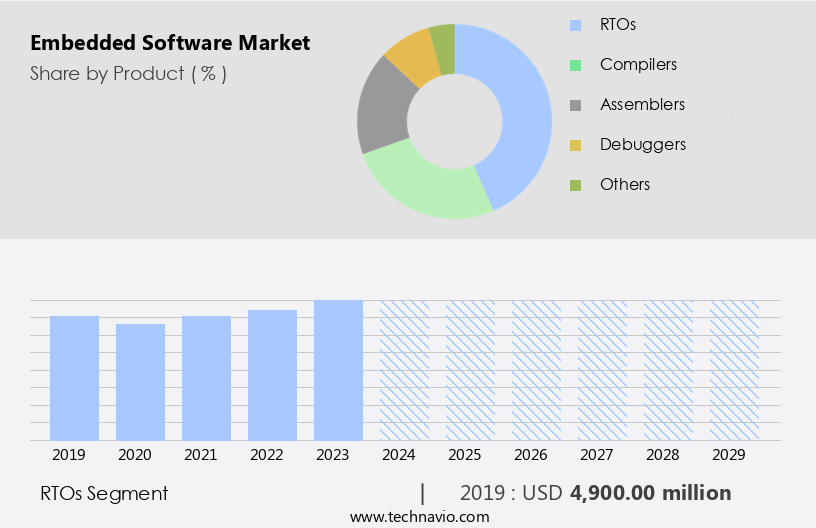
The rtos segment is estimated to witness significant growth during the forecast period.
Real-time operating systems (RTOS) serve as the foundation for applications that process data in real time, without delays. In the global RTOS market, significant investments are being made, particularly in the Internet of Things (IoT) and machine-to-machine (M2M) communications sectors, as these technologies gain mainstream adoption. IoT devices, such as those used in industries like telecommunications, banking, finance, insurance, information technology infrastructure services, retail, and healthcare, require embedded computers with real-time applications. Ultra-low-power (ULP) processors are essential for these devices, as they consume less power and enhance performance. The increase in power efficiency is crucial for mobile computing applications and devices, including notebooks, ultra-portables, and wearables, which all benefit from extended battery life.
Embedded software plays a pivotal role in the functionality and reliability of these devices. Safety and reliability are paramount, with functional safety and certification standards ensuring the safe operation of critical systems. Memory management, security protocols, and system architecture design are essential components of embedded software development. Agile development methodologies, such as continuous integration and code review, enable efficient software development and bug tracking. Software lifecycle management is crucial for maintaining the functionality and security of IoT devices. Proprietary software and open-source software have their advantages, with the former offering exclusive features and the latter promoting collaboration and customization.
Software development kits (SDKs) and application programming interfaces (APIs) facilitate the development of applications and device drivers, while edge computing and cloud connectivity enable data processing and analysis. Artificial intelligence, machine learning, and data analytics are transforming various industries, including industrial automation and aerospace & defense, by providing insights and improving efficiency. Human-machine interaction and remote monitoring are essential for enhancing user experience and ensuring the safety and reliability of these systems. Power management and energy efficiency are crucial considerations for the long-term success of IoT devices.
Get a glance at the market report of share of various segments Request Free Sample
The RTOs segment was valued at USD 4.9 billion in 2019 and showed a gradual increase during the forecast period.
Regional Analysis
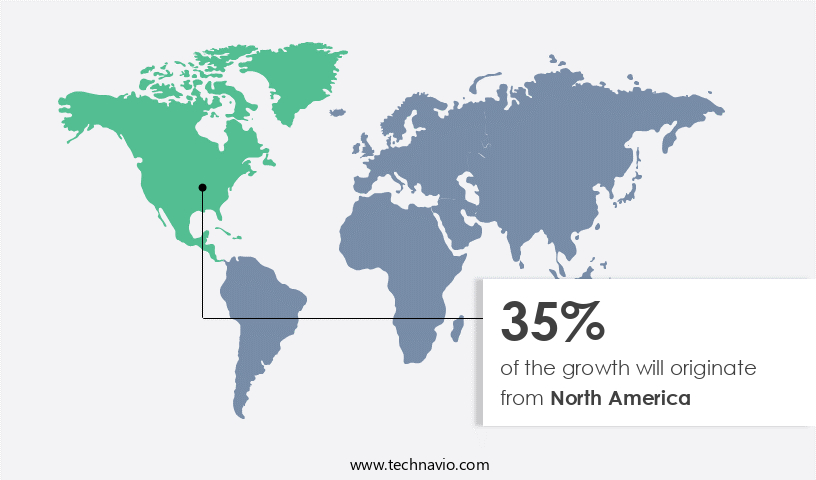
North America is estimated to contribute 35% to the growth of the global market during the forecast period.Technavio’s analysts have elaborately explained the regional trends and drivers that shape the market during the forecast period.
For more insights on the market size of various regions, Request Free Sample
In North America, the market for additive manufacturing in the technology sector is experiencing significant growth. Factors driving this expansion include the demand for quicker product development cycles, cost savings through reduced manufacturing costs, and the efficient management of intricate hardware control systems. The proliferation of tablets and netbooks in the industrial sector is further fueling market growth in this region. Embedded software plays a pivotal role in various applications, including Google's self-driving car project. This initiative aimed to enhance vehicle control, ensuring safer and more convenient travel for individuals regardless of their driving abilities. Microcontrollers, such as advanced reduced instruction set computing machines (ARM), are employed to create new hardware, implement control algorithms, and interface with the rest of the autonomous systems.
The development of real-time operating systems and software licensing enables efficient and reliable system performance. Over-the-air updates ensure that software remains current and secure, addressing any potential vulnerabilities. Safety and reliability are paramount, with functional safety and certification standards ensuring that systems meet stringent requirements. Open-source software and code optimization streamline development processes, while requirements engineering and user interface design create intuitive and user-friendly applications. Agile development methodologies, such as continuous integration and code review, ensure that software is of high quality and meets customer needs. Industrial automation, artificial intelligence, and data analytics are key areas of application for embedded software, with machine learning and remote monitoring providing valuable insights for optimizing processes and improving efficiency.
Security protocols, system architecture design, and version control are essential components of software lifecycle management, ensuring that software remains secure and up-to-date throughout its lifespan. Embedded software services, including embedded Linux and connected devices, offer customized solutions for various industries, including aerospace & defense, medical devices, and power management. The integration of application programming interfaces, device drivers, and cloud connectivity enables seamless communication between different systems and components. Edge computing and the hardware abstraction layer further enhance system performance and flexibility. In the rapidly evolving world of additive manufacturing, these technologies and trends are shaping the future of the market.
Market Dynamics
Our researchers analyzed the data with 2024 as the base year, along with the key drivers, trends, and challenges. A holistic analysis of drivers will help companies refine their marketing strategies to gain a competitive advantage.
What are the key market drivers leading to the rise in the adoption of Embedded Software Industry?
- High adoption of embedded software in semiconductor industry is the key driver of the market.
- In the semiconductor sector, embedded software plays a crucial role in designing Integrated Circuits (IC), which interconnect various electronic components such as capacitors, transistors, amplifiers, oscillators, computer memory, and timers. The telecom and communication industry leads the semiconductor market due to the escalating demand for smartphones and tablets. To create advanced devices, smartphone and tablet manufacturers are integrating new and innovative embedded software technologies with hardware.
- Embedded software is essential for controlling several parameters required for the product's proper functioning. The significant demand for ICs, which form the foundation of smartphones, fuels the expansion of the market. Software companies are adopting strategic initiatives like mergers and acquisitions to expand their global footprint and strengthen their market position.
What are the market trends shaping the Embedded Software Industry?
- Emergence of embedded software in in-vehicle infotainment is the upcoming market trend.
- Infotainment systems, a fusion of information and entertainment, have emerged due to technological advancements and growing consumer preferences for personalized in-vehicle experiences. These systems offer entertainment, navigation, and connectivity solutions, integrating software and hardware components in automobiles. They encompass audio, video, and other content delivery systems, as well as in-vehicle navigation devices, Internet and Wi-Fi connectivity, social networking applications, and telematics systems. The increasing use of in-built connectivity and telematics is transforming the in-vehicle experience for both passengers and drivers.
- With consumers accustomed to interacting with their personal mobile devices, they now expect similar user interfaces from their infotainment systems. Infotainment systems are developed using embedded software, which facilitates seamless integration of various components. This software plays a crucial role in managing and coordinating the functioning of different in-vehicle systems, ensuring a harmonious user experience.
What challenges does the Embedded Software Industry face during its growth?
- Data security and privacy issues is a key challenge affecting the industry growth.
- Embedded software plays a crucial role in digitizing enterprise data on a global scale. However, this widespread use brings significant concerns, including privacy, security, liability, and intellectual property protection. The risks associated with embedded software are heightened due to the irreversible nature of the software once designed and implemented. Moreover, once backend processes are deployed, users have no control over them. Given the sensitive nature of the data handled by market participants, data security is a paramount concern. The need for robust security measures is escalating as communication among systems becomes increasingly direct, without human intervention.
- Companies in this sector prioritize safeguarding their clients' confidential information and financial data from potential third-party misuse. The importance of data security in embedded software is gaining momentum and is a key market trend.
Exclusive Customer Landscape
The embedded software market forecasting report includes the adoption lifecycle of the market, covering from the innovator’s stage to the laggard’s stage. It focuses on adoption rates in different regions based on penetration. Furthermore, the embedded software market report also includes key purchase criteria and drivers of price sensitivity to help companies evaluate and develop their market growth analysis strategies.
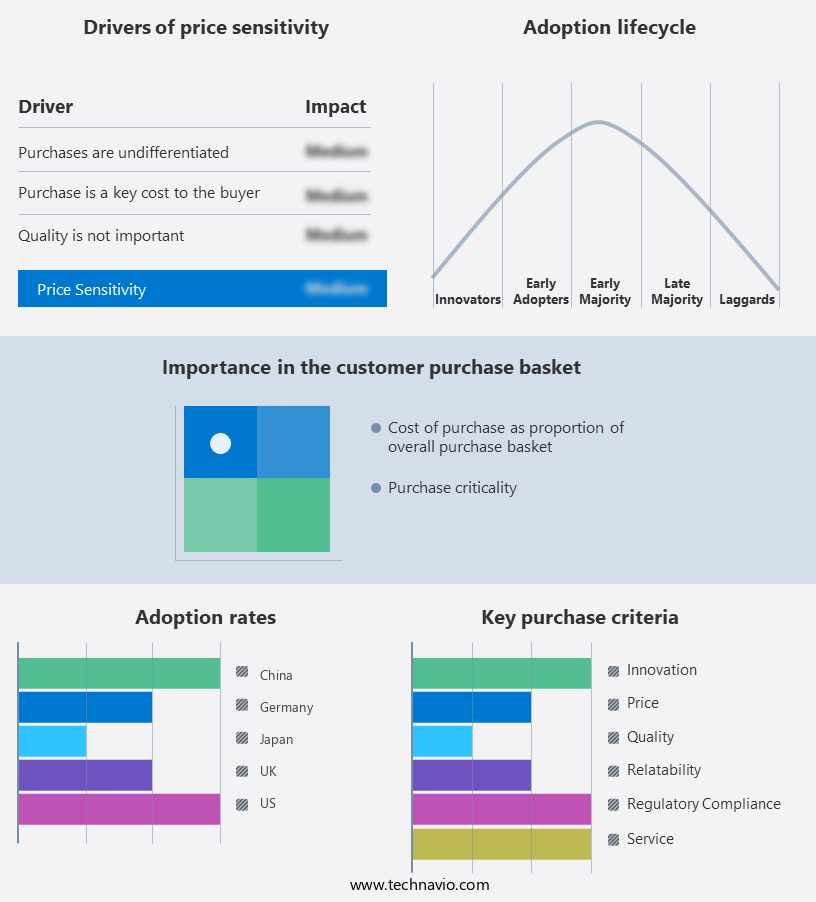
Customer Landscape
Key Companies & Market Insights
Companies are implementing various strategies, such as strategic alliances, embedded software market forecast, partnerships, mergers and acquisitions, geographical expansion, and product/service launches, to enhance their presence in the industry.
Advantech Co. Ltd. - The company specializes in providing advanced embedded software solutions, including Device On, enhancing system functionality and efficiency for various industries. These innovative offerings enable seamless integration and optimization of technologies, ensuring optimal performance and adaptability. By leveraging cutting-edge software, businesses can streamline operations, improve productivity, and stay competitive in today's dynamic market.
The industry research and growth report includes detailed analyses of the competitive landscape of the market and information about key companies, including:
- Advantech Co. Ltd.
- BlackBerry Ltd.
- Emerson Electric Co.
- Enea AB
- Green Hills Software LLC
- Intel Corp.
- International Business Machines Corp.
- Lantronix Inc.
- Microchip Technology Inc.
- Microsoft Corp.
- Mitsubishi Electric Corp.
- National Instruments Corp.
- NEC Corp.
- NXP Semiconductors NV
- Reliance Industries Ltd.
- STMicroelectronics NV
- Texas Instruments Inc.
- Toshiba Corp.
Qualitative and quantitative analysis of companies has been conducted to help clients understand the wider business environment as well as the strengths and weaknesses of key industry players. Data is qualitatively analyzed to categorize companies as pure play, category-focused, industry-focused, and diversified; it is quantitatively analyzed to categorize companies as dominant, leading, strong, tentative, and weak.
Research Analyst Overview
Embedded software plays a crucial role in powering the functionality of various devices and systems across diverse industries. Real-time operating systems (RTOS) form the foundation for developing such software, ensuring deterministic response times and efficient resource utilization. The market for embedded software is witnessing significant growth due to the increasing demand for advanced features in consumer electronics, industrial automation, aerospace & defense, and the Internet of Things (IoT). One of the key trends shaping the market is software licensing models. Traditional proprietary software licensing is being challenged by open-source software, which offers flexibility, cost-effectiveness, and community support. However, safety and reliability remain paramount in industries such as aerospace & defense and medical devices, leading to the adoption of certification standards and stringent testing procedures.
Another trend is over-the-air (OTA) updates, which enable software enhancements and bug fixes to be delivered remotely to connected devices. This not only reduces the need for physical maintenance but also ensures that devices remain up-to-date with the latest features and security patches. Code optimization is another critical aspect of embedded software development, as memory management and power consumption are significant concerns. Agile development methodologies and continuous integration practices help streamline the software development process, enabling faster time-to-market and better collaboration between teams. Functional safety and security protocols are essential for ensuring the safe and secure operation of embedded systems.
System architecture design plays a crucial role in integrating various components, including hardware, software, and communication interfaces. Bug tracking and code review processes help identify and address issues early in the development cycle, reducing the risk of errors and improving overall quality. Software development kits (SDKs) and application programming interfaces (APIs) simplify the development process by providing pre-built components and interfaces. Edge computing and cloud connectivity enable real-time data processing and analysis, while machine learning and artificial intelligence offer advanced functionality and enhanced user experiences. Embedded software services providers offer expertise in various aspects of the software development lifecycle, from requirements engineering and user interface design to system architecture design, certification standards, and testing.
Memory management and power management are critical considerations for optimizing performance and extending battery life in battery-powered devices. In the evolving landscape of embedded software, the focus is on delivering high-performance, reliable, and secure software solutions that meet the unique requirements of various industries and applications. The market is expected to continue growing, driven by the increasing adoption of connected devices and the demand for advanced functionality and improved user experiences.
|
Market Scope |
|
|
Report Coverage |
Details |
|
Page number |
233 |
|
Base year |
2024 |
|
Historic period |
2019-2023 |
|
Forecast period |
2025-2029 |
|
Growth momentum & CAGR |
Accelerate at a CAGR of 9.8% |
|
Market growth 2025-2029 |
USD 10075.3 million |
|
Market structure |
Fragmented |
|
YoY growth 2024-2025(%) |
8.5 |
|
Key countries |
France, Italy, US, Canada, China, Japan, India, South Korea, Germany, and UK |
|
Competitive landscape |
Leading Companies, Market Positioning of Companies, Competitive Strategies, and Industry Risks |
What are the Key Data Covered in this Embedded Software Market Research and Growth Report?
- CAGR of the Embedded Software industry during the forecast period
- Detailed information on factors that will drive the growth and forecasting between 2025 and 2029
- Precise estimation of the size of the market and its contribution of the industry in focus to the parent market
- Accurate predictions about upcoming growth and trends and changes in consumer behaviour
- Growth of the market across North America, APAC, Europe, South America, and Middle East and Africa
- Thorough analysis of the market’s competitive landscape and detailed information about companies
- Comprehensive analysis of factors that will challenge the embedded software market growth of industry companies
We can help! Our analysts can customize this embedded software market research report to meet your requirements.
 RIA -
RIA - 
