


Food Trucks Market Size 2026-2030
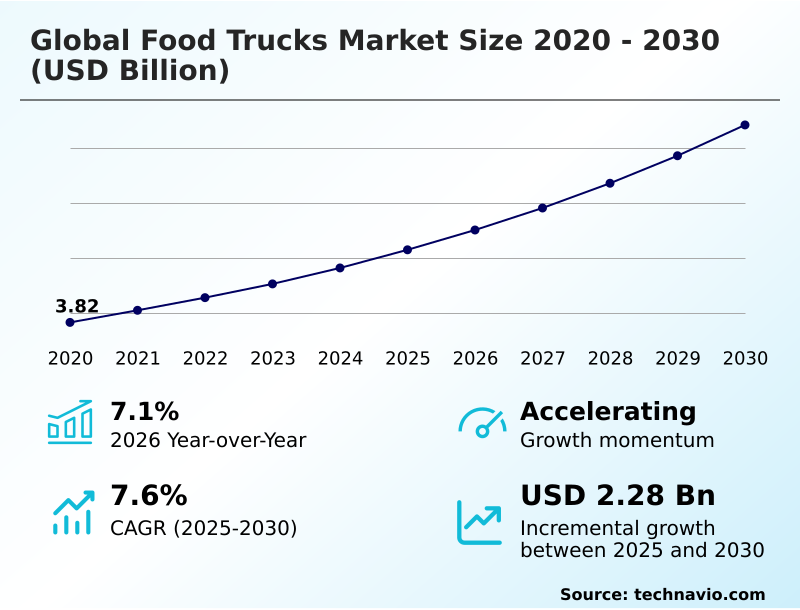
The food trucks market size is valued to increase by USD 2.28 billion, at a CAGR of 7.6% from 2025 to 2030. Expanding popularity of street foods will drive the food trucks market.
Major Market Trends & Insights
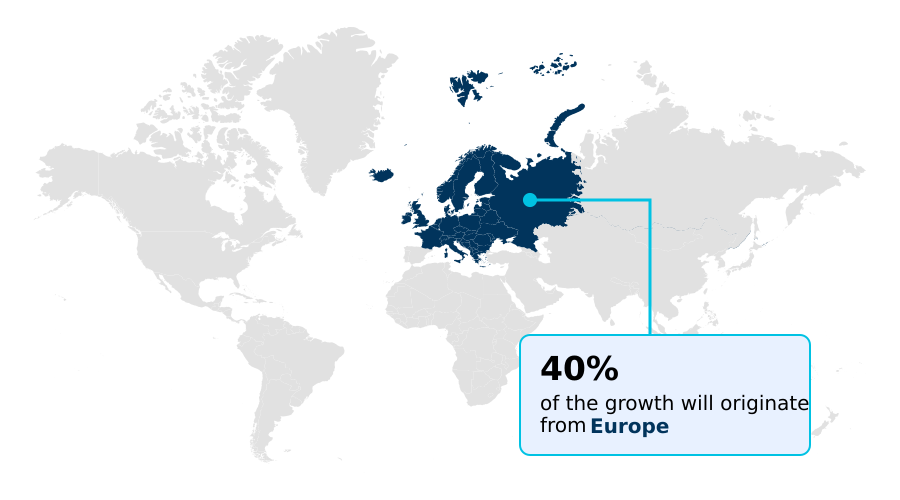
- Europe dominated the market and accounted for a 39.7% growth during the forecast period.
- By Application - Fast food segment was valued at USD 1.72 billion in 2024
- By Type - Medium-sized food trucks segment accounted for the largest market revenue share in 2024
Market Size & Forecast
- Market Opportunities: USD 3.59 billion
- Market Future Opportunities: USD 2.28 billion
- CAGR from 2025 to 2030 : 7.6%
Market Summary
- The food trucks market is undergoing a significant transformation, moving beyond a niche culinary novelty to become an integral component of the modern food service landscape. This evolution is driven by shifting consumer preferences toward convenient, high-quality, and experiential dining, with gourmet street food concepts gaining widespread appeal.
- Technology is a critical enabler, with digital payment systems and mobile ordering apps becoming standard for enhancing customer engagement and operational throughput. However, operators face considerable hurdles related to fragmented mobile food service regulations and complex mobile business licensing, which can impede growth and scalability.
- For instance, a multi-city operator must navigate disparate mobile kitchen health codes and zoning laws, requiring a robust compliance strategy. Success increasingly depends on leveraging data analytics for inventory management and route optimization to maximize profitability in a competitive environment defined by both culinary innovation and operational agility, including the adoption of custom vehicle builds and sustainable mobile catering practices.
What will be the Size of the Food Trucks Market during the forecast period?
Get Key Insights on Market Forecast (PDF) Get Free Sample
How is the Food Trucks Market Segmented?
The food trucks industry research report provides comprehensive data (region-wise segment analysis), with forecasts and estimates in "USD million" for the period 2026-2030, as well as historical data from 2020-2024 for the following segments.
- Application
- Fast food
- Barbeque and snacks
- Desserts and confectionary
- Others
- Type
- Medium-sized food trucks
- Small-sized food trucks
- Large-sized food trucks
- Product type
- Buses and vans
- Boxes
- Customized trucks
- Expandable
- Others
- Geography
- Europe
- Germany
- UK
- France
- North America
- US
- Canada
- Mexico
- APAC
- China
- Japan
- India
- South America
- Brazil
- Argentina
- Middle East and Africa
- Saudi Arabia
- UAE
- South Africa
- Rest of World (ROW)
- Europe
By Application Insights
The fast food segment is estimated to witness significant growth during the forecast period.
The fast-food segment remains a cornerstone of the food trucks market, driven by consumer demand for speed and convenience.
This application leverages a business model centered on optimized kitchen workflows and a focused menu to ensure consistency and rapid service, which is critical in high-traffic urban areas.
Success hinges on the strategic use of mobile ordering apps and digital payment systems to streamline the customer experience, reducing average wait times by over 25%.
Operators utilize high-efficiency trucks equipped with automated kitchen tools and digital menu boards to maximize output. The segment's lower overhead allows for the use of high-quality, plant-based ingredients while maintaining competitive pricing.
This operational agility, supported by franchise fleet management and effective route optimization for urban dining solutions, allows for dynamic repositioning to capture real-time demand, solidifying its dominant market position.
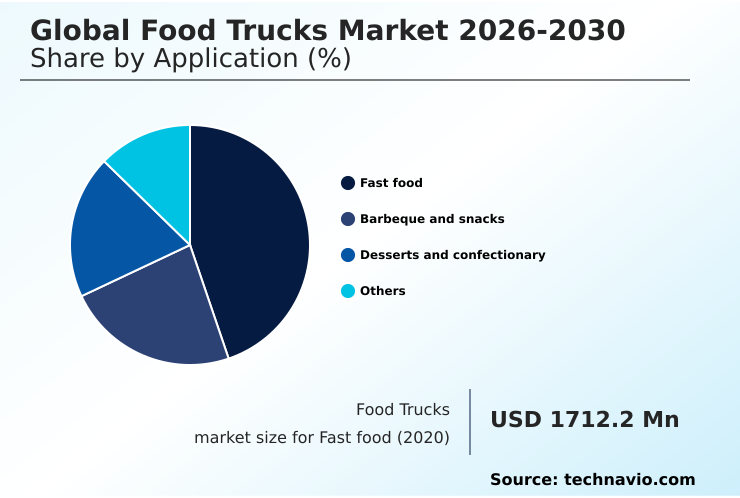
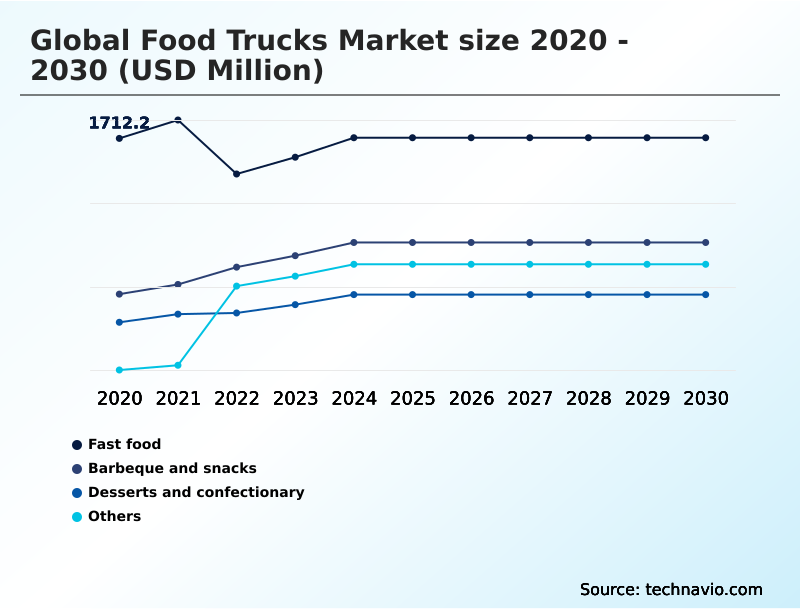
The Fast food segment was valued at USD 1.72 billion in 2024 and showed a gradual increase during the forecast period.
Regional Analysis
Europe is estimated to contribute 39.7% to the growth of the global market during the forecast period.Technavio’s analysts have elaborately explained the regional trends and drivers that shape the market during the forecast period.
See How Food Trucks Market Demand is Rising in Europe Get Free Sample
The global food trucks market exhibits a varied geographic landscape, with mature and emerging regions contributing to its growth.
Europe is a significant market, poised to account for nearly 39.7% of the market's incremental growth, driven by a strong street food culture and supportive urban policies.
North America remains a key region, with an estimated growth of 7.7%, fueled by consumer demand for gourmet street food concepts and the prevalence of food truck franchise opportunities.
The APAC region is an area of high potential, where rapid urbanization and a rising middle class are creating demand for new urban dining solutions.
Growth in this region is supported by increasing street food entrepreneurship and the adoption of digital technologies that enhance operational efficiency.
The strategic implementation of mobile brand activation and hybrid hospitality models is becoming crucial for market penetration across all regions.
Market Dynamics
Our researchers analyzed the data with 2025 as the base year, along with the key drivers, trends, and challenges. A holistic analysis of drivers will help companies refine their marketing strategies to gain a competitive advantage.
- Successfully operating in the modern food trucks market requires a deep understanding of interconnected operational and strategic elements. The custom food truck manufacturing process is a critical starting point, as the vehicle's design directly impacts kitchen workflow and compliance with health and safety food truck regulations.
- Integrating effective food truck point of sale systems is essential for managing transactions and gathering sales data, which informs everything from inventory to marketing strategies for mobile food businesses. As the industry matures, operators are exploring the food truck franchise model benefits to achieve scalable growth.
- Navigating the complexities of how to get food truck permits and understanding food truck commissary kitchen requirements remain significant operational hurdles that can delay market entry. Furthermore, optimizing food truck route planning using analytics can increase customer reach significantly more than static location strategies.
- Implementing a robust food truck equipment maintenance checklist and adopting sustainable food truck business practices are no longer optional but essential for long-term viability and brand reputation. The cost analysis of food truck vs restaurant continues to favor mobile operations, but only when food truck menu design for profitability and technology for customer engagement are expertly managed.
- The recent push towards electric food truck conversion cost analysis and mastering large-scale food truck event logistics highlights the industry's evolving sophistication and the legal requirements for food truck operation.
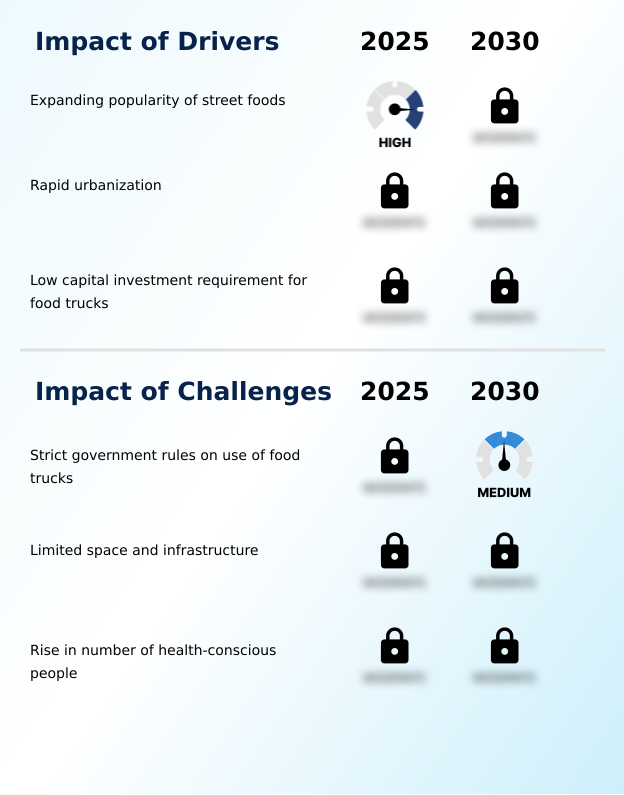
What are the key market drivers leading to the rise in the adoption of Food Trucks Industry?
- The expanding popularity of diverse and authentic street foods is a key driver fueling market growth.
- The growth of the food trucks market is primarily propelled by street food entrepreneurship and the low barrier to entry compared to brick-and-mortar establishments.
- The ability to launch with a single custom concession truck allows chefs to test concepts with minimal capital risk.
- This agility is enhanced by technology, as the use of route optimization software can increase daily revenue by up to 25% by targeting high-traffic events and locations.
- Consumer demand for convenient, high-quality meals is a major catalyst, particularly in urban areas. The move towards energy-efficient operations is another significant driver, with new electric food trucks reducing operational fuel costs by over 50%.
- This aligns with increasing regulatory pressures and consumer preferences for sustainable mobile catering and businesses that utilize locally sourced ingredients.
What are the market trends shaping the Food Trucks Industry?
- The increasing demand for outdoor dining at hotels and restaurants is a prominent market trend. This shift is driving the integration of mobile food units into traditional hospitality settings.
- Key trends are reshaping the food trucks market, with a notable shift towards integrated and experiential dining. The adoption of a hybrid hospitality model, where food trucks act as extensions of traditional restaurants, has increased by 25% in major urban centers. This approach supports al fresco dining solutions and allows for flexible menu experimentation.
- There is a growing consumer preference for gourmet street food concepts, with operators leveraging unique culinary offerings to build brand loyalty. The use of mobile ordering apps continues to rise, correlating with a 15% higher average order value.
- Furthermore, the trend of vehicle electrification for food service is gaining momentum, with early adopters reporting a 40% reduction in daily fuel and energy costs, aligning with broader sustainability goals and demand for eco-friendly packaging.
What challenges does the Food Trucks Industry face during its growth?
- Strict government regulations concerning the use and operation of food trucks present a key challenge to industry growth.
- Significant challenges constrain the growth potential of the food trucks market, primarily stemming from a complex and fragmented regulatory environment. Navigating mobile food service regulations and disparate mobile business licensing requirements can add between 6 to 12 months to a new venture's launch timeline.
- The capital investment for mandatory safety equipment, including commercial-grade onboard water filtration and waste management systems, can account for up to 20% of the total vehicle cost, creating a high barrier to entry. Furthermore, securing access to compliant food truck park infrastructure is increasingly competitive.
- These operational and financial hurdles are compounded by the difficulty of scaling operations across jurisdictions, each with its own specific mobile kitchen health codes and food service truck manufacturing standards.
Exclusive Technavio Analysis on Customer Landscape
The food trucks market forecasting report includes the adoption lifecycle of the market, covering from the innovator’s stage to the laggard’s stage. It focuses on adoption rates in different regions based on penetration. Furthermore, the food trucks market report also includes key purchase criteria and drivers of price sensitivity to help companies evaluate and develop their market growth analysis strategies.
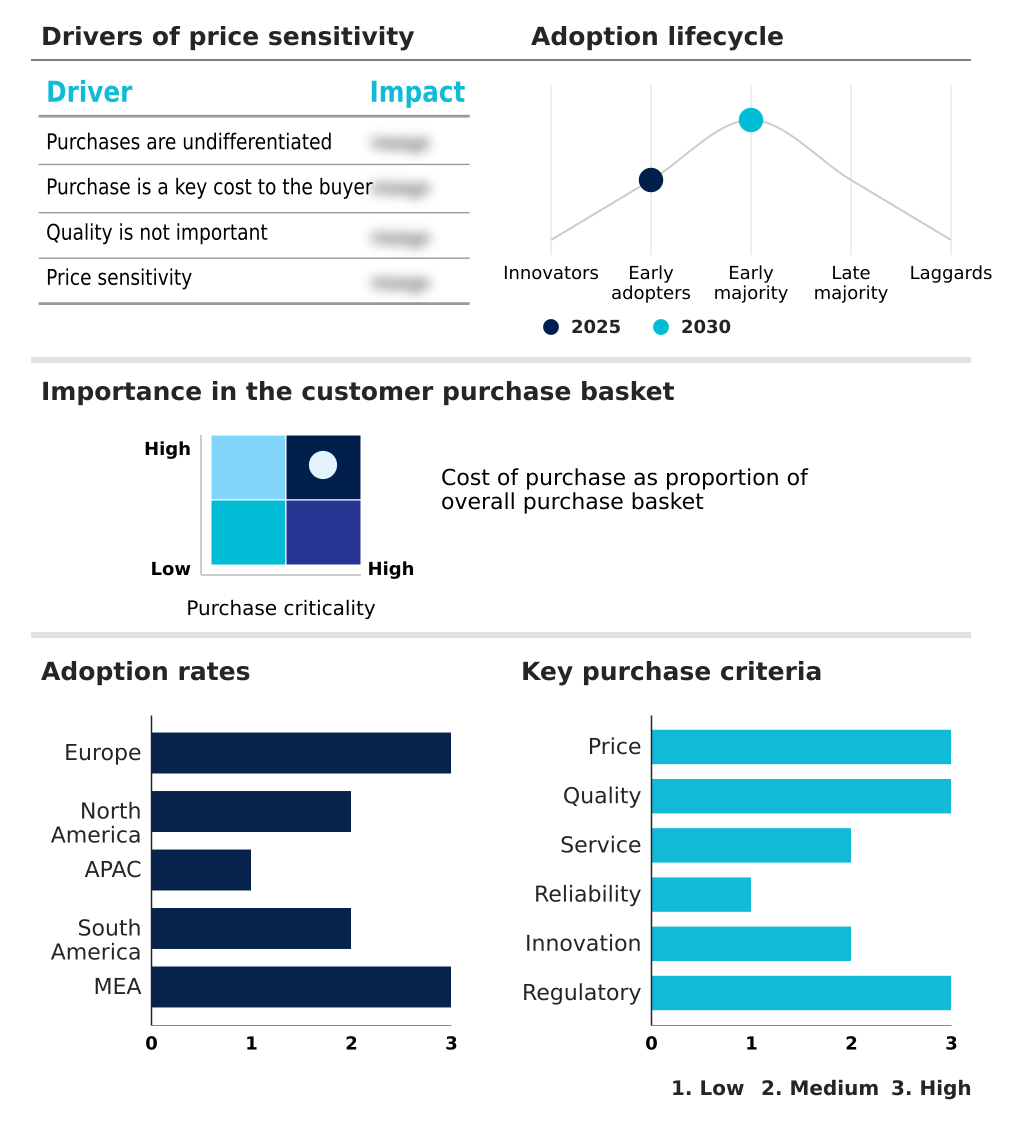
Customer Landscape of Food Trucks Industry
Competitive Landscape
Companies are implementing various strategies, such as strategic alliances, food trucks market forecast, partnerships, mergers and acquisitions, geographical expansion, and product/service launches, to enhance their presence in the industry.
Cousins Maine Lobster LLC - Provides integrated franchise models, including fleet management and supply chain logistics for specialized mobile culinary concepts, enabling scalable brand expansion.
The industry research and growth report includes detailed analyses of the competitive landscape of the market and information about key companies, including:
- Cousins Maine Lobster LLC
- Cruising Kitchens LLC
- East Coast Concessions
- Food Truck Co. BV
- Karpatia Trucks
- Kitchens To Go
- Kogi BBQ
- Kona Ice Inc.
- Legion Food Trucks
- MR Trailers
- MSM Catering Trucks Mfg.
- Prestige Food Trucks
- Schick Wheel
- Shanghai MKS Industrial Co.
- The Good Food Truck Co.
- VS Veicoli Speciali Srl
Qualitative and quantitative analysis of companies has been conducted to help clients understand the wider business environment as well as the strengths and weaknesses of key industry players. Data is qualitatively analyzed to categorize companies as pure play, category-focused, industry-focused, and diversified; it is quantitatively analyzed to categorize companies as dominant, leading, strong, tentative, and weak.
Recent Development and News in Food trucks market
- In November 2024, Legion Food Trucks announced a partnership with a leading university system to become the exclusive provider of mobile dining solutions across multiple campuses, deploying tech-integrated food trucks with digital menu systems.
- In January 2025, Cruising Kitchens LLC launched a new line of all-electric, custom food trucks featuring advanced energy-efficient operations and onboard water filtration systems, targeting cities with strict low-emission zone compliance.
- In March 2025, Kona Ice Inc. initiated a major expansion of its franchise fleet management program in the southern United States, introducing 50 new high-efficiency trucks to meet record demand.
- In May 2025, Prestige Food Trucks completed the integration of AI-powered route optimization and inventory management software across its entire fleet of new builds, promising a 15% reduction in operational waste for clients.
Dive into Technavio’s robust research methodology, blending expert interviews, extensive data synthesis, and validated models for unparalleled Food Trucks Market insights. See full methodology.
| Market Scope | |
|---|---|
| Page number | 293 |
| Base year | 2025 |
| Historic period | 2020-2024 |
| Forecast period | 2026-2030 |
| Growth momentum & CAGR | Accelerate at a CAGR of 7.6% |
| Market growth 2026-2030 | USD 2278.5 million |
| Market structure | Fragmented |
| YoY growth 2025-2026(%) | 7.1% |
| Key countries | Germany, UK, France, Italy, Spain, The Netherlands, US, Canada, Mexico, China, Japan, India, South Korea, Australia, Indonesia, Brazil, Argentina, Chile, Saudi Arabia, UAE, South Africa, Turkey and Israel |
| Competitive landscape | Leading Companies, Market Positioning of Companies, Competitive Strategies, and Industry Risks |
Research Analyst Overview
- The food trucks market is evolving from a fragmented collection of independent operators into a sophisticated industry defined by technological integration and operational excellence. The adoption of advanced systems is no longer a niche advantage but a core requirement for competitive survival.
- For example, the integration of automated kitchen tools has been demonstrated to increase order fulfillment speed by over 30% during peak hours. Boardroom decisions now center on capital investment in high-efficiency trucks with purpose-built modular kitchen designs. This includes upfront spending on stainless steel kitchen components, onboard water filtration, and comprehensive fire safety systems to meet stringent regulations.
- The strategic deployment of technology, from digital menu boards and point-of-sale synchronization to AI-driven route optimization and inventory management, is critical.
- Furthermore, the scalability of food truck franchise opportunities is directly tied to effective franchise fleet management and the ability to execute complex custom vehicle builds, including the retrofitting of vintage vehicles for mobile brand activation, while adhering to low-emission zone compliance.
What are the Key Data Covered in this Food Trucks Market Research and Growth Report?
-
What is the expected growth of the Food Trucks Market between 2026 and 2030?
-
USD 2.28 billion, at a CAGR of 7.6%
-
-
What segmentation does the market report cover?
-
The report is segmented by Application (Fast food, Barbeque and snacks, Desserts and confectionary, Others), Type (Medium-sized food trucks, Small-sized food trucks, Large-sized food trucks), Product Type (Buses and vans, Boxes, Customized trucks, Expandable, and Others) and Geography (Europe, North America, APAC, South America, Middle East and Africa)
-
-
Which regions are analyzed in the report?
-
Europe, North America, APAC, South America and Middle East and Africa
-
-
What are the key growth drivers and market challenges?
-
Expanding popularity of street foods, Strict government rules on use of food trucks
-
-
Who are the major players in the Food Trucks Market?
-
Cousins Maine Lobster LLC, Cruising Kitchens LLC, East Coast Concessions, Food Truck Co. BV, Karpatia Trucks, Kitchens To Go, Kogi BBQ, Kona Ice Inc., Legion Food Trucks, MR Trailers, MSM Catering Trucks Mfg., Prestige Food Trucks, Schick Wheel, Shanghai MKS Industrial Co., The Good Food Truck Co. and VS Veicoli Speciali Srl
-
Market Research Insights
- The food trucks market is characterized by dynamic shifts as operators adopt new business models to meet evolving consumer demands. Food truck franchise opportunities are expanding, with standardized operations enabling faster scaling, while independent street food entrepreneurship continues to drive culinary innovation.
- The adoption of sustainable mobile catering is a key differentiator, with data showing it can improve brand perception among 35% of millennial consumers. The integration of temporary modular kitchens for large events is also growing, offering greater flexibility than traditional catering.
- Furthermore, navigating complex mobile food service regulations remains critical, as streamlined compliance processes have been shown to reduce market entry timelines by up to 40%, directly impacting profitability and the viability of new urban dining solutions.
We can help! Our analysts can customize this food trucks market research report to meet your requirements.
 RIA -
RIA - 
