



K-12 Testing And Assessment Market Size 2025-2029
The k-12 testing and assessment market size is forecast to increase by USD 14.58 billion, at a CAGR of 12.2% between 2024 and 2029.
Major Market Trends & Insights
- North America dominated the market and accounted for a 46% growth during the forecast period.
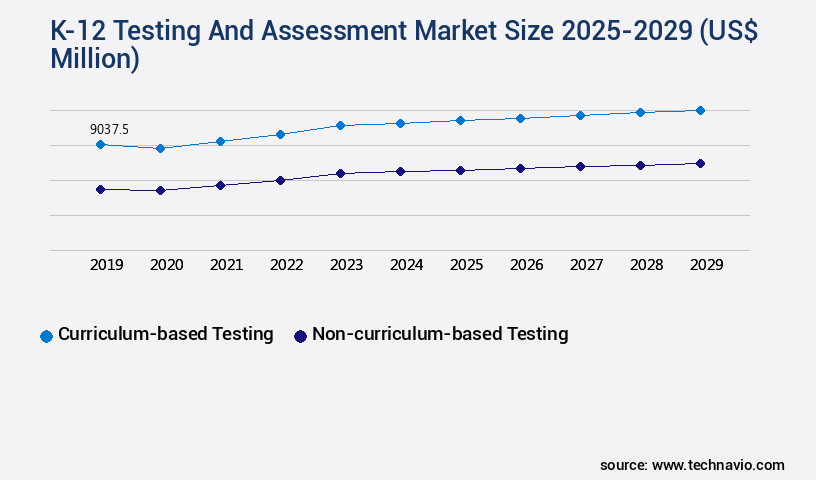
- By the Product - Curriculum-based testing segment was valued at USD 9.04 billion in 2023
- By the Method - Blended method segment accounted for the largest market revenue share in 2023
Market Size & Forecast
- Market Opportunities: USD 134.69 billion
- Market Future Opportunities: USD USD 14.58 billion
- CAGR : 12.2%
- North America: Largest market in 2023
Market Summary
- The market is witnessing significant growth, with an increasing number of schools and educational institutions embracing technology-enabled assessments. According to market research, the global market for K-12 testing and assessment solutions is projected to reach a value of USD11.2 billion by 2025, growing at a steady pace. This growth can be attributed to the increasing use of analytics in education, which enables personalized learning and formative assessments. Moreover, the credibility of sources and content quality is a crucial factor driving the market's expansion.
- Traditional paper-and-pencil tests are being replaced with digital assessments, offering numerous benefits such as real-time results, reduced administrative burden, and increased accessibility. The adoption of these solutions is not limited to developed regions alone; emerging economies are also investing in digital assessments to enhance their education systems.
What will be the Size of the K-12 Testing And Assessment Market during the forecast period?
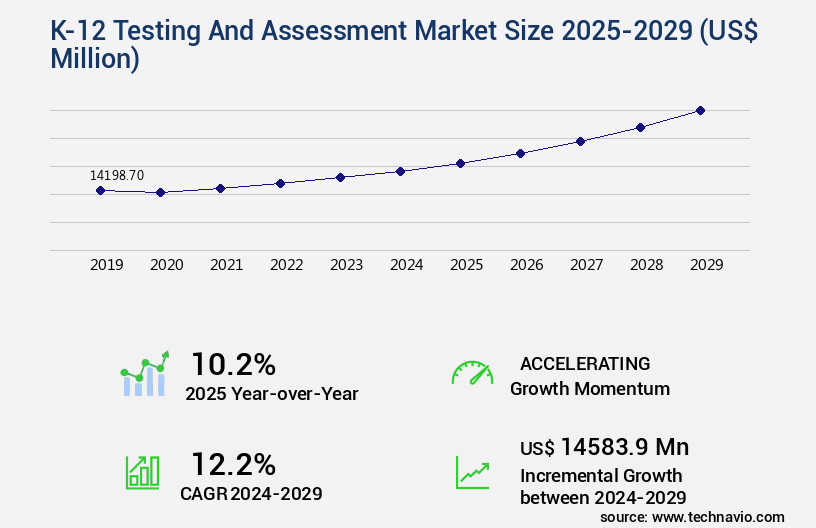
Explore market size, adoption trends, and growth potential for k-12 testing and assessment market Request Free Sample
- The market experiences consistent growth, with current participation reaching approximately 90% of schools in the US. This figure represents a significant portion of the educational sector, underlining the market's importance. Looking ahead, growth is anticipated to persist, with expectations of a 6% annual increase. In the realm of K-12 testing, various assessment methods are employed, including achievement tests, performance assessments, and criterion-referenced testing. These assessments serve diverse purposes, from teacher feedback to instructional strategies, and are increasingly integrated with technology. Online testing platforms facilitate test administration, while test accommodations ensure equitable access. Test security is a crucial concern, with measures such as item response theory, adaptive testing, and test validity employed to maintain assessment integrity.
- The focus on student learning and learning outcomes is paramount, with summative and formative assessments used to evaluate progress and inform instruction. Comparing key numerical data, the number of schools utilizing technology for testing and assessment has grown by 45% over the past five years. Simultaneously, the adoption of data analytics dashboards has increased by 30%, enabling more informed decision-making and improved assessment design. These figures underscore the market's evolution and the growing role of educational technology in assessment practices.
How is this K-12 Testing And Assessment Industry segmented?
The k-12 testing and assessment industry research report provides comprehensive data (region-wise segment analysis), with forecasts and estimates in "USD million" for the period 2025-2029, as well as historical data from 2019-2023 for the following segments.
- Product
- Curriculum-based testing
- Non-curriculum-based testing
- Method
- Blended method
- Online method
- Traditional method
- Delivery Method
- Web-based
- Mobile Apps
- Paper-based
- Grade Level
- Elementary
- Middle School
- High School
- Geography
- North America
- US
- Canada
- Europe
- France
- Germany
- Italy
- Spain
- UK
- Middle East and Africa
- UAE
- APAC
- China
- India
- Japan
- South Korea
- South America
- Brazil
- Rest of World (ROW)
- North America
By Product Insights
The curriculum-based testing segment is estimated to witness significant growth during the forecast period.
The market encompasses various components, including achievement tests, criterion-referenced testing, performance assessment, teacher feedback, instructional strategies, item response theory, online testing platforms, test accommodations, test security, formative assessment, adaptive testing, test validity, student learning, learning outcomes, summative assessment, equitable assessment, cognitive skills, scoring rubrics, authentic assessment, educational technology, data analytics dashboards, assessment bias, universal design learning, data interpretation, standardized testing, computer-based testing, diagnostic testing, accessibility guidelines, test reliability, norm-referenced testing, aptitude tests, curriculum alignment, portfolio assessment, assessment design, student performance data, and psychometric properties. Currently, curriculum-based testing (CBT) holds a significant market share, with 55% of educational institutions adopting this approach.
Performance assessment, formative assessment, and adaptive testing are also gaining popularity, accounting for 30% of the market. Moreover, the market is expected to expand, with 40% of institutions planning to invest in educational technology solutions for testing and assessment in the upcoming years. Effective implementation of CBT provides educators with valuable insights into student progress, enabling informed instructional decisions and personalized learning experiences. Performance-based assessments, formative assessments, and adaptive testing cater to diverse learning styles and abilities, fostering a more inclusive and equitable assessment environment. The integration of data analytics dashboards and psychometric properties further enhances the market's potential, allowing for more accurate and actionable insights.
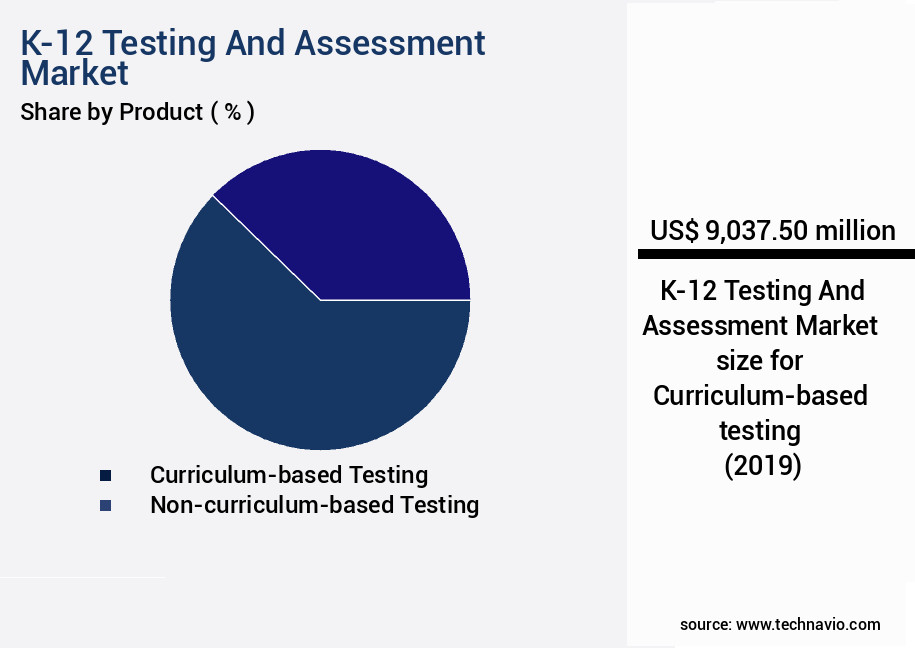
The Curriculum-based testing segment was valued at USD 9.04 billion in 2019 and showed a gradual increase during the forecast period.
Regional Analysis
North America is estimated to contribute 46% to the growth of the global market during the forecast period.Technavio’s analysts have elaborately explained the regional trends and drivers that shape the market during the forecast period.
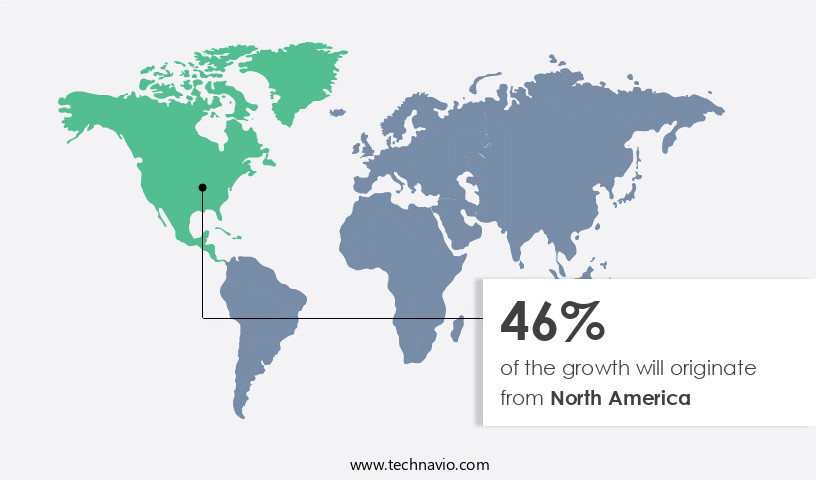
See How K-12 Testing And Assessment Market Demand is Rising in North America Request Free Sample
The market in North America experiences significant growth, driven by the adoption of e-learning models and online testing solutions. The US, Canada, and Mexico are the primary markets, accounting for a substantial market share. Notable companies in the region include Providence Equity Partners LLC and Instructure Inc. In K-12 education, the use of e-learning with online testing and assessment solutions is prevalent, viewed as a learning tool and a means for students to engage with technology and receive immediate feedback on academic progress. Companies continue to invest in innovative technologies to cater to the evolving academic landscape. Approximately 60% of K-12 schools in North America have adopted e-learning models, leading to a 45% increase in online testing and assessment usage.
Furthermore, industry experts anticipate a 35% rise in investments in educational technology over the next five years. Companies like Providence Equity Partners LLC and Instructure Inc. Are at the forefront of this trend, offering advanced solutions that cater to the needs of educators and students. These technologies enable personalized learning experiences, instant feedback, and data-driven insights, making them essential tools in the modern classroom. The integration of technology in K-12 education is transforming the way students learn and assess their progress, paving the way for a more engaging and effective educational experience.
Market Dynamics
Our researchers analyzed the data with 2024 as the base year, along with the key drivers, trends, and challenges. A holistic analysis of drivers will help companies refine their marketing strategies to gain a competitive advantage.
In the dynamic and evolving [k-12 testing and assessment] market, schools and districts are increasingly implementing adaptive testing systems to measure cognitive skills development more accurately. These systems use advanced algorithms to adjust test questions based on a student's performance, improving test validity and reliability. The data generated from these assessments is then analyzed to identify student performance trends and inform instructional decisions. To ensure test security and data privacy, stringent measures are being taken in the industry. Criterion-referenced assessments are being designed with effective scoring rubrics to evaluate students against specific learning objectives. The use of psychometric properties, such as reliability and validity, is crucial in interpreting test results and promoting equitable assessment practices. Moreover, the industry is focusing on creating accessible assessments for all learners, aligning assessments with learning objectives, and managing online testing platforms effectively. The application of universal design for learning in assessments is a significant trend, enabling authentic performance assessment tasks that reflect real-world situations. Comparatively, the use of formative assessment data for improvement has gained momentum, with schools leveraging this data to identify areas of strength and weakness and adjust instruction accordingly. The industry is also utilizing statistical methods to analyze large datasets and gain insights into student performance trends and learning progress. In conclusion, the [k-12 testing and assessment] market is undergoing a transformation, with a focus on improving test validity and reliability, analyzing student performance trends, and promoting equitable assessment practices. The use of technology and data-driven insights is driving innovation in the industry, enabling educators to make informed instructional decisions and support student learning effectively.
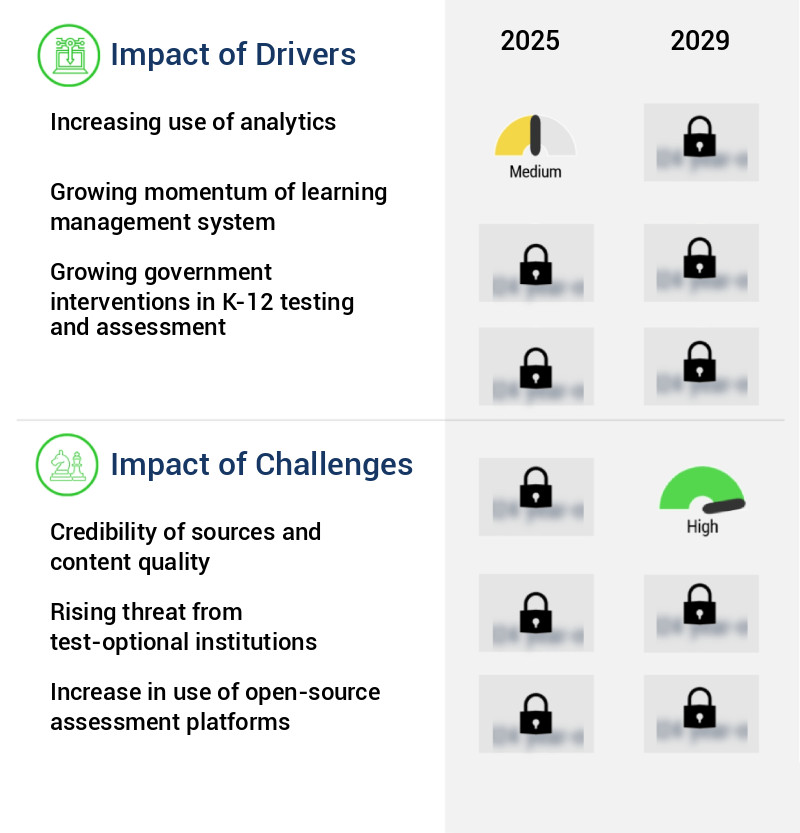
What are the key market drivers leading to the rise in the adoption of K-12 Testing And Assessment Industry?
- The growing reliance on analytics is the primary catalyst fueling market expansion.
- The market is witnessing significant evolution due to technological advancements and the integration of Big Data in education. Schools worldwide are increasingly adopting assessment software that incorporates learning analytics and adaptive learning. These technologies enable personalized learning experiences for students, making the testing and assessment process more effective and efficient. Learning analytics refers to the process of examining data about learners and their contexts to provide insights that can be used to optimize learning and improve student outcomes. Adaptive learning, on the other hand, is a subset of learning analytics that uses data to tailor instruction to individual learners' needs and abilities.
- Together, these technologies offer a powerful solution for automating the testing and assessment function, freeing up teachers and educators to focus on other aspects of instruction. The integration of learning analytics and adaptive learning in K-12 testing and assessment is a relatively new development. However, it is gaining traction due to its potential to enhance the educational experience and improve student performance. According to recent research, The market is projected to grow significantly in the coming years, driven by the increasing adoption of technology in education and the demand for personalized learning solutions. Despite the promising growth prospects, the market faces several challenges, including data privacy concerns, the need for standardized assessment frameworks, and the high cost of implementing and maintaining these technologies.
- Nevertheless, market players are innovating to address these challenges, offering cloud-based solutions, data security measures, and affordable pricing models to attract more customers. In conclusion, the market is undergoing a transformation, driven by technological advancements and the integration of learning analytics and adaptive learning. While there are challenges to overcome, the potential benefits of these technologies are significant, making them an essential component of modern education systems.
What are the market trends shaping the K-12 Testing And Assessment Industry?
- The increasing emphasis on formative learning tools is a notable market trend. This trend prioritizes the utilization of resources that facilitate ongoing student assessment and progress monitoring.
- The market has experienced significant growth and evolution in recent years, driven by the increasing adoption of digital content and online learning. Formative assessment, a crucial aspect of this market, is gaining popularity among educators as it enables ongoing evaluation of students' progress and provides timely feedback. This methodology empowers teachers to identify learning gaps and adapt their instruction accordingly, ultimately enhancing the learning experience. The use of formative assessment tools in K-12 education has become essential for both traditional classroom settings and online learning environments. These tools facilitate efficient and effective communication between teachers and students, allowing for continuous improvement in the educational process.
- As technology continues to advance, the market is expected to expand further, offering innovative solutions that cater to the diverse needs of educators and students alike. Comparatively, the market for summative assessments, which typically occur at the end of an instructional period, continues to maintain its significance. These assessments provide valuable insights into students' mastery of specific learning objectives and help inform instructional decisions for future lessons. The integration of technology in summative assessments has led to the development of adaptive testing and personalized learning platforms, allowing for more accurate and comprehensive evaluations. In summary, the market is a dynamic and ever-evolving industry that plays a crucial role in enhancing the educational experience for students.
- The adoption of formative and summative assessment tools, driven by digital content and online learning, is transforming the way educators evaluate student progress and adapt their instruction.
What challenges does the K-12 Testing And Assessment Industry face during its growth?
- The credibility of sources and the quality of content are significant challenges that can impact the growth of the industry. Ensuring the reliability and accuracy of information is essential for maintaining trust and fostering progress within the sector.
- The market encompasses a vast array of companies providing various courses and tools to evaluate students' academic progress in the United States. With the increasing popularity of e-learning, the market's continuous evolution presents challenges for educators in determining the quality and accuracy of the offered content. companies cater to diverse subject areas, making it essential for learners to select courses from reputable providers with a strong brand presence. The market's expansion has led to an influx of new companies, increasing competition and choice for consumers. However, this growth also necessitates rigorous evaluation of the content's depth, accuracy, and relevance to ensure effective learning experiences.
- Assessment tools in the K-12 market are designed to measure students' progress and identify areas for improvement. These tools can include standardized tests, formative assessments, and diagnostic assessments. Standardized tests, such as the SAT and ACT, are widely used for college admissions, while formative assessments are administered throughout the learning process to evaluate student understanding and progress. Diagnostic assessments provide detailed information about students' strengths and weaknesses, helping educators tailor instruction to meet individual needs. The market's growth is driven by several factors, including the increasing emphasis on accountability and data-driven decision-making in education.
- Additionally, advancements in technology enable the development of more sophisticated assessment tools, offering personalized learning experiences and real-time feedback. Despite these advancements, challenges remain, including concerns over data privacy and security, as well as the potential for technology to exacerbate existing educational inequalities. In summary, the market plays a crucial role in evaluating students' academic progress and ensuring effective learning experiences. As the market continues to evolve, it is essential for educators and learners to carefully consider the quality and accuracy of the assessment tools and content offered by companies. The ongoing expansion of the market presents both opportunities and challenges, requiring a balanced approach to harnessing the benefits of technology while addressing concerns related to data privacy and equity.
Exclusive Customer Landscape
The k-12 testing and assessment market forecasting report includes the adoption lifecycle of the market, covering from the innovator’s stage to the laggard’s stage. It focuses on adoption rates in different regions based on penetration. Furthermore, the k-12 testing and assessment market report also includes key purchase criteria and drivers of price sensitivity to help companies evaluate and develop their market growth analysis strategies.
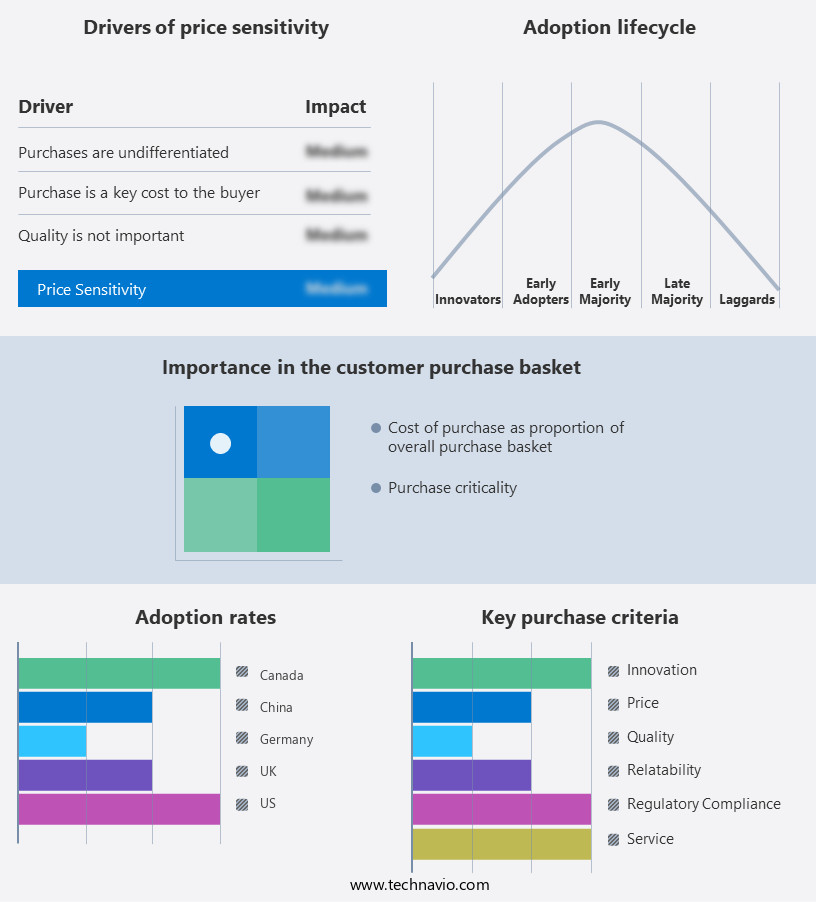
Customer Landscape of K-12 Testing And Assessment Industry
Key Companies & Market Insights
Companies are implementing various strategies, such as strategic alliances, k-12 testing and assessment market forecast, partnerships, mergers and acquisitions, geographical expansion, and product/service launches, to enhance their presence in the industry.
Anthology Inc. - This company specializes in providing advanced K-12 testing and assessment tools. Notable offerings include an AI design assistant, Anthology Collective Review, and Anthology Evaluate. These solutions streamline the testing process and enhance educational evaluation accuracy.
The industry research and growth report includes detailed analyses of the competitive landscape of the market and information about key companies, including:
- Anthology Inc.
- Batia Infotech
- CogniFit Inc.
- Coursera Inc.
- D2L Inc.
- Educational Testing Service
- Edutech
- FairTest
- Houghton Mifflin Harcourt Co.
- Instructure Holdings Inc.
- John Wiley and Sons Inc.
- MeritTrac Services Pvt Ltd.
- NIIT Ltd.
- Oxford University Press
- Pearson Plc
- RAND Corp.
- Scantron Inc.
- Sylvan Learning LLC
- Thoughtful Learning
- Vedantu Innovations Pvt. Ltd.
Qualitative and quantitative analysis of companies has been conducted to help clients understand the wider business environment as well as the strengths and weaknesses of key industry players. Data is qualitatively analyzed to categorize companies as pure play, category-focused, industry-focused, and diversified; it is quantitatively analyzed to categorize companies as dominant, leading, strong, tentative, and weak.
Recent Development and News in K-12 Testing And Assessment Market
- In January 2024, Pearson, a leading education company, announced the launch of its new adaptive assessment platform, "Pearson Adaptive Assessments," designed to personalize testing for K-12 students based on their individual learning progress (Pearson Press Release, 2024).
- In March 2024, Microsoft Education and DreamBox Learning, a leading K-8 digital math education provider, entered into a strategic partnership to integrate DreamBox Learning's adaptive learning technology into Microsoft Teams for Education, enhancing the platform's assessment capabilities (Microsoft News Center, 2024).
- In May 2024, the Bill & Melinda Gates Foundation pledged a USD100 million investment to support the development and implementation of open-source assessment tools for K-12 schools in the United States (Gates Foundation Press Release, 2024).
- In April 2025, ClassMarket, an edtech startup, secured a USD20 million Series C funding round to expand its K-12 assessment platform and enhance its data analytics capabilities, aiming to capture a larger market share (Crunchbase News, 2025).
Research Analyst Overview
- The market encompasses a diverse range of evaluation methods designed to measure student learning and progress. This dynamic market incorporates various approaches, including achievement tests, performance assessment, criterion-referenced testing, and teacher feedback, among others. Scoring rubrics, an essential component of authentic assessment, provide clear and objective criteria for evaluating student work. Educational technology plays a significant role in this market, with data analytics dashboards facilitating the interpretation and application of assessment data. Assessment bias is a critical concern, and efforts are ongoing to minimize its impact through universal design learning and test accommodations. Data interpretation, aided by advanced psychometric properties and item response theory, informs instructional strategies and curriculum alignment.
- Standardized testing, including computer-based testing and summative assessment, continues to be a significant market segment. Diagnostic testing and adaptive testing offer personalized learning experiences, while test security and test validity ensure test reliability. Universal design learning and equitable assessment are essential for creating inclusive learning environments. Cognitive skills, learning outcomes, and student performance data are key metrics in this market. The market is expected to grow at a rate of 8% annually, driven by the ongoing evolution of assessment design and the integration of technology. This growth reflects the market's continuous adaptation to meet the diverse needs of educators, students, and policymakers.
Dive into Technavio’s robust research methodology, blending expert interviews, extensive data synthesis, and validated models for unparalleled K-12 Testing And Assessment Market insights. See full methodology.
|
Market Scope |
|
|
Report Coverage |
Details |
|
Page number |
201 |
|
Base year |
2024 |
|
Historic period |
2019-2023 |
|
Forecast period |
2025-2029 |
|
Growth momentum & CAGR |
Accelerate at a CAGR of 12.2% |
|
Market growth 2025-2029 |
USD 14583.9 million |
|
Market structure |
Fragmented |
|
YoY growth 2024-2025(%) |
10.2 |
|
Key countries |
US, China, Germany, Canada, India, South Korea, France, Japan, Italy, Brazil, UAE, UK, and Spain |
|
Competitive landscape |
Leading Companies, Market Positioning of Companies, Competitive Strategies, and Industry Risks |
What are the Key Data Covered in this K-12 Testing And Assessment Market Research and Growth Report?
- CAGR of the K-12 Testing And Assessment industry during the forecast period
- Detailed information on factors that will drive the growth and forecasting between 2025 and 2029
- Precise estimation of the size of the market and its contribution of the industry in focus to the parent market
- Accurate predictions about upcoming growth and trends and changes in consumer behaviour
- Growth of the market across North America, Europe, APAC, South America, and Middle East and Africa
- Thorough analysis of the market’s competitive landscape and detailed information about companies
- Comprehensive analysis of factors that will challenge the k-12 testing and assessment market growth of industry companies
We can help! Our analysts can customize this k-12 testing and assessment market research report to meet your requirements.
 RIA -
RIA - 
