



SaaS Customer Relationship Management (CRM) Market Size 2025-2029
The SaaS customer relationship management (CRM) market size is forecast to increase by USD 112.63 billion, at a CAGR of 18.1% between 2024 and 2029.
- The market witnesses significant growth, driven primarily by the increasing adoption of cloud-based solutions among Small and Medium-sized Enterprises (SMEs). This trend is fueled by the flexibility, affordability, and ease of implementation that SaaS CRM systems offer. Additionally, the integration of advanced analytics capabilities into these systems is transforming the way businesses manage customer interactions and gain valuable insights. However, the market also faces challenges, with data security concerns emerging as a major obstacle. As businesses continue to store sensitive customer information in the cloud, ensuring robust data protection measures becomes crucial.
- This requires SaaS CRM providers to invest in advanced security features and adhere to stringent data privacy regulations. Companies seeking to capitalize on market opportunities and navigate challenges effectively should focus on offering user-friendly, customizable, and secure solutions, while continuously innovating to meet evolving customer needs and expectations. Retailers are also acquiring other businesses and implementing cloud computing to support their growing customer bases.
What will be the Size of the SaaS Customer Relationship Management (CRM) Market during the forecast period?
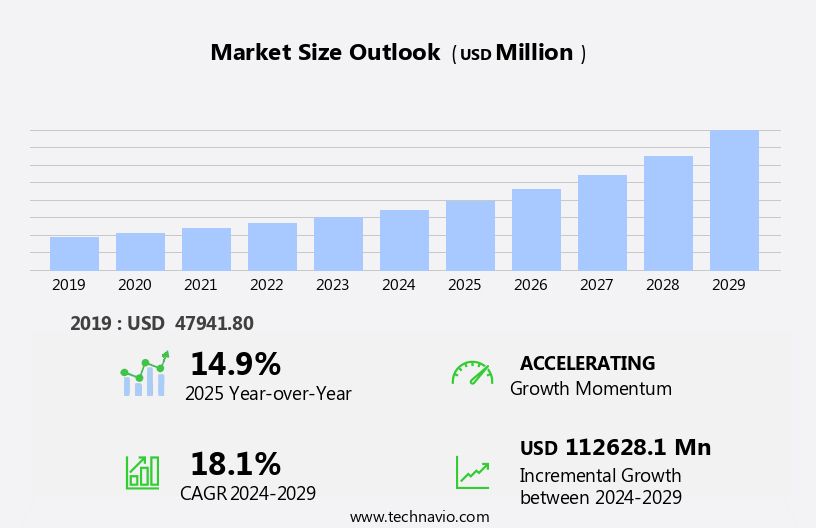
Explore in-depth regional segment analysis with market size data - historical 2019-2023 and forecasts 2025-2029 - in the full report.
Request Free Sample
The Customer Relationship Management (CRM) market continues to evolve, driven by the ongoing demand for more effective and efficient ways to manage customer interactions. Cloud-based CRM solutions have gained significant traction, offering flexibility, scalability, and cost savings. Integration with Enterprise Resource Planning (ERP) systems and subscription services enable organizations to streamline processes and gain a holistic view of their business operations. Contact management is a crucial aspect of CRM, allowing businesses to maintain accurate and up-to-date customer information. Implementation services ensure a smooth transition to CRM systems, while training and support help users maximize their investment. Contact centers and customer service management have become essential components, enabling businesses to provide responsive and personalized service.
Workflow optimization and automation are key trends, with marketing automation, data visualization, and predictive analytics enabling targeted campaigns and improved customer satisfaction (CSAT). Sales force automation, customer retention, and sales pipeline management help organizations identify opportunities and manage the entire customer journey. Social CRM, help desks, and support channels provide additional touchpoints for engaging with customers and addressing their needs. Data migration, API integrations, business intelligence, and reporting & analytics offer valuable insights, while customer segmentation and case management enable tailored approaches to customer engagement. Pricing models and data security are critical considerations, with ongoing concerns around data privacy and protection.
Churn rate remains a key performance indicator, with predictive modeling and opportunity management helping to mitigate losses and retain customers. The SAAS CRM market continues to unfold, with new innovations and applications emerging across various sectors.
How is this SaaS Customer Relationship Management (CRM) Industry segmented?
The saas customer relationship management (CRM) industry research report provides comprehensive data (region-wise segment analysis), with forecasts and estimates in "USD million" for the period 2025-2029, as well as historical data from 2019-2023 for the following segments.
- End-user
- Retail
- BFSI
- Manufacturing
- Telecom and IT
- Others
- Application
- Service and support
- Sales
- Marketing
- E-commerce
- Type
- Operational CRM systems
- Analytical CRM systems
- Collaborative CRM systems
- Geography
- North America
- US
- Canada
- Mexico
- Europe
- France
- Germany
- Italy
- Spain
- UK
- APAC
- China
- Japan
- Rest of World (ROW)
- North America
By End-user Insights
The retail segment is estimated to witness significant growth during the forecast period. In the retail sector, the adoption of Software-as-a-Service (SaaS) Customer Relationship Management (CRM) solutions is on the rise. Retail companies are increasingly utilizing SaaS CRM to enhance customer relationships, boost productivity, and drive revenue in the highly competitive market. The expanding retail and e-commerce landscape, characterized by the opening of new stores and the development of digital sales models, is fueling this trend. SaaS CRM plays a pivotal role in this process, enabling retailers to effectively manage customer interactions, streamline workflows, and gain valuable insights through data analytics.
Additionally, features such as contact management, customer service management, lead scoring, and sales pipeline management facilitate efficient sales processes and customer retention. Integration with Enterprise Resource Planning (ERP) systems, marketing automation, and social CRM further enhance the capabilities of SaaS CRM solutions. Training and support services ensure a smooth implementation and adoption of these advanced tools. Pricing models catering to various business sizes and requirements add to the appeal of SaaS CRM for retailers. Data security and privacy are paramount considerations, with SaaS CRM providers implementing robust measures to safeguard customer information. Overall, the evolving retail landscape and the need for effective customer management are driving the adoption of SaaS CRM solutions.
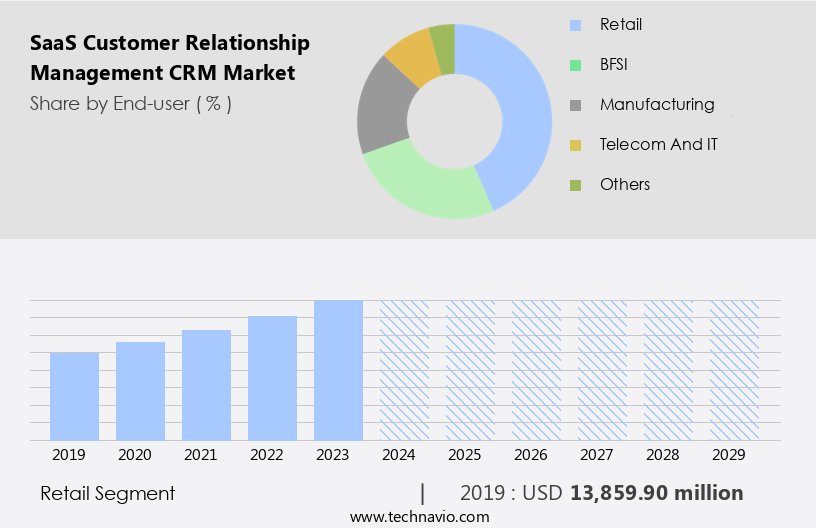
The Retail segment was valued at USD 13.86 billion in 2019 and showed a gradual increase during the forecast period.
The SaaS Customer Relationship Management (CRM) Market is expanding rapidly as businesses prioritize digital transformation and client engagement. Cloud-based CRM software offers flexibility, scalability, and real-time insights, outperforming traditional onpremise CRM systems in cost-efficiency and accessibility. Companies leverage these tools for streamlined account management, empowering teams with centralized data to better serve clients and boost loyalty. Demand for consulting services is also surging, as organizations seek tailored CRM implementations and integration support. Advanced features like predictive modelling are enhancing forecasting, customer behavior analysis, and sales strategy optimization. Furthermore, integration with contact center solutions ensures seamless communication and superior customer experiences.
Regional Analysis
North America is estimated to contribute 53% to the growth of the global market during the forecast period. Technavio's analysts have elaborately explained the regional trends and drivers that shape the market during the forecast period.
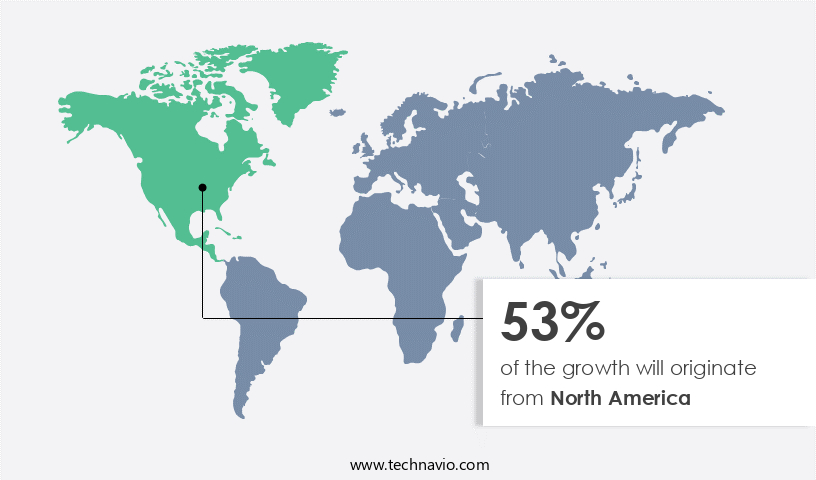
The North American market for SaaS CRM is experiencing significant growth due to the widespread adoption of public cloud services by enterprises. The region's advanced technological infrastructure and the presence of numerous cloud service providers, including Microsoft, Salesforce, and Oracle, are key drivers of market expansion. Enterprises are increasingly investing in cloud solutions to streamline business processes and gain insights from customer data. SaaS CRM offerings provide access to various enterprise applications, such as ERP, CRM, and HRM, via web browsers using one-click functionality. Integration with ERP systems is crucial for businesses to manage their customer interactions effectively and gain a holistic view of their operations.
The SaaS Customer Relationship Management (CRM) Market is evolving rapidly as businesses prioritize digital-first customer engagement strategies. At the forefront are AI-powered CRM platforms that automate tasks, analyze data, and deliver personalized interactions at scale. Integrated selfservice portal empower customers to find solutions independently, enhancing satisfaction while reducing support loads. A streamlined user interface (UI) ensures intuitive navigation, allowing teams to manage customer journeys efficiently. The adoption of business intelligence tools enables real-time insights into customer behavior, sales trends, and campaign performance. Furthermore, effective customer feedback management is becoming a core CRM feature, capturing sentiment and shaping product and service improvements. Together, these innovations are redefining CRM as a smart, user-centric growth engine for modern enterprises.
Market Dynamics
Our researchers analyzed the data with 2024 as the base year, along with the key drivers, trends, and challenges. A holistic analysis of drivers will help companies refine their marketing strategies to gain a competitive advantage.
What are the key market drivers leading to the rise in the adoption of SaaS Customer Relationship Management (CRM) Industry?
- The significant growth in Small and Medium Enterprises (SMEs) adopting Software-as-a-Service (SaaS) Customer Relationship Management (CRM) solutions serves as the primary market driver. SaaS Customer Relationship Management (CRM) solutions have gained significant traction among Small and Medium Enterprises (SMEs) due to the growth of cloud computing. These solutions are increasingly becoming indispensable for businesses in retail, banking, financial services and insurance (BFSI), healthcare, and telecom and IT sectors. SMEs, which previously relied on standalone applications for various business functions, are now transitioning to SaaS CRM to integrate multiple functions into a unified application.
- SaaS CRM solutions enable businesses to automate various processes, from lead generation to sales closure, and provide real-time insights into customer behavior and preferences. The adoption of SaaS CRM is a strategic investment for SMEs looking to streamline their business processes, enhance customer engagement, and gain a competitive edge in their respective industries. SaaS CRM offers numerous benefits to SMEs, including improved planning and resource management, streamlined data management, reduced operational costs, enhanced decision-making capabilities, and increased sales. Key features such as customer onboarding, customer journey mapping, lead scoring, customer success management, workflow automation, knowledge base, reporting & analytics, API integrations, business intelligence, and training & support are essential for SMEs to optimize their marketing and sales operations and align process efficiencies.
What are the market trends shaping the SaaS Customer Relationship Management (CRM) Industry?
- The integration of analytics capabilities into Software-as-a-Service (SaaS) Customer Relationship Management (CRM) systems is currently a significant market trend. This development enables businesses to gain valuable insights from their customer data, enhancing their ability to make informed decisions and improve overall customer engagement. SaaS CRM solutions are transforming the way businesses manage customer relationships by offering advanced functionalities such as marketing automation, data visualization, mobile CRM, predictive analytics, sales force automation, customer retention, campaign management, social CRM, help desk, sales pipeline management, and support channels.
- The integration of e-mail, social media, and other platforms with analytics capabilities allows marketers to capture and analyze customer data in a centralized location, ultimately leading to more effective and personalized engagement efforts. These tools enable enterprises to efficiently process and analyze customer data from various sources, including emails, marketing campaigns, and customer interactions. By providing real-time insights into customer behavior patterns, SaaS CRMs empower businesses to make data-driven decisions and optimize marketing strategies for improved customer engagement and retention.
What challenges does the SaaS Customer Relationship Management (CRM) Industry face during its growth?
- Data security concerns represent a significant challenge to the industry's growth, as ensuring the protection of sensitive information is a mandatory requirement for businesses to maintain their reputation and trust with customers. SaaS CRM solutions have gained significant traction among enterprises, including small and medium-sized businesses (SMEs), due to their cost-effective and flexible nature. These solutions offer numerous advantages, such as easy access to software programs, low upfront costs, and scalability. However, the adoption of SaaS CRM comes with security and privacy concerns. Cyberattacks are becoming increasingly common, posing a significant threat to businesses, leading to revenue losses and production inefficiencies. SMEs, in particular, are vulnerable due to limited IT security infrastructure and smaller internal budgets. Cybercriminals often target SMEs through espionage, sabotage, and data theft, resulting in ransomware attacks.
- To mitigate these risks, SaaS CRM companies are focusing on data security, implementing robust security measures, and offering pricing models that cater to different budgets. Opportunity management, lead management, customer segmentation, case management, sales process optimization, and predictive modeling are key features that businesses look for in SaaS CRM solutions. As businesses continue to prioritize customer relationships, the demand for advanced SaaS CRM solutions that offer data security and effective lead management is expected to grow. Despite the challenges, the benefits of SaaS CRM solutions, such as improved customer engagement and streamlined sales processes, make them an essential tool for businesses seeking to optimize their operations and enhance their customer relationships.
Exclusive Customer Landscape
The saas customer relationship management (CRM) market forecasting report includes the adoption lifecycle of the market, covering from the innovator's stage to the laggard's stage. It focuses on adoption rates in different regions based on penetration. Furthermore, the saas customer relationship management (CRM) market report also includes key purchase criteria and drivers of price sensitivity to help companies evaluate and develop their market growth analysis strategies.
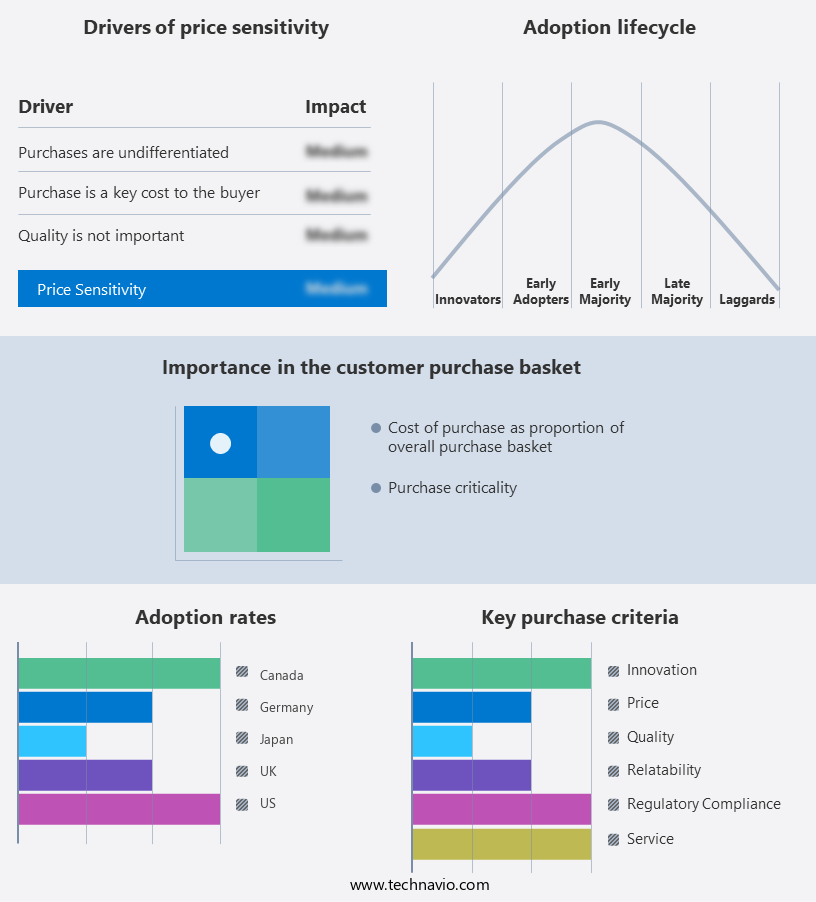
Customer Landscape
Key Companies & Market Insights
Companies are implementing various strategies, such as strategic alliances, saas customer relationship management (CRM) market forecast, partnerships, mergers and acquisitions, geographical expansion, and product/service launches, to enhance their presence in the industry.
Capillary Technologies - The company provides Software-as-a-Service (SaaS) solutions for managing customer relationships, featuring applications like Engage plus and Insights plus.
The industry research and growth report includes detailed analyses of the competitive landscape of the market and information about key companies, including:
- Capillary Technologies
- Cendyn Group LLC
- DataAegis Software Pvt Ltd.
- Doxim Inc.
- HCL Technologies Ltd.
- HubSpot Inc.
- Infor Inc.
- International Business Machines Corp.
- NICE Ltd.
- Oracle Corp.
- Pegasystems Inc.
- Sage Group Plc
- Salesforce Inc.
- SAP SE
- SugarCRM Inc.
- Veeva Systems Inc.
- Verint Systems Inc.
- Vtiger Systems India Pvt. Ltd.
- Zendesk Inc.
- Zoho Corp. Pvt. Ltd.
Qualitative and quantitative analysis of companies has been conducted to help clients understand the wider business environment as well as the strengths and weaknesses of key industry players. Data is qualitatively analyzed to categorize companies as pure play, category-focused, industry-focused, and diversified; it is quantitatively analyzed to categorize companies as dominant, leading, strong, tentative, and weak.
Recent Development and News in SaaS Customer Relationship Management (CRM) Market
- In January 2024, Salesforce, a leading CRM provider, announced the launch of Salesforce CRM Genie, an AI-powered solution designed to automate data entry and lead qualification (Salesforce Press Release, 2024). This innovation aimed to streamline sales processes and improve efficiency for businesses.
- In March 2024, Microsoft and Adobe signed a strategic partnership agreement, integrating Microsoft Teams with Adobe Experience Cloud. This collaboration enabled seamless customer interaction across sales, marketing, and customer service channels (Microsoft News Center, 2024).
- In May 2024, HubSpot raised USD500 million in a Series H funding round, valuing the company at USD 15 billion (HubSpot Press Release, 2024). This significant investment fueled the company's growth and expansion plans in the competitive CRM market.
- In April 2025, Zoho Corporation entered the Japanese market by launching its CRM solution in partnership with NTT Communications. This strategic move aimed to tap into the untapped potential of the Japanese market and expand Zoho's global footprint (Zoho Press Release, 2025).
Research Analyst Overview
The SaaS CRM market is witnessing significant advancements, with AI-powered solutions leading the charge. User interfaces (UI) are becoming more intuitive, enabling seamless interaction with business intelligence and data analytics tools. Compliance certifications ensure data security, while automated workflows and API security streamline operations. Machine learning and deep learning algorithms deliver personalized experiences, enhancing employee engagement. Data encryption, customer community management, and sentiment analysis foster brand reputation management. Interactive dashboards and voice recognition facilitate efficient data governance. Gamified onboarding and omni-channel support improve user experience (UX).
Disaster recovery and offline access ensure business continuity, while mobile accessibility caters to the modern workforce. Sales enablement tools and virtual assistants boost productivity. Social listening provides valuable insights, completing the CRM solution's comprehensive offering.
Dive into Technavio's robust research methodology, blending expert interviews, extensive data synthesis, and validated models for unparalleled SaaS Customer Relationship Management (CRM) Market insights. See full methodology.
|
Market Scope |
|
|
Report Coverage |
Details |
|
Page number |
233 |
|
Base year |
2024 |
|
Historic period |
2019-2023 |
|
Forecast period |
2025-2029 |
|
Growth momentum & CAGR |
Accelerate at a CAGR of 18.1% |
|
Market growth 2025-2029 |
USD 112.63 billion |
|
Market structure |
Fragmented |
|
YoY growth 2024-2025(%) |
14.9 |
|
Key countries |
US, Canada, UK, Germany, Mexico, France, Italy, Spain, Japan, and China |
|
Competitive landscape |
Leading Companies, Market Positioning of Companies, Competitive Strategies, and Industry Risks |
What are the Key Data Covered in this SaaS Customer Relationship Management (CRM) Market Research and Growth Report?
- CAGR of the SaaS Customer Relationship Management (CRM) industry during the forecast period
- Detailed information on factors that will drive the growth and forecasting between 2025 and 2029
- Precise estimation of the size of the market and its contribution of the industry in focus to the parent market
- Accurate predictions about upcoming growth and trends and changes in consumer behaviour
- Growth of the market across North America, Europe, APAC, South America, and Middle East and Africa
- Thorough analysis of the market's competitive landscape and detailed information about companies
- Comprehensive analysis of factors that will challenge the saas customer relationship management (CRM) market growth of industry companies
We can help! Our analysts can customize this saas customer relationship management (CRM) market research report to meet your requirements.
 RIA -
RIA - 
