


Business Intelligence In Healthcare Sector Market Analysis, Size, and Forecast 2025-2029: North America (US and Canada), Europe (France, Germany, and UK), APAC (China, India, Japan, and South Korea), South America (Brazil), and Rest of World (ROW)

Business Intelligence In Healthcare Sector Market Analysis, Size, and Forecast 2025-2029:
North America (US and Canada), Europe (France, Germany, and UK), APAC (China, India, Japan, and South Korea), South America (Brazil), and Rest of World (ROW)

Published: Apr 2025 220 Pages SKU: IRTNTR73573

Market Overview at a Glance

$18.88 B
Market Opportunity
23%
CAGR
19.5
YoY growth 2024-2025(%)

Business Intelligence In Healthcare Sector Market Size 2025-2029

The business intelligence in healthcare sector market size is forecast to increase by USD 18.88 billion at a CAGR of 23% between 2024 and 2029.

  • The Business Intelligence (BI) market in healthcare is experiencing significant growth, driven by the increasing need for improved efficiency and data-driven decision-making in the sector. One of the key trends in this market is the rising adoption of predictive analytics and artificial intelligence (AI) technologies to enhance healthcare operations and patient care. These advanced BI tools enable healthcare providers to analyze large volumes of data, identify patterns, and make accurate predictions, leading to better patient outcomes and cost savings. Another significant factor fueling market growth is the presence of open-source BI companies, offering cost-effective solutions that cater to the unique requirements of the healthcare industry.
  • However, the implementation of BI tools in healthcare faces challenges, including data security and privacy concerns, interoperability issues, and the need for specialized expertise to effectively analyze and interpret complex healthcare data. Despite these obstacles, the market presents numerous opportunities for companies to innovate and provide solutions that address these challenges, ultimately improving patient care and operational efficiency in the healthcare sector.

What will be the Size of the Business Intelligence In Healthcare Sector Market during the forecast period?
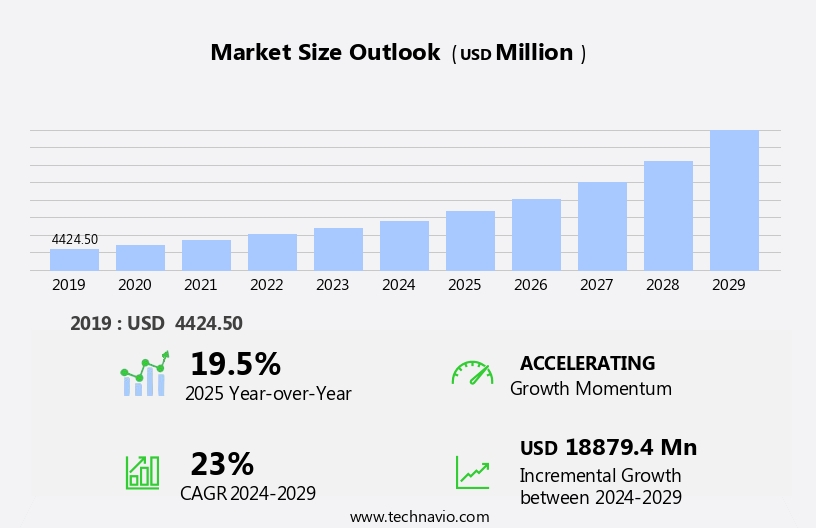
Business Intelligence In Healthcare Sector Market Size

 Request Free Sample

How is this Business Intelligence In Healthcare Sector Industry segmented?

The healthcare business intelligence market research report provides comprehensive data (region-wise segment analysis), with forecasts and estimates in "USD million" for the period 2025-2029, as well as historical data from 2019-2023 for the following segments.

  • Component
    • Software
    • Services
  • Deployment
    • Cloud-based
    • On-premise
  • Application
    • Clinical analytics
    • Financial analytics
    • Operational analytics
    • Population health management
  • Geography
    • North America
      • US
      • Canada
    • Europe
      • France
      • Germany
      • UK
    • APAC
      • China
      • India
      • Japan
      • South Korea
    • South America
      • Brazil
    • Rest of World (ROW)

By Component Insights

The software segment is estimated to witness significant growth during the forecast period.

In the dynamic healthcare business intelligence market solutions have emerged as essential tools for organizations to gain valuable insights from their data. BI platforms facilitate the analysis of data from various sources, generating actionable insights for decision-making. Dashboard and reporting software create customized visualizations of key performance indicators (KPIs) and metrics, ensuring real-time access to critical information. Data analytics software, fueled by advanced algorithms and machine learning models, uncover hidden patterns, trends, and relationships within healthcare data. Clinical data warehousing enables the storage, organization, and management of large volumes of structured and unstructured data from multiple sources, enhancing interoperability and data accessibility.

Interoperability standards ensure seamless data exchange between different systems, promoting clinical decision support and population health management. Patient satisfaction and regulatory compliance are crucial aspects of healthcare operations. Performance reporting and revenue cycle management help organizations monitor and improve their financial performance. Supply chain management and emergency preparedness ensure efficient operations and effective response to crises. Healthcare data analytics plays a pivotal role in disease outbreak prediction, risk stratification, cost containment, and quality improvement initiatives. Wearable technology integration, data visualization dashboards, and mobile healthcare applications further enhance patient-centered care and patient engagement. Precision medicine and hospital operations optimization leverage data analytics to deliver personalized care and streamline processes.

Cloud-based solutions and artificial intelligence in helathcare  enable healthcare organizations to harness the power of data for predictive modeling, disease surveillance, and population health management. Regulatory compliance, physician practice management, and healthcare administration are also areas where BI solutions offer significant benefits. Data mining algorithms and healthcare administration tools support cost containment, disease management, and public health surveillance. Value-based care and patient-centered care models rely on BI solutions to optimize resource allocation, improve patient outcomes, and reduce healthcare disparities.
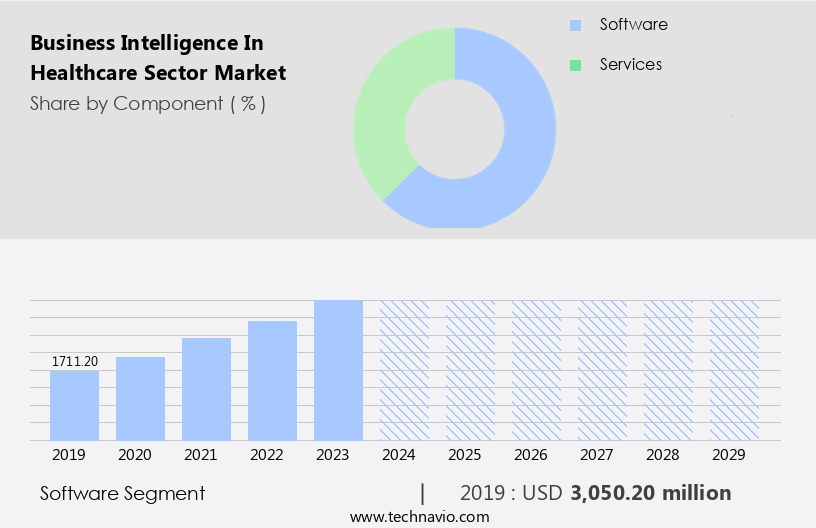
Business Intelligence In Healthcare Sector Market Size

Request Free Sample

The Software segment was valued at USD 3.05 billion in 2019 and showed a gradual increase during the forecast period.

Regional Analysis

North America is estimated to contribute 30% to the growth of the global market during the forecast period.Technavio's analysts have elaborately explained the regional trends and drivers that shape the market during the forecast period.
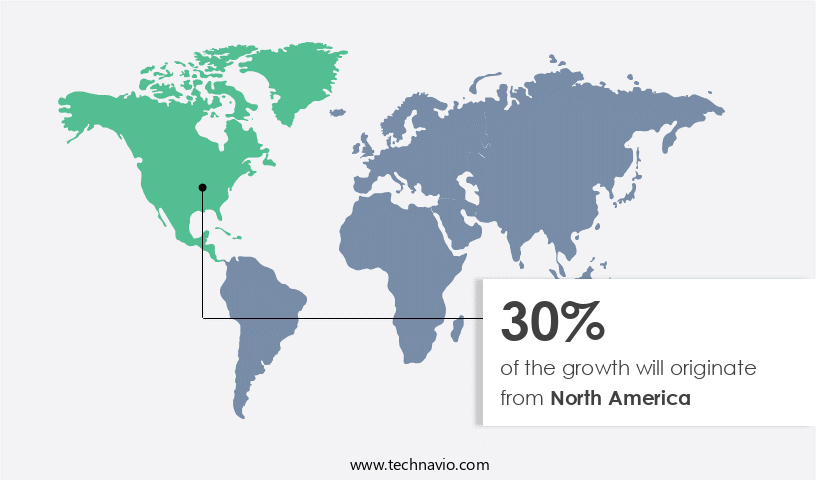
Business Intelligence In Healthcare Sector Market Share by Geography

 Request Free Sample

In the North American healthcare sector, there is a significant increase in spending, with countries like the US and Canada leading the way. To mitigate these costs, healthcare institutions are turning to Business Intelligence (BI) and data analytics. BI plays a crucial role in the healthcare industry by providing valuable insights for cost reduction, revenue enhancement, and enhancing patient safety. The sector generates vast amounts of data from various sources, including pharmaceutical professionals, hospitals, and insurance companies. Electronic Health Records (EHRs) have become increasingly prevalent in the US and Canada, offering a wealth of patient data. By harnessing analytics technologies, data from multiple sources can be consolidated and analyzed.

Interoperability standards ensure seamless data exchange between systems, enabling clinical decision support, population health management, and performance reporting. Machine learning models and artificial intelligence (AI) can be employed for predictive modeling, risk stratification, and disease outbreak prediction. Cloud-based solutions facilitate access to real-time data for hospital operations optimization, revenue cycle management, and supply chain management. Patient engagement platforms and wearable technology integration contribute to patient-centered care, while regulatory compliance ensures data security and privacy. Data visualization dashboards facilitate easy understanding of complex data, and data mining algorithms uncover hidden trends and health disparities. Quality improvement initiatives and value-based care are key areas of focus, with AI and BI playing a pivotal role in improving healthcare delivery and patient outcomes. Public health surveillance and emergency preparedness are other critical applications of BI in the healthcare sector.

Market Dynamics

Our researchers analyzed the data with 2024 as the base year, along with the key drivers, trends, and challenges. A holistic analysis of drivers will help companies refine their marketing strategies to gain a competitive advantage.In the dynamic healthcare business intelligence market continues to play a pivotal role in driving innovation and improving patient care. The application of advanced technologies, such as clinical data warehousing and interoperability standards, facilitates seamless data exchange and analysis. This enables providers to make informed decisions, enhance clinical decision support, and optimize hospital operations. Moreover, the integration of machine learning models and predictive modeling in healthcare analytics leads to disease outbreak prediction and risk stratification, ensuring emergency preparedness. Additionally, the adoption of cloud-based solutions and data visualization dashboards streamlines revenue cycle management and population health management. Health disparities are addressed through data mining algorithms and healthcare administration's focus on access to healthcare and patient-centered care.

Precision medicine and value-based care initiatives further enhance patient engagement and satisfaction, while regulatory compliance and physician practice management ensure quality improvement. Wearable technology integration and mobile healthcare applications expand access to healthcare services and contribute to cost containment. The ongoing evolution of these market dynamics underscores the importance of continuous adaptation and innovation in the healthcare sector.

What are the key market drivers leading to the rise in the adoption of Business Intelligence In Healthcare Sector Industry?

  • The essential factor driving market growth is the enhanced efficiency of Business Intelligence (BI) tools. The healthcare sector is facing competition because of the growing number of hospitals and the pressure of competitive pricing. This has motivated enterprises to increase the speed of their processes to reduce operation cycle time. 
  • BI tools provide real-time information that can help end-users to avoid process delays and centralize their management to improve market response and decision-making. In addition, end-users need to transform data into actionable intelligence through constant improvements in customer-facing strategies to achieve a competitive advantage. BI tools help hospitals and other end-users to transform raw sales consistently and efficiently, service, marketing, and patient data into useful information. Analytics saw increased use at other functional levels, especially in operations and finance. Organizations made significant investments in streamlining claims processing and ensuring that hospitals had sufficient resources to properly care for the sudden increase in patient load. Within the healthcare business intelligence market has a wide range of applications, such as the analysis of social media conversations, fraud detection, management information systems, and disease diagnosis. 
  • The use of business intelligence in the healthcare sector helps the stakeholders track health records regarding patients treatment and medications in real time and storing the information. Such actions ensure cost efficiency and the execution of successful treatment regimes. The need to guarantee drug safety and improve health management are the two crucial factors contributing to the growth of the market segment. These solutions also help the industry incumbents to perform test programs using various mathematical techniques such as cluster analysis and predictive analysis to assess the possible adverse effects of drugs. Thus, the improved efficiency offered by business intelligence in healthcare sector is expected to increase the market growth during the forecast period.

What are the market trends shaping the Business Intelligence In Healthcare Sector Industry?

  • The expansion of cloud-based BI platforms is an emerging market trend. The expansion of cloud-based BI platforms is a major trend shaping the healthcare sector. Healthcare organizations are increasingly adopting cloud BI solutions to enhance flexibility, scalability, and cost-effectiveness. Traditional on-premises BI systems often require significant capital investment in hardware, software, and skilled IT personnel. In contrast, cloud-based platforms offer a subscription-based model, reducing upfront costs and making advanced BI tools accessible to healthcare providers of all sizes.
  • Cloud BI enables real-time data access, integration, and analysis across multiple healthcare systems, allowing providers to make faster, data-driven decisions. This is especially critical in clinical environments where timely insights can directly impact patient outcomes. Moreover, the ease of integration with electronic health records (EHRs), claims data, and other healthcare databases through the cloud promotes a more holistic view of patient and operational data.
  • Data security and compliance remain important considerations, but advancements in cloud security protocols, encryption, and adherence to regulations such as HIPAA have made cloud BI platforms increasingly reliable for sensitive healthcare data. Leading companies are also offering industry-specific solutions that cater to regulatory needs and interoperability standards.
  • The COVID-19 pandemic accelerated the shift toward cloud-based analytics, as remote work and telehealth services became more prevalent. Going forward, the demand for agility, real-time collaboration, and remote accessibility is expected to continue fueling the growth of cloud-based BI in healthcare. As healthcare systems increasingly prioritize digital transformation, cloud BI platforms are positioned to become integral components of their operational and clinical strategies.

What challenges does the Business Intelligence In Healthcare Sector Industry face during its growth?

  • The emergence of open-source Business Intelligence (BI) companies poses a significant challenge to the industry's growth trajectory, as these entities offer cost-effective alternatives to proprietary BI solutions, potentially disrupting the market dynamics and revenue streams of established players. 
  • Open-source BI companies provide software solutions that are freely available and can be modified by users according to their needs. Although this gives users greater flexibility and cost-effectiveness, it also poses challenges for commercial BI companies, as they must compete with free software. Companies like Pentaho, BIRT, SpagoBI, KNIME, and JasperReport are providing BI solutions for free. One challenge that arises from the presence of open-source BI companies is that it may be difficult for commercial companies to monetize their products. This is because customers may opt to use free, open-source solutions instead of paying for commercial BI products. As a result, commercial BI companies may have to offer additional features or services to attract customers. Another challenge is that open-source BI companies may have a strong community of developers and users who are constantly improving and updating the software. This can make it difficult for commercial companies to keep up with the latest trends and technologies and may result in them falling behind in terms of product development and innovation. Additionally, open-source BI companies may have a larger user base than commercial companies, which can make it difficult for commercial companies to compete on price. Customers may be more inclined to choose open-source solutions that are free, even if they are not as comprehensive or feature-rich as commercial solutions. Overall, the presence of open-source BI companies in the healthcare sector presents challenges for commercial BI companies, which is expected to affect the growth of the market in the forecast period.

Exclusive Customer Landscape

The business intelligence in healthcare sector market forecasting report includes the adoption lifecycle of the market, covering from the innovator's stage to the laggard's stage. It focuses on adoption rates in different regions based on penetration. Furthermore, the business intelligence in healthcare sector market report also includes key purchase criteria and drivers of price sensitivity to help companies evaluate and develop their market growth analysis strategies.
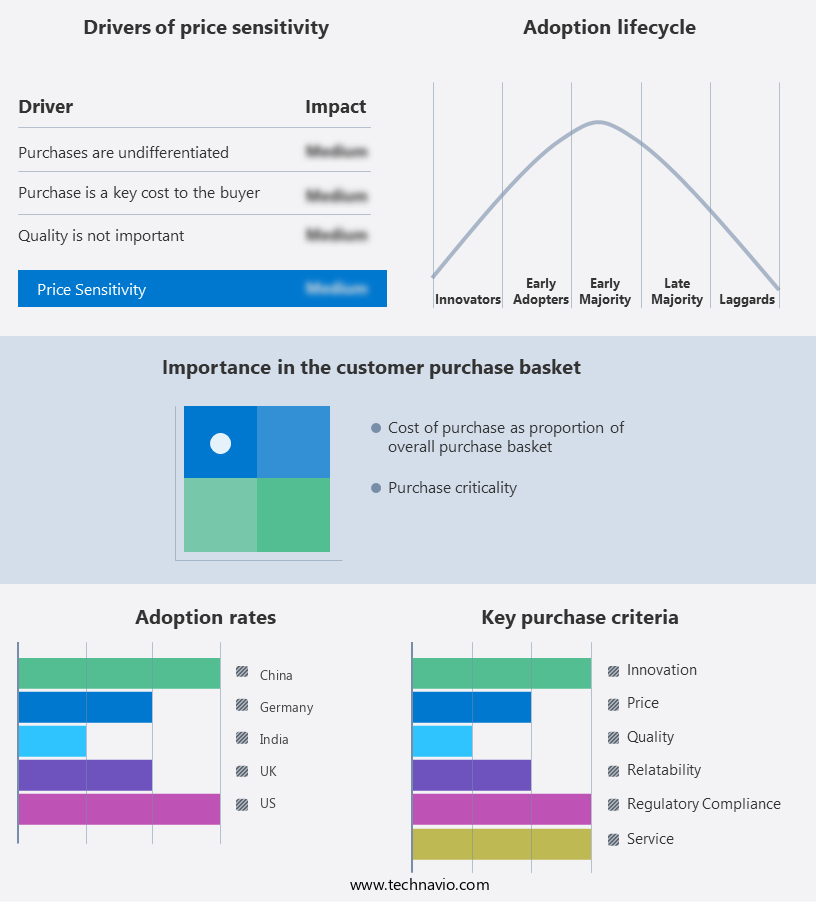
Business Intelligence In Healthcare Sector Market Share by Geography

 Customer Landscape

Key Companies & Market Insights

Companies are implementing various strategies, such as strategic alliances, business intelligence in healthcare sector market forecast, partnerships, mergers and acquisitions, geographical expansion, and product/service launches, to enhance their presence in the industry.

Accenture PLC - The company specializes in providing business intelligence solutions for the healthcare sector, specifically Accenture Health Analytics. These offerings aim to enhance patient care, streamline operations, and bolster informed decision-making through data-driven insights. By leveraging advanced analytics and industry expertise, our solutions enable healthcare organizations to effectively address complex challenges and seize new opportunities.

The industry research and growth report includes detailed analyses of the competitive landscape of the market and information about key companies, including:

  • Accenture PLC
  • Board International SA
  • Domo Inc.
  • Google LLC
  • Hexaware Technologies Ltd.
  • Idera Inc.
  • Infor Inc.
  • International Business Machines Corp.
  • Microsoft Corp.
  • MicroStrategy Inc.
  • Open Text Corp.
  • Oracle Corp.
  • Perficient Inc.
  • QlikTech International AB
  • SAP SE
  • SAS Institute Inc.
  • Sisense Ltd.
  • Tableau Software LLC
  • Tata Consultancy Services Ltd.
  • TIBCO Software Inc.

Qualitative and quantitative analysis of companies has been conducted to help clients understand the wider business environment as well as the strengths and weaknesses of key industry players. Data is qualitatively analyzed to categorize companies as pure play, category-focused, industry-focused, and diversified; it is quantitatively analyzed to categorize companies as dominant, leading, strong, tentative, and weak.

Recent Development and News in Business Intelligence In Healthcare Sector Market

  • In February 2024, IBM Watson Health announced the launch of its new AI-powered clinical trial matching platform, IBM Watson for Clinical Trial Discovery. This innovative solution aims to help patients find relevant clinical trials based on their unique health profile, thereby accelerating the process of identifying and enrolling in appropriate studies (IBM Press Release, 2024).
  • In July 2025, Amazon Web Services (AWS) and Microsoft Azure entered into a strategic partnership to offer joint solutions for healthcare organizations. This collaboration allows healthcare providers to leverage the combined capabilities of AWS and Azure for advanced analytics, machine learning, and data security (AWS Press Release, 2025).
  • In October 2024, Cerner Corporation, a leading healthcare technology company, completed its acquisition of AI-powered clinical decision support platform, Commissio. This acquisition is expected to strengthen Cerner's offerings in the area of predictive analytics and population health management (Cerner Press Release, 2024).

Research Analyst Overview

In the dynamic healthcare sector, business intelligence plays a pivotal role in driving innovation and improving patient outcomes. The market for care coordination solutions is expanding, enabling seamless communication between healthcare providers and enhancing patient journey analysis. Clinical trial optimization and drug discovery are benefiting from advanced digital health technologies, including clinical trial recruitment platforms and big data management systems. Personalized treatment plans are being developed through disease modeling and genetic testing, while connected health technologies facilitate real-time analytics and virtual care. Health economics and healthcare policy analysis are essential for provider performance benchmarking and predictive analytics, ensuring cost-effective and efficient care.

The Business Intelligence in Healthcare Sector Market is transforming through next-gen innovations like AI-driven predictive analytics and cloud-based data warehousing, enabling real-time insights and scalable data management. Real-time patient monitoring enhances care delivery, while automated claims processing improves administrative efficiency. Personalized medicine analytics supports targeted treatments, and blockchain for data security ensures protected health information. Emerging trends include IoT-enabled BI integration and advanced data visualization tools that provide actionable insights. With increasing demand for virtual care, telemedicine BI integration is expanding, while zero-trust security models are becoming essential for safeguarding healthcare data across distributed BI ecosystems.

The Business Intelligence in Healthcare Sector Market is evolving rapidly with the integration of advanced analytics tools. Healthcare BI software for patient care optimization is streamlining personalized treatment plans, while cloud-based analytics for revenue cycle management enhances financial workflows. Predictive analytics for population health management enables proactive interventions, and AI-driven BI tools for clinical decision support improve diagnostic accuracy. Data visualization platforms for healthcare payers and real-time analytics for hospital operations optimize resource allocation. Additionally, business intelligence for claims management efficiency and secure BI solutions for healthcare data privacy support compliance. Platforms now also enhance telemedicine integration and financial performance management for healthcare providers.

Big data management and data analytics platforms enable fraud detection and data quality assessment, ensuring data governance and integrity. Medical imaging analysis and prescriptive analytics further enhance clinical decision-making and drug development processes. Biomedical sensors and remote patient monitoring provide valuable data for real-time intervention and disease management. Overall, the healthcare sector's business intelligence landscape is characterized by continuous innovation, data-driven insights, and a focus on improving patient care and outcomes.

Dive into Technavio's robust research methodology, blending expert interviews, extensive data synthesis, and validated models for unparalleled Business Intelligence In Healthcare Sector Market insights. See full methodology.

Market Scope

Report Coverage

Details

Page number

220

Base year

2024

Historic period

2019-2023

Forecast period

2025-2029

Growth momentum & CAGR

Accelerate at a CAGR of 23%

Market growth 2025-2029

USD 18879.4 million

Market structure

Fragmented

YoY growth 2024-2025(%)

19.5

Key countries

US, Canada, Germany, China, UK, India, Japan, Brazil, France, and South Korea

Competitive landscape

Leading Companies, Market Positioning of Companies, Competitive Strategies, and Industry Risks

Request Free Sample

What are the Key Data Covered in this Business Intelligence In Healthcare Sector Market Research and Growth Report?

  • CAGR of the Business Intelligence In Healthcare Sector industry during the forecast period
  • Detailed information on factors that will drive the growth and forecasting between 2025 and 2029
  • Precise estimation of the size of the market and its contribution of the industry in focus to the parent market
  • Accurate predictions about upcoming growth and trends and changes in consumer behaviour
  • Growth of the market across North America, Europe, APAC, South America, and Middle East and Africa
  • Thorough analysis of the market's competitive landscape and detailed information about companies
  • Comprehensive analysis of factors that will challenge the business intelligence in healthcare sector market growth of industry companies

We can help! Our analysts can customize this business intelligence in healthcare sector market research report to meet your requirements.

Get in touch

1 Executive Summary

  • 1.1 Market overview
    • Executive Summary - Chart on Market Overview
    • Executive Summary - Data Table on Market Overview
    • Executive Summary - Chart on Global Market Characteristics
    • Executive Summary - Chart on Market by Geography
    • Executive Summary - Chart on Market Segmentation by Component
    • Executive Summary - Chart on Market Segmentation by Deployment
    • Executive Summary - Chart on Market Segmentation by Application
    • Executive Summary - Chart on Incremental Growth
    • Executive Summary - Data Table on Incremental Growth
    • Executive Summary - Chart on Company Market Positioning

2 Technavio Analysis

  • 2.1 Analysis of price sensitivity, lifecycle, customer purchase basket, adoption rates, and purchase criteria
    • Analysis of price sensitivity, lifecycle, customer purchase basket, adoption rates, and purchase criteria
  • 2.2 Criticality of inputs and Factors of differentiation
    • Overview on criticality of inputs and factors of differentiation
  • 2.3 Factors of disruption
    • Overview on factors of disruption
  • 2.4 Impact of drivers and challenges
    • Impact of drivers and challenges in 2024 and 2029

3 Market Landscape

  • 3.1 Market ecosystem
    • Parent Market
    • Data Table on - Parent Market
  • 3.2 Market characteristics
    • Market characteristics analysis
  • 3.3 Value chain analysis
    • Value chain analysis

4 Market Sizing

  • 4.1 Market definition
    • Offerings of companies included in the market definition
  • 4.2 Market segment analysis
    • Market segments
  • 4.3 Market size 2024
    • 4.4 Market outlook: Forecast for 2024-2029
      • Chart on Global - Market size and forecast 2024-2029 ($ million)
      • Data Table on Global - Market size and forecast 2024-2029 ($ million)
      • Chart on Global Market: Year-over-year growth 2024-2029 (%)
      • Data Table on Global Market: Year-over-year growth 2024-2029 (%)

    5 Historic Market Size

    • 5.1 Global Business Intelligence Market In Healthcare Sector 2019 - 2023
      • Historic Market Size - Data Table on Global Business Intelligence Market In Healthcare Sector 2019 - 2023 ($ million)
    • 5.2 Component segment analysis 2019 - 2023
      • Historic Market Size - Component Segment 2019 - 2023 ($ million)
    • 5.3 Deployment segment analysis 2019 - 2023
      • Historic Market Size - Deployment Segment 2019 - 2023 ($ million)
    • 5.4 Application segment analysis 2019 - 2023
      • Historic Market Size - Application Segment 2019 - 2023 ($ million)
    • 5.5 Geography segment analysis 2019 - 2023
      • Historic Market Size - Geography Segment 2019 - 2023 ($ million)
    • 5.6 Country segment analysis 2019 - 2023
      • Historic Market Size - Country Segment 2019 - 2023 ($ million)

    6 Qualitative Analysis

    • 6.1 Impact of AI on global business intelligence market in healthcare sector

      7 Five Forces Analysis

      • 7.1 Five forces summary
        • Five forces analysis - Comparison between 2024 and 2029
      • 7.2 Bargaining power of buyers
        • Bargaining power of buyers - Impact of key factors 2024 and 2029
      • 7.3 Bargaining power of suppliers
        • Bargaining power of suppliers - Impact of key factors in 2024 and 2029
      • 7.4 Threat of new entrants
        • Threat of new entrants - Impact of key factors in 2024 and 2029
      • 7.5 Threat of substitutes
        • Threat of substitutes - Impact of key factors in 2024 and 2029
      • 7.6 Threat of rivalry
        • Threat of rivalry - Impact of key factors in 2024 and 2029
      • 7.7 Market condition
        • Chart on Market condition - Five forces 2024 and 2029

      8 Market Segmentation by Component

      • 8.1 Market segments
        • Chart on Component - Market share 2024-2029 (%)
        • Data Table on Component - Market share 2024-2029 (%)
      • 8.2 Comparison by Component
        • Chart on Comparison by Component
        • Data Table on Comparison by Component
      • 8.3 Software - Market size and forecast 2024-2029
        • Chart on Software - Market size and forecast 2024-2029 ($ million)
        • Data Table on Software - Market size and forecast 2024-2029 ($ million)
        • Chart on Software - Year-over-year growth 2024-2029 (%)
        • Data Table on Software - Year-over-year growth 2024-2029 (%)
      • 8.4 Services - Market size and forecast 2024-2029
        • Chart on Services - Market size and forecast 2024-2029 ($ million)
        • Data Table on Services - Market size and forecast 2024-2029 ($ million)
        • Chart on Services - Year-over-year growth 2024-2029 (%)
        • Data Table on Services - Year-over-year growth 2024-2029 (%)
      • 8.5 Market opportunity by Component
        • Market opportunity by Component ($ million)
        • Data Table on Market opportunity by Component ($ million)

      9 Market Segmentation by Deployment

      • 9.1 Market segments
        • Chart on Deployment - Market share 2024-2029 (%)
        • Data Table on Deployment - Market share 2024-2029 (%)
      • 9.2 Comparison by Deployment
        • Chart on Comparison by Deployment
        • Data Table on Comparison by Deployment
      • 9.3 Cloud-based - Market size and forecast 2024-2029
        • Chart on Cloud-based - Market size and forecast 2024-2029 ($ million)
        • Data Table on Cloud-based - Market size and forecast 2024-2029 ($ million)
        • Chart on Cloud-based - Year-over-year growth 2024-2029 (%)
        • Data Table on Cloud-based - Year-over-year growth 2024-2029 (%)
      • 9.4 On-premise - Market size and forecast 2024-2029
        • Chart on On-premise - Market size and forecast 2024-2029 ($ million)
        • Data Table on On-premise - Market size and forecast 2024-2029 ($ million)
        • Chart on On-premise - Year-over-year growth 2024-2029 (%)
        • Data Table on On-premise - Year-over-year growth 2024-2029 (%)
      • 9.5 Market opportunity by Deployment
        • Market opportunity by Deployment ($ million)
        • Data Table on Market opportunity by Deployment ($ million)

      10 Market Segmentation by Application

      • 10.1 Market segments
        • Chart on Application - Market share 2024-2029 (%)
        • Data Table on Application - Market share 2024-2029 (%)
      • 10.2 Comparison by Application
        • Chart on Comparison by Application
        • Data Table on Comparison by Application
      • 10.3 Clinical analytics - Market size and forecast 2024-2029
        • Chart on Clinical analytics - Market size and forecast 2024-2029 ($ million)
        • Data Table on Clinical analytics - Market size and forecast 2024-2029 ($ million)
        • Chart on Clinical analytics - Year-over-year growth 2024-2029 (%)
        • Data Table on Clinical analytics - Year-over-year growth 2024-2029 (%)
      • 10.4 Financial analytics - Market size and forecast 2024-2029
        • Chart on Financial analytics - Market size and forecast 2024-2029 ($ million)
        • Data Table on Financial analytics - Market size and forecast 2024-2029 ($ million)
        • Chart on Financial analytics - Year-over-year growth 2024-2029 (%)
        • Data Table on Financial analytics - Year-over-year growth 2024-2029 (%)
      • 10.5 Operational analytics - Market size and forecast 2024-2029
        • Chart on Operational analytics - Market size and forecast 2024-2029 ($ million)
        • Data Table on Operational analytics - Market size and forecast 2024-2029 ($ million)
        • Chart on Operational analytics - Year-over-year growth 2024-2029 (%)
        • Data Table on Operational analytics - Year-over-year growth 2024-2029 (%)
      • 10.6 Population health management - Market size and forecast 2024-2029
        • Chart on Population health management - Market size and forecast 2024-2029 ($ million)
        • Data Table on Population health management - Market size and forecast 2024-2029 ($ million)
        • Chart on Population health management - Year-over-year growth 2024-2029 (%)
        • Data Table on Population health management - Year-over-year growth 2024-2029 (%)
      • 10.7 Market opportunity by Application
        • Market opportunity by Application ($ million)
        • Data Table on Market opportunity by Application ($ million)

      11 Customer Landscape

      • 11.1 Customer landscape overview
        • Analysis of price sensitivity, lifecycle, customer purchase basket, adoption rates, and purchase criteria

      12 Geographic Landscape

      • 12.1 Geographic segmentation
        • Chart on Market share by geography 2024-2029 (%)
        • Data Table on Market share by geography 2024-2029 (%)
      • 12.2 Geographic comparison
        • Chart on Geographic comparison
        • Data Table on Geographic comparison
      • 12.3 North America - Market size and forecast 2024-2029
        • Chart on North America - Market size and forecast 2024-2029 ($ million)
        • Data Table on North America - Market size and forecast 2024-2029 ($ million)
        • Chart on North America - Year-over-year growth 2024-2029 (%)
        • Data Table on North America - Year-over-year growth 2024-2029 (%)
      • 12.4 Europe - Market size and forecast 2024-2029
        • Chart on Europe - Market size and forecast 2024-2029 ($ million)
        • Data Table on Europe - Market size and forecast 2024-2029 ($ million)
        • Chart on Europe - Year-over-year growth 2024-2029 (%)
        • Data Table on Europe - Year-over-year growth 2024-2029 (%)
      • 12.5 APAC - Market size and forecast 2024-2029
        • Chart on APAC - Market size and forecast 2024-2029 ($ million)
        • Data Table on APAC - Market size and forecast 2024-2029 ($ million)
        • Chart on APAC - Year-over-year growth 2024-2029 (%)
        • Data Table on APAC - Year-over-year growth 2024-2029 (%)
      • 12.6 South America - Market size and forecast 2024-2029
        • Chart on South America - Market size and forecast 2024-2029 ($ million)
        • Data Table on South America - Market size and forecast 2024-2029 ($ million)
        • Chart on South America - Year-over-year growth 2024-2029 (%)
        • Data Table on South America - Year-over-year growth 2024-2029 (%)
      • 12.7 Middle East and Africa - Market size and forecast 2024-2029
        • Chart on Middle East and Africa - Market size and forecast 2024-2029 ($ million)
        • Data Table on Middle East and Africa - Market size and forecast 2024-2029 ($ million)
        • Chart on Middle East and Africa - Year-over-year growth 2024-2029 (%)
        • Data Table on Middle East and Africa - Year-over-year growth 2024-2029 (%)
      • 12.8 US - Market size and forecast 2024-2029
        • Chart on US - Market size and forecast 2024-2029 ($ million)
        • Data Table on US - Market size and forecast 2024-2029 ($ million)
        • Chart on US - Year-over-year growth 2024-2029 (%)
        • Data Table on US - Year-over-year growth 2024-2029 (%)
      • 12.9 China - Market size and forecast 2024-2029
        • Chart on China - Market size and forecast 2024-2029 ($ million)
        • Data Table on China - Market size and forecast 2024-2029 ($ million)
        • Chart on China - Year-over-year growth 2024-2029 (%)
        • Data Table on China - Year-over-year growth 2024-2029 (%)
      • 12.10 Germany - Market size and forecast 2024-2029
        • Chart on Germany - Market size and forecast 2024-2029 ($ million)
        • Data Table on Germany - Market size and forecast 2024-2029 ($ million)
        • Chart on Germany - Year-over-year growth 2024-2029 (%)
        • Data Table on Germany - Year-over-year growth 2024-2029 (%)
      • 12.11 Canada - Market size and forecast 2024-2029
        • Chart on Canada - Market size and forecast 2024-2029 ($ million)
        • Data Table on Canada - Market size and forecast 2024-2029 ($ million)
        • Chart on Canada - Year-over-year growth 2024-2029 (%)
        • Data Table on Canada - Year-over-year growth 2024-2029 (%)
      • 12.12 UK - Market size and forecast 2024-2029
        • Chart on UK - Market size and forecast 2024-2029 ($ million)
        • Data Table on UK - Market size and forecast 2024-2029 ($ million)
        • Chart on UK - Year-over-year growth 2024-2029 (%)
        • Data Table on UK - Year-over-year growth 2024-2029 (%)
      • 12.13 India - Market size and forecast 2024-2029
        • Chart on India - Market size and forecast 2024-2029 ($ million)
        • Data Table on India - Market size and forecast 2024-2029 ($ million)
        • Chart on India - Year-over-year growth 2024-2029 (%)
        • Data Table on India - Year-over-year growth 2024-2029 (%)
      • 12.14 Japan - Market size and forecast 2024-2029
        • Chart on Japan - Market size and forecast 2024-2029 ($ million)
        • Data Table on Japan - Market size and forecast 2024-2029 ($ million)
        • Chart on Japan - Year-over-year growth 2024-2029 (%)
        • Data Table on Japan - Year-over-year growth 2024-2029 (%)
      • 12.15 Brazil - Market size and forecast 2024-2029
        • Chart on Brazil - Market size and forecast 2024-2029 ($ million)
        • Data Table on Brazil - Market size and forecast 2024-2029 ($ million)
        • Chart on Brazil - Year-over-year growth 2024-2029 (%)
        • Data Table on Brazil - Year-over-year growth 2024-2029 (%)
      • 12.16 France - Market size and forecast 2024-2029
        • Chart on France - Market size and forecast 2024-2029 ($ million)
        • Data Table on France - Market size and forecast 2024-2029 ($ million)
        • Chart on France - Year-over-year growth 2024-2029 (%)
        • Data Table on France - Year-over-year growth 2024-2029 (%)
      • 12.17 South Korea - Market size and forecast 2024-2029
        • Chart on South Korea - Market size and forecast 2024-2029 ($ million)
        • Data Table on South Korea - Market size and forecast 2024-2029 ($ million)
        • Chart on South Korea - Year-over-year growth 2024-2029 (%)
        • Data Table on South Korea - Year-over-year growth 2024-2029 (%)
      • 12.18 Market opportunity by geography
        • Market opportunity by geography ($ million)
        • Data Tables on Market opportunity by geography ($ million)

      13 Drivers, Challenges, and Opportunity/Restraints

      • 13.1 Market drivers
        • 13.2 Market challenges
          • 13.3 Impact of drivers and challenges
            • Impact of drivers and challenges in 2024 and 2029
          • 13.4 Market opportunities/restraints

            14 Competitive Landscape

            • 14.1 Overview
              • 14.2 Competitive Landscape
                • Overview on criticality of inputs and factors of differentiation
              • 14.3 Landscape disruption
                • Overview on factors of disruption
              • 14.4 Industry risks
                • Impact of key risks on business

              15 Competitive Analysis

              • 15.1 Companies profiled
                • Companies covered
              • 15.2 Company ranking index
                • Company ranking index
              • 15.3 Market positioning of companies
                • Matrix on companies position and classification
              • 15.4 Accenture PLC
                • Accenture PLC - Overview
                • Accenture PLC - Business segments
                • Accenture PLC - Key news
                • Accenture PLC - Key offerings
                • Accenture PLC - Segment focus
                • SWOT
              • 15.5 Board International SA
                • Board International SA - Overview
                • Board International SA - Product / Service
                • Board International SA - Key offerings
                • SWOT
              • 15.6 Idera Inc.
                • Idera Inc. - Overview
                • Idera Inc. - Product / Service
                • Idera Inc. - Key offerings
                • SWOT
              • 15.7 Infor Inc.
                • Infor Inc. - Overview
                • Infor Inc. - Product / Service
                • Infor Inc. - Key news
                • Infor Inc. - Key offerings
                • SWOT
              • 15.8 International Business Machines Corp.
                • International Business Machines Corp. - Overview
                • International Business Machines Corp. - Business segments
                • International Business Machines Corp. - Key news
                • International Business Machines Corp. - Key offerings
                • International Business Machines Corp. - Segment focus
                • SWOT
              • 15.9 Microsoft Corp.
                • Microsoft Corp. - Overview
                • Microsoft Corp. - Business segments
                • Microsoft Corp. - Key news
                • Microsoft Corp. - Key offerings
                • Microsoft Corp. - Segment focus
                • SWOT
              • 15.10 MicroStrategy Inc.
                • MicroStrategy Inc. - Overview
                • MicroStrategy Inc. - Product / Service
                • MicroStrategy Inc. - Key offerings
                • SWOT
              • 15.11 Open Text Corp.
                • Open Text Corp. - Overview
                • Open Text Corp. - Business segments
                • Open Text Corp. - Key news
                • Open Text Corp. - Key offerings
                • Open Text Corp. - Segment focus
                • SWOT
              • 15.12 Oracle Corp.
                • Oracle Corp. - Overview
                • Oracle Corp. - Business segments
                • Oracle Corp. - Key news
                • Oracle Corp. - Key offerings
                • Oracle Corp. - Segment focus
                • SWOT
              • 15.13 QlikTech International AB
                • QlikTech International AB - Overview
                • QlikTech International AB - Product / Service
                • QlikTech International AB - Key offerings
                • SWOT
              • 15.14 SAP SE
                • SAP SE - Overview
                • SAP SE - Business segments
                • SAP SE - Key news
                • SAP SE - Key offerings
                • SAP SE - Segment focus
                • SWOT
              • 15.15 SAS Institute Inc.
                • SAS Institute Inc. - Overview
                • SAS Institute Inc. - Product / Service
                • SAS Institute Inc. - Key news
                • SAS Institute Inc. - Key offerings
                • SWOT
              • 15.16 Sisense Ltd.
                • Sisense Ltd. - Overview
                • Sisense Ltd. - Product / Service
                • Sisense Ltd. - Key news
                • Sisense Ltd. - Key offerings
                • SWOT
              • 15.17 Tableau Software LLC
                • Tableau Software LLC - Overview
                • Tableau Software LLC - Product / Service
                • Tableau Software LLC - Key offerings
                • SWOT
              • 15.18 TIBCO Software Inc.
                • TIBCO Software Inc. - Overview
                • TIBCO Software Inc. - Product / Service
                • TIBCO Software Inc. - Key offerings
                • SWOT

              16 Appendix

              • 16.1 Scope of the report
                • 16.2 Inclusions and exclusions checklist
                  • Inclusions checklist
                  • Exclusions checklist
                • 16.3 Currency conversion rates for US$
                  • Currency conversion rates for US$
                • 16.4 Research methodology
                  • Research methodology
                • 16.5 Data procurement
                  • Information sources
                • 16.6 Data validation
                  • Data validation
                • 16.7 Validation techniques employed for market sizing
                  • Validation techniques employed for market sizing
                • 16.8 Data synthesis
                  • Data synthesis
                • 16.9 360 degree market analysis
                  • 360 degree market analysis
                • 16.10 List of abbreviations
                  • List of abbreviations

                Research Methodology

                Technavio presents a detailed picture of the market by way of study, synthesis, and summation of data from multiple sources. The analysts have presented the various facets of the market with a particular focus on identifying the key industry influencers. The data thus presented is comprehensive, reliable, and the result of extensive research, both primary and secondary.

                INFORMATION SOURCES

                Primary sources

                • Manufacturers and suppliers
                • Channel partners
                • Industry experts
                • Strategic decision makers

                Secondary sources

                • Industry journals and periodicals
                • Government data
                • Financial reports of key industry players
                • Historical data
                • Press releases

                DATA ANALYSIS

                Data Synthesis

                • Collation of data
                • Estimation of key figures
                • Analysis of derived insights

                Data Validation

                • Triangulation with data models
                • Reference against proprietary databases
                • Corroboration with industry experts

                REPORT WRITING

                Qualitative

                • Market drivers
                • Market challenges
                • Market trends
                • Five forces analysis

                Quantitative

                • Market size and forecast
                • Market segmentation
                • Geographical insights
                • Competitive landscape

                Interested in this report?

                Get your sample now to see our research methodology and insights!

                Download Now

                Frequently Asked Questions

                Business Intelligence In Healthcare Sector market growth will increase by $ 18879.4 mn during 2025-2029 .

                The Business Intelligence In Healthcare Sector market is expected to grow at a CAGR of 23% during 2025-2029 .

                Business Intelligence In Healthcare Sector market is segmented by Component( Software, Services) Deployment( Cloud-based, On-premise, APAC, South America, Middle East and Africa) Application( Clinical analytics, Financial analytics, Operational analytics, Population health management, Middle East and Africa)

                Accenture PLC, Board International SA, Domo Inc., Google LLC, Hexaware Technologies Ltd., Idera Inc., Infor Inc., International Business Machines Corp., Microsoft Corp., MicroStrategy Inc., Open Text Corp., Oracle Corp., Perficient Inc., QlikTech International AB, SAP SE, SAS Institute Inc., Sisense Ltd., Tableau Software LLC, Tata Consultancy Services Ltd., TIBCO Software Inc. are a few of the key vendors in the Business Intelligence In Healthcare Sector market.

                North America will register the highest growth rate of 30% among the other regions. Therefore, the Business Intelligence In Healthcare Sector market in North America is expected to garner significant business opportunities for the vendors during the forecast period.

                US, Canada, Germany, China, UK, India, Japan, Brazil, France, South Korea

                • Improved efficiency of BI toolsThe healthcare sector is facing competition because of the growing number of hospitals and the pressure of competitive pricing. This has motivated enterprises to increase the speed of their processes to reduce operation cycle time. BI tools provide real-time information that can help end-users to avoid process delays and centralize their management to improve market response and decision-making. In addition is the driving factor this market.
                • end-users need to transform data into actionable intelligence through constant improvements in customer-facing strategies to achieve a competitive advantage. BI tools help hospitals and other end-users to transform raw sales consistently and efficiently is the driving factor this market.
                • service is the driving factor this market.
                • marketing is the driving factor this market.
                • and patient data into useful information. Analytics saw increased use at other functional levels is the driving factor this market.
                • especially in operations and finance. Organizations made significant investments in streamlining claims processing and ensuring that hospitals had sufficient resources to properly care for the sudden increase in patient load. Within the healthcare sector is the driving factor this market.
                • business intelligence has a wide range of applications is the driving factor this market.
                • such as the analysis of social media conversations is the driving factor this market.
                • fraud detection is the driving factor this market.
                • management information systems is the driving factor this market.
                • and disease diagnosis. The use of business intelligence in the healthcare sector helps the stakeholders track health records regarding patients treatment and medications in real time and storing the information. Such actions ensure cost efficiency and the execution of successful treatment regimes. The need to guarantee drug safety and improve health management are the two crucial factors contributing to the growth of the market segment. These solutions also help the industry incumbents to perform test programs using various mathematical techniques such as cluster analysis and predictive analysis to assess the possible adverse effects of drugs. Thus is the driving factor this market.
                • the improved efficiency offered by business intelligence in healthcare sector is expected to increase the market growth during the forecast period. is the driving factor this market.

                The Business Intelligence In Healthcare Sector market vendors should focus on grabbing business opportunities from the Software segment as it accounted for the largest market share in the base year.
