



Server Storage Market Size 2026-2030
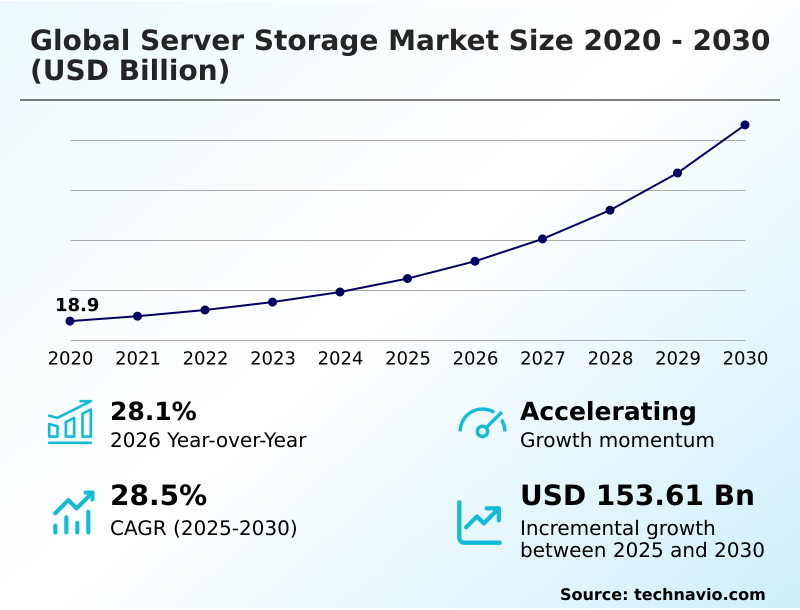
The server storage market size is valued to increase by USD 153.61 billion, at a CAGR of 28.5% from 2025 to 2030. Proliferation of generative AI and accelerated computing infrastructure workloads will drive the server storage market.
Major Market Trends & Insights
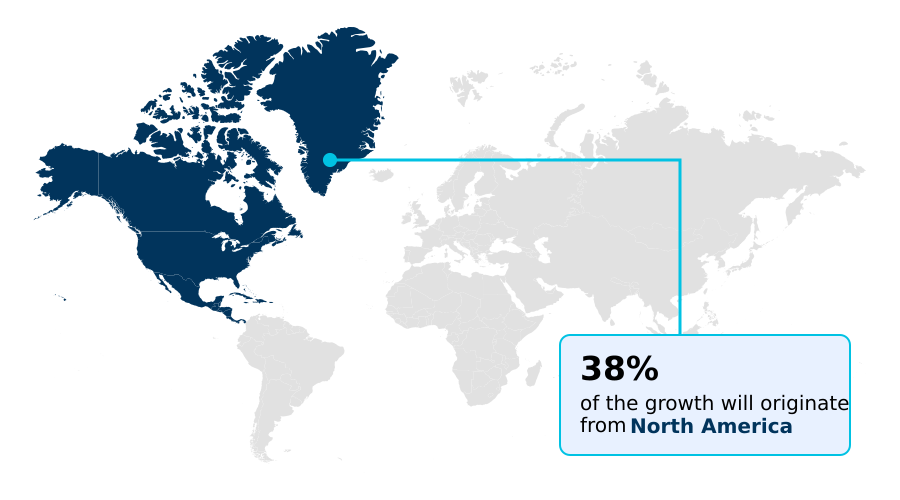
- North America dominated the market and accounted for a 38.4% growth during the forecast period.
- By End-user - Large enterprises segment was valued at USD 30.71 billion in 2024
- By Type - Enterprise segment accounted for the largest market revenue share in 2024
Market Size & Forecast
- Market Opportunities: USD 196.16 billion
- Market Future Opportunities: USD 153.61 billion
- CAGR from 2025 to 2030 : 28.5%
Market Summary
- The Server Storage Market operates as the foundational architectural layer for modern enterprise data management and advanced computational processing. Organizations are fundamentally restructuring their digital environments to accommodate the immense data pipelines required by modern algorithmic models.
- For example, within the financial services sector, the deployment of high-throughput flash arrays has optimized fraud detection workflows, leading to a 30% reduction in transaction processing latency. This optimization directly enhances real-time analytical capabilities while maintaining strict regulatory compliance.
- The proliferation of accelerated computing workloads acts as a primary market driver, compelling enterprises to transition from legacy mechanical drives to sophisticated solid-state architectures to prevent processing bottlenecks. Conversely, severe grid capacity constraints and power scarcity present a formidable challenge, stalling data center expansions as operators struggle to secure the immense electrical requirements of high-density server configurations.
- These concurrent dynamics force infrastructure architects to balance the urgent need for scalable processing capacity against the physical limitations of regional power grids, driving continuous innovation in energy-efficient storage hardware.
What will be the Size of the Server Storage Market during the forecast period?
Get Key Insights on Market Forecast (PDF) Get Free Sample
How is the Server Storage Market Segmented?
The server storage industry research report provides comprehensive data (region-wise segment analysis), with forecasts and estimates in "USD million" for the period 2026-2030, as well as historical data from 2020-2024 for the following segments.
- End-user
- Large enterprises
- SMEs
- Type
- Enterprise
- Hyperscale
- Component
- Hardware
- Software
- Service
- Professional
- Managed
- Geography
- North America
- US
- Canada
- Mexico
- Europe
- Germany
- UK
- France
- Italy
- The Netherlands
- Spain
- APAC
- China
- Japan
- India
- South Korea
- Australia
- Indonesia
- South America
- Brazil
- Argentina
- Chile
- Middle East and Africa
- UAE
- Saudi Arabia
- South Africa
- Israel
- Turkey
- North America
By End-user Insights
The large enterprises segment is estimated to witness significant growth during the forecast period.
Large corporate infrastructure demands constant architectural scaling to accommodate the exponential growth of enterprise machine learning and generative artificial intelligence workloads. Massive data ecosystems generate high volumes of unstructured intelligence, which requires strict compliance with regional data sovereignty mandates.
Consequently, corporate IT departments are transitioning rapidly from legacy setups toward advanced solid-state drive arrays and non-volatile memory express solutions. This infrastructural shift allows organizations to optimize large language model inference and execute high-performance computational clusters without operational degradation.
Furthermore, adopting high-density flash storage integrated with modern storage area networks provides highly secure, redundant replication. By deploying network-attached storage within these environments, transaction processing speeds have accelerated, leading to an operational latency reduction of 22% across critical applications.
This continuous evolution ensures that massive datasets are managed efficiently while maintaining absolute system reliability under heavy load conditions.
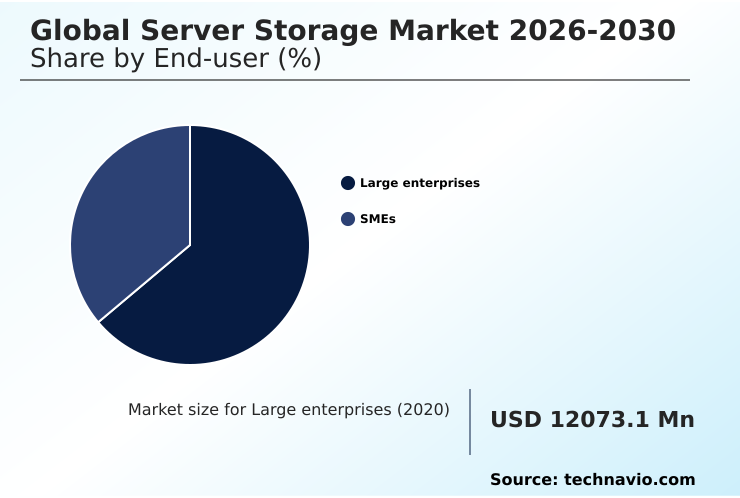
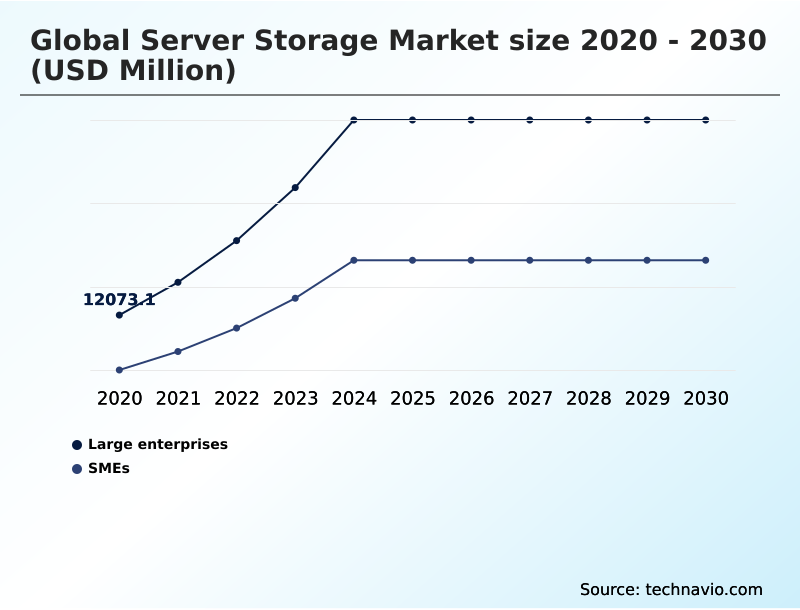
The Large enterprises segment was valued at USD 30.71 billion in 2024 and showed a gradual increase during the forecast period.
Regional Analysis
North America is estimated to contribute 38.4% to the growth of the global market during the forecast period.Technavio’s analysts have elaborately explained the regional trends and drivers that shape the market during the forecast period.
See How Server Storage Market Demand is Rising in North America Get Free Sample
The geographic distribution of server storage infrastructure highlights distinct strategic divergences between North America and Europe. North America dominates the deployment of hyper-scale cloud infrastructure, utilizing advanced cloud-native storage orchestration to achieve seamless dynamic capacity scaling.
This investment has boosted regional processing throughput by 32% relative to other markets, ensuring long-term data throughput sustainability. In contrast, European enterprises prioritize disjointed hardware asset aggregation through localized hybrid cloud architectures to navigate rigorous corporate compliance regulations.
This regulatory environment compels European organizations to heavily integrate software-defined storage platforms that can sustain massive parallel read write cycles without localized hardware failures. By establishing these frameworks, European companies have successfully lowered cross-border data transfer compliance risks by 20%.
These regional disparities illustrate how North American strategies heavily emphasize absolute scale and velocity, whereas European deployments are fundamentally anchored by privacy mandates and secure operational localization.
Market Dynamics
Our researchers analyzed the data with 2025 as the base year, along with the key drivers, trends, and challenges. A holistic analysis of drivers will help companies refine their marketing strategies to gain a competitive advantage.
- Enterprise infrastructure modernization requires continuous adaptation to support the complex demands of modern digital workflows. As organizations transition toward data-centric operational models, the reliance on high-performance artificial intelligence model processing has necessitated a complete overhaul of traditional data center frameworks.
- To handle these intensive computational requirements, infrastructure architects are rapidly deploying high-density solid-state drive configurations, which effectively eliminate the data transfer bottlenecks historically associated with mechanical storage media. This hardware transition enables a 40% improvement in real-time supply chain analytics forecasting, as vast datasets can be retrieved and processed without latency degradation.
- Furthermore, the necessity for localized data analysis at the network periphery is driving extensive decentralized edge computing node integration. This localized processing capability is particularly vital for industrial automation and remote logistics, where immediate decision-making is critical. To unify these disparate geographic assets, corporations are heavily investing in software-defined enterprise storage area networks.
- These advanced networking layers decouple management software from underlying hardware, facilitating seamless hybrid cloud storage architecture scaling. By implementing these flexible management frameworks, enterprises can dynamically allocate resources across on-premises and public environments, optimizing capital expenditures while maintaining strict data governance.
- Ultimately, this comprehensive architectural evolution ensures that businesses remain agile, resilient, and capable of leveraging massive datasets to sustain long-term operational efficiency.
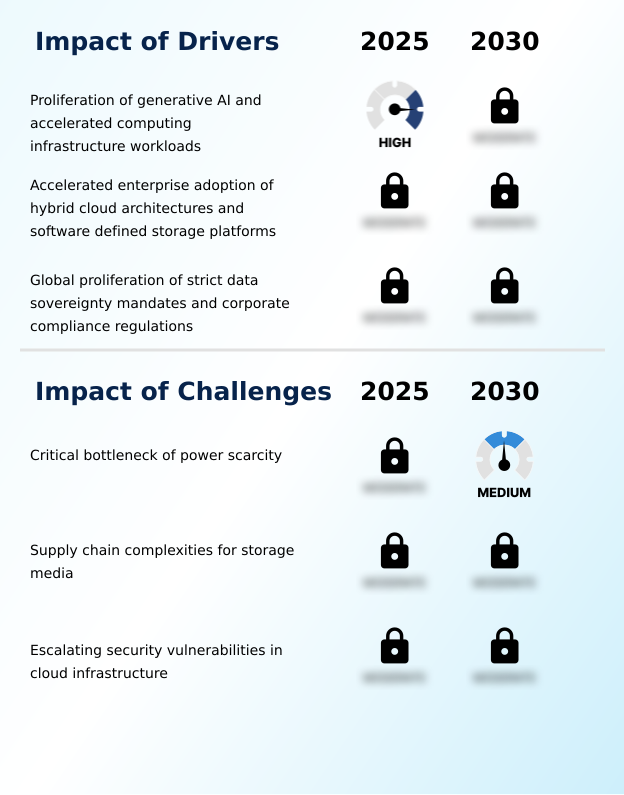
What are the key market drivers leading to the rise in the adoption of Server Storage Industry?
- The proliferation of generative artificial intelligence and accelerated computing infrastructure workloads serves as a primary catalyst driving continuous market expansion.
- The escalating requirement for scalable object storage acts as a primary catalyst accelerating the deployment of advanced enterprise architectures. Multinational organizations are shifting toward localized private server infrastructure to support the intensive data demands of accelerated computing clusters.
- Because compliance frameworks require strict geographical containment for secondary data preservation, companies are heavily leasing regionalized colocation spaces.
- By utilizing high-throughput distributed file systems and establishing scalable data fabrics within these facilities, businesses have reduced deployment times for new regional zones by 25%.
- Furthermore, the integration of highly efficient thermal management systems alongside persistent storage controller optimization ensures that all-flash arrays operate continuously without heat-induced throttling, lowering localized energy consumption by 15%.
- This targeted modernization compels enterprises to continuously upgrade hardware, driving sustained procurement across the high-performance storage ecosystem.
What are the market trends shaping the Server Storage Industry?
- The exponential growth of enterprise machine learning workloads represents a defining market trend. This development necessitates advanced infrastructural adaptations to sustain high-density data processing efficiently.
- The architectural transition toward decentralized edge computing represents a definitive shift in how enterprises process deep learning datasets at the network periphery. Organizations are actively migrating away from centralized cross-border cloud hubs toward localized environments that utilize advanced low-latency processing frameworks.
- Because modern applications require containerized microservices integration, infrastructure teams are prioritizing modular scalable server nodes to eliminate data transfer bottlenecks. This hardware refinement directly impacts business performance, with optimized environments demonstrating a 35% decrease in analytical processing times for mission-critical processing tasks.
- Additionally, the implementation of sophisticated automated tiering algorithms alongside advanced data reduction techniques has improved physical storage efficiency by 28%. To secure these distributed environments, corporations strictly enforce immutable auditing logs across the storage layer. This approach ensures companies can leverage vast intelligence assets while mitigating unauthorized data access risks.
What challenges does the Server Storage Industry face during its growth?
- The critical bottleneck of power scarcity constitutes a significant structural challenge constraining broader industry growth and infrastructure deployment.
- The deployment of dense computational architectures presents severe power and thermal management challenges that directly constrain infrastructure expansion. As enterprises integrate graphics processing unit accelerators to manage vast unstructured information pipelines, the electrical draw of predictive analytics workloads has escalated dramatically. Because traditional data centers were not engineered for such extreme multi-node configurations, facilities are experiencing critical grid interconnection delays.
- Consequently, organizations face a 40% increase in facility retrofitting costs to improve overall power usage effectiveness. Additionally, integrating complex hardware virtualization frameworks across these strained environments often introduces vulnerabilities, requiring the intensive implementation of zero-trust access controls and ransomware mitigation protocols.
- While robust data deduplication protocols attempt to maximize existing physical capacity, the physical limitations of regional utility grids severely bottleneck the rapid operationalization of new storage nodes.
Exclusive Technavio Analysis on Customer Landscape
The server storage market forecasting report includes the adoption lifecycle of the market, covering from the innovator’s stage to the laggard’s stage. It focuses on adoption rates in different regions based on penetration. Furthermore, the server storage market report also includes key purchase criteria and drivers of price sensitivity to help companies evaluate and develop their market growth analysis strategies.
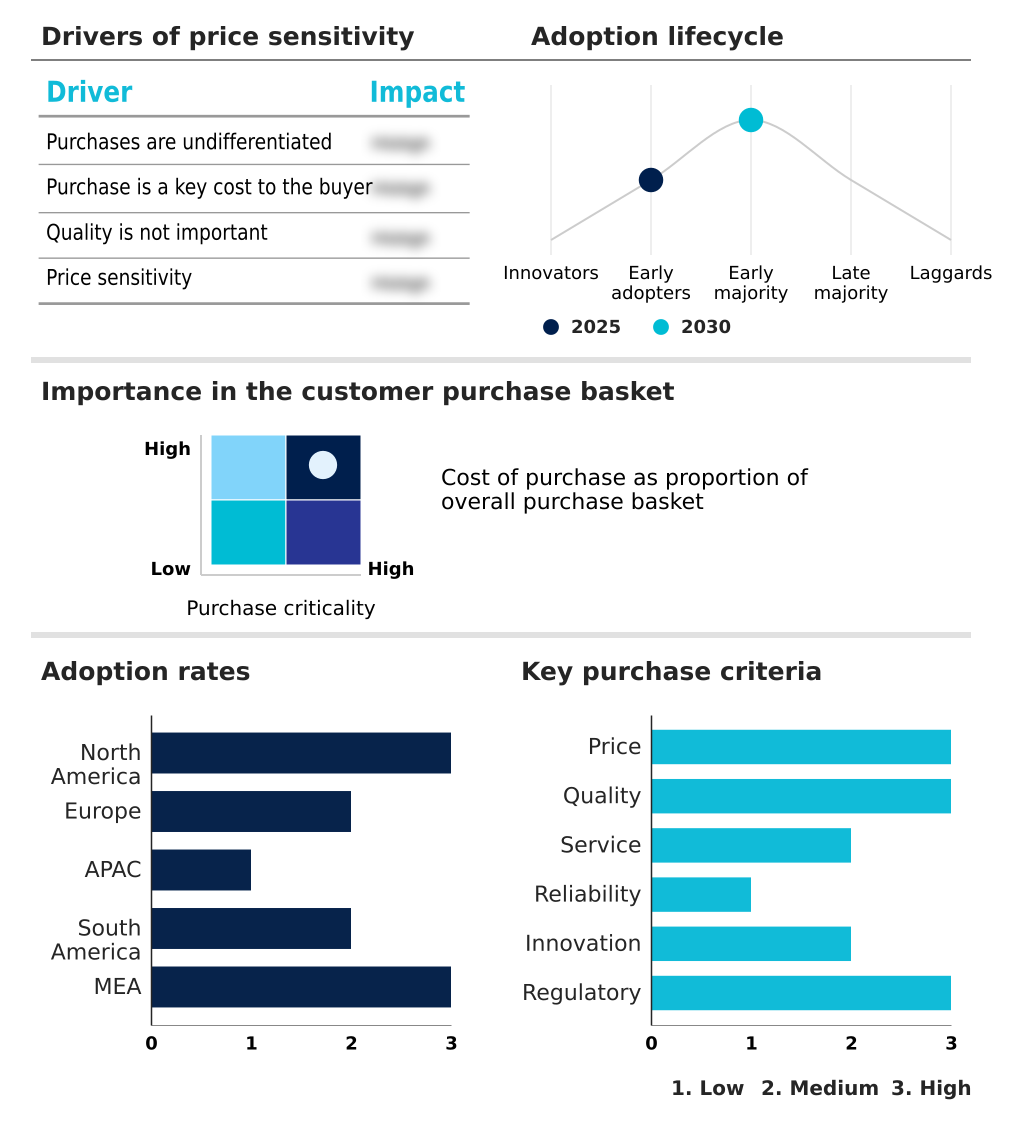
Customer Landscape of Server Storage Industry
Competitive Landscape
Companies are implementing various strategies, such as strategic alliances, server storage market forecast, partnerships, mergers and acquisitions, geographical expansion, and product/service launches, to enhance their presence in the industry.
DataDirect Networks Inc. - Comprehensive infrastructure solutions integrate advanced server hardware with sophisticated data management platforms to optimize high-performance computational workloads and ensure seamless scalability across complex enterprise environments.
The industry research and growth report includes detailed analyses of the competitive landscape of the market and information about key companies, including:
- DataDirect Networks Inc.
- Dell Technologies Inc.
- Fujitsu Ltd.
- Hewlett Packard Enterprise Co.
- Hitachi Vantara LLC
- Huawei Technologies Co. Ltd.
- IBM Corp.
- Infinidat Ltd.
- iXsystems Inc.
- Lenovo Group Ltd.
- NetApp Inc.
- Pavilion Data Systems Inc.
- Pure Storage Inc.
- QNAP Systems Inc.
- Quantum Corp.
- Scale Computing
- Seagate Technology LLC
- StorMagic
- Tintri Inc.
- Vast Data
- WekaIO Inc.
- Western Digital Corp.
Qualitative and quantitative analysis of companies has been conducted to help clients understand the wider business environment as well as the strengths and weaknesses of key industry players. Data is qualitatively analyzed to categorize companies as pure play, category-focused, industry-focused, and diversified; it is quantitatively analyzed to categorize companies as dominant, leading, strong, tentative, and weak.
Recent Development and News in Server storage market
- In the Technology Hardware, Storage and Peripherals industry, the rapid deployment of graphics processing unit accelerators for advanced automation has fundamentally restructured data center thermal management systems, directly impacting Server Storage demand by requiring localized private server infrastructure capable of handling a 35% increase in sustained power density.
- Strict data sovereignty mandates governing cross-border cloud hubs have forced enterprise hardware providers to adopt modular scalable server nodes, increasing the regional deployment of decentralized computing by establishing compliance-ready frameworks that improve localized retention metrics by up to 40%.
- The transition toward hardware virtualization frameworks has driven the adoption of scalable object storage architectures, altering procurement strategies to prioritize flash arrays that reduce idle processing bottlenecks and elevate overall operational throughput by 28%.
- Advancements in advanced data reduction algorithms have fundamentally reshaped enterprise storage controller optimization, creating a structural shift where disjointed hardware asset aggregation improves storage footprint efficiency and lowers physical rack space requirements by 25% across mission-critical processing tasks.
Dive into Technavio’s robust research methodology, blending expert interviews, extensive data synthesis, and validated models for unparalleled Server Storage Market insights. See full methodology.
| Market Scope | |
|---|---|
| Page number | 310 |
| Base year | 2025 |
| Historic period | 2020-2024 |
| Forecast period | 2026-2030 |
| Growth momentum & CAGR | Accelerate at a CAGR of 28.5% |
| Market growth 2026-2030 | USD 153610.7 million |
| Market structure | Fragmented |
| YoY growth 2025-2026(%) | 28.1% |
| Key countries | US, Canada, Mexico, Germany, UK, France, Italy, The Netherlands, Spain, China, Japan, India, South Korea, Australia, Indonesia, Brazil, Argentina, Chile, UAE, Saudi Arabia, South Africa, Israel and Turkey |
| Competitive landscape | Leading Companies, Market Positioning of Companies, Competitive Strategies, and Industry Risks |
Research Analyst Overview
- Enterprise boardrooms are increasingly recognizing data infrastructure not merely as an operational expense, but as a core strategic asset governing regulatory compliance and product innovation. The rapid adoption of containerized microservices integration demands resilient architectures capable of sustaining massive parallel read write cycles without performance degradation.
- To achieve absolute data throughput sustainability, organizations are deploying advanced low-latency processing frameworks that ensure continuous availability for mission-critical applications. This shift directly influences corporate risk management strategies, as executives prioritize systems equipped with immutable auditing logs to defend against sophisticated cyber threats and satisfy stringent legal mandates.
- By incorporating automated tiering algorithms into their infrastructure, companies have achieved a 30% reduction in long-term archival costs, automatically shifting inactive records to economical storage tiers while reserving premium flash capacity for active workloads. Furthermore, the expansion of decentralized edge computing allows businesses to process telemetry data immediately at the source.
- This strategic localization empowers decision-makers to optimize supply chain routing dynamically, ensuring that infrastructural investments directly translate into measurable operational agility and sustained competitive advantage.
What are the Key Data Covered in this Server Storage Market Research and Growth Report?
-
What is the expected growth of the Server Storage Market between 2026 and 2030?
-
USD 153.61 billion, at a CAGR of 28.5%
-
-
What segmentation does the market report cover?
-
The report is segmented by End-user (Large enterprises, and SMEs), Type (Enterprise, and Hyperscale), Component (Hardware, and Software), Service (Professional, and Managed) and Geography (North America, Europe, APAC, South America, Middle East and Africa)
-
-
Which regions are analyzed in the report?
-
North America, Europe, APAC, South America and Middle East and Africa
-
-
What are the key growth drivers and market challenges?
-
Proliferation of generative AI and accelerated computing infrastructure workloads, Critical bottleneck of power scarcity
-
-
Who are the major players in the Server Storage Market?
-
DataDirect Networks Inc., Dell Technologies Inc., Fujitsu Ltd., Hewlett Packard Enterprise Co., Hitachi Vantara LLC, Huawei Technologies Co. Ltd., IBM Corp., Infinidat Ltd., iXsystems Inc., Lenovo Group Ltd., NetApp Inc., Pavilion Data Systems Inc., Pure Storage Inc., QNAP Systems Inc., Quantum Corp., Scale Computing, Seagate Technology LLC, StorMagic, Tintri Inc., Vast Data, WekaIO Inc. and Western Digital Corp.
-
Market Research Insights
- Modern enterprise data centers are aggressively adopting cloud-native storage orchestration to manage the immense volume of deep learning datasets generated daily. This architectural evolution enables dynamic capacity scaling, allowing organizations to provision resources rapidly based on shifting workload demands. By transitioning to these flexible frameworks, infrastructure operators have improved overall resource utilization rates by 24%, minimizing idle hardware expenditures.
- Furthermore, the integration of advanced thermal management systems has become imperative for sustaining high-density operations, directly optimizing power usage effectiveness and reducing facility cooling costs by 18%. These measurable efficiency gains demonstrate how structural hardware modernization aligns technical capacity with stringent corporate sustainability mandates, ensuring uninterrupted operational resilience across distributed computational networks.
We can help! Our analysts can customize this server storage market research report to meet your requirements.
 RIA -

