


South Korea Logistics Automation Market Size 2026-2030
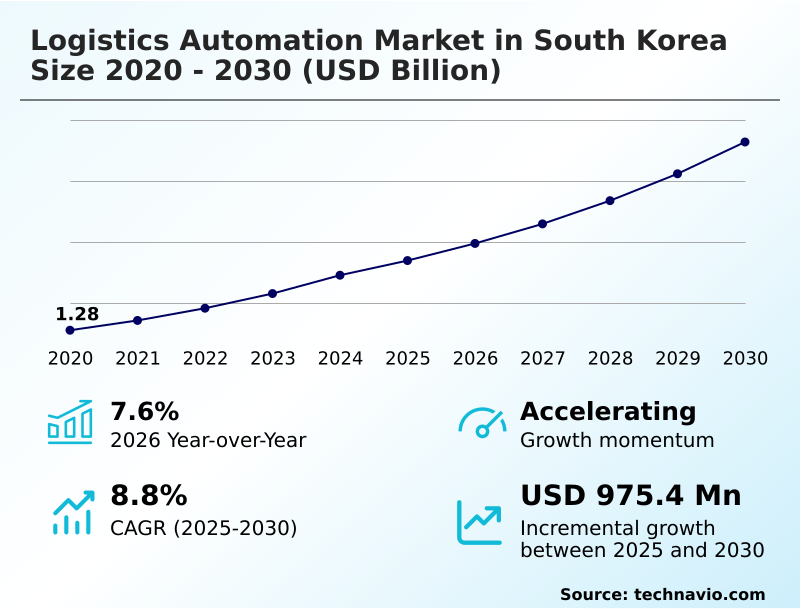
The south korea logistics automation market size is valued to increase by USD 975.4 million, at a CAGR of 8.8% from 2025 to 2030. Demographic evolution and escalation of labor costs will drive the south korea logistics automation market.
Major Market Trends & Insights
- By Component - Hardware segment was valued at USD 1.12 billion in 2024
- By End-user - Retail and e-commerce segment accounted for the largest market revenue share in 2024
Market Size & Forecast
- Market Opportunities: USD 1.55 billion
- Market Future Opportunities: USD 975.4 million
- CAGR from 2025 to 2030 : 8.8%
Market Summary
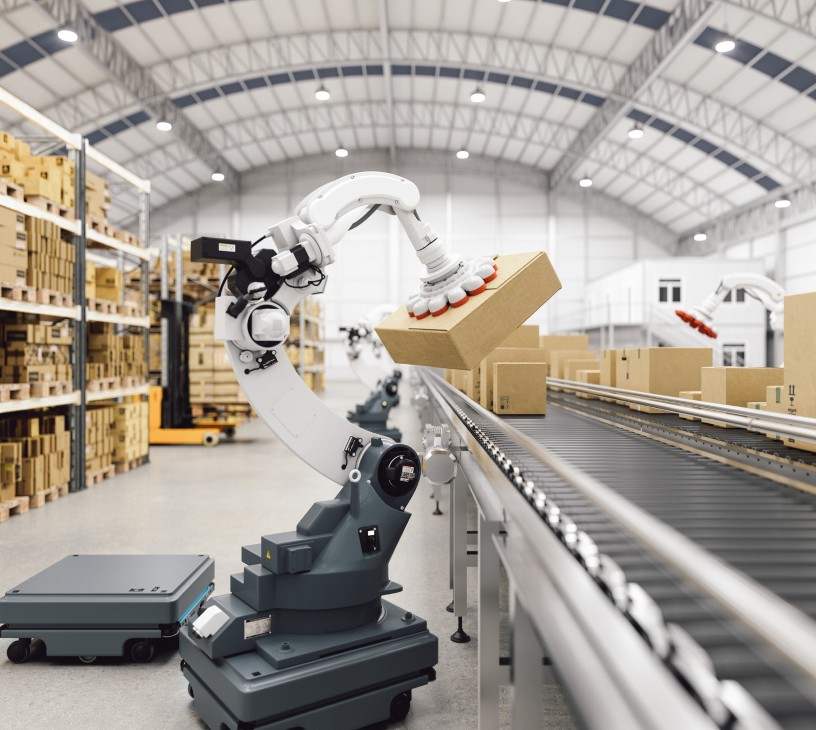
- The logistics automation market in South Korea is defined by the strategic deployment of mechanical systems and software to enhance supply chain productivity. This ecosystem relies on technologies like autonomous mobile robots and high-speed sorting systems, all coordinated by centralized warehouse management systems.
- The adoption is driven by pressing needs to counter high labor costs and meet consumer demands for near-instant delivery in dense urban environments. A key business scenario involves optimizing e-commerce fulfillment, where automated storage and retrieval systems are used to process thousands of individual orders with high precision, dramatically reducing manual errors and improving throughput.
- Innovations in AI and modular design allow these systems to scale with fluctuating demand, ensuring local enterprises maintain a competitive edge. The integration of sophisticated sensors and cloud data processing facilitates the rapid, transparent movement of goods, from cold chain logistics for pharmaceuticals to high-value electronics, solidifying the sector's role in the national economy.
What will be the Size of the South Korea Logistics Automation Market during the forecast period?
Get Key Insights on Market Forecast (PDF) Get Free Sample
How is the South Korea Logistics Automation Market Segmented?
The south korea logistics automation industry research report provides comprehensive data (region-wise segment analysis), with forecasts and estimates in "USD million" for the period 2026-2030, as well as historical data from 2020-2024 for the following segments.
- Component
- Hardware
- Software
- Services
- End-user
- Retail and e-commerce
- Automotive
- Healthcare
- Aerospace
- Others
- Technology
- Conveyor systems
- AGVs
- Robotic arms
- Sorting systems
- Geography
- APAC
- South Korea
- APAC
By Component Insights
The hardware segment is estimated to witness significant growth during the forecast period.
The hardware segment is foundational to the logistics automation market in South Korea, encompassing physical machinery and robotic systems.
With a 15% decline in available manual laborers, companies are compelled to adopt solutions like automated storage and retrieval systems and modular conveyor platforms to maintain operational continuity.
This equipment, including everything from stacker cranes to collaborative robots, is critical for maximizing vertical space in high-cost urban centers. Firms leverage this hardware for automated inspection and to enable intralogistics software, ensuring goods move efficiently.
The focus is on robust, high-throughput systems, such as cross-belt sorters and laser-guided AGVs, that can handle the demands of modern distribution while integrating seamlessly with advanced warehouse execution systems.
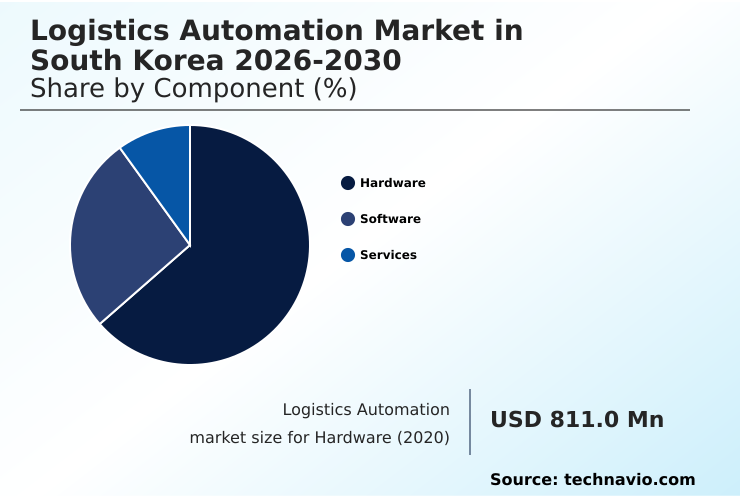
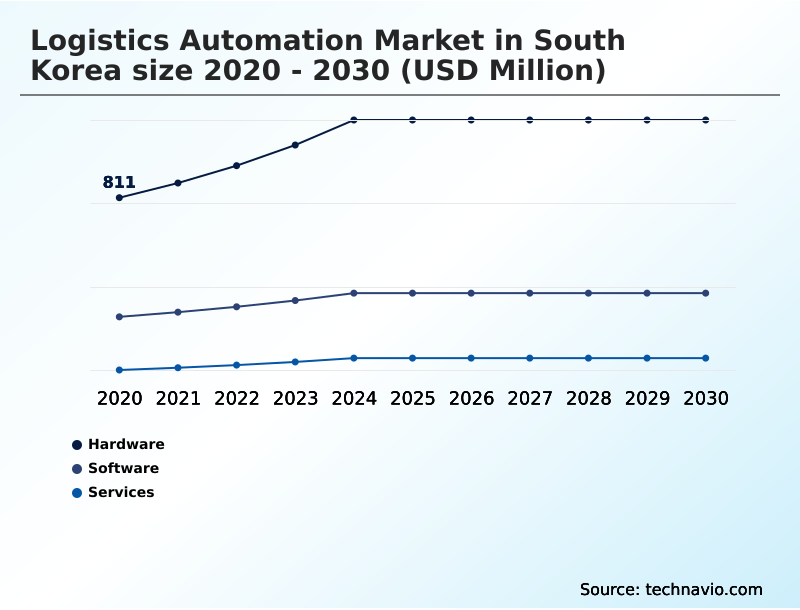
The Hardware segment was valued at USD 1.12 billion in 2024 and showed a gradual increase during the forecast period.
Market Dynamics
Our researchers analyzed the data with 2025 as the base year, along with the key drivers, trends, and challenges. A holistic analysis of drivers will help companies refine their marketing strategies to gain a competitive advantage.
- Strategic decision-making in the logistics automation market in South Korea requires a deep understanding of specific technologies and their financial implications. Evaluating the ROI of autonomous mobile robots and understanding the benefits of digital twin in warehousing are critical first steps. Firms are increasingly using AI for predictive logistics analytics to forecast demand and optimize inventory.
- A key debate centers on automated guided vehicles vs mobile robots, with choices depending on facility layout and flexibility needs. Successfully integrating WMS with robotic systems is a common technical hurdle, alongside addressing cybersecurity risks in automated warehouses. For e-commerce players, micro-fulfillment center design principles are vital for rapid urban delivery.
- The implementation of high-density storage for urban logistics and sustainable logistics automation technologies addresses both efficiency and environmental concerns. Using collaborative robots in order fulfillment offers a hybrid approach, though challenges of legacy system integration persist. For specialized sectors, automated cold chain temperature monitoring is non-negotiable.
- The cost analysis of warehouse automation must factor in both initial investment in technologies like robotic arms for mixed-case palletizing and long-term operational gains. The ability of these systems to provide real-time tracking in logistics automation allows for throughput rates that are several times higher than what is achievable through purely manual processes.
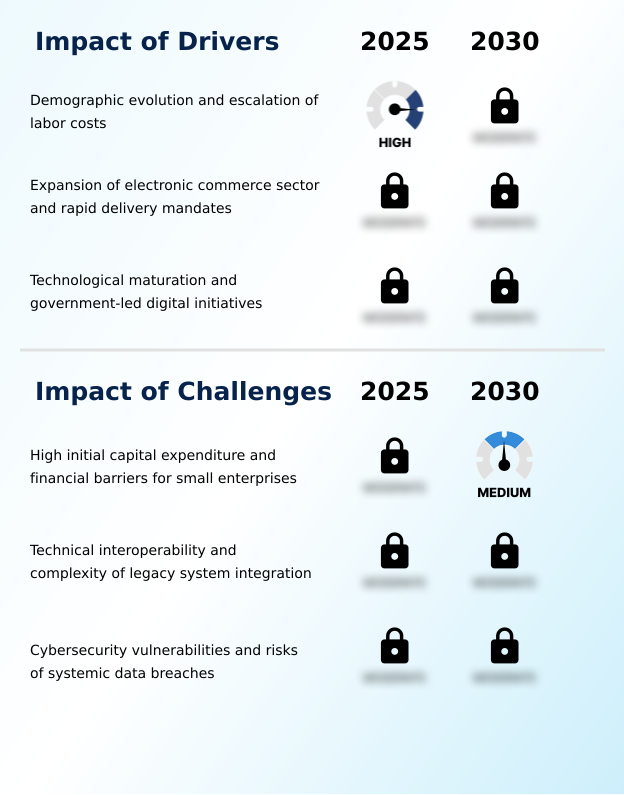
What are the key market drivers leading to the rise in the adoption of South Korea Logistics Automation Industry?
- Demographic shifts, including a rapidly aging population, combined with escalating labor costs, serve as a primary driver for market growth.
- The primary driver for the logistics automation market in South Korea is a severe labor shortage, compelling companies to adopt smart factory logistics and automated material handling.
- With consumer expectations for e-commerce delivery narrowing to a three-hour window in urban centers, automation is no longer optional. This demand is met by deploying voice-guided work devices and other goods-to-person technologies that significantly increase picking speed and accuracy.
- Another major catalyst is strong government support through initiatives like the Digital New Deal, which provides financial incentives for adopting smart warehouse solutions.
- This, combined with the nation’s extensive 5G network, creates an ideal environment for deploying IoT-enabled logistics and other data-intensive automation technologies, enhancing overall supply chain visibility.
What are the market trends shaping the South Korea Logistics Automation Industry?
- The integration of artificial intelligence with digital twin technology is emerging as a transformative market trend. This convergence enables dynamic, predictive, and adaptive logistics operations.
- A transformative trend in the logistics automation market in South Korea is the convergence of AI with warehouse simulation and digital twin technology. This allows operators to create virtual replicas of warehouses, enabling stress-testing of changes to automated guided vehicle paths or conveyor speeds without physical disruption, leading to near-perfect operational uptime.
- The proliferation of urban micro-fulfillment solutions is another key trend, driven by consumer demand for rapid delivery. These compact, highly automated centers use vertical lift modules and robotic arms to process hundreds of orders per hour.
- Furthermore, there's a significant shift toward green logistics, with automated packaging systems reducing material waste by up to 20% and intelligent power management for robotic systems cutting energy consumption.
What challenges does the South Korea Logistics Automation Industry face during its growth?
- A key challenge affecting industry growth is the high initial capital expenditure and significant financial barriers faced by small and medium-sized enterprises.
- A significant challenge in the logistics automation market in South Korea is the high initial capital expenditure, which creates financial barriers for smaller enterprises whose debt service ratios have reached a ten-year high. This investment hurdle is compounded by the technical complexity of system integration services, especially when attempting to connect new autonomous forklift operation hardware with legacy IT systems.
- A lack of interoperability and standardized communication protocols often leads to project delays and reliance on expensive custom middleware. Furthermore, the increased connectivity of automated systems introduces substantial cybersecurity risks. Protecting interconnected warehouse robotics integration networks from data breaches requires continuous investment in advanced security measures, adding another layer of operational cost and complexity for businesses.
Exclusive Technavio Analysis on Customer Landscape
The south korea logistics automation market forecasting report includes the adoption lifecycle of the market, covering from the innovator’s stage to the laggard’s stage. It focuses on adoption rates in different regions based on penetration. Furthermore, the south korea logistics automation market report also includes key purchase criteria and drivers of price sensitivity to help companies evaluate and develop their market growth analysis strategies.
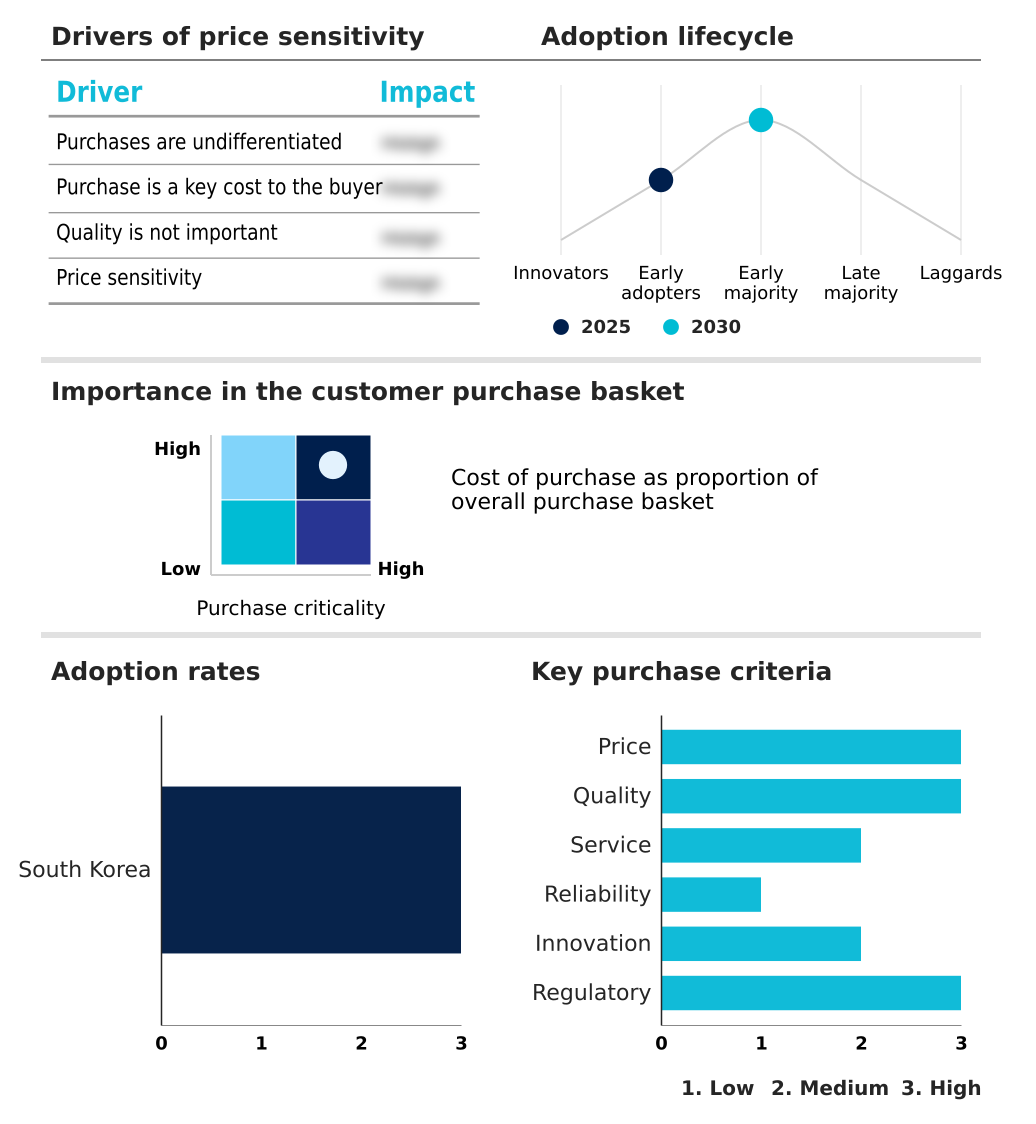
Customer Landscape of South Korea Logistics Automation Industry
Competitive Landscape
Companies are implementing various strategies, such as strategic alliances, south korea logistics automation market forecast, partnerships, mergers and acquisitions, geographical expansion, and product/service launches, to enhance their presence in the industry.
ABB Ltd. - The vendor portfolio includes robotic picking, Autonomous Mobile Robots (AMRs), automated cross-docking, and AI-enabled software for optimizing distribution center operations.
The industry research and growth report includes detailed analyses of the competitive landscape of the market and information about key companies, including:
- ABB Ltd.
- Auto Control Systems
- Bastian Solutions LLC
- Beumer Group GmbH and Co. KG
- CJ Logistics Corp.
- Daifuku Co. Ltd.
- Dematic Group
- Geekplus Technology Co. Ltd.
- Hanwha Group
- Honeywell International Inc.
- Interroll Holding AG
- Kardex Holding AG
- KNAPP AG
- LG CNS
- LS ELECTRIC Co. Ltd.
- Murata Machinery Ltd.
- Samsung SDS
- Swisslog Holding AG
- TGW Logistics GmbH
- Vanderlande Industries BV
Qualitative and quantitative analysis of companies has been conducted to help clients understand the wider business environment as well as the strengths and weaknesses of key industry players. Data is qualitatively analyzed to categorize companies as pure play, category-focused, industry-focused, and diversified; it is quantitatively analyzed to categorize companies as dominant, leading, strong, tentative, and weak.
Recent Development and News in South korea logistics automation market
- In March, 2025, Doosan Robotics introduced a new line of high-speed collaborative robots designed for palletizing and de-palletizing tasks in distribution centers.
- In April, 2025, SK C and C completed the implementation of an advanced digital twin and AI platform at a high-tech manufacturing logistics facility in Cheongju.
- In August, 2025, GS Retail inaugurated a new automated micro-fulfillment center in the Seoul metropolitan area to manage its hyper-local grocery delivery services.
- In November, 2025, Lotte Data Communication launched a dedicated support center to offer round-the-clock maintenance and remote diagnostic services for automated logistics facilities.
Dive into Technavio’s robust research methodology, blending expert interviews, extensive data synthesis, and validated models for unparalleled South Korea Logistics Automation Market insights. See full methodology.
| Market Scope | |
|---|---|
| Page number | 199 |
| Base year | 2025 |
| Historic period | 2020-2024 |
| Forecast period | 2026-2030 |
| Growth momentum & CAGR | Accelerate at a CAGR of 8.8% |
| Market growth 2026-2030 | USD 975.4 million |
| Market structure | Fragmented |
| YoY growth 2025-2026(%) | 7.6% |
| Key countries | South Korea |
| Competitive landscape | Leading Companies, Market Positioning of Companies, Competitive Strategies, and Industry Risks |
Research Analyst Overview
- The logistics automation market in South Korea is advancing rapidly, driven by the need to streamline complex supply chains. The core of this evolution lies in the integration of sophisticated hardware and software.
- Modern warehouses deploy integrated conveyor systems with zero-pressure accumulation and optical character recognition for intake, leading to automated storage and retrieval systems that enable high-density storage through technologies like vertical lift modules and automated bin shuttles. For fulfillment, operations rely on a combination of goods-to-person technologies, piece-picking robots, and collaborative robots equipped with 3D vision systems and advanced end-of-arm tooling.
- The movement of goods is managed by autonomous mobile robots and laser-guided AGVs, orchestrated by intelligent warehouse management systems. For outbound logistics, robotic palletizing, automated cross-docking, and high-speed sorting systems, including cross-belt sorters, are essential.
- This entire ecosystem, from stacker cranes to micro-fulfillment solutions, is managed by AI-enabled software and warehouse execution systems that support warehouse simulation, achieving operational uptime greater than 99% in some advanced facilities.
What are the Key Data Covered in this South Korea Logistics Automation Market Research and Growth Report?
-
What is the expected growth of the South Korea Logistics Automation Market between 2026 and 2030?
-
USD 975.4 million, at a CAGR of 8.8%
-
-
What segmentation does the market report cover?
-
The report is segmented by Component (Hardware, Software, and Services), End-user (Retail and e-commerce, Automotive, Healthcare, Aerospace, and Others), Technology (Conveyor systems, AGVs, Robotic arms, and Sorting systems) and Geography (APAC)
-
-
Which regions are analyzed in the report?
-
APAC
-
-
What are the key growth drivers and market challenges?
-
Demographic evolution and escalation of labor costs, High initial capital expenditure and financial barriers for small enterprises
-
-
Who are the major players in the South Korea Logistics Automation Market?
-
ABB Ltd., Auto Control Systems, Bastian Solutions LLC, Beumer Group GmbH and Co. KG, CJ Logistics Corp., Daifuku Co. Ltd., Dematic Group, Geekplus Technology Co. Ltd., Hanwha Group, Honeywell International Inc., Interroll Holding AG, Kardex Holding AG, KNAPP AG, LG CNS, LS ELECTRIC Co. Ltd., Murata Machinery Ltd., Samsung SDS, Swisslog Holding AG, TGW Logistics GmbH and Vanderlande Industries BV
-
Market Research Insights
- Modernization is driven by smart warehouse solutions that integrate IoT-enabled logistics and robotic process automation for greater efficiency. Companies are achieving enhanced supply chain visibility through system integration services and predictive maintenance for robotics, reducing downtime by over 25%. Key strategies include e-commerce fulfillment automation, last-mile delivery automation, and cold chain logistics automation, managed by advanced intralogistics software.
- Decision-making is enhanced by demand forecasting algorithms and remote diagnostic services. The adoption of robotics-as-a-service (RaaS) models is lowering entry barriers, while facility redesign for automation, incorporating automated packaging systems and smart palletizing, optimizes workflows.
- Technologies such as automated material handling, sortation system throughput, and automated vehicle loading are becoming standard, with warehouse robotics integration achieving order processing rates 30% faster than manual methods.
We can help! Our analysts can customize this south korea logistics automation market research report to meet your requirements.
 RIA -
RIA - 
