



Virtual Reality VR Headset Market Size 2025-2029
The virtual reality vr headset market size is forecast to increase by USD 43.64 billion at a CAGR of 51.1% between 2024 and 2029.
- The Virtual Reality (VR) headset market is experiencing significant growth, driven primarily by the surging interest and investment In the gaming industry. This sector's expansion is fueled by advancements in technology, which offer increasingly experiences for users. Another key trend is the growing integration of Augmented Reality (AR) and VR technologies by companies, broadening the application scope of these devices beyond gaming. However, challenges persist, including rising health concerns and user comfort issues. As more consumers adopt VR headsets for extended periods, there is a growing awareness of potential eye strain, headaches, and motion sickness.
- Companies seeking to capitalize on this market's opportunities must focus on addressing these challenges through innovative design and ergonomic solutions. By staying abreast of these trends and addressing user needs, businesses can effectively navigate the strategic landscape of the VR headset market.
What will be the Size of the Virtual Reality VR Headset Market during the forecast period?
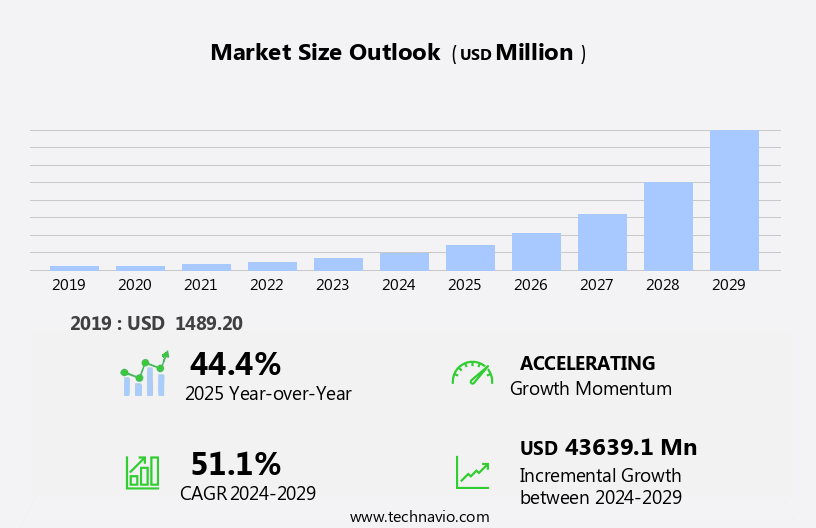
- The virtual reality (VR) headset market is experiencing significant growth, driven by advancements in VR technology and increasing demand across various sectors. According to market research, the global VR headset market size is projected to reach substantial revenue by 2026, growing at a steady compound annual growth rate. Consumers are increasingly adopting VR headsets for gaming experiences, while industries such as healthcare, military, training, and retail are exploring the technology for innovative applications. Notable sectors include Google Cardboard and other mobile VR solutions, console-connected headsets like PlayStation, and standalone devices such as Meta Quest and future offerings like Apple Vision Pro and Meta Quest Pro.
- VR technology continues to revolutionize industries, offering enhanced training simulations, improved patient care, and new retail experiences.
How is this Virtual Reality VR Headset Industry segmented?
The virtual reality vr headset industry research report provides comprehensive data (region-wise segment analysis), with forecasts and estimates in "USD million" for the period 2025-2029, as well as historical data from 2019-2023 for the following segments.
- Application
- Commercial
- Individual
- Type
- Mid-range device
- Low-end device
- High-end device
- Geography
- North America
- US
- Canada
- APAC
- China
- India
- Japan
- Europe
- France
- Germany
- Italy
- UK
- Middle East and Africa
- South America
- Brazil
- North America
By Application Insights
The commercial segment is estimated to witness significant growth during the forecast period.
The virtual reality (VR) headset market encompasses significant commercial applications, accounting for a substantial market share. Businesses leverage VR technology to enhance training, experiences, and productivity in various sectors, ranging from education and entertainment to enterprise solutions. Notably, VR headsets are extensively utilized in corporate training and simulation, enabling employees to practice skills in a risk-free virtual environment. This approach not only boosts worker performance but also reduces training costs compared to traditional methods. In addition to corporate applications, VR headsets find extensive use in healthcare, virtual training, simulation events, and live virtual entertainment. Companies like PlayStation, Microsoft, and start-ups offer innovative solutions such as the PlayStation Headset, Microsoft HoloLens, and VR simulators.
VR devices, including head-mounted displays and gesture-tracking devices, are adopted by large technology companies and healthcare provisions for patient care systems, medical training, planned ries, and healthcare applications. The VR market continues to expand, with high-resolution displays, compact devices, and head-up displays gaining traction. Despite advancements, challenges such as VR sickness, neck pain, and low resolution persist. Nonetheless, the market's potential in commercial industries, real estate, and healthcare applications is vast, with AR devices and VR projectors also gaining popularity.
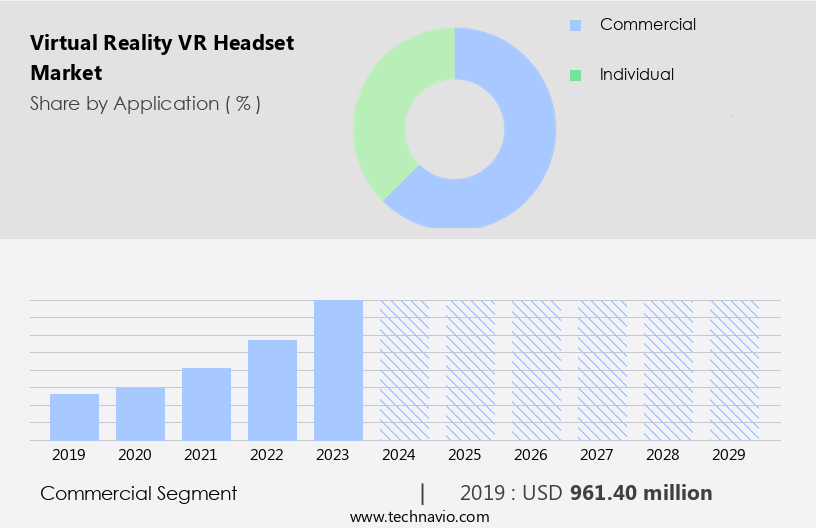
Get a glance at the market report of share of various segments Request Free Sample
The Commercial segment was valued at USD 961.40 billion in 2019 and showed a gradual increase during the forecast period.
Regional Analysis
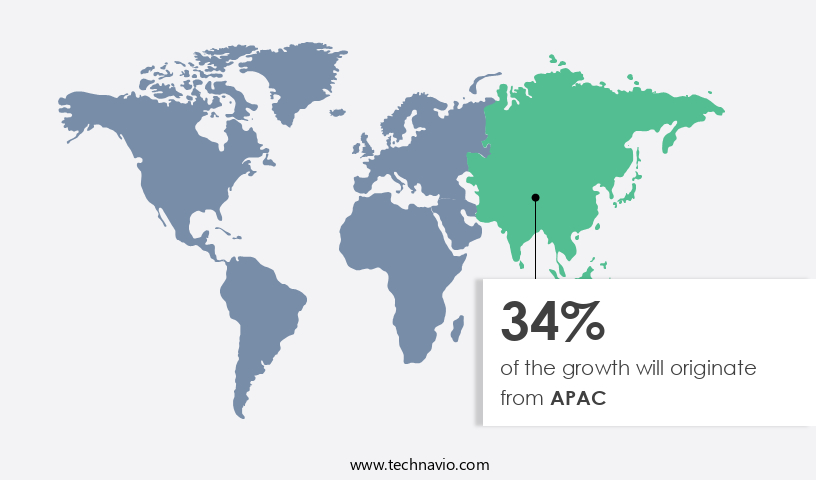
APAC is estimated to contribute 34% to the growth of the global market during the forecast period.Technavio’s analysts have elaborately explained the regional trends and drivers that shape the market during the forecast period.
For more insights on the market size of various regions, Request Free Sample
The North American virtual reality (VR) headset market has experienced substantial growth due to increasing consumer interest in digital experiences. Major players In the region include Meta Platforms (Oculus), HTC, Sony, and Valve. Oculus, owned by Meta Platforms, has been In the consumer VR headset segment with its popular Rift and Quest series. The Quest 3, launched in October 2023, gained popularity due to its wireless, all-in-one design and competitive pricing. Available in 128 Giga Byte (GB) and 512 GB variants, it offers a compelling VR experience for consumers. The VR market further expands into industries such as healthcare, commercial, and retail sectors.
Devices like PlayStation Headset, Microsoft HoloLens, and VR simulators cater to virtual training, simulation events, and medical applications, including planned ries, patient care systems, and medical training. VR headsets, head-mounted displays, and gesture-tracking devices are essential components of this market. Large technology companies and start-ups continue to innovate, developing compact, high-resolution devices and head-up displays, VR projectors, and AR devices. Despite advancements, concerns regarding health issues, such as VR sickness, neck pain, and low resolution, remain.
Market Dynamics
Our researchers analyzed the data with 2024 as the base year, along with the key drivers, trends, and challenges. A holistic analysis of drivers will help companies refine their marketing strategies to gain a competitive advantage.
What are the key market drivers leading to the rise In the adoption of Virtual Reality VR Headset Industry?
Rising interest and growth in gaming industry is the key driver of the market.
- The global virtual reality (VR) headset market has experienced remarkable growth, fueled by the expanding gaming and entertainment industries. Consumers' increasing demand for experiences has driven VR technology into the mainstream. VR headsets offer a groundbreaking solution for gamers seeking more realistic and engaging experiences, with advanced graphics, spatial audio, and interactive gameplay in virtual environments. This convergence of technology and consumer preferences has significantly expanded the market for VR headset producers.
- The gaming sector's massive expansion has been a major catalyst for this growth.
What are the market trends shaping the Virtual Reality VR Headset Industry?
Growing AR/VR Integration introduced by s is the upcoming market trend.
- Augmented Reality (AR) and Virtual Reality (VR) technologies are revolutionizing user experiences by integrating digital content with the physical world. AR overlays digital information onto the real environment, while VR creates an entirely digital environment. The convergence of AR and VR is gaining momentum due to its potential to enhance user experiences, particularly In the gaming industry. Major gaming companies are incorporating AR elements into their VR games, such as Microsoft's HoloLens 2, which projects holographic images onto the user's environment.
- Beyond gaming, AR/VR is also being adopted In the enterprise sector for training, simulations, and collaboration. Companies like Oculus and HTC are producing VR headsets with AR capabilities specifically for business applications. This technological fusion is transforming industries, offering innovative solutions for various applications.
What challenges does the Virtual Reality VR Headset Industry face during its growth?
Rising health concerns and problems related to user comfort is a key challenge affecting the industry growth.
- Virtual Reality (VR) headsets have gained significant attention In the technology industry, offering users an experience. However, the use of VR headsets comes with health risks, primarily motion sickness and visual fatigue. Motion sickness, also known as virtual reality sickness, occurs when there is a discrepancy between the user's perceived motion and actual motion experienced. This phenomenon can result in symptoms such as nausea, vertigo, and pain, limiting the widespread adoption of VR technology. Moreover, prolonged usage of VR headsets can lead to visual fatigue and eye strain. The nature of virtual reality requires users to focus intently, leading to eye strain and potential long-term visual problems.
- As a result, manufacturers are under increasing pressure to develop solutions that mitigate these negative impacts and enhance user comfort. This market trend underscores the importance of addressing health concerns to expand the user base and maximize the potential of this innovative technology.
Exclusive Customer Landscape
The virtual reality vr headset market forecasting report includes the adoption lifecycle of the market, covering from the innovator’s stage to the laggard’s stage. It focuses on adoption rates in different regions based on penetration. Furthermore, the virtual reality vr headset market report also includes key purchase criteria and drivers of price sensitivity to help companies evaluate and develop their market growth analysis strategies.
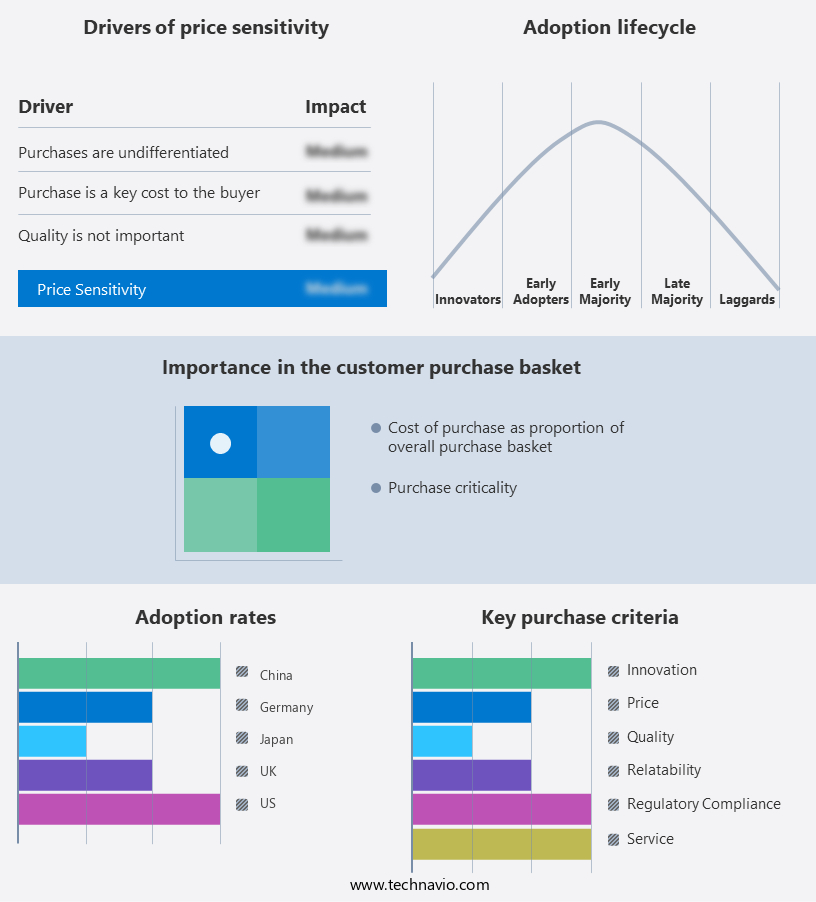
Customer Landscape
Key Companies & Market Insights
Companies are implementing various strategies, such as strategic alliances, virtual reality vr headset market forecast, partnerships, mergers and acquisitions, geographical expansion, and product/service launches, to enhance their presence In the industry.
Apple Inc. - The company introduces a cutting-edge virtual reality (VR) headset, the Apple Vision Pro, enhancing experiences for users. This innovative device aligns with our commitment to delivering advanced technology solutions. The VR headset's integration of state-of-the-art features significantly improves user engagement and interaction, providing a more captivating and interactive environment. By focusing on delivering a high-quality VR experience, we aim to lead the market and set new industry standards.
The industry research and growth report includes detailed analyses of the competitive landscape of the market and information about key companies, including:
- Apple Inc.
- ASUSTeK Computer Inc.
- ByteDance Ltd.
- FOVE Inc.
- Goertek Inc.
- Google LLC
- HP Inc.
- HTC Corp.
- LG Corp.
- Meta Platforms Inc.
- Microsoft Corp.
- NOLO Co. Ltd.
- Pimax Inc.
- Samsung Electronics Co. Ltd.
- Seiko Epson Corp.
- Sony Group Corp.
- Valve Corp.
- Varjo Technologies Oy
- WorldViz Inc.
- Xiaomi Inc.
Qualitative and quantitative analysis of companies has been conducted to help clients understand the wider business environment as well as the strengths and weaknesses of key industry players. Data is qualitatively analyzed to categorize companies as pure play, category-focused, industry-focused, and diversified; it is quantitatively analyzed to categorize companies as dominant, leading, strong, tentative, and weak.
Research Analyst Overview
Virtual Reality (VR) headsets have emerged as a transformative technology, revolutionizing various sectors by offering experiences. This market encompasses a range of devices, from non- to fully head-mounted displays (HMDs), as well as gesture-tracking devices and head-up displays. The VR market is experiencing significant growth, driven by advancements in technology and increasing adoption across commercial industries. One of the primary sectors witnessing substantial growth is healthcare, where VR is being utilized for virtual training, simulation events, and patient care systems. In planned ries, VR technology enables medical professionals to rehearse procedures, leading to improved precision and patient outcomes.
Moreover, VR headsets have found applications In the retail sector, enabling businesses to offer customers shopping experiences. In the realm of computer hardware, VR devices have become essential components, with large technology companies and start-ups investing heavily in research and development. Virtual Reality technology offers numerous benefits, including the ability to create realistic simulations and environments. However, it also presents challenges, such as health concerns related to VR sickness and physical discomfort. Eye and hearing issues are among the most common concerns, with prolonged use of low-resolution displays potentially causing eye strain and discomfort. Despite these challenges, the market for VR headsets continues to expand, with new devices and applications emerging regularly.
High-resolution displays and compact, lightweight designs are becoming increasingly popular, addressing concerns related to comfort and immersion. Furthermore, VR technology is not limited to HMDs alone. Augmented Reality (AR) devices, which overlay digital information onto the real world, are also gaining traction. These devices offer unique applications, particularly in commercial industries and real estate, where they can be used for virtual property tours and product demonstrations. The VR market is dynamic and evolving, with new players and innovations continually entering the scene. As technology advances and adoption rates increase, the potential applications for VR headsets are virtually limitless. Whether it's in healthcare, retail, or any other industry, VR is poised to transform the way we live, work, and interact with the world around us.
|
Market Scope |
|
|
Report Coverage |
Details |
|
Page number |
191 |
|
Base year |
2024 |
|
Historic period |
2019-2023 |
|
Forecast period |
2025-2029 |
|
Growth momentum & CAGR |
Accelerate at a CAGR of 51.1% |
|
Market growth 2025-2029 |
USD 43639.1 million |
|
Market structure |
Fragmented |
|
YoY growth 2024-2025(%) |
44.4 |
|
Key countries |
US, China, UK, Japan, Canada, India, Germany, France, Italy, and Brazil |
|
Competitive landscape |
Leading Companies, Market Positioning of Companies, Competitive Strategies, and Industry Risks |
What are the Key Data Covered in this Virtual Reality VR Headset Market Research and Growth Report?
- CAGR of the Virtual Reality VR Headset industry during the forecast period
- Detailed information on factors that will drive the growth and forecasting between 2025 and 2029
- Precise estimation of the size of the market and its contribution of the industry in focus to the parent market
- Accurate predictions about upcoming growth and trends and changes in consumer behaviour
- Growth of the market across North America, APAC, Europe, Middle East and Africa, and South America
- Thorough analysis of the market’s competitive landscape and detailed information about companies
- Comprehensive analysis of factors that will challenge the virtual reality vr headset market growth of industry companies
We can help! Our analysts can customize this virtual reality vr headset market research report to meet your requirements.
 RIA -
RIA - 
