
US Third-Party Logistics (3PL) Market Analysis - Size and Forecast 2025-2029

US Third-Party Logistics (3PL) Market Analysis - Size and Forecast 2025-2029

Published: Jan 2025 163 Pages SKU: IRTNTR41202

Market Overview at a Glance

$132.3 B
Market Opportunity
8.2%
CAGR
7.8
YoY growth 2024-2025(%)

US Third-Party Logistics (3Pl) Market Size 2025-2029 

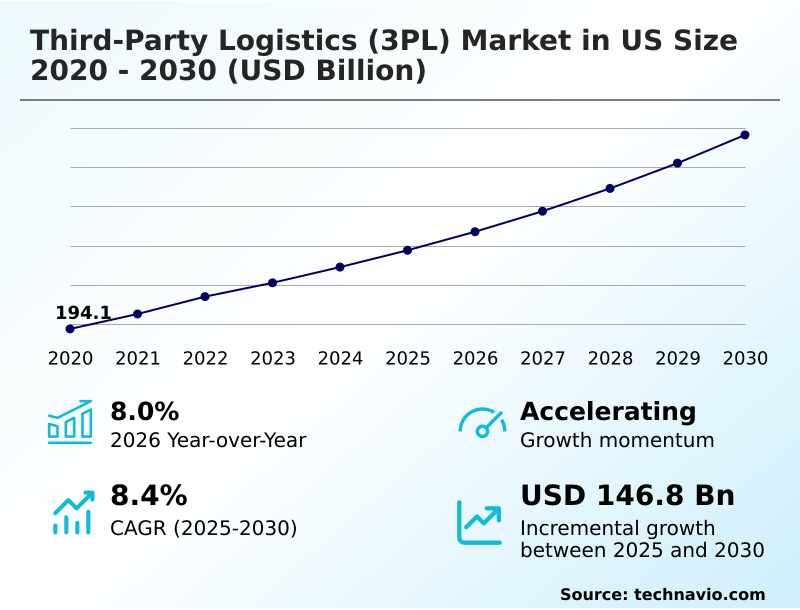
The us third-party logistics (3pl) market size is forecast to increase by USD 132.3 billion at a CAGR of 8.2% between 2024 and 2029.

  • The Third-Party Logistics (3PL) market in the US is experiencing significant growth, driven by the increasing trend of cross-border trade. As globalization continues to expand, businesses are increasingly turning to 3PL providers to manage their international logistics needs. Another key trend shaping the market is the emergence of advanced technologies such as blockchain and Radio Frequency Identification (RFID) in logistics. These technologies offer enhanced supply chain visibility, security, and efficiency, making them valuable tools for 3PLs to offer their clients. However, the market is not without challenges. The ongoing trade war between major economies poses a significant risk to the market, with potential tariffs and trade restrictions impacting logistics costs and operations.
  • Additionally, the increasing complexity of global supply chains and customer expectations for faster delivery times require 3PLs to continually innovate and adapt to remain competitive. Companies seeking to capitalize on market opportunities and navigate challenges effectively must focus on leveraging technology, building resilient supply chains, and providing exceptional customer service.

What will be the size of the US Third-Party Logistics (3Pl) Market during the forecast period?


Third-Party Logistics (3PL) Market in US Size

 Explore in-depth regional segment analysis with market size data - historical 2019-2023 and forecasts 2025-2029 - in the full report.  
Request Free Sample


  • The 3PL market in the US is witnessing significant advancements, driven by the integration of digital twin technology and blockchain in logistics operations. Order accuracy and customer satisfaction are prioritized through value-added services, network optimization, and demand forecasting. Green logistics and data-driven decisions are essential for competitive advantage, with automation technologies streamlining contract logistics and delivery speed. Damage prevention and inventory control are enhanced through supply chain transparency and warehousing optimization. Capacity planning and transportation mode selection are crucial for cost-effective solutions, while emerging technologies such as sustainability initiatives and supply chain visibility continue to shape the industry. Network planning and competitive advantage are intertwined, as companies leverage digital transformation to mitigate supply chain disruptions and offer dedicated logistics services.

How is this market segmented?

The market research report provides comprehensive data (region-wise segment analysis), with forecasts and estimates in "USD billion" for the period 2025-2029, as well as historical data from 2019-2023 for the following segments.

  • End-user
    • Retail
    • Manufacturing
    • Automotive
    • Food and beverages
    • Others
  • Service
    • Transportation
    • Warehousing and distribution
    • Others
  • Geography
    • North America
      • US

By End-user Insights

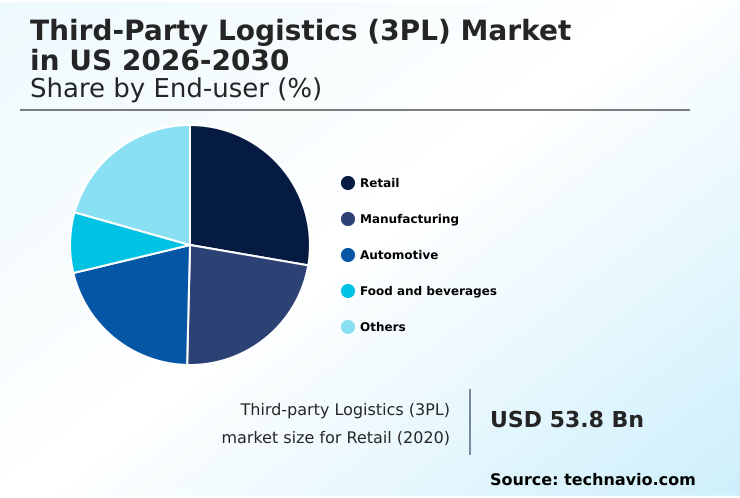
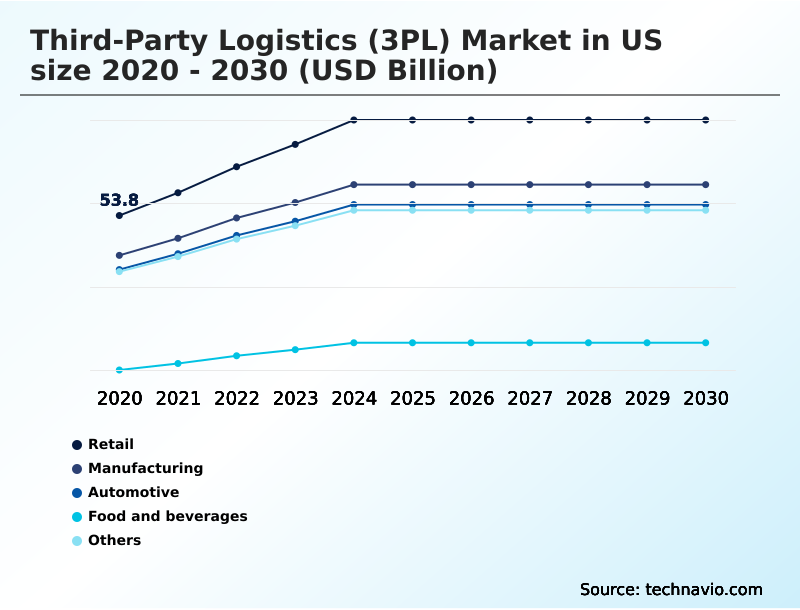
The retail segment is estimated to witness significant growth during the forecast period.

In the dynamic retail industry, both organized retail and consumer goods sectors experience significant growth. Fast-moving consumer goods (FMCGs) and slow-moving consumer goods (SMCGs) are distinct categories. FMCGs, with a shelf life under a year, consist of household and cleaning products, personal care items, tobacco, apparel and footwear, and pet food/pet care. These goods are bought frequently due to recurring expenditures. SMCGs, characterized by a longer shelf life, include home improvement products, furniture, and household appliances. To stay competitive, industry players invest substantially in product innovation. Data analytics and predictive analytics are crucial tools for understanding consumer behavior and market trends.

Last-mile delivery solutions enhance customer satisfaction, while pick-and-pack services ensure efficient order fulfillment. Freight forwarding streamlines transportation management, and robotics and automation improve efficiency. Cloud-based logistics software, business intelligence, and real-time visibility enable cost optimization and supply chain resilience. Reverse logistics, compliance, and regulations are essential for managing returns and maintaining inventory. E-commerce integration, packaging, and labeling, and delivery network design are vital for seamless omni-channel fulfillment. Risk management, route optimization, security and safety, and mobile technology are integral components of modern logistics. Artificial intelligence and machine learning enable advanced sorting, sequencing, and load planning. Fleet management, big data, and customer service are critical for maintaining a competitive edge.

In this evolving landscape, players must adapt to meet the changing demands of consumers and the market.


Third-Party Logistics (3PL) Market in US Share by End-user

Request Free Sample


The Retail segment was valued at  USD 56.50 billion in 2019 and showed a gradual increase during the forecast period.
Market Dynamics

Our researchers analyzed the data with 2024 as the base year, along with the key drivers, trends, and challenges. A holistic analysis of drivers will help companies refine their marketing strategies to gain a competitive advantage.

What are the US Third-Party Logistics (3Pl) Market market drivers leading to the rise in adoption of the Industry?

  • Cross-border trade is a significant and essential driver for market growth, as it fosters economic interdependence and the exchange of goods and services between nations. 

  • The third-party logistics (3PL) market in the US is experiencing significant growth due to the increasing trend of cross-border trade. This expansion allows businesses to reach new markets and customer bases, contributing to economic growth through increased tax revenue and GDP. In response to this demand, there is a growing focus on advanced logistics solutions to support cross-border commerce. One area of innovation is omni-channel fulfillment, which enables businesses to offer seamless shopping experiences across multiple channels. Customer service is also a key priority, with 3PLs utilizing fleet management and real-time visibility to ensure timely and accurate delivery.
  • Big data and artificial intelligence (AI) are being leveraged to optimize delivery network design and improve overall efficiency. Packaging and labeling are also critical components of the 3PL value proposition. Advanced solutions in these areas can help reduce costs, minimize damage during transportation, and ensure compliance with various regulations. Overall, the 3PL market is poised for continued growth as businesses seek to streamline their supply chains and expand their reach in an increasingly interconnected global economy.

What are the US Third-Party Logistics (3Pl) Market market trends shaping the Industry?

  • The integration of blockchain technology and RFID in logistics is an emerging market trend. This innovative combination is set to revolutionize supply chain management through enhanced security, transparency, and efficiency.

  • In the dynamic landscape of third-party logistics (3PL) in the US, technology plays a pivotal role in driving efficiency and enhancing service quality. Providers are increasingly adopting advanced technologies such as predictive analytics, data analytics, and robotics and automation to optimize operations and meet evolving customer demands. One of the most significant trends is the integration of blockchain technology into logistics processes. Blockchain enhances transparency and security by creating a decentralized, immutable record of transactions. This technology is particularly beneficial for last-mile delivery, pick and pack, freight forwarding, business continuity planning, distribution centers, and order fulfillment.
  • By using blockchain, stakeholders can track products in real-time, ensuring greater visibility and accountability throughout the supply chain. Moreover, transportation management systems (TMS) are becoming increasingly sophisticated, enabling real-time tracking, route optimization, and freight rate benchmarking. The adoption of these technologies is expected to continue, as businesses seek to streamline their logistics processes and improve overall supply chain performance. In conclusion, the US 3PL market is witnessing significant innovation, with a focus on leveraging technology to enhance operational efficiency, improve visibility, and deliver superior customer service. By investing in advanced technologies like predictive analytics, data analytics, robotics and automation, and blockchain, 3PL providers are well-positioned to meet the evolving needs of their clients and stay competitive in the market.

How does US Third-Party Logistics (3Pl) Market market faces challenges face during its growth?

  • The trade war's significant impact poses a major challenge to the industry's growth trajectory. 

  • The Third-Party Logistics (3PL) market in the US is experiencing significant growth due to the increasing demand for efficiency improvements and cost optimization. Businesses are turning to cloud-based logistics solutions to streamline operations and enhance business intelligence. Reverse logistics is another key area of focus, as companies seek to minimize waste and maximize the value of returned goods. Compliance and regulations continue to be a critical concern, with logistics software providing essential tools for ensuring adherence to complex rules. E-commerce integration is a major driver of growth in the 3PL market, as businesses strive to meet the demands of online shoppers for fast and reliable shipping and handling.
  • Logistics software plays a crucial role in managing inventory, ensuring accurate tracking and reducing the risk of stockouts or overstocks. Cost optimization is a key priority, with 3PLs leveraging advanced analytics and automation to reduce transportation costs and improve supply chain visibility. In summary, the 3PL market in the US is characterized by a focus on efficiency, innovation, and compliance. Cloud-based solutions, business intelligence, inventory management, e-commerce integration, and shipping and handling are key areas of investment, as businesses seek to optimize their logistics operations and stay competitive in a rapidly changing marketplace.

Exclusive US Third-Party Logistics (3Pl) Market Customer Landscape

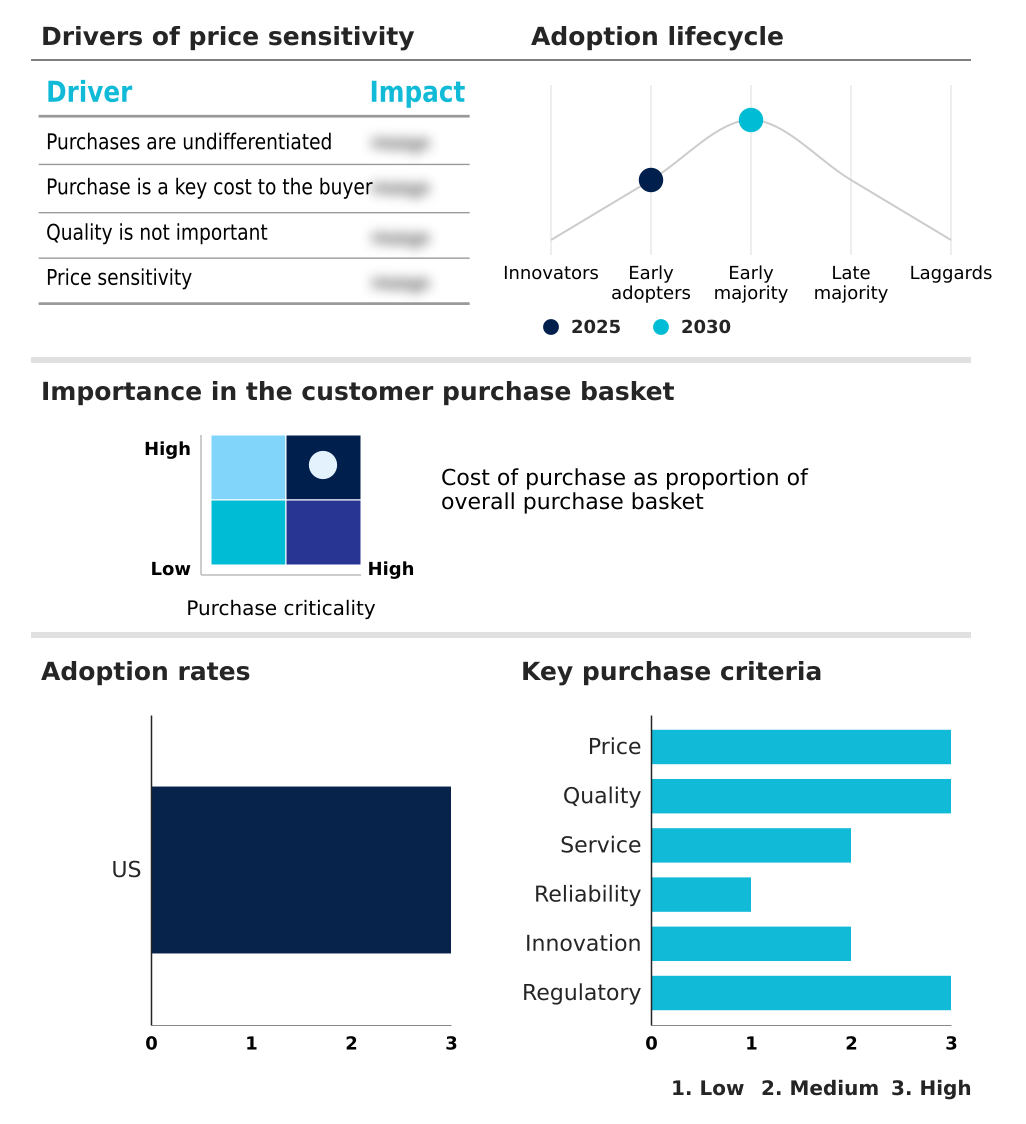
The market forecasting report includes the adoption lifecycle of the market, covering from the innovator’s stage to the laggard’s stage. It focuses on adoption rates in different regions based on penetration. Furthermore, the report also includes key purchase criteria and drivers of price sensitivity to help companies evaluate and develop their market growth analysis strategies.
Third-Party Logistics (3PL) Market in US Share by Geography

 Customer Landscape

Key Companies & Market Insights

Companies are implementing various strategies, such as strategic alliances, market forecast partnerships, mergers and acquisitions, geographical expansion, and product/service launches, to enhance their presence in the market.

The market research and growth report includes detailed analyses of the competitive landscape of the market and information about key companies, including:

  • Americold Realty Trust Inc.
  • Blu Logistics
  • Burris Logistics Co.
  • C H Robinson Worldwide Inc.
  • Crete Carrier Corp.
  • Deutsche Post AG
  • Expeditors International of Washington Inc.
  • FedEx Corp.
  • Hub Group Inc.
  • J B Hunt Transport Services Inc.
  • Kenco Group Inc.
  • Kuehne Nagel Management AG
  • M and W Logistics Group Inc.
  • NFI Industries Inc.
  • Ryder System Inc.
  • Taylor Logistics Inc.
  • Total Quality Logistics LLC
  • United Parcel Service Inc.
  • Wagner Logistics Inc.
  • XPO Inc.

Qualitative and quantitative analysis of companies has been conducted to help clients understand the wider business environment as well as the strengths and weaknesses of key market players. Data is qualitatively analyzed to categorize companies as pure play, category-focused, industry-focused, and diversified; it is quantitatively analyzed to categorize companies as dominant, leading, strong, tentative, and weak.

Recent Development and News in Third-Party Logistics (3PL) Market In US

  • In March 2024, DHL Supply Chain, a leading 3PL provider, announced the launch of its new Robotic Picking Solution, revolutionizing order fulfillment processes for e-commerce businesses. This innovative technology uses robots to pick and pack orders more efficiently and accurately, reducing human intervention and errors (DHL Press Release).
  • In June 2025, UPS entered into a strategic partnership with Microsoft to integrate UPS's logistics data and services into Microsoft's Azure platform. This collaboration aims to provide real-time visibility and predictive analytics for customers, enhancing supply chain efficiency and responsiveness (UPS Press Release).
  • In October 2024, XPO Logistics completed the acquisition of BDP International's Contract Logistics business, expanding its global network and adding significant capacity to its European and Asian operations. This acquisition strengthened XPO's position as a major player in the 3PL market (XPO Logistics SEC Filing).
  • In January 2025, the Biden Administration announced the Bipartisan Infrastructure Law, which includes USD17 billion for ports and waterways infrastructure improvements. This investment is expected to boost demand for 3PL services, as companies seek to optimize their supply chains and adapt to increased shipping volumes (White House Press Release).

Research Analyst Overview

The third-party logistics (3PL) market in the US continues to evolve, with dynamic market activities shaping the industry's landscape. Seamlessly integrated solutions, such as predictive analytics and data analytics, are revolutionizing operations in various sectors. Last mile delivery, pick and pack, freight forwarding, business continuity planning, and distribution centers are no longer standalone functions but essential components of a cohesive logistics strategy. Efficiency improvements through cloud-based solutions, reverse logistics, and business intelligence are driving growth. Compliance and regulations, inventory management, e-commerce integration, and shipping and handling are also critical areas of focus. Robotics and automation are transforming order fulfillment, transportation management, and warehouse operations.

Logistics software, cost optimization, and fulfillment centers are essential for supply chain resilience. Load planning, risk management, and supply chain optimization are key elements of a comprehensive logistics strategy. Sorting and sequencing, route optimization, security and safety, mobile technology, tracking and tracing, omni-channel fulfillment, customer service, fleet management, big data, real-time visibility, packaging and labeling, and delivery network design are all interconnected components of the evolving 3PL market. Incorporating artificial intelligence (AI) and real-time data analysis is becoming increasingly important for staying competitive. The integration of these technologies is revolutionizing operations, from warehouse management to transportation and delivery.

The market's continuous dynamism is a testament to the industry's ability to adapt and innovate, ensuring it remains a vital component of the global business landscape.

Dive into Technavio’s robust research methodology, blending expert interviews, extensive data synthesis, and validated models for unparalleled Third-Party Logistics (3PL) Market in US insights. See full methodology.

Market Scope

Report Coverage

Details

Page number

163

Base year

2024

Historic period

2019-2023

Forecast period

2025-2029

Growth momentum & CAGR

Accelerate at a CAGR of 8.2%

Market growth 2025-2029

USD 132.3 billion

Market structure

Fragmented

YoY growth 2024-2025(%)

7.8

Competitive landscape

Leading Companies, Market Positioning of Companies, Competitive Strategies, and Industry Risks

Request Free Sample

What are the Key Data Covered in this Market Research Report?

  • CAGR of the market during the forecast period
  • Detailed information on factors that will drive the market growth and forecasting between 2025 and 2029
  • Precise estimation of the size of the market  and its contribution of the market in focus to the parent market
  • Accurate predictions about upcoming market growth and trends and changes in consumer behaviour
  • Growth of the market across US
  • Thorough analysis of the market’s competitive landscape and detailed information about companies
  • Comprehensive analysis of factors that will challenge the growth of market companies

We can help! Our analysts can customize this market research report to meet your requirements Get in touch


1 Executive Summary

  • 1.1 Market overview
    • Executive Summary - Chart on Market Overview
    • Executive Summary - Data Table on Market Overview
    • Executive Summary - Chart on Country Market Characteristics
    • Executive Summary - Chart on Market Segmentation by End-user
    • Executive Summary - Chart on Market Segmentation by Service
    • Executive Summary - Chart on Company Market Positioning

2 Technavio Analysis

  • 2.1 Analysis of price sensitivity, lifecycle, customer purchase basket, adoption rates, and purchase criteria
    • Analysis of price sensitivity, lifecycle, customer purchase basket, adoption rates, and purchase criteria
  • 2.2 Criticality of inputs and Factors of differentiation
    • Overview on criticality of inputs and factors of differentiation
  • 2.3 Factors of disruption
    • Overview on factors of disruption
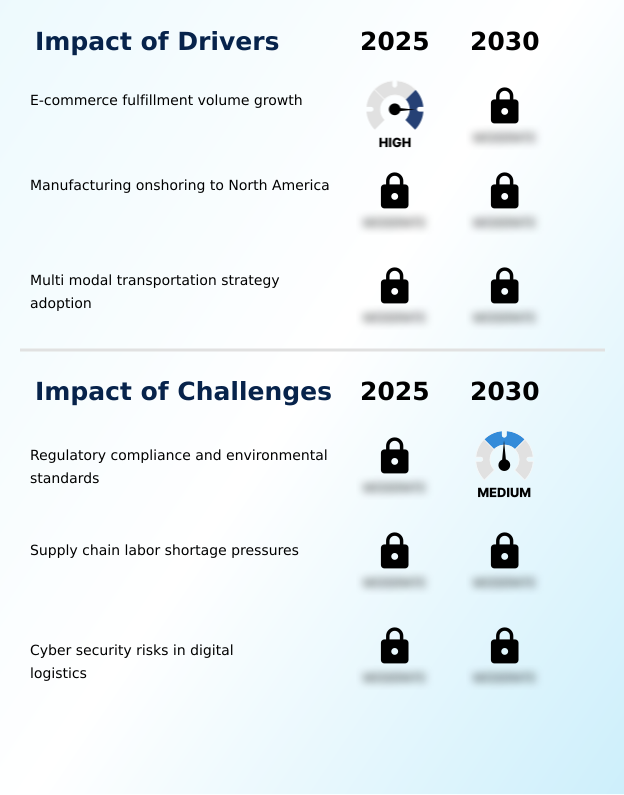
  • 2.4 Impact of drivers and challenges
    • Impact of drivers and challenges in 2024 and 2029

3 Market Landscape

  • 3.1 Market ecosystem
    • Parent Market
    • Data Table on - Parent Market
  • 3.2 Market characteristics
    • Market characteristics analysis
  • 3.3 Value chain analysis
    • Value chain analysis

4 Market Sizing

  • 4.1 Market definition
    • Offerings of companies included in the market definition
  • 4.2 Market segment analysis
    • Market segments
  • 4.3 Market size 2024
    • 4.4 Market outlook: Forecast for 2024-2029
      • Chart on US - Market size and forecast 2024-2029 ($ billion)
      • Data Table on US - Market size and forecast 2024-2029 ($ billion)
      • Chart on US: Year-over-year growth 2024-2029 (%)
      • Data Table on US: Year-over-year growth 2024-2029 (%)

    5 Historic Market Size

    • 5.1 Third-Party Logistics (3PL) Market in US 2019 - 2023
      • Historic Market Size - Data Table on Third-Party Logistics (3PL) Market in US 2019 - 2023 ($ billion)
    • 5.2 End-user segment analysis 2019 - 2023
      • Historic Market Size - End-user Segment 2019 - 2023 ($ billion)
    • 5.3 Service segment analysis 2019 - 2023
      • Historic Market Size - Service Segment 2019 - 2023 ($ billion)

    6 Qualitative Analysis

    • 6.1 Impact of AI on the Third-Party Logistics (3PL) Market in US

      7 Five Forces Analysis

      • 7.1 Five forces summary
        • Five forces analysis - Comparison between 2024 and 2029
      • 7.2 Bargaining power of buyers
        • Bargaining power of buyers - Impact of key factors 2024 and 2029
      • 7.3 Bargaining power of suppliers
        • Bargaining power of suppliers - Impact of key factors in 2024 and 2029
      • 7.4 Threat of new entrants
        • Threat of new entrants - Impact of key factors in 2024 and 2029
      • 7.5 Threat of substitutes
        • Threat of substitutes - Impact of key factors in 2024 and 2029
      • 7.6 Threat of rivalry
        • Threat of rivalry - Impact of key factors in 2024 and 2029
      • 7.7 Market condition
        • Chart on Market condition - Five forces 2024 and 2029

      8 Market Segmentation by End-user

      • 8.1 Market segments
        • Chart on End-user - Market share 2024-2029 (%)
        • Data Table on End-user - Market share 2024-2029 (%)
      • 8.2 Comparison by End-user
        • Chart on Comparison by End-user
        • Data Table on Comparison by End-user
      • 8.3 Retail - Market size and forecast 2024-2029
        • Chart on Retail - Market size and forecast 2024-2029 ($ billion)
        • Data Table on Retail - Market size and forecast 2024-2029 ($ billion)
        • Chart on Retail - Year-over-year growth 2024-2029 (%)
        • Data Table on Retail - Year-over-year growth 2024-2029 (%)
      • 8.4 Manufacturing - Market size and forecast 2024-2029
        • Chart on Manufacturing - Market size and forecast 2024-2029 ($ billion)
        • Data Table on Manufacturing - Market size and forecast 2024-2029 ($ billion)
        • Chart on Manufacturing - Year-over-year growth 2024-2029 (%)
        • Data Table on Manufacturing - Year-over-year growth 2024-2029 (%)
      • 8.5 Automotive - Market size and forecast 2024-2029
        • Chart on Automotive - Market size and forecast 2024-2029 ($ billion)
        • Data Table on Automotive - Market size and forecast 2024-2029 ($ billion)
        • Chart on Automotive - Year-over-year growth 2024-2029 (%)
        • Data Table on Automotive - Year-over-year growth 2024-2029 (%)
      • 8.6 Food and beverages - Market size and forecast 2024-2029
        • Chart on Food and beverages - Market size and forecast 2024-2029 ($ billion)
        • Data Table on Food and beverages - Market size and forecast 2024-2029 ($ billion)
        • Chart on Food and beverages - Year-over-year growth 2024-2029 (%)
        • Data Table on Food and beverages - Year-over-year growth 2024-2029 (%)
      • 8.7 Others - Market size and forecast 2024-2029
        • Chart on Others - Market size and forecast 2024-2029 ($ billion)
        • Data Table on Others - Market size and forecast 2024-2029 ($ billion)
        • Chart on Others - Year-over-year growth 2024-2029 (%)
        • Data Table on Others - Year-over-year growth 2024-2029 (%)
      • 8.8 Market opportunity by End-user
        • Market opportunity by End-user ($ billion)
        • Data Table on Market opportunity by End-user ($ billion)

      9 Market Segmentation by Service

      • 9.1 Market segments
        • Chart on Service - Market share 2024-2029 (%)
        • Data Table on Service - Market share 2024-2029 (%)
      • 9.2 Comparison by Service
        • Chart on Comparison by Service
        • Data Table on Comparison by Service
      • 9.3 Transportation - Market size and forecast 2024-2029
        • Chart on Transportation - Market size and forecast 2024-2029 ($ billion)
        • Data Table on Transportation - Market size and forecast 2024-2029 ($ billion)
        • Chart on Transportation - Year-over-year growth 2024-2029 (%)
        • Data Table on Transportation - Year-over-year growth 2024-2029 (%)
      • 9.4 Warehousing and distribution - Market size and forecast 2024-2029
        • Chart on Warehousing and distribution - Market size and forecast 2024-2029 ($ billion)
        • Data Table on Warehousing and distribution - Market size and forecast 2024-2029 ($ billion)
        • Chart on Warehousing and distribution - Year-over-year growth 2024-2029 (%)
        • Data Table on Warehousing and distribution - Year-over-year growth 2024-2029 (%)
      • 9.5 Others - Market size and forecast 2024-2029
        • Chart on Others - Market size and forecast 2024-2029 ($ billion)
        • Data Table on Others - Market size and forecast 2024-2029 ($ billion)
        • Chart on Others - Year-over-year growth 2024-2029 (%)
        • Data Table on Others - Year-over-year growth 2024-2029 (%)
      • 9.6 Market opportunity by Service
        • Market opportunity by Service ($ billion)
        • Data Table on Market opportunity by Service ($ billion)

      10 Customer Landscape

      • 10.1 Customer landscape overview
        • Analysis of price sensitivity, lifecycle, customer purchase basket, adoption rates, and purchase criteria

      11 Drivers, Challenges, and Opportunity/Restraints

      • 11.1 Market drivers
        • 11.2 Market challenges
          • 11.3 Impact of drivers and challenges
            • Impact of drivers and challenges in 2024 and 2029
          • 11.4 Market opportunities/restraints

            12 Competitive Landscape

            • 12.1 Overview
              • 12.2 Competitive Landscape
                • Overview on criticality of inputs and factors of differentiation
              • 12.3 Landscape disruption
                • Overview on factors of disruption
              • 12.4 Industry risks
                • Impact of key risks on business

              13 Competitive Analysis

              • 13.1 Companies profiled
                • Companies covered
              • 13.2 Company ranking index
                • Company ranking index
              • 13.3 Market positioning of companies
                • Matrix on companies position and classification
              • 13.4 Americold Realty Trust Inc.
                • Americold Realty Trust Inc. - Overview
                • Americold Realty Trust Inc. - Business segments
                • Americold Realty Trust Inc. - Key news
                • Americold Realty Trust Inc. - Key offerings
                • Americold Realty Trust Inc. - Segment focus
                • SWOT
              • 13.5 Burris Logistics Co.
                • Burris Logistics Co. - Overview
                • Burris Logistics Co. - Product / Service
                • Burris Logistics Co. - Key offerings
                • SWOT
              • 13.6 C H Robinson Worldwide Inc.
                • C H Robinson Worldwide Inc. - Overview
                • C H Robinson Worldwide Inc. - Business segments
                • C H Robinson Worldwide Inc. - Key news
                • C H Robinson Worldwide Inc. - Key offerings
                • C H Robinson Worldwide Inc. - Segment focus
                • SWOT
              • 13.7 Deutsche Post AG
                • Deutsche Post AG - Overview
                • Deutsche Post AG - Business segments
                • Deutsche Post AG - Key news
                • Deutsche Post AG - Key offerings
                • Deutsche Post AG - Segment focus
                • SWOT
              • 13.8 Expeditors International of Washington Inc.
                • Expeditors International of Washington Inc. - Overview
                • Expeditors International of Washington Inc. - Business segments
                • Expeditors International of Washington Inc. - Key offerings
                • Expeditors International of Washington Inc. - Segment focus
                • SWOT
              • 13.9 FedEx Corp.
                • FedEx Corp. - Overview
                • FedEx Corp. - Business segments
                • FedEx Corp. - Key news
                • FedEx Corp. - Key offerings
                • FedEx Corp. - Segment focus
                • SWOT
              • 13.10 Hub Group Inc.
                • Hub Group Inc. - Overview
                • Hub Group Inc. - Product / Service
                • Hub Group Inc. - Key offerings
                • SWOT
              • 13.11 J B Hunt Transport Services Inc.
                • J B Hunt Transport Services Inc. - Overview
                • J B Hunt Transport Services Inc. - Business segments
                • J B Hunt Transport Services Inc. - Key offerings
                • J B Hunt Transport Services Inc. - Segment focus
                • SWOT
              • 13.12 Kenco Group Inc.
                • Kenco Group Inc. - Overview
                • Kenco Group Inc. - Product / Service
                • Kenco Group Inc. - Key offerings
                • SWOT
              • 13.13 Kuehne Nagel Management AG
                • Kuehne Nagel Management AG - Overview
                • Kuehne Nagel Management AG - Business segments
                • Kuehne Nagel Management AG - Key news
                • Kuehne Nagel Management AG - Key offerings
                • Kuehne Nagel Management AG - Segment focus
                • SWOT
              • 13.14 M and W Logistics Group Inc.
                • M and W Logistics Group Inc. - Overview
                • M and W Logistics Group Inc. - Product / Service
                • M and W Logistics Group Inc. - Key offerings
                • SWOT
              • 13.15 NFI Industries Inc.
                • NFI Industries Inc. - Overview
                • NFI Industries Inc. - Product / Service
                • NFI Industries Inc. - Key offerings
                • SWOT
              • 13.16 Ryder System Inc.
                • Ryder System Inc. - Overview
                • Ryder System Inc. - Business segments
                • Ryder System Inc. - Key news
                • Ryder System Inc. - Key offerings
                • Ryder System Inc. - Segment focus
                • SWOT
              • 13.17 United Parcel Service Inc.
                • United Parcel Service Inc. - Overview
                • United Parcel Service Inc. - Business segments
                • United Parcel Service Inc. - Key news
                • United Parcel Service Inc. - Key offerings
                • United Parcel Service Inc. - Segment focus
                • SWOT
              • 13.18 XPO Inc.
                • XPO Inc. - Overview
                • XPO Inc. - Business segments
                • XPO Inc. - Key news
                • XPO Inc. - Key offerings
                • XPO Inc. - Segment focus
                • SWOT

              14 Appendix

              • 14.1 Scope of the report
                • 14.2 Inclusions and exclusions checklist
                  • Inclusions checklist
                  • Exclusions checklist
                • 14.3 Currency conversion rates for US$
                  • Currency conversion rates for US$
                • 14.4 Research methodology
                  • Research methodology
                • 14.5 Data procurement
                  • Information sources
                • 14.6 Data validation
                  • Data validation
                • 14.7 Validation techniques employed for market sizing
                  • Validation techniques employed for market sizing
                • 14.8 Data synthesis
                  • Data synthesis
                • 14.9 360 degree market analysis
                  • 360 degree market analysis
                • 14.10 List of abbreviations
                  • List of abbreviations

                Research Methodology

                Technavio presents a detailed picture of the market by way of study, synthesis, and summation of data from multiple sources. The analysts have presented the various facets of the market with a particular focus on identifying the key industry influencers. The data thus presented is comprehensive, reliable, and the result of extensive research, both primary and secondary.

                INFORMATION SOURCES

                Primary sources

                • Manufacturers and suppliers
                • Channel partners
                • Industry experts
                • Strategic decision makers

                Secondary sources

                • Industry journals and periodicals
                • Government data
                • Financial reports of key industry players
                • Historical data
                • Press releases

                DATA ANALYSIS

                Data Synthesis

                • Collation of data
                • Estimation of key figures
                • Analysis of derived insights

                Data Validation

                • Triangulation with data models
                • Reference against proprietary databases
                • Corroboration with industry experts

                REPORT WRITING

                Qualitative

                • Market drivers
                • Market challenges
                • Market trends
                • Five forces analysis

                Quantitative

                • Market size and forecast
                • Market segmentation
                • Geographical insights
                • Competitive landscape

                Interested in this report?

                Get your sample now to see our research methodology and insights!

                Download Now

                Frequently Asked Questions

                Third-Party Logistics (3Pl) market growth will increase by $ 132.3 bn during 2025-2029 .

                The Third-Party Logistics (3Pl) market is expected to grow at a CAGR of 8.2% during 2025-2029 .

                Third-Party Logistics (3Pl) market is segmented by End-user( Retail, Manufacturing, Automotive, Food and beverages, Others) Service( Transportation, Warehousing and distribution, Others)

                Americold Realty Trust Inc., Blu Logistics, Burris Logistics Co., C H Robinson Worldwide Inc., Crete Carrier Corp., Deutsche Post AG, Expeditors International of Washington Inc., FedEx Corp., Hub Group Inc., J B Hunt Transport Services Inc., Kenco Group Inc., Kuehne Nagel Management AG, M and W Logistics Group Inc., NFI Industries Inc., Ryder System Inc., Taylor Logistics Inc., Total Quality Logistics LLC, United Parcel Service Inc., Wagner Logistics Inc., XPO Inc. are a few of the key vendors in the Third-Party Logistics (3Pl) market.

                North America will register the highest growth rate of 100% among the other regions. Therefore, the Third-Party Logistics (3Pl) market in North America is expected to garner significant business opportunities for the vendors during the forecast period.

                US

                • Increasing cross-border tradeCross-border trade involves the sales and purchase of goods and services across international land borders. It allows enterprises to expand their business in terms of geography and demographics. It also helps boost the economy of a country as the export and import of goods lead to an increase in tax revenue is the driving factor this market.
                • which contributes to the gross domestic product (GDP). This has encouraged various manufacturers to increase their cross-border trade is the driving factor this market.
                • thus enhancing the demand for 3PL providers. Increasing cross-border trade is also leading to a rise in the development of new trade corridors and the expansion of the existing trade corridors. Trade corridors are integrated transport networks between geographical regions to facilitate trade and promote economic development. These corridors comprise integrated infrastructures is the driving factor this market.
                • such as railroads and highways is the driving factor this market.
                • which link cities or countries. Various state government bodies in the US are investing in developing new transport infrastructure programs is the driving factor this market.
                • including trade corridors is the driving factor this market.
                • for the easy transportation of goods and commodities. For instance is the driving factor this market.
                • The Trade Corridor Enhancement Program (TCEP) has been initiated in California is the driving factor this market.
                • the US is the driving factor this market.
                • which aims at freight rail system expansions is the driving factor this market.
                • truck corridor improvements is the driving factor this market.
                • surface transportation is the driving factor this market.
                • and more.These economic corridors will be used by enterprises to transport products such as electronics is the driving factor this market.
                • vegetables is the driving factor this market.
                • and fruits across borders during the forecast period. 3PL services will be used to transport these products with their desired quality. With an increase in cross-border trade is the driving factor this market.
                • the demand for 3PL services will also rise is the driving factor this market.
                • which will drive the growth of the third-party logistics (3PL) market in US during the forecast period. is the driving factor this market.

                The Third-Party Logistics (3Pl) market vendors should focus on grabbing business opportunities from the Retail segment as it accounted for the largest market share in the base year.