


Aerogel Market Analysis North America, Europe, APAC, South America, Middle East and Africa - US, Germany, China, UK, Japan - Size and Forecast 2024-2028

Aerogel Market Analysis North America, Europe, APAC, South America, Middle East and Africa - US, Germany, China, UK, Japan - Size and Forecast 2024-2028

Published: Jul 2024 180 Pages SKU: IRTNTR70473

Market Overview at a Glance

$822.1 Mn
Market Opportunity
13.63%
CAGR
11.72
YoY growth 2023-2024(%)

Aerogel Market Size 2024-2028

The aerogel market size is forecast to increase by USD 822.1 million at a CAGR of 13.63% between 2023 and 2028.

  • The market is experiencing significant growth due to the increasing demand for lightweight and thin insulation materials. The use of aerogels in apparel for colder climates is a burgeoning trend, offering enhanced comfort and warmth to consumers. However, the high cost of production remains a major challenge for market growth. Despite this, the potential benefits of aerogels, including their exceptional insulation properties and low thermal conductivity, make them an attractive alternative to traditional insulation materials. As the market continues to evolve, innovations in production methods and cost reduction strategies are expected to drive growth and expand the applications of aerogels in various industries.
  • What will be the Size of the Aerogel Market During the Forecast Period?

    Aerogel Market Size

     Request Free Sample

  • The market encompasses a range of high-performance insulation materials, including thermal resistance leaders such as silica, polymer, and carbon aerogels. Known for their ultra-low densities and exceptional thermal insulation properties, aerogels offer significant benefits in various industries. In transportation, aerogels' lightweight and fire-resistant qualities enhance internal combustion engines and electric vehicles. Maritime applications utilize aerogels for thermal insulation in marine engines and refrigeration systems. In building and construction, aerogels' insulation properties contribute to energy efficiency and sustainability. Additionally, performance coatings and industrial processes, such as oil refining and natural gas production, benefit from the use of aerogels. With advancements in manufacturing techniques, including supercritical drying and ambient pressure drying, the perspectives for this market are promising.
  • Product literatures highlight the unique mesoporous solid foam nanostructure networks, porosity, and liquid component interactions that contribute to the superior insulation properties of aerogels.
  • How is this Aerogel Industry segmented and which is the largest segment?

    The aerogel industry research report provides comprehensive data (region-wise segment analysis), with forecasts and estimates in "USD million" for the period 2024-2028, as well as historical data from 2018-2022 for the following segments.

    • Application
      • Oil and gas
      • Construction
      • Automotive
      • marine
      • aerospace
      • Performance coatings
    • Product
      • Silica
      • Polymer
      • Carbon
      • Others
    • Geography
      • North America
        • US
      • Europe
        • Germany
        • UK
      • APAC
        • China
        • Japan
      • South America
        • Middle East and Africa

        By Application Insights

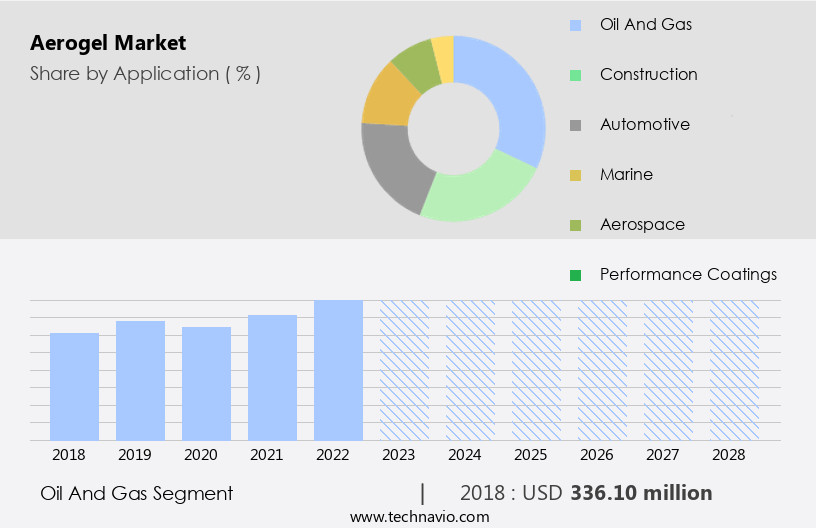
        • The oil and gas segment is estimated to witness significant growth during the forecast period.

        The oil and gas industry relies heavily on insulation materials to maintaIn the temperature of hydrocarbon transport pipelines, particularly in challenging environments such as sub-sea and arctic regions. Aerogels, known for their thermal resistance, lightweight, and low density properties, are increasingly being adopted for this purpose. These insulations help prevent the clogging of unprocessed hydrocarbons in flow lines, ensuring efficient transportation. Aerogels are available in various forms, including blankets, particles, panels, monoliths, and performance coatings, made from silica, polymers, or carbon. The superior insulation properties of aerogels make them an essential component In the oil and gas sector, contributing to the growth of this market.

        Additionally, the eco-friendly nature of aerogels adds to their appeal as a sustainable insulation material.
        Aerogel Market Size

        Get a glance at the  Aerogel Industry report of share of various segments Request Free Sample

        The Oil and gas segment was valued at USD 336.10 million in 2018 and showed a gradual increase during the forecast period.

        Regional Analysis

        • North America is estimated to contribute 45% to the growth of the global market during the forecast period.

        Technavio’s analysts have elaborately explained the regional trends and drivers that shape the market during the forecast period.

        Aerogel Market Share by Geography

        For more insights on the market share of various regions, Request Free Sample

        The North American the market is experiencing significant growth due to increasing product innovation and expanding applications in various industries. The primary drivers of this market are the oil and gas sectors, with increasing usage in automotive, marine, and aerospace applications. Key players in this region include Aspen Aerogels and Aerogel Technologies, both of which offer high-performance aerogels in various forms. These companies cater to diverse markets, including thermal insulation for buildings and construction, performance coatings, and lightweight materials for aerospace engineering. Aerogels, known for their thermal resistance, lightweight, low density, and fire-resistant properties, are increasingly being adopted for their insulation capabilities in various industries.

        The market is expected to continue growing due to advancements in materials, such as mesoporous solid foams, nanostructure networks, and porosity, which enhance the insulation material's performance. The eco-friendly nature of aerogels, coupled with their potential applications in healthcare, electronics, and agriculture, further expands their market reach.

        Market Dynamics

        Our  researchers analyzed the data with 2023 as the base year, along with the key drivers, trends, and challenges. A holistic analysis of drivers will help companies refine their marketing strategies to gain a competitive advantage.

        What are the key market drivers leading to the rise In the adoption of Aerogel Industry?

        Growing demand for lightweight and thinner substitutes for insulation is the key driver of the market.

      • The global market for aerogels, including thermal resistance, lightweight, and low-density materials such as silica aerogels, polymer aerogels, and carbon aerogels, is experiencing significant growth due to increasing demand for energy efficiency and insulation in various industries. Aerogels offer superior thermal insulation properties compared to traditional insulation materials like polyurethane foam, mineral wool, rock wool, and stone wool. Their unique nanostructure network and high porosity make them effective in reducing heat loss, making them ideal for applications in internal combustion engines, electric vehicles, marine, building and construction, performance coatings, oil, gas, and power generation. The eco-friendly nature of aerogels also makes them attractive for use in healthcare, electronics, and apparel industries.
      • Advancements in materials and manufacturing processes such as supercritical drying, ambient pressure drying, and freeze-drying have improved the mechanical strength and versatility of aerogels, expanding their applications in agriculture, aerospace engineering, spacecraft insulation, fuel lines, and electronics protection. The growing focus on energy efficiency and reducing carbon emissions, as well as the increasing adoption of renewable energy sources, are expected to drive the growth of the market In the coming years. Despite the high production costs, the competitive nature of the market and the potential for cost savings through improved energy efficiency and reduced material usage make aerogels a promising investment for manufacturers and consumers alike.
      • What are the market trends shaping the Aerogel Industry?

        Growing use of apparel for colder places is the upcoming market trend.

      • Aerogel, a revolutionary material known for its thermal resistance, lightweight, and low density properties, is increasingly being utilized across various industries. In the realm of thermal insulation, aerogels offer unparalleled performance. They are used in blankets, panels, and monoliths to insulate internal combustion engines, electric vehicles, marine applications, and buildings. Aerogels' fire-resistant nature makes them suitable for use in aerospace, healthcare, electronics, and mechanical engineering. The production of aerogels involves supercritical drying techniques, such as freeze-drying, ambient pressure drying, and supercritical drying, which preserve the nanostructure network and porosity of the material. Two primary types of aerogels exist: silica aerogels and polymer and carbon aerogels.
      • These materials offer superior insulation compared to traditional materials like polyurethane foam, Rock wool, Mineral wool, and Stone wool. Aerogels' eco-friendly nature and versatility make them a desirable alternative in industries seeking energy efficiency and reduced emissions. They are used in power generation, agriculture, and even spacecraft insulation. In the building and construction sector, aerogels are employed to minimize heat loss, protect fuel lines, and safeguard electronics. Additionally, they are used in performance coatings for cooking oil, wheat, barley, corn, petroleum, fertilizers, and energy supply applications. The competitive nature of the market, with players such as Enersens, Cabot Corporation, and various fabricators and installers, is driving advancements in materials and applications.
      • As the world transitions to cleaner energy sources and more energy-efficient technologies, the demand for aerogels is expected to grow. The Versailles Declaration and EU leaders' focus on energy efficiency, oil imports, energy mixes, and energy interconnections of gas further underscores the importance of insulation materials like aerogels. In conclusion, aerogels' unique properties and versatility make them an essential component in various industries. Their use In thermal insulation, fire resistance, and eco-friendly applications is driving their demand and growth In the market. As the world moves towards cleaner energy sources and more energy-efficient technologies, the importance of aerogels is set to increase.
      • What challenges does the Aerogel Industry face during its growth?

        High cost of production is a key challenge affecting the industry growth.

      • The market faces a significant challenge due to the high manufacturing costs associated with producing these advanced materials. The expense is primarily driven by the high cost of raw materials, particularly alkoxide-based precursors, and the intricate production processes. These methods involve lengthy reaction times limited by diffusion and solvent exchange steps, as well as the installation of small-scale production facilities by manufacturers. Furthermore, extensive research and development (R&D) investments add to the overall cost. Synthesizing aerogel materials employs various techniques, but their versatility is limited. The primary factors contributing to the high cost include the costly raw materials, complex production processes, and substantial R&D investments.
      • Silica aerogels, in particular, are affected by the high price of alkoxide-based precursors. The production processes are intricate, with lengthy reaction times and solvent exchange steps, and small-scale production capacities. Despite these challenges, advancements in materials science continue to drive innovation In the market, with potential applications in various industries such as thermal insulation, fire-resistance, and performance coatings. Aerogels offer exceptional thermal resistance, making them highly desirable for insulation applications. Their low density and high porosity contribute to their excellent insulation properties, making them suitable for use in blankets, panels, monoliths, and other forms. Aerogels have gained popularity in industries such as internal combustion engines, electric vehicles, marine, building and construction, and aerospace.
      • They are also used in various sectors like healthcare, electronics, agriculture, power generation, and spacecraft insulation. Aerogels are available in various forms, including blanket aerogels, particle aerogels, aerogel panels, and performance coatings. These materials are made from silica, polymers, or carbon, and their production involves methods such as supercritical drying, ambient pressure drying, and freeze-drying. Aerogels have a unique nanostructure network, which provides them with excellent insulation properties, making them an eco-friendly alternative to traditional insulation materials like polyurethane foam, rock wool, mineral wool, and stone wool. The demand for aerogels is driven by their superior performance in various applications.
      • In the automotive industry, aerogels are used for insulating fuel lines and protecting electronics from heat. In the marine industry, they are used for insulating ships to improve fuel efficiency and reduce emissions. In the construction sector, aerogels are used for insulating buildings to improve energy efficiency and reduce heating and cooling costs. In the aerospace industry, aerogels are used for insulating spacecraft to maintain optimal temperatures and protect against extreme temperatures. Aerogels are also used in various industries for their unique properties. In the healthcare sector, they are used for wound dressings due to their high porosity and ability to absorb fluids.
      • In the electronics industry, they are used for thermal management and as protective coatings. In the apparel industry, aerogels are used for insulation in extreme weather conditions. In the agriculture sector, they are used for insulating greenhouses to maintain optimal temperatures and improve crop yields. In the power generation sector, aerogels are used for insulating power generators to improve efficiency and reduce heat loss. Despite the high manufacturing costs, the potential applications of aerogels in various industries continue to drive innovation and growth In the market. The market is expected to grow, with estimations suggesting a significant increase in demand for aerogels In the coming years.
      • The competitive nature of the market, with players like Enersens, Cabot Corporation, and others, is expected to drive innovation and cost reductions. The versatility of aerogels, combined with their unique properties, makes them a valuable addition to various industries, and their eco-friendly nature makes them an attractive alternative to traditional insulation materials. In conclusion, The market faces challenges due to high manufacturing costs, but the potential applications in various industries continue to drive innovation and growth. The unique properties of aerogels, such as their exceptional thermal resistance, low density, and high porosity, make them valuable additions to industries such as automotive, marine, construction, aerospace, healthcare, electronics, agriculture, and power generation.
      • The competitive nature of the market, with players investing in R&D and expanding production capacities, is expected to drive cost reductions and make aerogels more accessible to a wider range of industries.
      • Exclusive Customer Landscape

        The aerogel market forecasting report includes the adoption lifecycle of the market, covering from the innovator’s stage to the laggard’s stage. It focuses on adoption rates in different regions based on penetration. Furthermore, the aerogel market report also includes key purchase criteria and drivers of price sensitivity to help companies evaluate and develop their market growth analysis strategies.

        Aerogel Market Share by Geography

         Customer Landscape

        Key Companies & Market Insights

        Companies are implementing various strategies, such as strategic alliances, aerogel market forecast, partnerships, mergers and acquisitions, geographical expansion, and product/service launches, to enhance their presence In the industry.

        Active Aerogels - Aerogel technology, a leading material known for its ultra-low thermal conductivity, is utilized by the company to produce high-performance aerogel products. These offerings encompass aerogel powder and beads, engineered via dielectric filling techniques for effective multifactor suppression. The result is a superior insulation solution that caters to various industries, including energy, construction, and transportation. The company's commitment to innovation and quality ensures the delivery of top-tier aerogel solutions to the global market.

        The industry research and growth report includes detailed analyses of the competitive landscape of the market and information about key companies, including:

        • Active Aerogels
        • Advanced Aerogels LLC
        • Aerogel Factory Co. Ltd.
        • Aerogel Technologies LLC
        • Aerogel UK Ltd.
        • Armacell International SA
        • Aspen Aerogels Inc.
        • BASF SE
        • Cabot Corp.
        • Dow Chemical Co.
        • Groupe PCAS
        • Guangdong Alison Hi Tech Co. Ltd.
        • Intelligent Insulation Ltd.
        • JIOS Aerogel Pte Ltd.
        • Nano Technology Co. Ltd.
        • Protective Polymers Ltd.
        • Svenska Aerogel Holding AB
        • Taasi Corp.
        • Xiamen Nameite New Materials Technology Co. Ltd.
        • ZheJiang Surnano Aerogel Co. Ltd.

        Qualitative and quantitative analysis of companies has been conducted to help clients understand the wider business environment as well as the strengths and weaknesses of key industry players. Data is qualitatively analyzed to categorize companies as pure play, category-focused, industry-focused, and diversified; it is quantitatively analyzed to categorize companies as dominant, leading, strong, tentative, and weak.

        Research Analyst Overview

        Aerogels are a unique class of materials known for their exceptional thermal resistance, lightweight, and low density properties. These insulating materials are derived from gels, which have their liquid components replaced with a gas, resulting in a solid material retaining the original gel's shape and structure. Aerogels exhibit remarkable fire-resistance, making them an ideal choice for thermal insulation applications in various industries. The market for aerogels is driven by their ability to provide superior insulation in various sectors. In the transportation industry, aerogels are used in internal combustion engines to reduce heat loss and improve fuel efficiency. Similarly, In the electric vehicle sector, they are utilized for battery insulation to maintain optimal temperature and enhance performance.

        The marine industry also benefits from aerogels due to their excellent thermal insulation properties, which help maintaIn the temperature of ships' engines and cargo. In the building and construction sector, aerogels are used as insulation materials for walls, roofs, and floors, reducing energy consumption and improving overall energy efficiency. Aerogels are also finding applications in aerospace engineering, where they are used for insulating spacecraft and protecting sensitive electronic components from extreme temperatures. Their eco-friendly nature and high mechanical strength make them suitable for use in various industries, including healthcare, electronics, apparel, agriculture, power generation, and more. Advancements in materials science have led to the development of different types of aerogels, such as silica aerogels, polymer aerogels, and carbon aerogels.

        The production process for aerogels includes supercritical drying, ambient pressure drying, and freeze-drying. Each method results in unique properties, making aerogels a versatile insulation material. Blanket aerogels and particle aerogels are two common forms of aerogels. Blanket aerogels are used for thermal insulation in various applications, while particle aerogels are used for insulation in industrial processes and as filters. Aerogel panels are another form of aerogels, which are used for insulation in buildings and other structures. The competitive nature of the market is driven by the perspectives of various stakeholders, including fabricators, installers, and end-users. The materials used to produce aerogels, such as silica, polymers, and carbon, impact their properties and applications.

        The bargaining power of suppliers and buyers also influences market dynamics. The use of aerogels in various industries is expected to grow due to their superior insulation properties and the increasing focus on energy efficiency. The versatility of aerogels and their potential applications in various industries make them an exciting area of research and development. In conclusion, the market is driven by the demand for superior insulation materials in various industries. The unique properties of aerogels, such as their thermal resistance, lightweight, and low density, make them an ideal choice for insulation applications. The competitive nature of the market is driven by the perspectives of various stakeholders, and advancements in materials science continue to expand the potential applications of aerogels.

        Market Scope

        Report Coverage

        Details

        Page number

        180

        Base year

        2023

        Historic period

        2018-2022

        Forecast period

        2024-2028

        Growth momentum & CAGR

        Accelerate at a CAGR of 13.63%

        Market growth 2024-2028

        USD 822.1 million

        Market structure

        Fragmented

        YoY growth 2023-2024(%)

        11.72

        Key countries

        US, Germany, China, UK, and Japan

        Competitive landscape

        Leading Companies, Market Positioning of Companies, Competitive Strategies, and Industry Risks

        Request Free Sample

        What are the Key Data Covered in this Aerogel Market Research and Growth Report?

        • CAGR of the Aerogel industry during the forecast period
        • Detailed information on factors that will drive the growth and forecasting between 2024 and 2028
        • Precise estimation of the size of the market and its contribution of the industry in focus to the parent market
        • Accurate predictions about upcoming growth and trends and changes in consumer behaviour
        • Growth of the market across North America, Europe, APAC, South America, and Middle East and Africa
        • Thorough analysis of the market’s competitive landscape and detailed information about companies
        • Comprehensive analysis of factors that will challenge the aerogel market growth of industry companies

        We can help! Our analysts can customize this aerogel market research report to meet your requirements.

        Get in touch


        Table of Contents not available.

        Research Methodology

        Technavio presents a detailed picture of the market by way of study, synthesis, and summation of data from multiple sources. The analysts have presented the various facets of the market with a particular focus on identifying the key industry influencers. The data thus presented is comprehensive, reliable, and the result of extensive research, both primary and secondary.

        INFORMATION SOURCES

        Primary sources

        • Manufacturers and suppliers
        • Channel partners
        • Industry experts
        • Strategic decision makers

        Secondary sources

        • Industry journals and periodicals
        • Government data
        • Financial reports of key industry players
        • Historical data
        • Press releases

        DATA ANALYSIS

        Data Synthesis

        • Collation of data
        • Estimation of key figures
        • Analysis of derived insights

        Data Validation

        • Triangulation with data models
        • Reference against proprietary databases
        • Corroboration with industry experts

        REPORT WRITING

        Qualitative

        • Market drivers
        • Market challenges
        • Market trends
        • Five forces analysis

        Quantitative

        • Market size and forecast
        • Market segmentation
        • Geographical insights
        • Competitive landscape

        Interested in this report?

        Get your sample now to see our research methodology and insights!

        Download Now

        Frequently Asked Questions

        Aerogel market growth will increase by $ 822.1 mn during 2024-2028.

        The Aerogel market is expected to grow at a CAGR of 13.63% during 2024-2028.

        Aerogel market is segmented by Application( Oil and gas, Construction, Automotive, marine, aerospace) Product( Silica, Polymer, Carbon, Others, Middle East and Africa)

        Active Aerogels, Advanced Aerogels LLC, Aerogel Factory Co. Ltd., Aerogel Technologies LLC, Aerogel UK Ltd., Armacell International SA, Aspen Aerogels Inc., BASF SE, Cabot Corp., Dow Chemical Co., Groupe PCAS, Guangdong Alison Hi Tech Co. Ltd., Intelligent Insulation Ltd., JIOS Aerogel Pte Ltd., Nano Technology Co. Ltd., Protective Polymers Ltd., Svenska Aerogel Holding AB, Taasi Corp., Xiamen Nameite New Materials Technology Co. Ltd., ZheJiang Surnano Aerogel Co. Ltd. are a few of the key vendors in the Aerogel market.

        North America will register the highest growth rate of 45% among the other regions. Therefore, the Aerogel market in North America is expected to garner significant business opportunities for the vendors during the forecast period.

        US, Germany, China, UK, Japan

        • Growing demand for lightweight and thinner substitutes for insulationSeveral countries is the driving factor this market.
        • such as the US is the driving factor this market.
        • South Korea is the driving factor this market.
        • and Germany is the driving factor this market.
        • are working toward minimizing their energy consumption. In Europe is the driving factor this market.
        • too is the driving factor this market.
        • there are stringent regulations on building insulation standards. The adoption of various energy consumption and insulation standards globally is expected to increase the demand for insulation materials. Traditional insulation materials such as Polyurethane (PU) foam is the driving factor this market.
        • mineral wool is the driving factor this market.
        • rock wool is the driving factor this market.
        • and stone wool have certain drawbacks. For instance is the driving factor this market.
        • the thick layers of these materials are required to meet the desired R-value is the driving factor this market.
        • which results in the loss of valuable floor space when subjected to new construction. In old buildings is the driving factor this market.
        • it is even tougher to introduce insulation as extra layers lead to changes in the aesthetic appearance of the building complex. Hence is the driving factor this market.
        • to fulfill energy standards set by various regulatory bodies and to avoid structural compromises in new constructions is the driving factor this market.
        • aerogels are used as ideal replacements for traditional insulation materials. This is owing to their low thermal conductivity and less space-occupying composition. The reduced thickness and superior insulation performance are of prime importance in the oil and gas industry as well. Before Aspen Aerogels commercialized its aerogel products is the driving factor this market.
        • oil and gas vessels and pipelines were constructed as three pipe-in-pipe configurations (inner pipe carrying oil is the driving factor this market.
        • a thick layer of traditional insulation material is the driving factor this market.
        • and an outer pipe covering these materials) were quite popular. These thick layers of insulation materials required pipelines of even larger diameters. With the use of aerogel materials is the driving factor this market.
        • the diameter of the outer pipeline could be reduced significantly. This is because aerogel materials are extremely lightweight as they consist of 95% to 98% of air. Aerogels provide better insulation and help in lowering the thickness of pipelines is the driving factor this market.
        • which makes them ideal for critical applications in the oil and gas and petrochemical industries. Aerogels are also used in apparel that is made for use in colder regions. This is due to their properties is the driving factor this market.
        • such as lightweight and low thermal conductivity. Due to their superior properties over other traditionally used insulating materials is the driving factor this market.
        • aerogels are widely used in the construction and industrial insulation segments. Such factors are expected to drive the growth of the global aerogel market during the forecast period. is the driving factor this market.

        The Aerogel market vendors should focus on grabbing business opportunities from the Oil and gas segment as it accounted for the largest market share in the base year.