



AI Talent Management Platforms Market Size 2026-2030
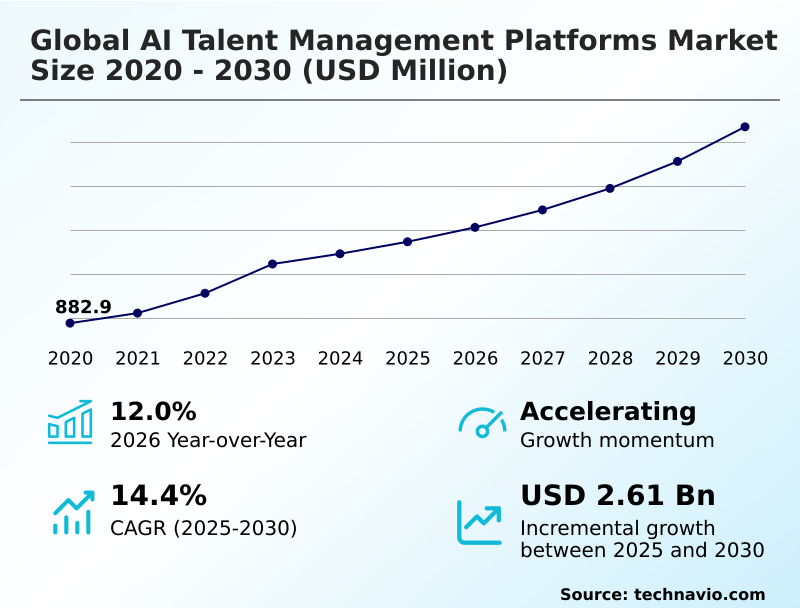
The ai talent management platforms market size is valued to increase by USD 2.61 billion, at a CAGR of 14.4% from 2025 to 2030. Evolution from process automation to agentic workforce orchestration will drive the ai talent management platforms market.
Major Market Trends & Insights
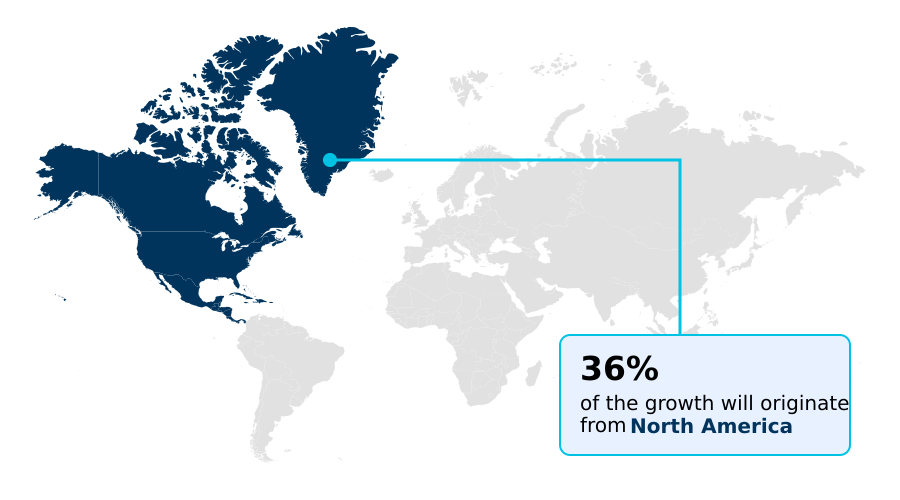
- North America dominated the market and accounted for a 35.9% growth during the forecast period.
- By Component - Solution segment was valued at USD 1.91 billion in 2024
- By Application - Candidate sourcing segment accounted for the largest market revenue share in 2024
Market Size & Forecast
- Market Opportunities: USD 4.46 billion
- Market Future Opportunities: USD 2.61 billion
- CAGR from 2025 to 2030 : 14.4%
Market Summary
- The AI Talent Management Platforms Market is undergoing a significant transformation, moving from administrative tools to strategic assets for workforce optimization. Core to this shift is the adoption of agentic decision support systems that enable skills-centric workforce models, allowing organizations to map talent to tasks with greater precision.
- This evolution is driven by the need for intelligent talent orchestration to navigate a competitive labor landscape. Key trends include the rise of generative AI career coaching and the use of algorithmic transparency dashboards to ensure fairness.
- For instance, a global logistics firm can deploy AI to analyze real-time supply chain disruptions and identify internal employees with adjacent skills for rapid redeployment, maintaining operational continuity without external hiring delays. However, challenges such as legacy infrastructure integration and ensuring ethical AI governance in high-stakes people decisions persist.
- Effective AI Talent Management Platforms must balance technological capability with human-centric design, turning people-data into a strategic asset comparable to financial metrics in enterprise decision-making.
What will be the Size of the AI Talent Management Platforms Market during the forecast period?
Get Key Insights on Market Forecast (PDF) Get Free Sample
How is the AI Talent Management Platforms Market Segmented?
The ai talent management platforms industry research report provides comprehensive data (region-wise segment analysis), with forecasts and estimates in "USD million" for the period 2026-2030, as well as historical data from 2020-2024 for the following segments.
- Component
- Solution
- Services
- Application
- Candidate sourcing
- Resume screening
- Interview scheduling
- Candidate engagement
- Others
- End-user
- IT and telecommunication
- BFSI
- Healthcare
- Retail
- Manufacturing
- Geography
- North America
- US
- Canada
- Mexico
- APAC
- China
- Japan
- India
- Europe
- Germany
- UK
- France
- South America
- Brazil
- Argentina
- Middle East and Africa
- Saudi Arabia
- UAE
- South Africa
- Rest of World (ROW)
- North America
By Component Insights
The solution segment is estimated to witness significant growth during the forecast period.
The market's solution segment is defined by cloud-native applications and software suites that serve as a continuous coordination layer for human capital.
Organizations leverage these platforms for a strategic shift toward agentic workforce orchestration, enabling hyper-personalized employee experience and high-velocity internal mobility. These systems utilize advanced analytics for predictive attrition modeling and promote equitable talent decisions through robust ethical AI governance.
Within the IT and telecommunication sector, which accounts for over 45% of platform adoption, the focus is on developing granular employee capabilities via automated career pathing.
This is achieved by implementing proactive retention strategies and ensuring algorithmic bias mitigation, moving beyond simple automation to a more integrated, skills-based human capital framework that aligns with explainable AI standards.
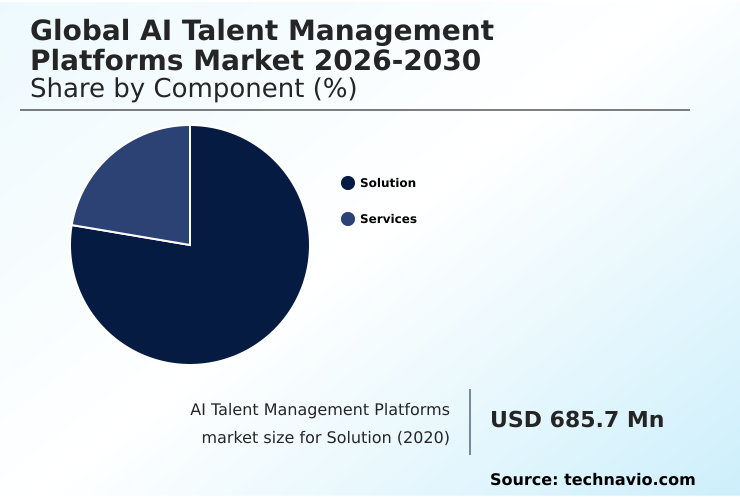
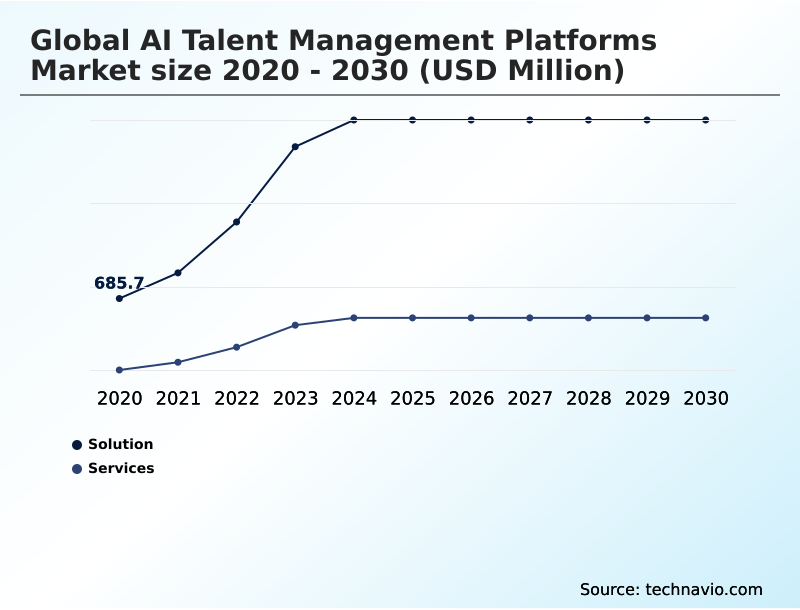
The Solution segment was valued at USD 1.91 billion in 2024 and showed a gradual increase during the forecast period.
Regional Analysis
North America is estimated to contribute 35.9% to the growth of the global market during the forecast period.Technavio’s analysts have elaborately explained the regional trends and drivers that shape the market during the forecast period.
See How AI Talent Management Platforms Market Demand is Rising in North America Get Free Sample
The global geographic landscape is dynamic, with North America and APAC collectively representing over 66% of the market's incremental growth.
In North America, particularly the United States and Canada, adoption is driven by a focus on data-driven diversity, equity, and inclusion and the need for intelligent talent orchestration.
This region is a hub for developing agentic decision support and succession management tools. Meanwhile, APAC, led by countries like China and India, leverages autonomous AI agents for high-volume recruitment and digital credentialing to manage its vast, mobile-first workforce.
In Europe, stringent regulations mandate responsible AI design and human-in-the-loop thresholds, fostering a market for platforms with strong ethical AI governance.
The focus across all regions is shifting toward skills-centric workforce models and deep learning skill inference, creating dynamic talent marketplaces that transcend geographical boundaries.
Market Dynamics
Our researchers analyzed the data with 2025 as the base year, along with the key drivers, trends, and challenges. A holistic analysis of drivers will help companies refine their marketing strategies to gain a competitive advantage.
- Organizations are increasingly focused on improving DEI with AI-driven tools, which requires a deep understanding of how to mitigate algorithmic bias in recruitment. The benefits of agentic workforce orchestration are clear, but successful implementation hinges on deploying agentic decision support systems effectively.
- This involves a strategic approach to implementing skills-based human capital architecture, which is often complicated by challenges of legacy infrastructure integration. A core objective is using AI for predictive attrition modeling and building a dynamic talent marketplace to enable high-velocity internal mobility. To achieve this, companies are creating automated career pathing models and applying sentiment analysis for retention.
- However, the role of explainable AI in hiring has become a critical governance issue, forcing a focus on ensuring ethical AI governance in HR and developing responsible AI by design. Boardrooms are now prioritizing compliance with the EU AI Act and other regulations, which includes securing data in AI talent platforms.
- Ultimately, success is determined by measuring ROI of talent intelligence and managing the specialized workforce needed for AI for succession management tools. Platforms offering transparent, ethical solutions see adoption rates nearly double those that do not, linking compliance directly to market penetration.
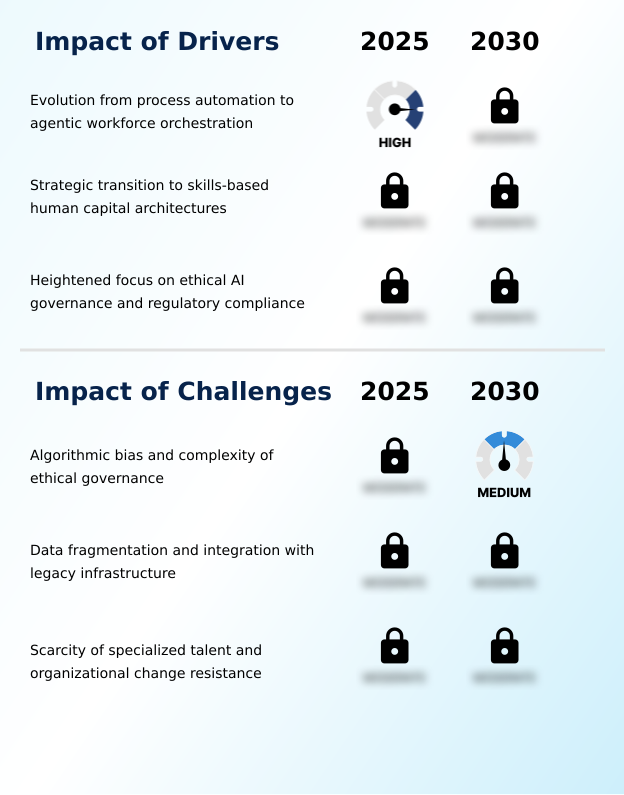
What are the key market drivers leading to the rise in the adoption of AI Talent Management Platforms Industry?
- A key market driver is the strategic evolution from basic process automation to sophisticated agentic workforce orchestration, transforming talent management into a proactive, decision-support function.
- Market growth is propelled by the transition to skills-centric workforce models, where enterprises utilize contextual applied artificial intelligence to map granular employee capabilities. This shift supports high-velocity internal mobility, with organizations reporting a 25% increase in filling critical roles internally.
- The adoption of enterprise-grade AI platforms is central to this trend, providing a continuous coordination layer for workforce planning. These systems facilitate automated career pathing and equitable talent decisions, moving beyond basic automation.
- The strategic adoption of a BTP-first mindset allows for the creation of adaptive decision-ready ecosystems, where a clean core ERP principle ensures that the system remains agile and scalable while supporting complex, data-driven talent strategies.
What are the market trends shaping the AI Talent Management Platforms Industry?
- The proliferation of hyper-personalized employee experience portals is an influential upcoming trend. These platforms increasingly utilize generative AI to provide customized career development paths for employees.
- Key trends are reshaping the market as organizations adopt proactive retention strategies through advanced analytics. Platforms now offer workforce intelligence platforms that utilize deep learning for a more than 20% improvement in attrition forecast accuracy. This is part of a broader shift toward a unified end-to-end AI suite delivering a hyper-personalized employee experience.
- The integration of AI-driven cognitive assessment tools is also critical, enabling a skills-first hiring approach that speeds up validation. Furthermore, the use of conversational avatars for interviewing is enhancing candidate-centricity and improving engagement rates by over 30%. This focus on human-centric governance is supported by a sociotechnical framework, ensuring technology augments rather than replaces human oversight in talent decisions.
What challenges does the AI Talent Management Platforms Industry face during its growth?
- A primary market challenge involves mitigating the inherent risks of algorithmic bias and navigating the complexity of establishing robust ethical governance frameworks for AI-driven talent decisions.
- A primary challenge is navigating the complexities of ethical AI governance while integrating platforms into legacy infrastructure. The risk of algorithmic bias necessitates robust mitigation strategies and a commitment to explainable AI standards, as failure to comply can increase legal exposure by over 50%.
- Many organizations struggle with data fragmentation, which hinders the performance of autonomous AI agents and predictive models. Successfully deploying a layered AI infrastructure requires a significant upfront investment in data cleansing, which can delay talent return on investment.
- Furthermore, a scarcity of professionals with HR data scientist competency creates a bottleneck, as does organizational resistance to AI-native agentic people analytics, with adoption rates in some sectors remaining below 40% two years post-implementation.
Exclusive Technavio Analysis on Customer Landscape
The ai talent management platforms market forecasting report includes the adoption lifecycle of the market, covering from the innovator’s stage to the laggard’s stage. It focuses on adoption rates in different regions based on penetration. Furthermore, the ai talent management platforms market report also includes key purchase criteria and drivers of price sensitivity to help companies evaluate and develop their market growth analysis strategies.
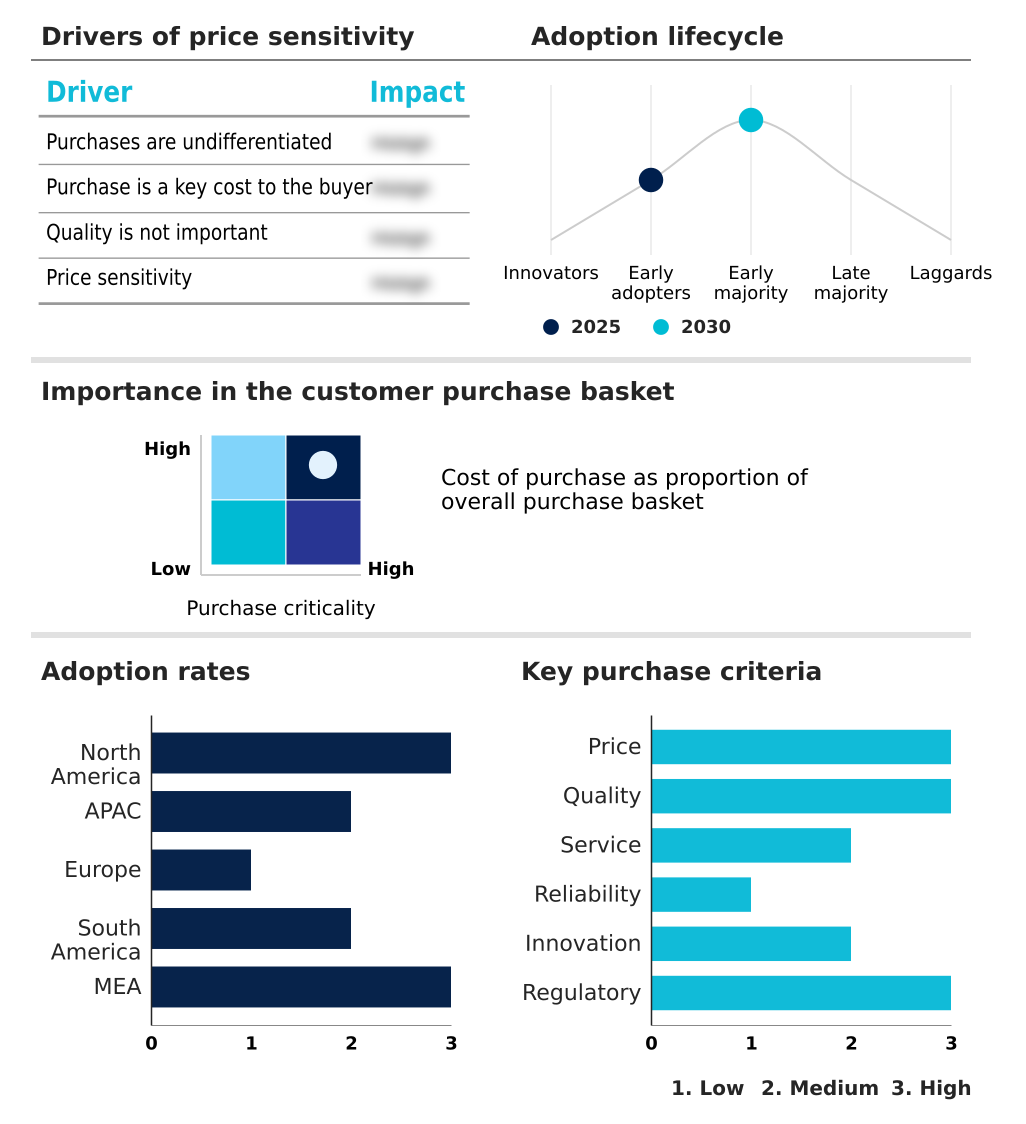
Customer Landscape of AI Talent Management Platforms Industry
Competitive Landscape
Companies are implementing various strategies, such as strategic alliances, ai talent management platforms market forecast, partnerships, mergers and acquisitions, geographical expansion, and product/service launches, to enhance their presence in the industry.
BetterUP Inc. - Key offerings focus on unified, AI-powered talent experience platforms that manage the entire employee lifecycle, from hiring and development to retention, enhancing organizational agility.
The industry research and growth report includes detailed analyses of the competitive landscape of the market and information about key companies, including:
- BetterUP Inc.
- Cornerstone OnDemand Inc.
- Eightfold AI
- Gloat Inc.
- Harver B.V.
- HireVue Inc.
- iCIMS Inc.
- Lattice Engines Inc.
- Microsoft Corp.
- OpenAI
- Oracle Corp.
- Paradox Inc
- Phenom People Inc.
- Retrain.Ai
- SAP SE
- SeekOut
- ServiceNow Inc.
- SmartRecruiters Inc.
- Visier Inc.
- Workday Inc.
Qualitative and quantitative analysis of companies has been conducted to help clients understand the wider business environment as well as the strengths and weaknesses of key industry players. Data is qualitatively analyzed to categorize companies as pure play, category-focused, industry-focused, and diversified; it is quantitatively analyzed to categorize companies as dominant, leading, strong, tentative, and weak.
Recent Development and News in Ai talent management platforms market
- In September 2025, iCIMS announced the acquisition of Apli, an AI-powered recruitment automation company, to enhance its capabilities in frontline hiring and create a unified talent acquisition platform.
- In October 2025, Workday completed its acquisition of Paradox, a conversational AI platform, to create an end-to-end talent acquisition suite combining Paradox's technology with Workday Recruiting and HiredScore.
- In September 2025, SAP announced the completion of its acquisition of SmartRecruiters, integrating the enterprise talent acquisition software into its SuccessFactors suite to manage the full hiring lifecycle.
- In February 2025, SAP introduced Joule AI agents as a significant advancement in enterprise artificial intelligence, designed to improve business productivity and collaboration by breaking down data and process silos.
Dive into Technavio’s robust research methodology, blending expert interviews, extensive data synthesis, and validated models for unparalleled AI Talent Management Platforms Market insights. See full methodology.
| Market Scope | |
|---|---|
| Page number | 304 |
| Base year | 2025 |
| Historic period | 2020-2024 |
| Forecast period | 2026-2030 |
| Growth momentum & CAGR | Accelerate at a CAGR of 14.4% |
| Market growth 2026-2030 | USD 2612.1 million |
| Market structure | Fragmented |
| YoY growth 2025-2026(%) | 12.0% |
| Key countries | US, Canada, Mexico, China, Japan, India, South Korea, Australia, Indonesia, Germany, UK, France, Italy, Spain, The Netherlands, Brazil, Argentina, Chile, Saudi Arabia, UAE, South Africa, Israel and Turkey |
| Competitive landscape | Leading Companies, Market Positioning of Companies, Competitive Strategies, and Industry Risks |
Research Analyst Overview
- The market's evolution is defined by a rapid pivot to agentic workforce orchestration, where skills-based human capital models are paramount. Platforms now deliver hyper-personalized employee experience through generative AI career coaching and use predictive attrition modeling with advanced sentiment analysis tools for proactive retention.
- This shift necessitates strong ethical AI governance and explainable AI standards to ensure algorithmic bias mitigation in high-stakes people decisions. Successful adoption depends on overcoming legacy infrastructure integration challenges and cultivating HR data scientist competency. Modern systems feature agentic decision support with autonomous AI agents facilitating skills-centric workforce models.
- These models are built on deep learning skill inference, creating dynamic talent marketplaces with human-in-the-loop thresholds. A key boardroom consideration is the move toward responsible AI design, as platforms with algorithmic transparency dashboards can reduce compliance-related errors by up to 40%.
- This unified talent ecosystem supports everything from candidate-centricity and automated skill extraction to digital credentialing, industrial internet-of-things (IIoT) workforce alignment, and smart factory technologies. It enables intelligent talent orchestration for nationalization initiatives, gig economy management, and validated psychometric testing, all while supporting data-driven diversity, equity, and inclusion and advanced succession management tools.
What are the Key Data Covered in this AI Talent Management Platforms Market Research and Growth Report?
-
What is the expected growth of the AI Talent Management Platforms Market between 2026 and 2030?
-
USD 2.61 billion, at a CAGR of 14.4%
-
-
What segmentation does the market report cover?
-
The report is segmented by Component (Solution, and Services), Application (Candidate sourcing, Resume screening, Interview scheduling, Candidate engagement, and Others), End-user (IT and telecommunication, BFSI, Healthcare, Retail, and Manufacturing) and Geography (North America, APAC, Europe, South America, Middle East and Africa)
-
-
Which regions are analyzed in the report?
-
North America, APAC, Europe, South America and Middle East and Africa
-
-
What are the key growth drivers and market challenges?
-
Evolution from process automation to agentic workforce orchestration, Algorithmic bias and complexity of ethical governance
-
-
Who are the major players in the AI Talent Management Platforms Market?
-
BetterUP Inc., Cornerstone OnDemand Inc., Eightfold AI, Gloat Inc., Harver B.V., HireVue Inc., iCIMS Inc., Lattice Engines Inc., Microsoft Corp., OpenAI, Oracle Corp., Paradox Inc, Phenom People Inc., Retrain.Ai, SAP SE, SeekOut, ServiceNow Inc., SmartRecruiters Inc., Visier Inc. and Workday Inc.
-
Market Research Insights
- The market is defined by a strategic move toward contextual applied artificial intelligence, with leading organizations adopting enterprise-grade AI platforms that feature layered AI infrastructure. This shift is yielding measurable business outcomes; for example, the use of AI-driven cognitive assessment tools has been shown to reduce time-to-hire by over 30% in high-volume recruitment scenarios.
- Furthermore, platforms focusing on skills-first hiring approaches are enabling a more than 15% improvement in internal mobility rates. These intelligent systems are no longer add-ons but are core to modern HR strategy, with a clean core ERP principle and BTP-first mindset becoming prerequisites for effective implementation.
- The emphasis is on achieving a tangible talent return on investment by optimizing the entire employee lifecycle through advanced analytics and automation.
We can help! Our analysts can customize this ai talent management platforms market research report to meet your requirements.
 RIA -
RIA - 
