



Healthcare Analytics Market Size 2026-2030
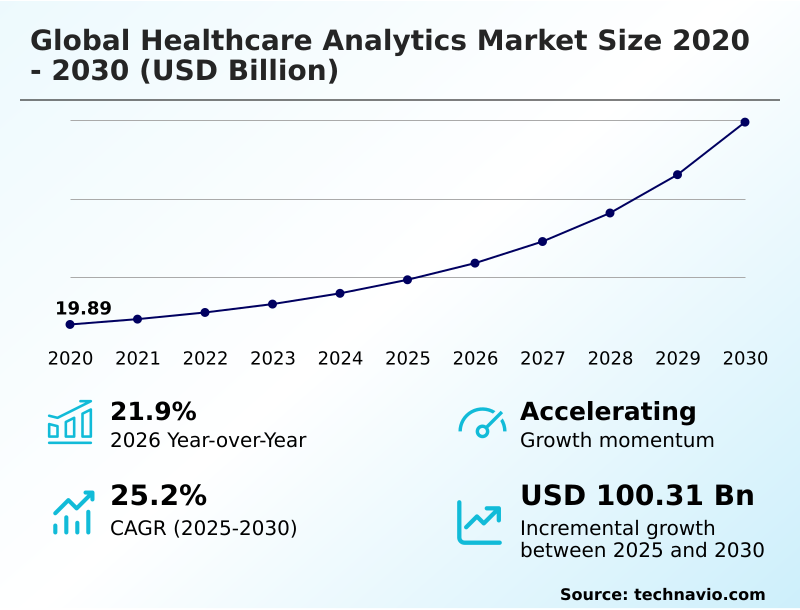
The healthcare analytics market size is valued to increase by USD 100.31 billion, at a CAGR of 25.2% from 2025 to 2030. Accelerated integration of AI and ML in healthcare analytics will drive the healthcare analytics market.
Major Market Trends & Insights
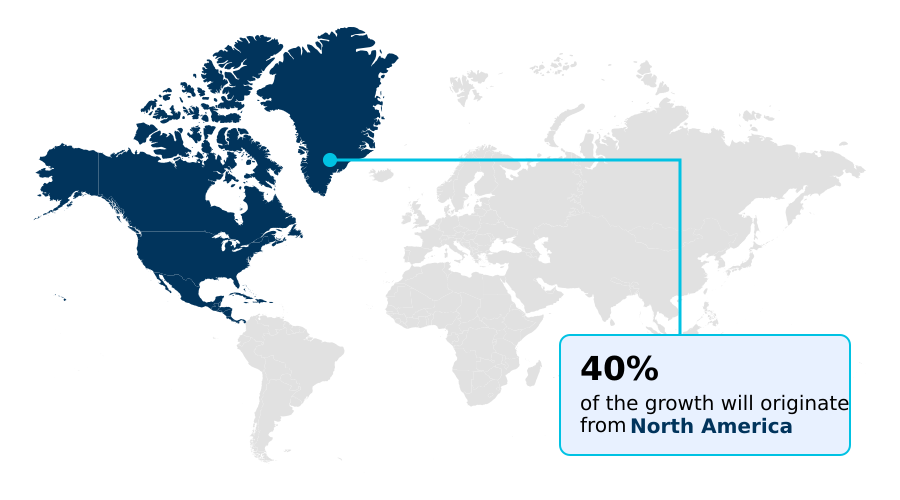
- North America dominated the market and accounted for a 39.9% growth during the forecast period.
- By Component - Services segment was valued at USD 15.71 billion in 2024
- By Deployment - On-premises segment accounted for the largest market revenue share in 2024
Market Size & Forecast
- Market Opportunities: USD 128.75 billion
- Market Future Opportunities: USD 100.31 billion
- CAGR from 2025 to 2030 : 25.2%
Market Summary
- The healthcare analytics market is fundamentally reshaping medical operations by transforming vast data streams into actionable intelligence. The core driver is the industry-wide pivot to value-based care, which requires sophisticated predictive analytics and machine learning models to forecast outcomes and manage costs.
- Providers are deploying an AI-powered platform to achieve clinical workflow optimization, with some hospitals automating routine administrative tasks to reduce staff workload by up to 30%. These platforms enhance clinical decision support by integrating real-world evidence and social determinants of health directly into electronic health records.
- A major trend is the adoption of cloud-native analytics, which provides the IT infrastructure scalability necessary for big data processing and population health management. However, progress is often hampered by data fragmentation and a lack of data interoperability.
- For example, a hospital system seeking to optimize its supply chain for critical medications might struggle to integrate inventory data with real-time patient admission forecasts from a separate system, highlighting the need for unified health data intelligence and adherence to standards like fast healthcare interoperability resources to enable seamless data silo integration.
What will be the Size of the Healthcare Analytics Market during the forecast period?
Get Key Insights on Market Forecast (PDF) Get Free Sample
How is the Healthcare Analytics Market Segmented?
The healthcare analytics industry research report provides comprehensive data (region-wise segment analysis), with forecasts and estimates in "USD million" for the period 2026-2030, as well as historical data from 2020-2024 for the following segments.
- Component
- Services
- Software
- Hardware
- Deployment
- On-premises
- Cloud-based
- Application
- Predictive analytics
- Descriptive analytics
- Geography
- North America
- US
- Canada
- Mexico
- Europe
- Germany
- UK
- France
- APAC
- China
- India
- Japan
- South America
- Brazil
- Argentina
- Colombia
- Middle East and Africa
- UAE
- Saudi Arabia
- South Africa
- Rest of World (ROW)
- North America
By Component Insights
The services segment is estimated to witness significant growth during the forecast period.
The services segment is crucial for implementing complex data strategies, encompassing consulting, maintenance, and managed services that facilitate the adoption of prescriptive analytics models.
Organizations leverage these offerings for revenue cycle management, integrating real-world evidence to enhance diagnostic accuracy and therapeutic effectiveness. Advanced services support big data processing and the deployment of modern data warehousing solutions, including lakehouse architecture.
By optimizing patient engagement analytics, providers can better understand patient payment behaviors and improve clinical performance monitoring.
The adoption of standards like fast healthcare interoperability resources is essential for this segment's success, with integrated service models accelerating drug development strategy timelines by up to 25% for life sciences clients.
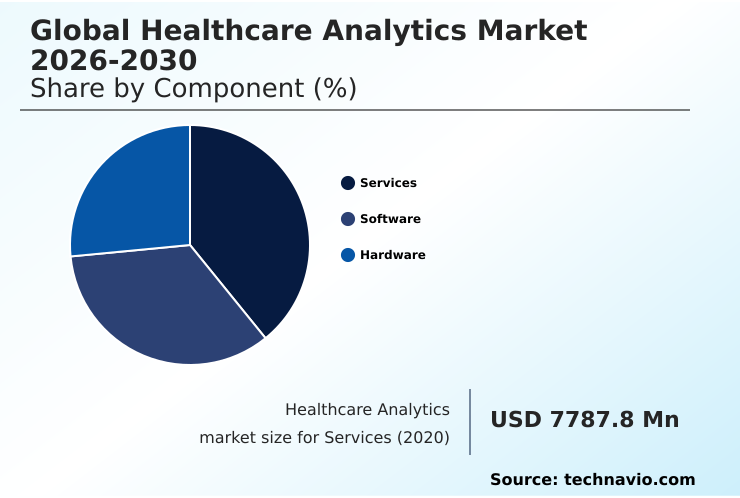
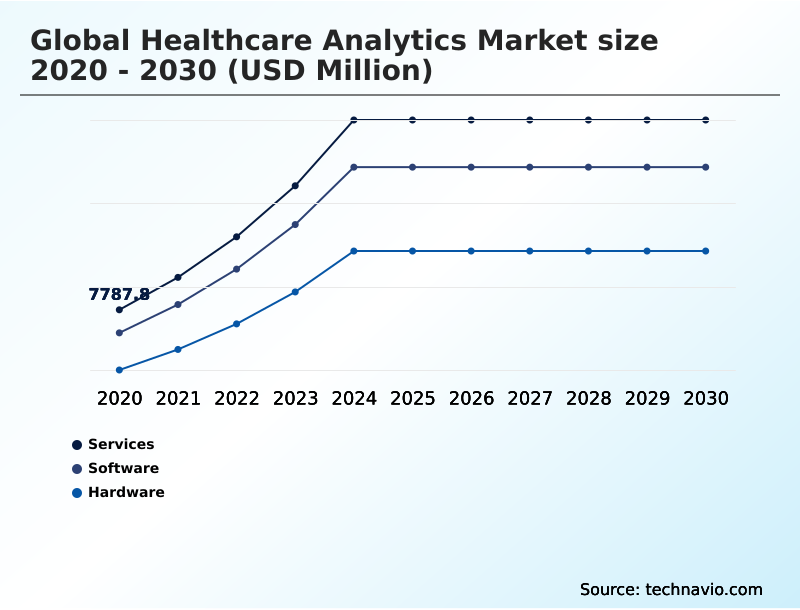
The Services segment was valued at USD 15.71 billion in 2024 and showed a gradual increase during the forecast period.
Regional Analysis
North America is estimated to contribute 39.9% to the growth of the global market during the forecast period.Technavio’s analysts have elaborately explained the regional trends and drivers that shape the market during the forecast period.
See How Healthcare Analytics Market Demand is Rising in North America Get Free Sample
The market landscape varies significantly by region, with North America leading in the adoption of genomic analytics and telehealth services. In contrast, APAC is rapidly expanding its digital infrastructure, with a focus on epidemiological analysis to manage public health.
The use of descriptive analytics for tracking operational efficiency metrics is now standard globally, with advanced systems showing a 15% improvement in resource allocation.
European markets are prioritizing the integration of social determinants of health and multi-omics information for holistic risk stratification and care episode analysis.
The development of agentic AI assistants for tasks like medical imaging analysis and the push for medicaid operations modernization further highlight the diverse applications driven by regional needs and data governance frameworks.
Market Dynamics
Our researchers analyzed the data with 2025 as the base year, along with the key drivers, trends, and challenges. A holistic analysis of drivers will help companies refine their marketing strategies to gain a competitive advantage.
- The evolution of healthcare analytics is centered on creating practical, high-impact solutions for both clinical and operational challenges. A key focus is on improving diagnostic accuracy with AI, particularly through AI for radiology workflow automation, which addresses critical staffing shortages.
- For population-level insights, cloud analytics for population health is becoming standard, enabling providers to implement analytics for value-based care reimbursement models effectively. In acute care settings, predictive modeling for sepsis detection demonstrates the power of real-time analytics at point-of-care. Operationally, optimizing revenue cycle with analytics and using machine learning for claims fraud are essential for financial stability.
- A significant technical hurdle being addressed is achieving interoperability in electronic health records, which is crucial for aggregating EHR data for clinical research and utilizing real-world data in clinical trials. These integrated datasets also power genomic data analysis platforms and support the trend toward AI in personalized medicine pathways.
- The ultimate goal is to connect disparate data points, such as using SDoH data for risk adjustment and applying natural language processing for clinical notes to gain a full patient view.
- These efforts are directly linked to managing chronic diseases with analytics and deploying analytics to reduce hospital readmissions, with integrated systems showing a reduction rate nearly double that of siloed approaches.
- The expansion of virtual care is supported by analytics for telehealth service delivery, while an overarching goal remains achieving data analytics for operational efficiency within a secure cloud for health data.
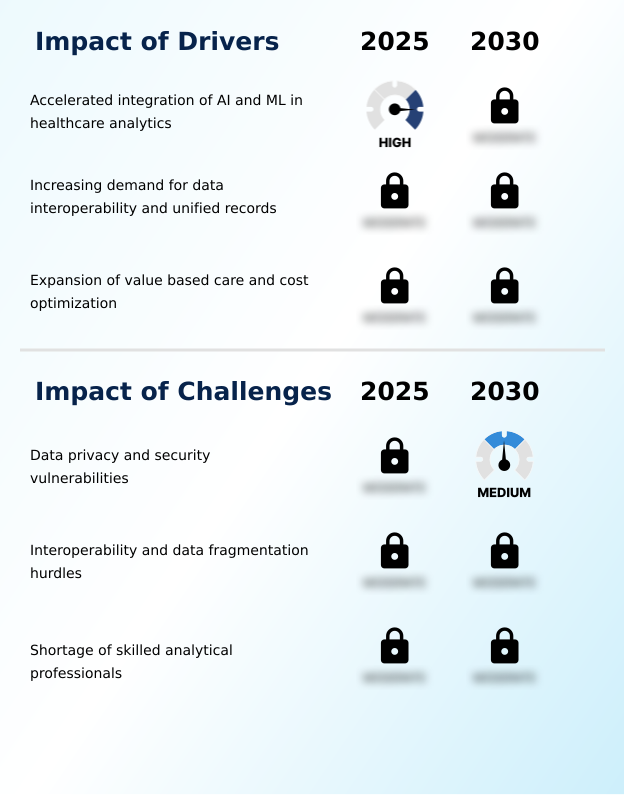
What are the key market drivers leading to the rise in the adoption of Healthcare Analytics Industry?
- The accelerated integration of AI and machine learning into healthcare analytics is a key driver propelling market expansion.
- The transition to value-based care and new reimbursement structures is a primary market driver, compelling a move away from traditional fee-for-service models. Advanced machine learning models embedded within electronic health records provide clinical decision support for improved care coordination.
- This integration supports population health management initiatives and enables effective remote patient monitoring, leading to a 25% reduction in hospital readmissions for certain chronic conditions.
- Furthermore, real-time data processing allows for dynamic patient risk scoring, and widespread administrative task automation frees up clinical resources, with some systems cutting documentation time by half. These advancements are also critical for clinical trial optimization, shortening development timelines.
What are the market trends shaping the Healthcare Analytics Industry?
- The adoption of generative modeling to enhance clinical precision is an emerging market trend, redefining diagnostic accuracy and personalized treatment planning.
- The shift toward cloud-native analytics is redefining the industry, enabling unprecedented IT infrastructure scalability and the creation of comprehensive longitudinal patient records. An AI-powered platform now integrates predictive analytics and natural language processing for advanced unstructured data parsing from sources like clinical notes and wearable device data.
- This facilitates proactive decision support and enables clinical workflow optimization at the point of care, improving efficiency by over 20%. As organizations move beyond basic business intelligence, the focus is on treatment pathway personalization and predictive financial analytics, which have demonstrated the ability to forecast resource needs with 30% greater accuracy.
What challenges does the Healthcare Analytics Industry face during its growth?
- Persistent vulnerabilities in data privacy and security represent a key challenge affecting industry growth and stakeholder trust.
- Significant challenges persist around data fragmentation and the lack of universal data interoperability, which inhibit effective health information exchange. The complexity of claims processing leads to high rates of insurance claim denials, while the risk of fraud detection failures remains a constant concern.
- Addressing these issues requires robust data silo integration and adherence to strict cybersecurity protocols to safeguard protected health information. While data tokenization offers a path forward, inconsistencies in applying evidence-based protocols across systems undermine the utility of health data intelligence. Without standardized data governance frameworks, achieving seamless public health surveillance and overcoming these hurdles remains difficult for many organizations.
Exclusive Technavio Analysis on Customer Landscape
The healthcare analytics market forecasting report includes the adoption lifecycle of the market, covering from the innovator’s stage to the laggard’s stage. It focuses on adoption rates in different regions based on penetration. Furthermore, the healthcare analytics market report also includes key purchase criteria and drivers of price sensitivity to help companies evaluate and develop their market growth analysis strategies.
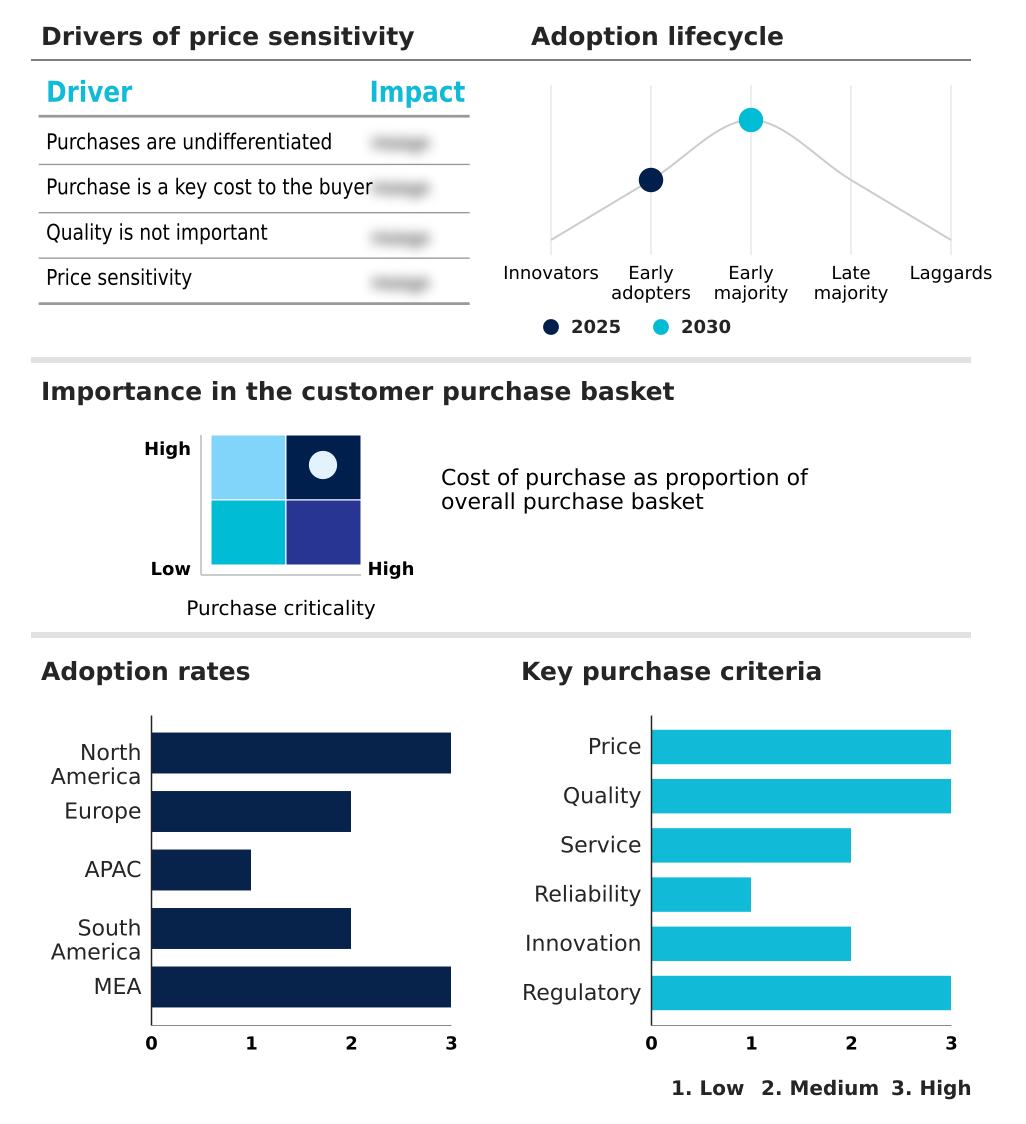
Customer Landscape of Healthcare Analytics Industry
Competitive Landscape
Companies are implementing various strategies, such as strategic alliances, healthcare analytics market forecast, partnerships, mergers and acquisitions, geographical expansion, and product/service launches, to enhance their presence in the industry.
Avgi Solutions Inc. - Delivering scalable, advanced analytics for payers, providers, and life sciences, leveraging predictive modeling and BI to drive value-based care and digital health insights.
The industry research and growth report includes detailed analyses of the competitive landscape of the market and information about key companies, including:
- Avgi Solutions Inc.
- CitiusTech Healthcare Technology
- Cotiviti Inc.
- ExlService Holdings Inc.
- Gainwell Technologies LLC
- GE HealthCare Technologies
- Health Catalyst Inc.
- IBM Corp.
- Inovalon Holdings Inc.
- IQVIA Holdings Inc.
- Komodo Health Inc.
- McKesson Corp.
- Medeanalytics Inc.
- Oracle Corp.
- RELX Plc
- SAS Institute Inc.
- United Health Group Inc.
- Veradigm LLC
- Wipro Ltd.
Qualitative and quantitative analysis of companies has been conducted to help clients understand the wider business environment as well as the strengths and weaknesses of key industry players. Data is qualitatively analyzed to categorize companies as pure play, category-focused, industry-focused, and diversified; it is quantitatively analyzed to categorize companies as dominant, leading, strong, tentative, and weak.
Recent Development and News in Healthcare analytics market
- In August 2024, Innovaccer launched its Government Health AI Data and Analytics Platform to unify fragmented datasets for public health systems and improve Medicaid operations.
- In October 2024, Oracle introduced its AI-powered Oracle Analytics Intelligence for Life Sciences platform to help research institutes unify diverse data for faster therapeutic insights.
- In May 2025, Health Catalyst launched Health Catalyst Ignite, a unified, cloud-based data and analytics ecosystem designed with a lakehouse architecture for the healthcare industry.
- In June 2025, SAS launched its SAS Health Cost of Care Analytics solution, using AI to help payers and providers analyze care episodes and reduce expenditures.
Dive into Technavio’s robust research methodology, blending expert interviews, extensive data synthesis, and validated models for unparalleled Healthcare Analytics Market insights. See full methodology.
| Market Scope | |
|---|---|
| Page number | 296 |
| Base year | 2025 |
| Historic period | 2020-2024 |
| Forecast period | 2026-2030 |
| Growth momentum & CAGR | Accelerate at a CAGR of 25.2% |
| Market growth 2026-2030 | USD 100314.7 million |
| Market structure | Fragmented |
| YoY growth 2025-2026(%) | 21.9% |
| Key countries | US, Canada, Mexico, Germany, UK, France, Italy, Spain, The Netherlands, China, India, Japan, South Korea, Singapore, Australia, Brazil, Argentina, Colombia, UAE, Saudi Arabia, South Africa, Egypt and Qatar |
| Competitive landscape | Leading Companies, Market Positioning of Companies, Competitive Strategies, and Industry Risks |
Research Analyst Overview
- The healthcare analytics market is defined by a strategic shift toward value-based care, compelling boardroom decisions on technology budgeting. An AI-powered platform that leverages machine learning models is now essential for population health management and clinical workflow optimization. These systems integrate predictive analytics with descriptive analytics to enhance clinical decision support within electronic health records.
- The push for data interoperability aims to solve data fragmentation by connecting disparate data warehousing solutions, often using a lakehouse architecture for big data processing. Cloud-native analytics support telehealth services and remote patient monitoring, while genomic analytics and the analysis of multi-omics information drive treatment pathway personalization. For operational efficiency, tools address revenue cycle management, claims processing, and fraud detection.
- Core capabilities include risk stratification, care coordination, and epidemiological analysis, all informed by health data intelligence. Natural language processing extracts insights from unstructured data, improving diagnostic accuracy. Ultimately, patient engagement analytics, social determinants of health, and real-world evidence inform evidence-based protocols, with data tokenization ensuring security. Companies using these integrated tools have reported a 20% improvement in care coordination efficiency.
What are the Key Data Covered in this Healthcare Analytics Market Research and Growth Report?
-
What is the expected growth of the Healthcare Analytics Market between 2026 and 2030?
-
USD 100.31 billion, at a CAGR of 25.2%
-
-
What segmentation does the market report cover?
-
The report is segmented by Component (Services, Software, and Hardware), Deployment (On-premises, and Cloud-based), Application (Predictive analytics, and Descriptive analytics) and Geography (North America, Europe, APAC, South America, Middle East and Africa)
-
-
Which regions are analyzed in the report?
-
North America, Europe, APAC, South America and Middle East and Africa
-
-
What are the key growth drivers and market challenges?
-
Accelerated integration of AI and ML in healthcare analytics, Data privacy and security vulnerabilities
-
-
Who are the major players in the Healthcare Analytics Market?
-
Avgi Solutions Inc., CitiusTech Healthcare Technology, Cotiviti Inc., ExlService Holdings Inc., Gainwell Technologies LLC, GE HealthCare Technologies, Health Catalyst Inc., IBM Corp., Inovalon Holdings Inc., IQVIA Holdings Inc., Komodo Health Inc., McKesson Corp., Medeanalytics Inc., Oracle Corp., RELX Plc, SAS Institute Inc., United Health Group Inc., Veradigm LLC and Wipro Ltd.
-
Market Research Insights
- The market's dynamism is fueled by the demand for real-time data processing and proactive decision support. The integration of unstructured data parsing has improved diagnostic accuracy by over 15% in complex cases. As providers shift away from fee-for-service models, predictive financial analytics become critical for managing new reimbursement structures, with advanced systems reducing insurance claim denials by up to 40%.
- Data silo integration through health information exchange platforms is enabling the creation of longitudinal patient records, which are essential for care episode analysis and clinical performance monitoring. The use of agentic AI assistants for administrative task automation is also rising, enhancing operational efficiency metrics across the board. This evolution supports better therapeutic effectiveness and more precise patient risk scoring.
We can help! Our analysts can customize this healthcare analytics market research report to meet your requirements.
 RIA -
RIA - 
