


Commercial Drones Market Size 2026-2030
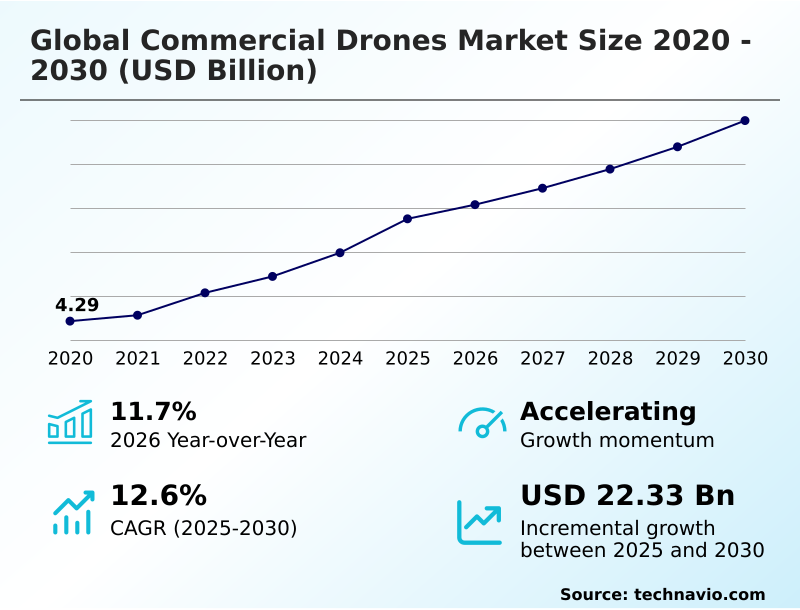
The commercial drones market size is valued to increase by USD 22.33 billion, at a CAGR of 12.6% from 2025 to 2030. Hydrogen fuel cell propulsion and long-endurance power management will drive the commercial drones market.
Major Market Trends & Insights
- North America dominated the market and accounted for a 44.3% growth during the forecast period.
- By Product - Software and services segment was valued at USD 10.77 billion in 2024
- By End-user - Infrastructure segment accounted for the largest market revenue share in 2024
Market Size & Forecast
- Market Opportunities: USD 45.57 billion
- Market Future Opportunities: USD 22.33 billion
- CAGR from 2025 to 2030 : 12.6%
Market Summary
- The commercial drones market is undergoing rapid industrialization, moving beyond niche applications toward large-scale, automated fleet deployments. This evolution is driven by advancements in hydrogen fuel cell propulsion and swarm intelligence, which enable long-endurance missions and coordinated multi-drone operations for tasks like large-area mapping.
- Key trends include the institutionalization of beyond visual line of sight (BVLOS) operations and the emergence of hybrid VTOL platforms. These developments are unlocking new efficiencies in industries such as energy, where a firm can use a drone fleet for autonomous pipeline inspection, improving safety and data collection speed. However, this progress faces hurdles.
- Data bottlenecks from high-resolution sensors like LiDAR and thermal imaging strain processing capabilities, while regulatory fragmentation slows the approval of widespread BVLOS flights. Furthermore, geopolitical trade restrictions create fragility in global supply chains for critical components like flight control systems and NDAA-compliant drones.
- The market's trajectory depends on harmonizing global standards and developing robust data infrastructure to support real-time AI processing and secure drone communications, turning unmanned aerial vehicle (UAV) technology into an essential industrial tool.
What will be the Size of the Commercial Drones Market during the forecast period?
Get Key Insights on Market Forecast (PDF) Get Free Sample
How is the Commercial Drones Market Segmented?
The commercial drones industry research report provides comprehensive data (region-wise segment analysis), with forecasts and estimates in "USD million" for the period 2026-2030, as well as historical data from 2020-2024 for the following segments.
- Product
- Software and services
- Hardware
- End-user
- Infrastructure
- Media and entertainment
- Agriculture
- Public safety
- Others
- Type
- Rotary blade
- Fixed wing
- Hybrid
- Geography
- North America
- US
- Canada
- Mexico
- Europe
- Germany
- UK
- France
- APAC
- China
- Japan
- India
- Middle East and Africa
- UAE
- Saudi Arabia
- Israel
- South America
- Brazil
- Argentina
- Rest of World (ROW)
- North America
By Product Insights
The software and services segment is estimated to witness significant growth during the forecast period.
The software and services segment is shifting the commercial drones market from hardware-centric operations to integrated data intelligence ecosystems. This includes advanced flight control systems and platforms for autonomous navigation and drone fleet management.
Demand for drone-as-a-service (DaaS) models is rising as enterprises prioritize real-time data processing for asset management without large capital outlays. The use of photogrammetry and 3D modeling with drones for digital twin creation is becoming standard for aerial surveying.
These platforms are essential for transforming raw aerial data into business intelligence, with secure data link security protocols ensuring information integrity.
The integration of edge computing for drones improves on-site data analysis, boosting operational efficiency in processing complex imagery by over 30%.
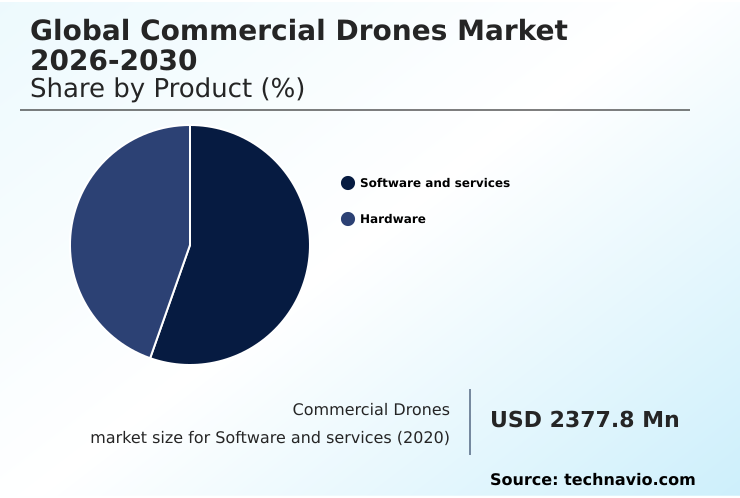
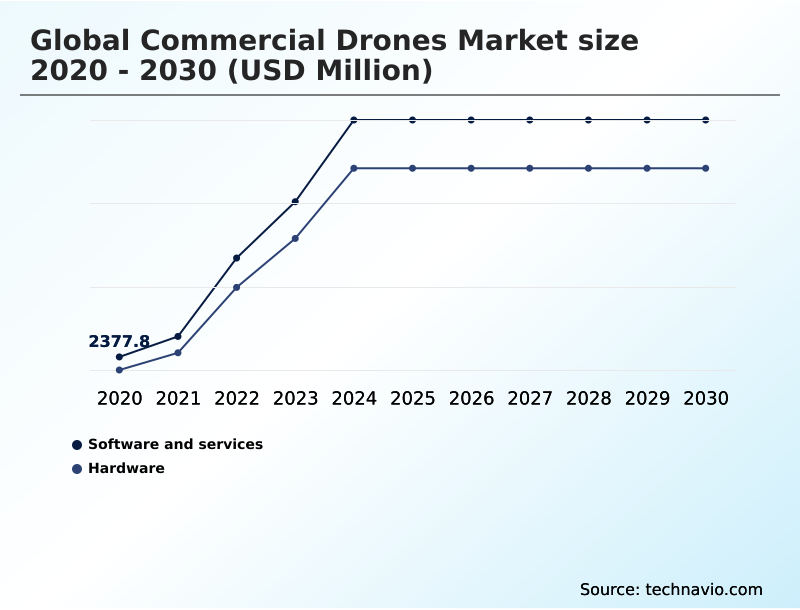
The Software and services segment was valued at USD 10.77 billion in 2024 and showed a gradual increase during the forecast period.
Regional Analysis
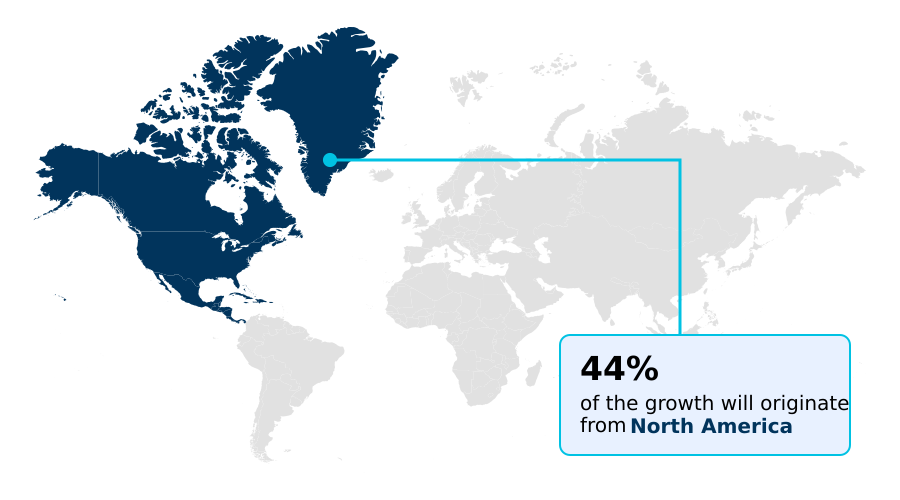
North America is estimated to contribute 44.3% to the growth of the global market during the forecast period.Technavio’s analysts have elaborately explained the regional trends and drivers that shape the market during the forecast period.
See How Commercial Drones Market Demand is Rising in North America Get Free Sample
The geographic landscape is led by North America, which is projected to contribute over 44% of the market's incremental growth, driven by progressive regulatory stances on airspace integration and unmanned aerial vehicle (UAV) deployment.
In Europe, the focus is on a harmonized u-space framework, fostering cross-border operations for industrial inspection drones and law enforcement drones. In this region, drone-based infrastructure monitoring has improved defect detection accuracy by 25%.
The APAC region, home to major manufacturing hubs, is the fastest-growing market, with governments promoting domestic type certification for drones used in supply chain logistics and firefighting support.
This regional push is creating resilient local ecosystems, moving beyond reliance on a few dominant hardware providers and fostering innovation in applications from cinematic drone photography to large-scale aerial light shows.
Market Dynamics
Our researchers analyzed the data with 2025 as the base year, along with the key drivers, trends, and challenges. A holistic analysis of drivers will help companies refine their marketing strategies to gain a competitive advantage.
- The sophistication of the commercial drones market is increasingly defined by specialized, high-value use cases. The regulatory framework for commercial drone delivery is maturing, enabling complex bvlos operations for pipeline inspection. The debate over hydrogen fuel cell vs battery for drones continues, with hybrid vtol drone for maritime surveillance showcasing the benefits of extended flight endurance.
- For environmental applications, drone based lidar for forestry management is an essential tool, while the best drones for precision agriculture spraying use ai-driven controllers. In infrastructure, using drones for wind turbine inspection is now standard, complemented by drone data processing for digital twins and drone-based 3d modeling for construction.
- The operational viability is a key focus, with firms conducting a cost-benefit analysis of drone-in-a-box systems and autonomous drone for warehouse inventory management. The public safety sector is a major adopter, with agencies implementing a drone as first responder program; these have been shown to cut initial assessment times by more than half.
- This is supported by thermal drones for firefighting support and public safety drone fleet management software. As the industry evolves, it grapples with urban air mobility ecosystem challenges and drone regulations for flying over people.
- The technical backbone relies on 5g network slicing for drone command, geofencing solutions for drone security, rtk vs ppk for drone surveying, and the procurement of ndaa compliant drones for government use, ensuring both performance and security.
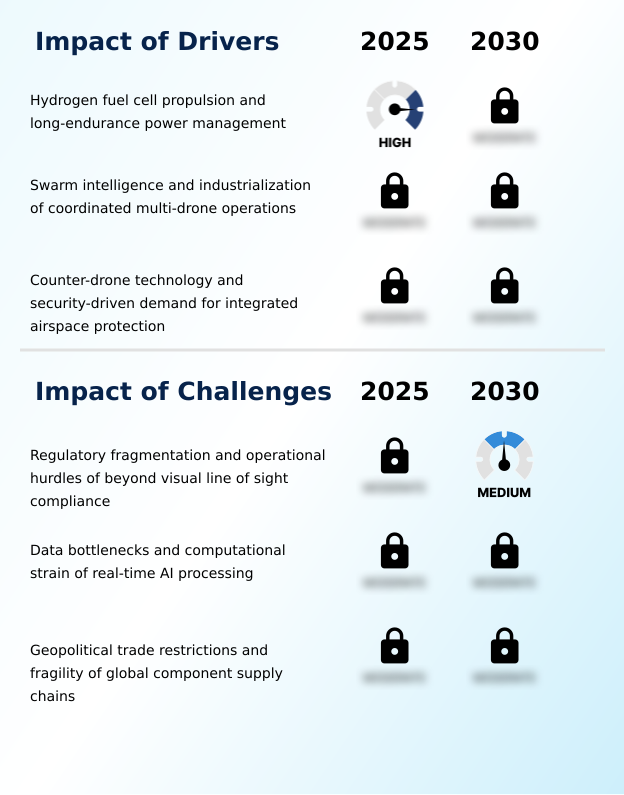
What are the key market drivers leading to the rise in the adoption of Commercial Drones Industry?
- The development of hydrogen fuel cell propulsion and long-endurance power management solutions is a key driver for expanding the operational capabilities of commercial drones.
- Market growth is propelled by drivers that enhance efficiency and security.
- The industrialization of swarm intelligence and drone swarms enables a single operator to manage multiple assets for tasks like precision agriculture or construction site mapping, covering areas up to ten times faster than a single drone.
- This drone swarm coordination relies on 5G drone connectivity and advanced detect and avoid systems.
- Another significant driver is the demand for longer flight endurance, with new propulsion systems extending operational times for energy sector drone applications from minutes to hours. This allows for more comprehensive industrial inspection drones.
- Simultaneously, the strategic evolution of counter-UAV (C-UAV) technology is creating a parallel demand for airspace protection. The adoption of these security systems has increased by over 50% at critical infrastructure sites, ensuring public safety drone programs can operate without interference.
What are the market trends shaping the Commercial Drones Industry?
- The institutionalization of beyond visual line of sight operations is a defining market trend. This is driving the development of autonomous airspace integration frameworks.
- Key market trends are centered on expanding operational scale and capability. The institutionalization of beyond visual line of sight (BVLOS) operations, supported by unmanned traffic management (UTM) systems, is enabling complex missions like last-mile drone delivery.
- The emergence of hybrid vertical take-off and landing (VTOL) platforms, some using hydrogen fuel cell technology, extends mission durations by over 200% compared to battery-only systems, which is critical for heavy-lift cargo drones. Concurrently, the expansion of urban air mobility (UAM) is driving investment in vertiport infrastructure.
- These platforms use advanced autonomous flight control for applications from search and rescue drones to environmental monitoring drones, with the integration of photogrammetry and multispectral sensors improving data collection accuracy for industrial clients by over 30%.
What challenges does the Commercial Drones Industry face during its growth?
- Regulatory fragmentation, coupled with the operational hurdles of achieving beyond visual line of sight compliance, remains a key challenge affecting industry growth and scalability.
- Significant challenges constrain market scalability, primarily regulatory fragmentation and data bottlenecks. Obtaining routine approvals for beyond visual line of sight flights for infrastructure monitoring uav remains complex, with the implementation of frameworks like u-space requiring substantial investment. A single advanced sensor mission can generate terabytes of data, creating processing delays of up to 48 hours and hindering real-time asset management.
- This strain on secure drone communications necessitates more powerful edge computing for drones. Furthermore, geopolitical trade restrictions impact supply chain logistics, forcing a shift to ndaa-compliant drones that can cost 20-30% more than alternatives. These hurdles complicate drone fleet management and slow the progress of obtaining type certification for new platforms that require remote identification (remote id) compliance.
Exclusive Technavio Analysis on Customer Landscape
The commercial drones market forecasting report includes the adoption lifecycle of the market, covering from the innovator’s stage to the laggard’s stage. It focuses on adoption rates in different regions based on penetration. Furthermore, the commercial drones market report also includes key purchase criteria and drivers of price sensitivity to help companies evaluate and develop their market growth analysis strategies.
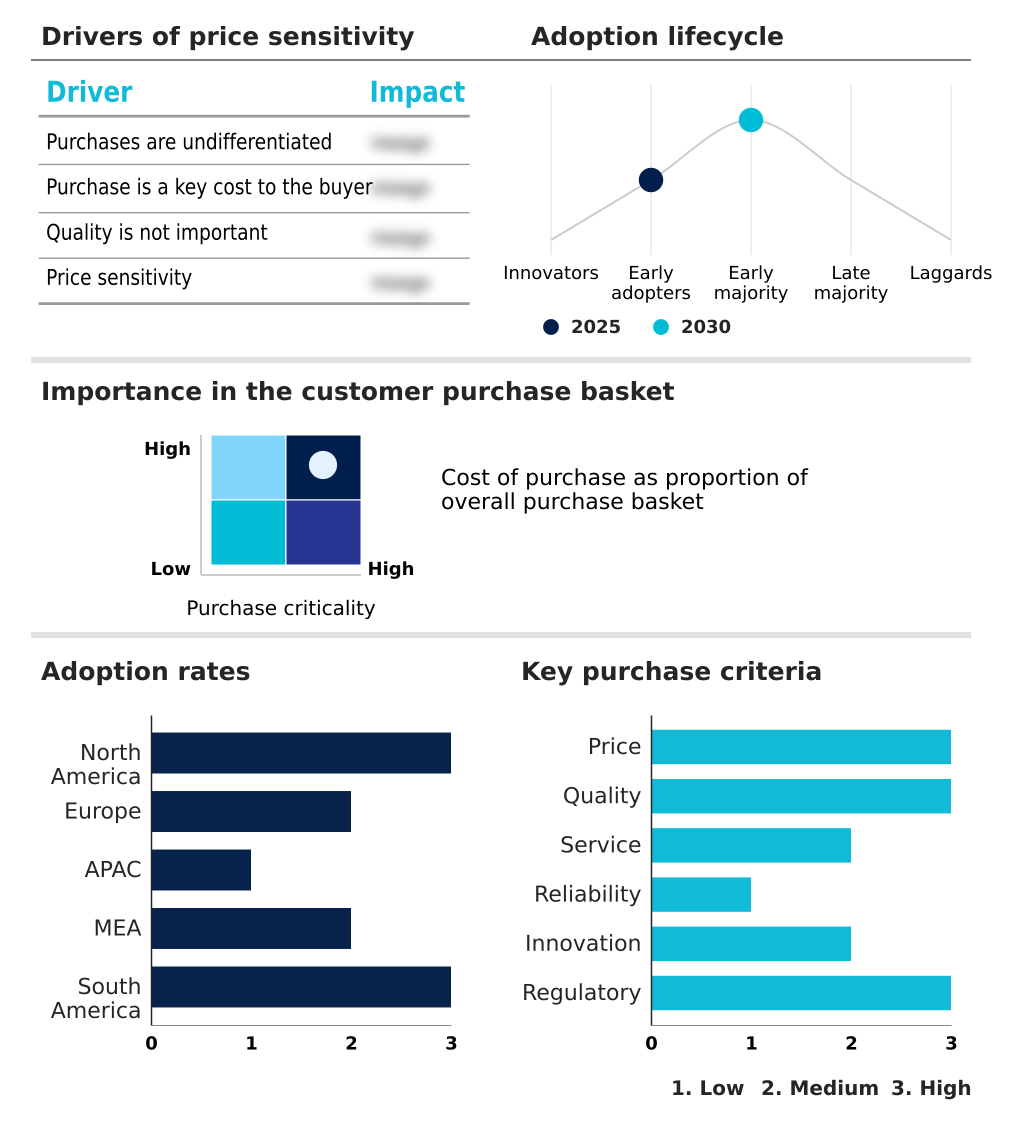
Customer Landscape of Commercial Drones Industry
Competitive Landscape
Companies are implementing various strategies, such as strategic alliances, commercial drones market forecast, partnerships, mergers and acquisitions, geographical expansion, and product/service launches, to enhance their presence in the industry.
Aeronavics - Specializes in heavy-lift UAVs and industrial inspection platforms for agriculture, surveying, infrastructure monitoring, and media applications, delivering robust aerial solutions for professional use.
The industry research and growth report includes detailed analyses of the competitive landscape of the market and information about key companies, including:
- Aeronavics
- AeroTargets International LLC
- AeroVironment Inc.
- Anadrone Systems Pvt. Ltd.
- Arc Sky LLC
- Autel Robotics Co. Ltd.
- DELAIR SAS
- Denel SOC Ltd.
- Draganfly Inc.
- EHang Holdings Ltd.
- Geotech Environmental Equipment
- iFlight Innovation Technology
- Intel Corp.
- Parrot Drones SAS
- Red Cat Holdings Inc.
- Skydio Inc.
- Teledyne Technologies Inc.
- The Boeing Co.
- Yuneec International Co. Ltd.
Qualitative and quantitative analysis of companies has been conducted to help clients understand the wider business environment as well as the strengths and weaknesses of key industry players. Data is qualitatively analyzed to categorize companies as pure play, category-focused, industry-focused, and diversified; it is quantitatively analyzed to categorize companies as dominant, leading, strong, tentative, and weak.
Recent Development and News in Commercial drones market
- In October 2024, Zipline received a landmark FAA authorization for large-scale, automated on-demand delivery services using its autonomous drone platform, marking a pivotal step toward routine beyond-visual-line-of-sight operations in the United States.
- In January 2025, Skydio Inc. secured a multi-year, USD 5 million contract with the Austin Police Department to expand its Drone as a First Responder (DFR) program, deploying automated drone-in-a-box systems across the city to reduce emergency response times.
- In March 2025, Doosan Mobility Innovation partnered with a major North American energy firm to launch the DS30W, a new hydrogen fuel cell-powered drone designed for long-endurance pipeline inspection, capable of over five hours of flight time.
- In May 2025, AeroVironment Inc. announced the acquisition of Planck Aerosystems, a specialist in AI-based autonomous drone landing technology, for approximately USD 45 million to enhance its maritime and moving-vehicle operational capabilities.
Dive into Technavio’s robust research methodology, blending expert interviews, extensive data synthesis, and validated models for unparalleled Commercial Drones Market insights. See full methodology.
| Market Scope | |
|---|---|
| Page number | 294 |
| Base year | 2025 |
| Historic period | 2020-2024 |
| Forecast period | 2026-2030 |
| Growth momentum & CAGR | Accelerate at a CAGR of 12.6% |
| Market growth 2026-2030 | USD 22330.4 million |
| Market structure | Fragmented |
| YoY growth 2025-2026(%) | 11.7% |
| Key countries | US, Canada, Mexico, Germany, UK, France, Italy, Spain, The Netherlands, China, Japan, India, South Korea, Australia, Indonesia, UAE, Saudi Arabia, Israel, South Africa, Turkey, Brazil, Argentina and Chile |
| Competitive landscape | Leading Companies, Market Positioning of Companies, Competitive Strategies, and Industry Risks |
Research Analyst Overview
- A strategic pivot toward full autonomy is reshaping boardroom decisions in the commercial drones market, balancing capital investment in hardware against the operational efficiencies of automation. The rise of drone-in-a-box solutions, featuring autonomous navigation and integrated ground control station technology, marks this shift.
- Every unmanned aerial vehicle (UAV) platform, from a vertical take-off and landing (VTOL) craft with hybrid propulsion systems to agile first person view (FPV) drones, relies on core components like advanced flight control systems, precise GNSS receivers, and secure data link security with 5G drone connectivity.
- Achieving routine beyond visual line of sight (BVLOS) operations depends on detect and avoid systems and alignment with the unmanned traffic management (UTM) and u-space framework for seamless airspace integration. Payloads are evolving, with light detection and ranging (LiDAR), multispectral sensors, and high-definition cameras with gimbal stabilization becoming standard for photogrammetry and inspection. The use of RTK navigation ensures accuracy.
- Enhanced flight endurance, often achieved with hydrogen fuel cell technology, is critical, as is sufficient payload capacity. For security, geofencing, remote identification (Remote ID), and counter-UAV (C-UAV) technology are essential, while government contracts demand NDAA-compliant drones with type certification.
- This focus on integrated systems, including edge computing for drones, has reduced data processing times for digital twin creation by up to 40%, accelerating actionable insights from drone swarms powered by swarm intelligence.
What are the Key Data Covered in this Commercial Drones Market Research and Growth Report?
-
What is the expected growth of the Commercial Drones Market between 2026 and 2030?
-
USD 22.33 billion, at a CAGR of 12.6%
-
-
What segmentation does the market report cover?
-
The report is segmented by Product (Software and services, and Hardware), End-user (Infrastructure, Media and entertainment, Agriculture, Public safety, and Others), Type (Rotary blade, Fixed wing, and Hybrid) and Geography (North America, Europe, APAC, Middle East and Africa, South America)
-
-
Which regions are analyzed in the report?
-
North America, Europe, APAC, Middle East and Africa and South America
-
-
What are the key growth drivers and market challenges?
-
Hydrogen fuel cell propulsion and long-endurance power management, Regulatory fragmentation and operational hurdles of beyond visual line of sight compliance
-
-
Who are the major players in the Commercial Drones Market?
-
Aeronavics, AeroTargets International LLC, AeroVironment Inc., Anadrone Systems Pvt. Ltd., Arc Sky LLC, Autel Robotics Co. Ltd., DELAIR SAS, Denel SOC Ltd., Draganfly Inc., EHang Holdings Ltd., Geotech Environmental Equipment, iFlight Innovation Technology, Intel Corp., Parrot Drones SAS, Red Cat Holdings Inc., Skydio Inc., Teledyne Technologies Inc., The Boeing Co. and Yuneec International Co. Ltd.
-
Market Research Insights
- Market dynamics are increasingly shaped by specialized applications that deliver quantifiable returns. In the energy sector drone applications, automated inspections reduce asset downtime by over 40% compared to traditional methods. Similarly, public safety drone programs have demonstrated the ability to decrease emergency response times by up to 60% in pilot urban areas.
- The growth in construction site mapping and last-mile drone delivery highlights a shift toward integrated autonomous flight control solutions that streamline supply chain logistics. As industries adopt drone-as-a-service (DaaS) models for tasks like precision agriculture and infrastructure monitoring, the focus turns to real-time data processing and secure drone communications.
- This pivot from hardware acquisition to data-centric outcomes underscores the market's maturation into a critical enabler of operational efficiency and asset management.
We can help! Our analysts can customize this commercial drones market research report to meet your requirements.
 RIA -
RIA - 
