


EEG And EMG Devices Market Size 2026-2030
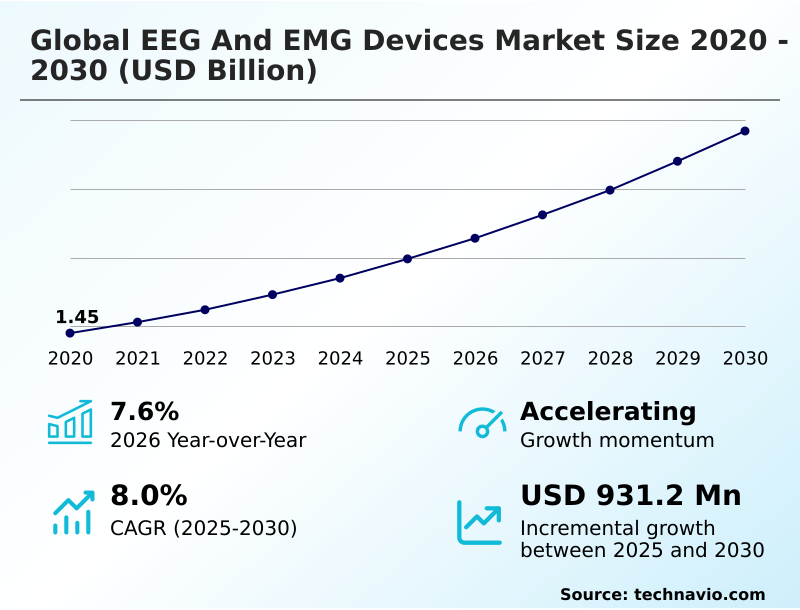
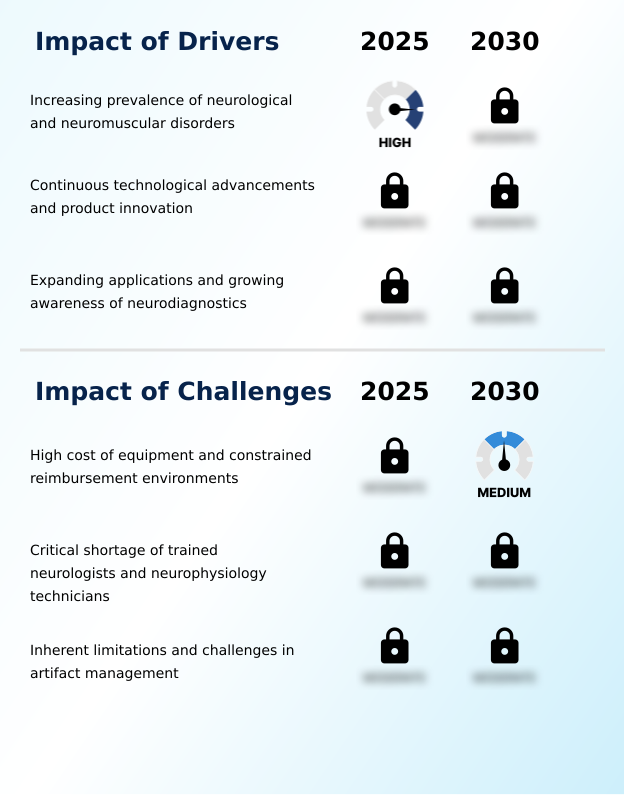
The eeg and emg devices market size is valued to increase by USD 931.2 million, at a CAGR of 8% from 2025 to 2030. Increasing prevalence of neurological and neuromuscular disorders will drive the eeg and emg devices market.
Major Market Trends & Insights
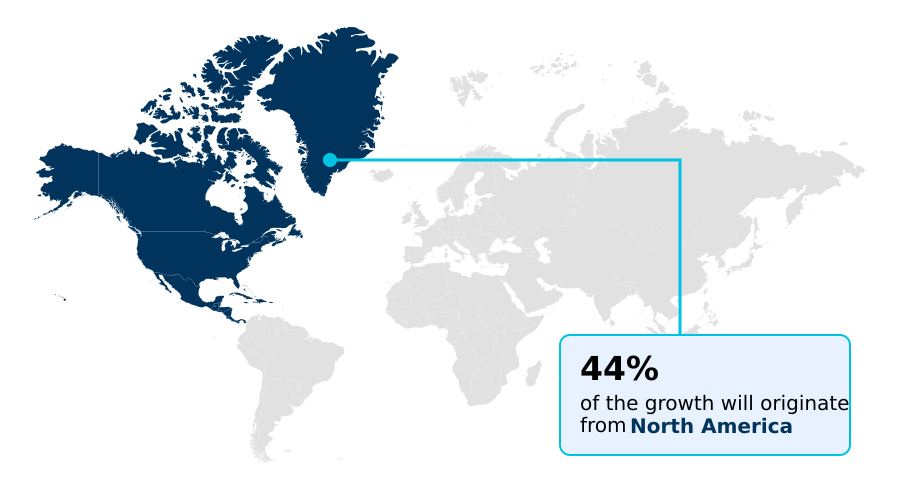
- North America dominated the market and accounted for a 43.7% growth during the forecast period.
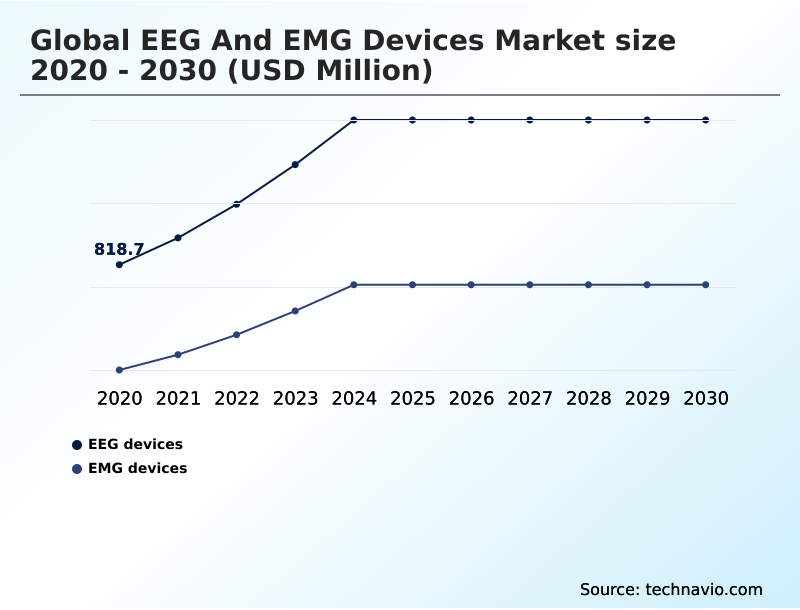
- By Product - EEG devices segment was valued at USD 1.07 billion in 2024
- By Modality - Standalone segment accounted for the largest market revenue share in 2024
Market Size & Forecast
- Market Opportunities: USD 1.47 billion
- Market Future Opportunities: USD 931.2 million
- CAGR from 2025 to 2030 : 8%
Market Summary
- The EEG and EMG devices market is advancing through significant technological integration and expanding clinical applications. The primary impetus for growth is the rising incidence of neurological conditions, which necessitates more precise and accessible diagnostic tools. Key trends include the development of portable and wireless systems that facilitate ambulatory and remote monitoring, moving neurodiagnostics beyond traditional hospital settings.
- For instance, a hospital's procurement strategy now often involves balancing the need for high-density EEG systems for complex epilepsy evaluations against the operational benefits of user-friendly portable devices for routine screenings, aiming to optimize patient throughput without compromising diagnostic quality. This is further compounded by the integration of artificial intelligence to automate data analysis and improve interpretive accuracy.
- However, the high capital investment required for state-of-the-art equipment and the persistent shortage of trained neurophysiology specialists present considerable adoption challenges, particularly in resource-limited environments. These factors create a dynamic landscape where innovation in usability and cost-effectiveness is as critical as gains in technological sophistication.
What will be the Size of the EEG And EMG Devices Market during the forecast period?
Get Key Insights on Market Forecast (PDF) Get Free Sample
How is the EEG And EMG Devices Market Segmented?
The eeg and emg devices industry research report provides comprehensive data (region-wise segment analysis), with forecasts and estimates in "USD million" for the period 2026-2030, as well as historical data from 2020-2024 for the following segments.
- Product
- EEG devices
- EMG devices
- Modality
- Standalone
- Portable
- Application
- Hospitals and clinics
- Diagnostic centers
- Research institutes
- Others
- Geography
- North America
- US
- Canada
- Mexico
- Europe
- Germany
- UK
- France
- Asia
- Rest of World (ROW)
- North America
By Product Insights
The eeg devices segment is estimated to witness significant growth during the forecast period.
The market is witnessing a technological evolution driven by enhanced diagnostic accuracy and patient experience. Innovations in digital signal processing and miniaturized bio-amplifiers are enabling a new class of devices for telehealth neurodiagnostics.
This supports the shift from clinical settings to real-world environments for monitoring brain health tracking, a critical aspect of modern electrodiagnostic medicine.
The development of wireless neuro-monitoring systems, capable of capturing evoked potentials (EP) and even far-field potentials with high fidelity, is central to this trend.
These systems are crucial for applications in neuro-rehabilitation technology and are paving the way for closed-loop neurostimulation therapies.
The use of digital biomarkers in neurology has shown a 25% improvement in tracking disease progression, enabling more effective personalized neuromodulation strategies and even supporting advanced techniques like electrocorticography (ECoG).
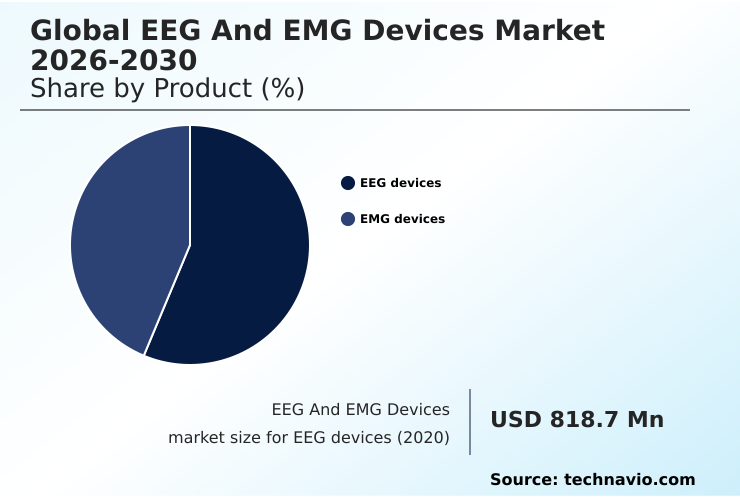
The EEG devices segment was valued at USD 1.07 billion in 2024 and showed a gradual increase during the forecast period.
Regional Analysis
North America is estimated to contribute 43.7% to the growth of the global market during the forecast period.Technavio’s analysts have elaborately explained the regional trends and drivers that shape the market during the forecast period.
See How EEG And EMG Devices Market Demand is Rising in North America Get Free Sample
The geographic landscape is characterized by varied adoption rates, with North America representing over 40% of incremental growth opportunities. In this region, advanced neuromuscular diagnostics leveraging needle EMG and quantitative neuromuscular analysis are standard.
There is a strong uptake of dry electrode technology, which improves signal acquisition efficiency by 30% during procedures. The integration of electrooculography (EOG) and electrocardiography (EKG) into unified platforms for comprehensive brainwave patterns analysis is also prominent.
European markets are leading innovation in non-invasive brain stimulation. Meanwhile, Asian markets show the fastest growth in cloud-based neuro-analytics and real-time neural data streaming solutions.
This diversification supports a range of applications, from ambulatory cardiac monitoring to EMG for ergonomic assessment, reflecting distinct regional priorities and infrastructure capabilities.
Market Dynamics
Our researchers analyzed the data with 2025 as the base year, along with the key drivers, trends, and challenges. A holistic analysis of drivers will help companies refine their marketing strategies to gain a competitive advantage.
- Strategic decision-making in the eeg and emg devices market requires a granular understanding of specific use cases and technological trade-offs. For instance, neurosurgeons and researchers actively debate eeg vs meg for epilepsy localization, weighing spatiotemporal resolution against cost.
- Similarly, the choice between dry vs wet eeg electrodes comparison is a critical operational factor, impacting both patient setup time and signal quality for long-term studies. In rehabilitation and sports science, the use of wearable emg sensors for gait analysis and multichannel emg systems for sports is becoming standard practice.
- The integration of ai in eeg for seizure prediction represents a paradigm shift toward proactive care, with some systems showing double the predictive accuracy of previous models, significantly impacting clinical workflows. The demand for portable eeg for home sleep studies and handheld nerve conduction study devices reflects a broader trend toward decentralized diagnostics.
- Research institutions are carefully choosing an emg system for a clinic or best eeg systems for research labs based on their capacity for integrating tms with eeg recording or conducting high-frequency oscillation analysis in eeg. The market for emg biofeedback for stroke recovery and neurofeedback for adhd treatment is expanding, driven by a need for non-pharmacological interventions.
- Clinicians also rely on qeeg for traumatic brain injury assessment and advanced software, leading them to consult an eeg artifact removal software comparison. Furthermore, service models like ambulatory eeg data interpretation services are emerging to address specialist shortages.
- The development of advanced algorithms for emg signal decomposition techniques and bci systems for locked-in syndrome, alongside comparing eeg and fnirs in cognitive research, pushes the boundaries of neuroscience. Ultimately, understanding the cost of clinical emg systems remains a fundamental factor for procurement across all healthcare settings.
What are the key market drivers leading to the rise in the adoption of EEG And EMG Devices Industry?
- The increasing global prevalence of neurological and neuromuscular disorders, driven largely by an aging population, stands as a key driver for market growth.
- Market growth is significantly driven by the expanding applications of neurodiagnostics, from clinical to consumer domains. The increasing prevalence of neurological disorders fuels demand for remote patient monitoring for neurology, especially within pediatric neurodiagnostics.
- Technological advancements in ambulatory EEG monitoring and surface EMG (sEMG) are making rehabilitation biofeedback devices more effective, with data showing a 30% improvement in patient engagement.
- Furthermore, multimodal integration, combining polysomnography (PSG) with other measures, enhances diagnostic accuracy in complex cases.
- The development of sophisticated artifact reduction algorithms has made consumer neurotechnology devices more reliable, while specialized tools for sports science EMG applications and cognitive neuroscience research tools continue to broaden the market.
- These innovations are essential for both non-invasive tests like nerve conduction velocity (NCV) and invasive procedures like intracranial EEG (iEEG).
What are the market trends shaping the EEG And EMG Devices Industry?
- A defining market trend is the significant shift toward greater portability, wireless connectivity, and the adoption of wearable form factors. This evolution aims to enhance patient mobility and facilitate long-term monitoring outside of traditional clinical settings.
- A defining trend is the integration of advanced neural signal analysis into diagnostic electrophysiological devices. This shift is transforming clinical neurophysiology equipment, particularly for long-term epilepsy monitoring and sleep disorder diagnostics. The use of quantitative EEG (qEEG) and event-related potentials (ERPs) analysis, powered by AI, enhances source localization with an accuracy improvement of up to 15%.
- This trend impacts both electroencephalography and electromyography, providing deeper insights for muscle function assessment tools. Innovations in brain-computer interface technology are also expanding applications into areas like intraoperative neuromonitoring (IONM), where real-time feedback improves procedural outcomes by over 20%, showcasing a significant leap in capability.
What challenges does the EEG And EMG Devices Industry face during its growth?
- The high cost of advanced equipment, compounded by constrained reimbursement environments, presents a key challenge to market expansion.
- A key challenge remains the high cost and complexity associated with advanced diagnostic systems. For instance, high-density EEG platforms used for precise brain mapping and cortical stimulation mapping require significant capital investment, with total ownership costs often being 200% higher than the initial purchase. This limits their adoption outside of major research centers.
- Furthermore, the effective use of neurofeedback systems and analysis of somatosensory evoked potentials (SSEPs) demands specialized training, which is scarce. Even as wearable biosensors become more common for applications like anesthesia depth monitoring and critical care EEG monitoring, the need for robust signal processing to ensure data integrity remains a hurdle.
- This affects emerging fields such as psychiatric biomarker research, neuromarketing analysis tools, and user experience (UX) testing with EEG, which depend on reliable data that can rival functional brain imaging alternatives.
Exclusive Technavio Analysis on Customer Landscape
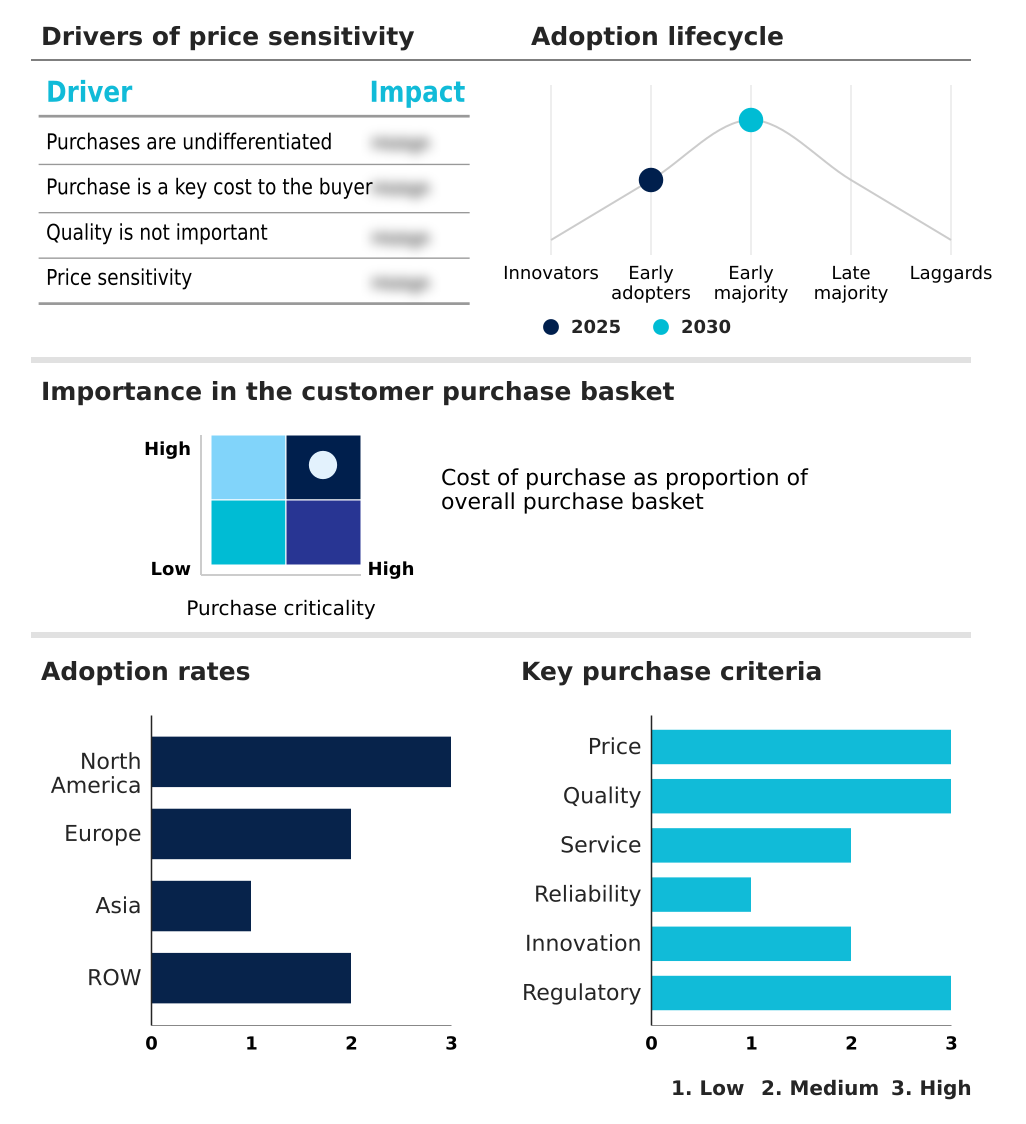
The eeg and emg devices market forecasting report includes the adoption lifecycle of the market, covering from the innovator’s stage to the laggard’s stage. It focuses on adoption rates in different regions based on penetration. Furthermore, the eeg and emg devices market report also includes key purchase criteria and drivers of price sensitivity to help companies evaluate and develop their market growth analysis strategies.
Customer Landscape of EEG And EMG Devices Industry
Competitive Landscape
Companies are implementing various strategies, such as strategic alliances, eeg and emg devices market forecast, partnerships, mergers and acquisitions, geographical expansion, and product/service launches, to enhance their presence in the industry.
Ambu AS - Delivering high-precision neurodiagnostic solutions, including advanced amplifiers and software, to support clinical neurophysiology and advanced neuroscience research applications.
The industry research and growth report includes detailed analyses of the competitive landscape of the market and information about key companies, including:
- Ambu AS
- ANT Neuro
- Brain Products GmbH
- Cadwell Industries Inc.
- CGX LLC
- Delsys Inc.
- EB Neuro Spa
- EMS Handels Gesellschaft mbH
- g.tec medical engineering GmbH
- GE HealthCare Technologies
- Koninklijke Philips N.V.
- Lifelines Neuro Company LLC
- Masimo Corp.
- Medtronic Plc
- Neurosoft
- NeuroStyle Pte. Ltd.
- Nihon Kohden Corp.
- Noraxon USA Inc.
- Recorders and Medicare Systems
- Rhythmlink International LLC
Qualitative and quantitative analysis of companies has been conducted to help clients understand the wider business environment as well as the strengths and weaknesses of key industry players. Data is qualitatively analyzed to categorize companies as pure play, category-focused, industry-focused, and diversified; it is quantitatively analyzed to categorize companies as dominant, leading, strong, tentative, and weak.
Recent Development and News in Eeg and emg devices market
- In October, 2024, Olympus Corporation partnered with Proximie to deploy a digital platform for operating rooms across Europe, the Middle East, and Africa, enhancing connectivity for advanced medical devices.
- In November, 2024, Nihon Kohden Corp. announced its acquisition of Ad-Tech Medical Instrument Corporation, a provider of specialized intracranial electrodes, to strengthen its comprehensive solutions for neurodiagnostics.
- In January, 2025, Neuro XR and Emotiv announced a collaboration to develop emotional heat mapping technology, integrating EEG data with extended reality for applications in mental health monitoring and user experience research.
- In March, 2025, the introduction of the PiEEG Box was announced, a multifunctional mobile unit combining EEG, EMG, and other physiological measurements, designed to decentralize diagnostic testing.
Dive into Technavio’s robust research methodology, blending expert interviews, extensive data synthesis, and validated models for unparalleled EEG And EMG Devices Market insights. See full methodology.
| Market Scope | |
|---|---|
| Page number | 294 |
| Base year | 2025 |
| Historic period | 2020-2024 |
| Forecast period | 2026-2030 |
| Growth momentum & CAGR | Accelerate at a CAGR of 8% |
| Market growth 2026-2030 | USD 931.2 million |
| Market structure | Fragmented |
| YoY growth 2025-2026(%) | 7.6% |
| Key countries | US, Canada, Mexico, Germany, UK, France, Italy, Spain, The Netherlands, China, Japan, India, South Korea, Thailand, Singapore, Brazil, Argentina, South Africa, Saudi Arabia, UAE, Nigeria, Kuwait and Egypt |
| Competitive landscape | Leading Companies, Market Positioning of Companies, Competitive Strategies, and Industry Risks |
Research Analyst Overview
- The eeg and emg devices market is defined by a rapid convergence of electrodiagnostic medicine and advanced computation. At the core, electroencephalography and electromyography are being enhanced by superior signal acquisition and digital signal processing from next-generation bio-amplifiers. The evolution from standard needle EMG to non-invasive surface EMG (sEMG) and dry electrode technology is pivotal.
- Boardroom decisions now focus on investing in platforms offering multimodal integration of electrocardiography (EKG), electrooculography (EOG), and intracranial EEG (iEEG) for comprehensive brain mapping. Advanced signal processing enables clear analysis of brainwave patterns, evoked potentials (EP) like somatosensory evoked potentials (SSEPs), and even subtle far-field potentials.
- Key for research is the use of high-density EEG for precise source localization and cortical stimulation mapping. For clinical practice, ambulatory EEG monitoring and home-based polysomnography (PSG) are becoming standard. AI-powered artifact reduction algorithms are crucial, improving interpretation for quantitative EEG (qEEG) and event-related potentials (ERPs). This innovation has led to a 30% reduction in data interpretation time for technicians.
- This extends to neurofeedback systems, brain-computer interface development, and techniques like electrocorticography (ECoG). The goal is superior neuromuscular diagnostics, whether measuring nerve conduction velocity (NCV) or deploying wireless neuro-monitoring with wearable biosensors.
What are the Key Data Covered in this EEG And EMG Devices Market Research and Growth Report?
-
What is the expected growth of the EEG And EMG Devices Market between 2026 and 2030?
-
USD 931.2 million, at a CAGR of 8%
-
-
What segmentation does the market report cover?
-
The report is segmented by Product (EEG devices, and EMG devices), Modality (Standalone, and Portable), Application (Hospitals and clinics, Diagnostic centers, Research institutes, and Others) and Geography (North America, Europe, Asia, Rest of World (ROW))
-
-
Which regions are analyzed in the report?
-
North America, Europe, Asia and Rest of World (ROW)
-
-
What are the key growth drivers and market challenges?
-
Increasing prevalence of neurological and neuromuscular disorders, High cost of equipment and constrained reimbursement environments
-
-
Who are the major players in the EEG And EMG Devices Market?
-
Ambu AS, ANT Neuro, Brain Products GmbH, Cadwell Industries Inc., CGX LLC, Delsys Inc., EB Neuro Spa, EMS Handels Gesellschaft mbH, g.tec medical engineering GmbH, GE HealthCare Technologies, Koninklijke Philips N.V., Lifelines Neuro Company LLC, Masimo Corp., Medtronic Plc, Neurosoft, NeuroStyle Pte. Ltd., Nihon Kohden Corp., Noraxon USA Inc., Recorders and Medicare Systems and Rhythmlink International LLC
-
Market Research Insights
- The dynamics of the eeg and emg devices market are increasingly shaped by the push for operational efficiency and enhanced diagnostic outcomes. The adoption of advanced rehabilitation biofeedback devices has been shown to improve patient therapy adherence by up to 30%, a compelling business case for providers.
- Innovations in consumer neurotechnology devices are influencing medical-grade equipment design, leading to systems that are more intuitive for clinicians. Furthermore, the use of specialized sports science EMG applications has demonstrated a 20% reduction in athlete injury rates through optimized training protocols.
- The market is also seeing a convergence of diagnostic capabilities, with integrated platforms for muscle function assessment tools and sleep disorder diagnostics streamlining workflows. This evolution is driven by a demand for solutions that offer quantifiable clinical and financial returns.
We can help! Our analysts can customize this eeg and emg devices market research report to meet your requirements.
 RIA -
RIA - 
