
US Foodservice Market Analysis, Size, and Forecast 2025-2029

US Foodservice Market Analysis, Size, and Forecast 2025-2029

Published: Jan 2025 192 Pages SKU: IRTNTR70236

Market Overview at a Glance

$3118.7 B
Market Opportunity
30.6%
CAGR
30.0
YoY growth 2024-2025(%)

US Foodservice Market Size 2025-2029 

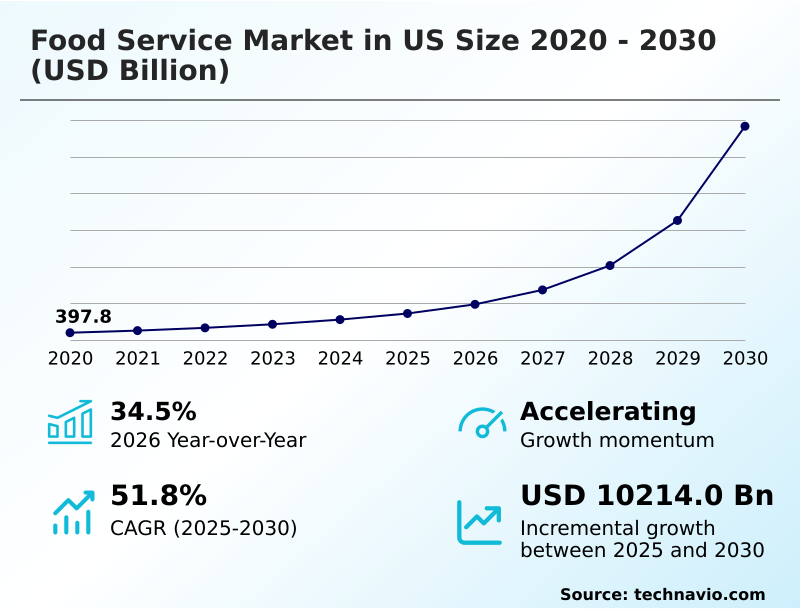
US foodservice market size is forecast to increase by USD 3118.7 billion, at a CAGR of 30.6% between 2024 and 2029. The increasing trend towards snacking and indulgence consumption, the highly diverse population's growing preference for ethnic cuisine, and the rising competition from the unorganized fast food sector.

Major Market Trends & Insights

  •     North America dominated the market and accounted for a 100% during the forecast period.
  •     Based upon the Type, the Fast foodservice segment was valued at USD 128.20 billion in 2022
  •     Based on the Solution , the Conventional segment accounted for the largest market revenue share in 2022

Market Size & Forecast

  •     Market Opportunities: USD 3118.7 billion
  •     Future Opportunities: USD 934.17 billion 
  •     CAGR : 30.6%

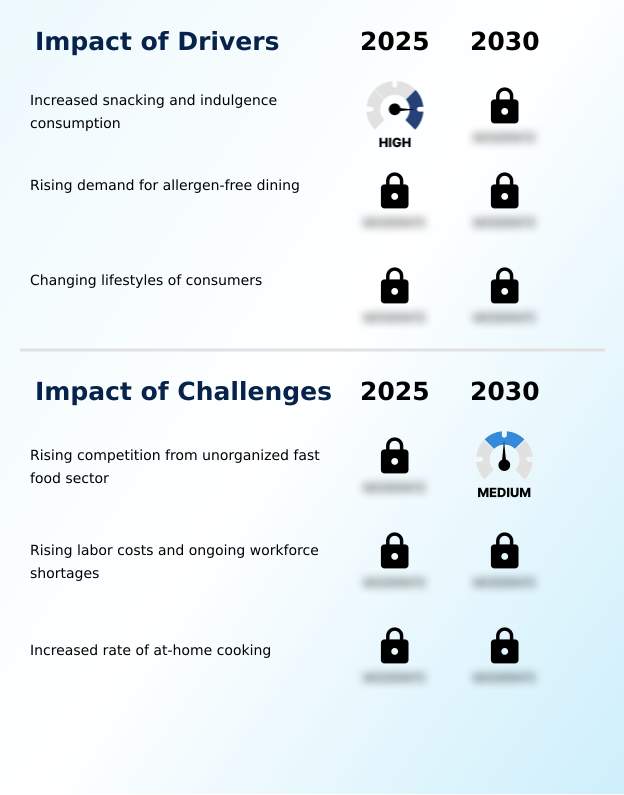
 The first driver, the shift towards snacking and indulgence, is fueled by consumers' busy lifestyles and changing eating habits. This trend presents opportunities for foodservice providers to offer convenient, on-the-go food options and innovative, indulgent menu items. The second driver, the diverse population's cravings for ethnic cuisine, adds complexity to the market landscape. Foodservice providers must cater to a wide range of cultural preferences and dietary needs while maintaining quality and authenticity.

This challenge requires a deep understanding of consumer demographics and culinary trends. The third driver, the unorganized fast food sector's growing presence, intensifies competition in the market. Established foodservice providers must differentiate themselves by offering superior quality, innovation, and customer experience to maintain market share. This competition necessitates strategic planning, operational efficiency, and a focus on customer satisfaction. Companies that successfully navigate these challenges will capitalize on the market's potential for growth and innovation.

What will be the size of the US Foodservice Market during the forecast period?
Foodservice Market in US Size

 Request Free Sample

  • The global foodservice market is experiencing a continuous shift driven by digital integration, sustainability, and performance optimization. Businesses are leveraging POS integration and online ordering apps to enhance transaction efficiency and streamline service. Strategic tools such as menu optimization techniques, cost accounting methods, and inventory control techniques are being adopted to improve operational accuracy and profitability. Ensuring food safety compliance and enforcing ingredient traceability are now critical, especially as data-driven systems gain traction.
  • Improving employee performance and satisfaction is also central, supported by staff scheduling software, employee engagement initiatives, and a structured performance management system. Restaurants are also investing in supplier relationship management, restaurant technology, purchasing optimization, and energy conservation practices to reduce waste and ensure sustainability. Customer-facing strategies include customer communication channels, digital menu boards, and online reputation management, all of which contribute to stronger customer retention strategies and increased loyalty program effectiveness. Corporate event catering, private events, and wedding catering provide opportunities for growth, while financial reporting and payroll management are essential for maintaining transparency and compliance. Worker's compensation, health insurance, and franchise technology are important considerations for business owners.
  • Recent analysis revealed the implementation of customer-centric features led to a 27% increase in customer satisfaction metrics across leading outlets. By comparison, businesses utilizing structured sales performance analysis and pricing model optimization observed a 19% improvement in revenue outcomes. This gap highlights the measurable impact of coordinated operational improvement strategies, particularly those supported by customer data analytics, feedback analysis tools, and profitability analysis. Integrated delivery logistics management and consistent customer experience management continue to define how the foodservice market evolves across digital and physical touchpoints.

How is this market segmented?

The market research report provides comprehensive data (region-wise segment analysis), with forecasts and estimates in "USD billion" for the period 2025-2029, as well as historical data from 2019-2023 for the following segments.

  • Type
    • Fast foodservice
    • Restaurant
    • Cafes and bars
    • Others
  • Solution
    • Conventional
    • Centralized
    • Ready-prepared
    • Assembly-serve
  • Sector
    • Commercial
    • Non-commercial
  • Business Segment
    • Chains
    • Independent
  • Service Model
    • Dine-In
    • Delivery
    • Takeaway
  • Target Audience
    • Families
    • Millennials
    • Professionals
  • Health Focus
    • Organic
    • Plant-Based
    • Gluten-Free
  • Geography
    • North America
      • US

By Type Insights

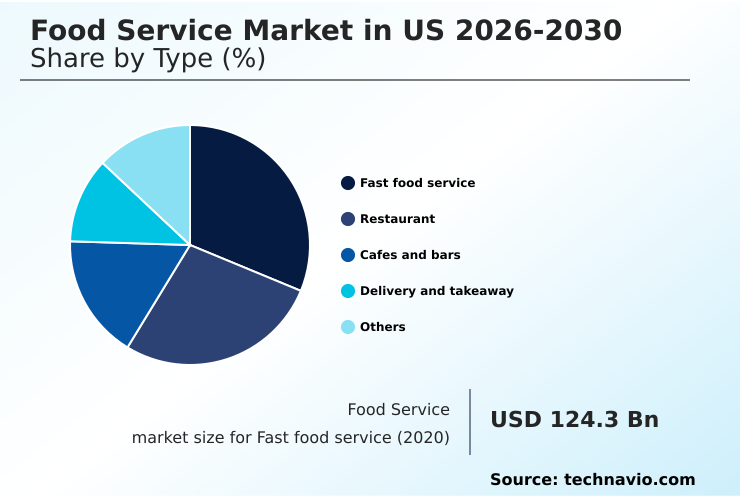
The fast foodservice segment is estimated to witness significant growth during the forecast period.

The US foodservice market is a dynamic and evolving industry, encompassing various segments such as table service, casual dining, banquet halls, and quick service restaurants. Table service establishments prioritize staff training and customer service to deliver an exceptional dining experience. Casual dining and banquet halls cater to large groups and special occasions, offering diverse menus and flexible event spaces. Revenue management, food waste reduction, and menu engineering are crucial strategies for optimizing operations and profitability. Food delivery services have gained popularity, with third-party platforms and restaurant partnerships streamlining the ordering process. Refrigeration units, restaurant design, and supply chain management are essential components of the industry, ensuring efficient and sustainable food handling and sourcing.

Ingredient sourcing, data analytics, and pricing strategies enable operators to make informed decisions and cater to changing consumer preferences. Menu design, marketing automation, and catering equipment cater to diverse customer needs and expectations. Energy efficiency, social media marketing, and food safety audits are essential aspects of modern foodservice operations. Fine dining establishments emphasize exceptional service and culinary expertise, while fast casual restaurants offer quick and convenient options for consumers on the go. Online ordering platforms, order fulfillment, and customer loyalty programs are essential tools for enhancing the customer experience and driving repeat business. Contract catering and foodservice equipment providers offer customized solutions for various market segments, from schools and healthcare facilities to corporate offices and event venues.

Sustainable practices, portion control systems, and cooking ranges are increasingly important considerations for operators seeking to minimize their environmental footprint and maintain high-quality food offerings. The foodservice industry is subject to various regulations and standards, including health inspections and food safety audits, ensuring the safety and well-being of consumers. The market's continued growth and evolution reflect the industry's ability to adapt to changing consumer preferences and demands.

Foodservice Market in US Size

Download Free Sample Report

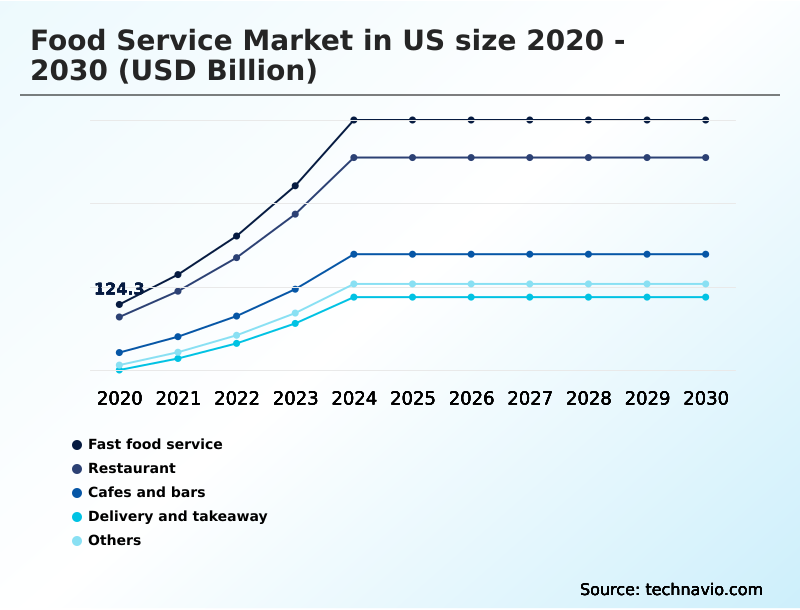
The Fast foodservice segment was valued at  USD 128.20 billion in 2019 and showed a gradual increase during the forecast period.
Market Dynamics

Our researchers analyzed the data with 2024 as the base year, along with the key drivers, trends, and challenges. A holistic analysis of drivers will help companies refine their marketing strategies to gain a competitive advantage.

The global restaurant technology market continues to evolve as operators seek tools that directly influence operational efficiency and profitability. Key areas of focus include impact restaurant technology adoption and the effectiveness of online ordering systems, which streamline processes while expanding customer access. Restaurants are prioritizing improving kitchen workflow efficiency and reducing food waste in restaurants through integrated solutions. Enhancements in optimizing restaurant supply chains and enhancing customer service strategies directly contribute to improving restaurant profit margins and measuring customer satisfaction.

Employee retention is supported by high restaurant employee engagement, while tools like menu engineering and sales forecasting for restaurant business improve performance. Operators use data to assess the impact of pricing strategies, manage restaurant labor cost optimization, and deploy marketing automation tools for campaign precision. Evaluating the measuring ROI of marketing campaigns and impact of restaurant technology on operations helps in strategic planning. The adoption of sustainable practices is increasingly vital, ensuring long-term viability.

What are the US Foodservice Market drivers leading to the rise in adoption of the Industry?

  • The primary factor fueling market growth is the heightened consumption of increased snacking and indulgence foods. The foodservice market in the US is witnessing significant shifts in consumer behavior, with an increasing preference for snacks and light meals over traditional sit-down meals. According to recent research, one in five new food products launched between January 2021 and June 2022 fell under the category of nuts and seeds, while one in eight were finger foods or potato-based snacks. Other popular snack subcategories include meat snacks, snack mixes, and fruit-based snacks. Approximately three in ten American children consume three or more snacks daily, and each additional snack is associated with a 9% increase in daily caloric intake.
  • To stay competitive in this dynamic market, restaurant operators are leveraging data analytics to optimize pricing strategies, sales forecasting, food cost control, and menu design. Restaurant management software, online ordering platforms, and food safety audits are essential tools for ensuring profitability and customer loyalty. Space planning and efficient restaurant supply management are also critical to maintaining a harmonious and productive restaurant environment. Marketing automation and customer loyalty programs are increasingly important for attracting and retaining customers. By analyzing customer data, restaurants can tailor their marketing efforts and offer personalized promotions and discounts. In conclusion, the foodservice industry is undergoing significant changes, and operators must adapt to these shifts by leveraging technology, data analytics, and customer insights to remain competitive and profitable.

What are the US Foodservice Market trends shaping the Industry?

  • A highly diverse population is currently embracing ethnic cuisines, marking a significant market trend. This culinary trend reflects the growing appreciation for cultural diversity and the desire to explore new flavors.
  • The foodservice market  is witnessing significant growth due to several key trends. One such trend is the increasing preference for ethnic cuisines, driven by the influx of immigrants and the expanding American palate. The Asian American population, which is the fastest-growing racial or ethnic group in the US, has introduced a diverse range of spicy cuisines from East and Southeast Asian countries and the Indian subcontinent. This trend is reflected in the market's response, with a favorable reception from consumers. Another trend shaping the foodservice industry is the focus on energy efficiency. Foodservice operators are increasingly investing in energy-efficient catering equipment and foodservice equipment to reduce operational costs and minimize their carbon footprint.
  • Social media marketing is also becoming essential for foodservice businesses, enabling them to engage with customers, manage online reviews, and promote their brand. Contract catering and order fulfillment systems are other areas of growth, with businesses leveraging technology to streamline operations and improve customer experience. Driver management and inventory management systems are also critical for ensuring efficient delivery and reducing food waste. Hygiene practices remain a top priority, with food safety regulations driving the adoption of advanced hygiene technologies and practices. Quick service restaurants (QSRs) are also adopting technology to enhance the customer experience, with self-service kiosks, mobile ordering, and contactless payment options becoming increasingly popular. Overall, the foodservice market in the US is dynamic and evolving, with trends such as energy efficiency, social media marketing, and technology adoption shaping the industry's future.

How does US Foodservice Market face challenges during its growth?

  • The unorganized fast food sector's increasing competition poses a significant challenge to the industry's growth trajectory. The foodservice market in the US faces challenges from the growing number of unorganized fast food companies. These companies, including those operating from street carts and trucks, offer affordable fast food options to price-conscious consumers. The presence of various consumer segments based on income levels in urban areas has led to an increase in the number of fast food restaurants. This trend is expected to continue during the forecast period, potentially hindering the growth of the formal foodservice industry. Labor management and health inspections are critical areas of focus for foodservice providers to maintain food safety standards.
  • Sustainable practices, such as water conservation and sourcing strategies, are also gaining importance. Food processors invest in portion control systems and commercial ovens to improve efficiency and consistency. Buffet service remains popular in various settings, requiring commercial ovens and cooking ranges to ensure food quality and safety. Customer service is a key differentiator, with providers emphasizing harmonious and immersive experiences to attract and retain customers. To navigate these market dynamics, foodservice providers must adopt innovative strategies. This includes investing in technology for labor management and health inspections, implementing sustainable practices, and offering diverse menu options to cater to various consumer segments.
  • By focusing on these areas, providers can maintain their competitive edge and meet the evolving demands of the foodservice market. In conclusion, the foodservice market in the US is undergoing significant changes, driven by the expansion of the unorganized fast food sector. Providers must address challenges in labor management, health inspections, and food safety standards while embracing sustainable practices and innovative technologies to remain competitive. By adapting to these trends, foodservice providers can capitalize on the growing demand for quality, affordable, and convenient food options.

Exclusive US Foodservice Market Customer Landscape

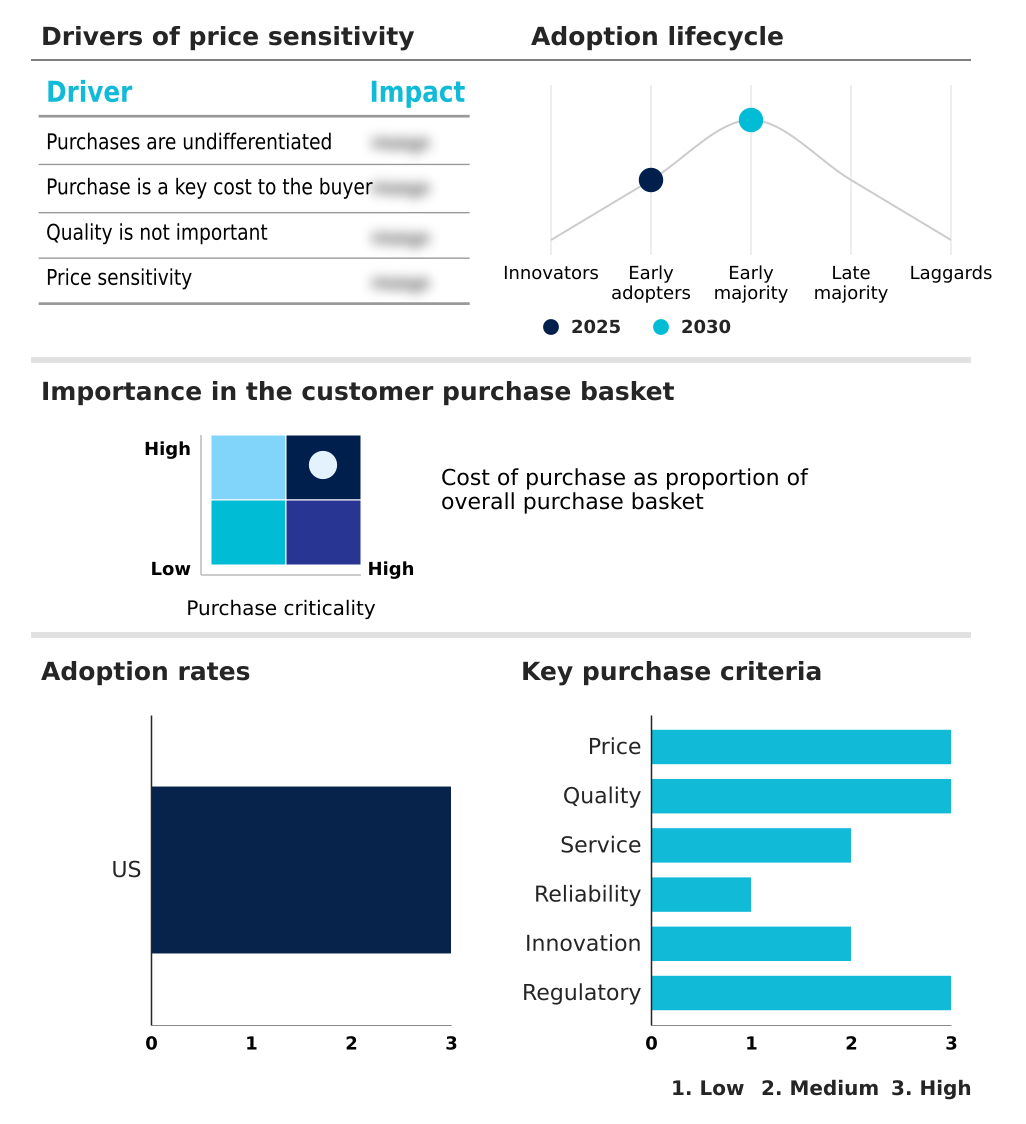
The market forecasting report includes the adoption lifecycle of the market, covering from the innovator's stage to the laggard's stage. It focuses on adoption rates in different regions based on penetration. Furthermore, the report also includes key purchase criteria and drivers of price sensitivity to help companies evaluate and develop their market growth analysis strategies.
Foodservice Market in US Share by Geography

 Customer Landscape

Key Companies & Market Insights

Companies are implementing various strategies, such as strategic alliances, market forecast partnerships, mergers and acquisitions, geographical expansion, and product/service launches, to enhance their presence in the market.

The market research and growth report includes detailed analyses of the competitive landscape of the market and information about key companies, including:

  • American Dairy Queen Corp.
  • Chick fil A Inc.
  • CKE Restaurants Holdings Inc.
  • Dominos Pizza Inc.
  • Inspire Brands Inc.
  • Jack in the Box Inc.
  • Marcos Franchising LLC
  • McDonald Corp.
  • MTY Food Group Inc.
  • Papa Johns International Inc.
  • Penn Station Inc.
  • Pret A Manger
  • Raising Canes Restaurants LLC
  • Restaurant Brands International Inc.
  • Shamrock Foods Co.
  • Starbucks Corp.
  • Sysco Corp.
  • The Subway Group
  • The Wendys Co.
  • Wingstop Inc.
  • YUM Brands Inc.

Qualitative and quantitative analysis of companies has been conducted to help clients understand the wider business environment as well as the strengths and weaknesses of key market players. Data is qualitatively analyzed to categorize companies as pure play, category-focused, industry-focused, and diversified; it is quantitatively analyzed to categorize companies as dominant, leading, strong, tentative, and weak.

Recent Development and News in Foodservice Market In US

  • In January 2024, Sysco Corporation, a leading foodservice distributor in the US, announced the acquisition of US Foods Holding Corp. for approximately USD3.5 billion. This merger aimed to create a larger, more competitive player in the foodservice distribution sector (Sysco Corporation Press Release, 2024).
  • In March 2024, McDonald's Corporation and DoorDash, a leading on-demand food delivery platform, announced a multi-year partnership to expand McDonald's delivery capabilities across the US. This collaboration allowed McDonald's to reach more customers through DoorDash's extensive network (McDonald's Corporation Press Release, 2024).
  • In May 2024, Starbucks Coffee Company unveiled its new plant-based protein bowl, made in collaboration with Beyond Meat, at select stores in the US. This strategic partnership and product launch catered to the growing demand for plant-based food options in the foodservice industry (Starbucks Coffee Company Press Release, 2024).
  • In January 2025, Grubhub and Uber Eats, two major food delivery platforms, announced their merger. The combined entity, Now Delivery, aimed to create a more competitive food delivery market in the US, offering a broader range of restaurant choices and delivery options to customers (Uber Technologies Inc. Press Release, 2025).

Research Analyst Overview

The US foodservice market is rapidly advancing, driven by integrated point of sale system and scalable online ordering platform solutions. Restaurants are adopting kitchen display system, inventory management software, and restaurant management system to boost operational efficiency metrics. Key focuses include supply chain optimization, food safety management system, and food cost control measures, supported by data analytics dashboard and financial reporting tools.

Strategic tools like menu engineering principles, pricing strategies analysis, and revenue management strategy improve profitability. Enhancing experience through table management system, labor scheduling software, customer relationship management, and customer feedback system is vital. Businesses also implement waste reduction strategies, food waste tracking, and energy efficiency improvements.

Staff training programs, customer service protocols, employee performance metrics, and customer satisfaction scores ensure service excellence. Growth is further accelerated through digital marketing campaigns, brand reputation management, sales forecasting techniques, and customer loyalty programs.

Buffet service and commercial ovens are staples in the industry, while cooking ranges and portion control systems optimize food production. The ongoing integration of technology, such as inventory management systems and delivery vehicles, enhances operational efficiency. The foodservice market in the US is a continually evolving landscape, with entities such as catering equipment, energy efficiency, social media marketing, fine dining, order fulfillment, online reviews, driver management, hygiene practices, catering services, contract catering, foodservice equipment, quick service, inventory management systems, delivery vehicles, labor management, health inspections, food safety standards, sustainable practices, food processors, portion control systems, cooking ranges, water conservation, sourcing strategies, buffet service, commercial ovens, customer service, and more, shaping the industry's future.

Dive into Technavio's robust research methodology, blending expert interviews, extensive data synthesis, and validated models for unparalleled Foodservice Market in US insights. See full methodology.

Market Scope

Report Coverage

Details

Page number

192

Base year

2024

Historic period

2019-2023

Forecast period

2025-2029

Growth momentum & CAGR

Accelerate at a CAGR of 30.6%

Market growth 2025-2029

USD 3118.7 billion

Market structure

Fragmented

YoY growth 2024-2025(%)

30.0

Competitive landscape

Leading Companies, Market Positioning of Companies, Competitive Strategies, and Industry Risks

Request Free Sample

What are the Key Data Covered in this Market Research Report?

  • CAGR of the market during the forecast period
  • Detailed information on factors that will drive the market growth and forecasting between 2025 and 2029
  • Precise estimation of the size of the market  and its contribution of the market in focus to the parent market
  • Accurate predictions about upcoming market growth and trends and changes in consumer behaviour
  • Growth of the market across US
  • Thorough analysis of the market's competitive landscape and detailed information about companies
  • Comprehensive analysis of factors that will challenge the growth of market companies

We can help! Our analysts can customize this market research report to meet your requirements Get in touch

1 Executive Summary

  • 1.1 Market overview
    • Executive Summary - Chart on Market Overview
    • Executive Summary - Data Table on Market Overview
    • Executive Summary - Chart on Country Market Characteristics
    • Executive Summary - Chart on Market Segmentation by Type
    • Executive Summary - Chart on Market Segmentation by Solution
    • Executive Summary - Chart on Market Segmentation by Sector
    • Executive Summary - Chart on Market Segmentation by Business Segment
    • Executive Summary - Chart on Company Market Positioning

2 Technavio Analysis

  • 2.1 Analysis of price sensitivity, lifecycle, customer purchase basket, adoption rates, and purchase criteria
    • Analysis of price sensitivity, lifecycle, customer purchase basket, adoption rates, and purchase criteria
  • 2.2 Criticality of inputs and Factors of differentiation
    • Overview on criticality of inputs and factors of differentiation
  • 2.3 Factors of disruption
    • Overview on factors of disruption
  • 2.4 Impact of drivers and challenges
    • Impact of drivers and challenges in 2024 and 2029

3 Market Landscape

  • 3.1 Market ecosystem
    • Parent Market
    • Data Table on - Parent Market
  • 3.2 Market characteristics
    • Market characteristics analysis
  • 3.3 Value chain analysis
    • Value chain analysis

4 Market Sizing

  • 4.1 Market definition
    • Offerings of companies included in the market definition
  • 4.2 Market segment analysis
    • Market segments
  • 4.3 Market size 2024
    • 4.4 Market outlook: Forecast for 2024-2029
      • Chart on US - Market size and forecast 2024-2029 ($ billion)
      • Data Table on US - Market size and forecast 2024-2029 ($ billion)
      • Chart on US: Year-over-year growth 2024-2029 (%)
      • Data Table on US: Year-over-year growth 2024-2029 (%)

    5 Historic Market Size

    • 5.1 Foodservice Market in US 2019 - 2023
      • Historic Market Size - Data Table on Foodservice Market in US 2019 - 2023 ($ billion)
    • 5.2 Type segment analysis 2019 - 2023
      • Historic Market Size - Type Segment 2019 - 2023 ($ billion)
    • 5.3 Solution segment analysis 2019 - 2023
      • Historic Market Size - Solution Segment 2019 - 2023 ($ billion)
    • 5.4 Sector segment analysis 2019 - 2023
      • Historic Market Size - Sector Segment 2019 - 2023 ($ billion)
    • 5.5 Business segment analysis 2019 - 2023
      • Historic Market Size - Business Segment 2019 - 2023 ($ billion)

    6 Qualitative Analysis

    • 6.1 Impact of AI on Foodservice Market in US

      7 Five Forces Analysis

      • 7.1 Five forces summary
        • Five forces analysis - Comparison between 2024 and 2029
      • 7.2 Bargaining power of buyers
        • Bargaining power of buyers - Impact of key factors 2024 and 2029
      • 7.3 Bargaining power of suppliers
        • Bargaining power of suppliers - Impact of key factors in 2024 and 2029
      • 7.4 Threat of new entrants
        • Threat of new entrants - Impact of key factors in 2024 and 2029
      • 7.5 Threat of substitutes
        • Threat of substitutes - Impact of key factors in 2024 and 2029
      • 7.6 Threat of rivalry
        • Threat of rivalry - Impact of key factors in 2024 and 2029
      • 7.7 Market condition
        • Chart on Market condition - Five forces 2024 and 2029

      8 Market Segmentation by Type

      • 8.1 Market segments
        • Chart on Type - Market share (2024-2029) (%)
        • Data Table on Type - Market share (2024-2029) (%)
      • 8.2 Comparison by Type
        • Chart on Comparison by Type
        • Data Table on Comparison by Type
      • 8.3 Fast foodservice - Market size and forecast (2024-2029)
        • Chart on Fast foodservice - Market size and forecast (2024-2029) ($ billion)
        • Data Table on Fast foodservice - Market size and forecast (2024-2029) ($ billion)
        • Chart on Fast foodservice - Year-over-year growth (2024-2029) (%)
        • Data Table on Fast foodservice - Year-over-year growth (2024-2029) (%)
      • 8.4 Restaurant - Market size and forecast (2024-2029)
        • Chart on Restaurant - Market size and forecast (2024-2029) ($ billion)
        • Data Table on Restaurant - Market size and forecast (2024-2029) ($ billion)
        • Chart on Restaurant - Year-over-year growth (2024-2029) (%)
        • Data Table on Restaurant - Year-over-year growth (2024-2029) (%)
      • 8.5 Cafes and bars - Market size and forecast (2024-2029)
        • Chart on Cafes and bars - Market size and forecast (2024-2029) ($ billion)
        • Data Table on Cafes and bars - Market size and forecast (2024-2029) ($ billion)
        • Chart on Cafes and bars - Year-over-year growth (2024-2029) (%)
        • Data Table on Cafes and bars - Year-over-year growth (2024-2029) (%)
      • 8.6 Others - Market size and forecast (2024-2029)
        • Chart on Others - Market size and forecast (2024-2029) ($ billion)
        • Data Table on Others - Market size and forecast (2024-2029) ($ billion)
        • Chart on Others - Year-over-year growth (2024-2029) (%)
        • Data Table on Others - Year-over-year growth (2024-2029) (%)
      • 8.7 Market opportunity by Type
        • Market opportunity by Type ($ billion)
        • Data Table on Market opportunity by Type ($ billion)

      9 Market Segmentation by Solution

      • 9.1 Market segments
        • Chart on Solution - Market share (2024-2029) (%)
        • Data Table on Solution - Market share (2024-2029) (%)
      • 9.2 Comparison by Solution
        • Chart on Comparison by Solution
        • Data Table on Comparison by Solution
      • 9.3 Conventional - Market size and forecast (2024-2029)
        • Chart on Conventional - Market size and forecast (2024-2029) ($ billion)
        • Data Table on Conventional - Market size and forecast (2024-2029) ($ billion)
        • Chart on Conventional - Year-over-year growth (2024-2029) (%)
        • Data Table on Conventional - Year-over-year growth (2024-2029) (%)
      • 9.4 Centralized - Market size and forecast (2024-2029)
        • Chart on Centralized - Market size and forecast (2024-2029) ($ billion)
        • Data Table on Centralized - Market size and forecast (2024-2029) ($ billion)
        • Chart on Centralized - Year-over-year growth (2024-2029) (%)
        • Data Table on Centralized - Year-over-year growth (2024-2029) (%)
      • 9.5 Ready-prepared - Market size and forecast (2024-2029)
        • Chart on Ready-prepared - Market size and forecast (2024-2029) ($ billion)
        • Data Table on Ready-prepared - Market size and forecast (2024-2029) ($ billion)
        • Chart on Ready-prepared - Year-over-year growth (2024-2029) (%)
        • Data Table on Ready-prepared - Year-over-year growth (2024-2029) (%)
      • 9.6 Assembly-serve - Market size and forecast (2024-2029)
        • Chart on Assembly-serve - Market size and forecast (2024-2029) ($ billion)
        • Data Table on Assembly-serve - Market size and forecast (2024-2029) ($ billion)
        • Chart on Assembly-serve - Year-over-year growth (2024-2029) (%)
        • Data Table on Assembly-serve - Year-over-year growth (2024-2029) (%)
      • 9.7 Market opportunity by Solution
        • Market opportunity by Solution ($ billion)
        • Data Table on Market opportunity by Solution ($ billion)

      10 Market Segmentation by Sector

      • 10.1 Market segments
        • Chart on Sector - Market share (2024-2029) (%)
        • Data Table on Sector - Market share (2024-2029) (%)
      • 10.2 Comparison by Sector
        • Chart on Comparison by Sector
        • Data Table on Comparison by Sector
      • 10.3 Commercial - Market size and forecast (2024-2029)
        • Chart on Commercial - Market size and forecast (2024-2029) ($ billion)
        • Data Table on Commercial - Market size and forecast (2024-2029) ($ billion)
        • Chart on Commercial - Year-over-year growth (2024-2029) (%)
        • Data Table on Commercial - Year-over-year growth (2024-2029) (%)
      • 10.4 Non-commercial - Market size and forecast (2024-2029)
        • Chart on Non-commercial - Market size and forecast (2024-2029) ($ billion)
        • Data Table on Non-commercial - Market size and forecast (2024-2029) ($ billion)
        • Chart on Non-commercial - Year-over-year growth (2024-2029) (%)
        • Data Table on Non-commercial - Year-over-year growth (2024-2029) (%)
      • 10.5 Market opportunity by Sector
        • Market opportunity by Sector ($ billion)
        • Data Table on Market opportunity by Sector ($ billion)

      11 Market Segmentation by Business Segment

      • 11.1 Market segments
        • Chart on Business Segment - Market share (2024-2029) (%)
        • Data Table on Business Segment - Market share (2024-2029) (%)
      • 11.2 Comparison by Business Segment
        • Chart on Comparison by Business Segment
        • Data Table on Comparison by Business Segment
      • 11.3 Chains - Market size and forecast (2024-2029)
        • Chart on Chains - Market size and forecast (2024-2029) ($ billion)
        • Data Table on Chains - Market size and forecast (2024-2029) ($ billion)
        • Chart on Chains - Year-over-year growth (2024-2029) (%)
        • Data Table on Chains - Year-over-year growth (2024-2029) (%)
      • 11.4 Independent - Market size and forecast (2024-2029)
        • Chart on Independent - Market size and forecast (2024-2029) ($ billion)
        • Data Table on Independent - Market size and forecast (2024-2029) ($ billion)
        • Chart on Independent - Year-over-year growth (2024-2029) (%)
        • Data Table on Independent - Year-over-year growth (2024-2029) (%)
      • 11.5 Market opportunity by Business Segment
        • Market opportunity by Business Segment ($ billion)
        • Data Table on Market opportunity by Business Segment ($ billion)

      12 Market Segmentation by Service Model

      • 12.1 Market segments
        • Chart on Service Model - Market share (2024-2029) (%)
        • Data Table on Service Model - Market share (2024-2029) (%)
      • 12.2 Comparison by Service Model
        • Chart on Comparison by Service Model
        • Data Table on Comparison by Service Model
      • 12.3 Dine-In - Market size and forecast (2024-2029)
        • Chart on Dine-In - Market size and forecast (2024-2029) ($ billion)
        • Data Table on Dine-In - Market size and forecast (2024-2029) ($ billion)
        • Chart on Dine-In - Year-over-year growth (2024-2029) (%)
        • Data Table on Dine-In - Year-over-year growth (2024-2029) (%)
      • 12.4 Delivery - Market size and forecast (2024-2029)
        • Chart on Delivery - Market size and forecast (2024-2029) ($ billion)
        • Data Table on Delivery - Market size and forecast (2024-2029) ($ billion)
        • Chart on Delivery - Year-over-year growth (2024-2029) (%)
        • Data Table on Delivery - Year-over-year growth (2024-2029) (%)
      • 12.5 Takeaway - Market size and forecast (2024-2029)
        • Chart on Takeaway - Market size and forecast (2024-2029) ($ billion)
        • Data Table on Takeaway - Market size and forecast (2024-2029) ($ billion)
        • Chart on Takeaway - Year-over-year growth (2024-2029) (%)
        • Data Table on Takeaway - Year-over-year growth (2024-2029) (%)
      • 12.6 Market opportunity by Service Model
        • Market opportunity by Service Model ($ billion)
        • Data Table on Market opportunity by Service Model ($ billion)

      13 Market Segmentation by Target Audience

      • 13.1 Market segments
        • Chart on Target Audience - Market share (2024-2029) (%)
        • Data Table on Target Audience - Market share (2024-2029) (%)
      • 13.2 Comparison by Target Audience
        • Chart on Comparison by Target Audience
        • Data Table on Comparison by Target Audience
      • 13.3 Families - Market size and forecast (2024-2029)
        • Chart on Families - Market size and forecast (2024-2029) ($ billion)
        • Data Table on Families - Market size and forecast (2024-2029) ($ billion)
        • Chart on Families - Year-over-year growth (2024-2029) (%)
        • Data Table on Families - Year-over-year growth (2024-2029) (%)
      • 13.4 Millennials - Market size and forecast (2024-2029)
        • Chart on Millennials - Market size and forecast (2024-2029) ($ billion)
        • Data Table on Millennials - Market size and forecast (2024-2029) ($ billion)
        • Chart on Millennials - Year-over-year growth (2024-2029) (%)
        • Data Table on Millennials - Year-over-year growth (2024-2029) (%)
      • 13.5 Professionals - Market size and forecast (2024-2029)
        • Chart on Professionals - Market size and forecast (2024-2029) ($ billion)
        • Data Table on Professionals - Market size and forecast (2024-2029) ($ billion)
        • Chart on Professionals - Year-over-year growth (2024-2029) (%)
        • Data Table on Professionals - Year-over-year growth (2024-2029) (%)
      • 13.6 Market opportunity by Target Audience
        • Market opportunity by Target Audience ($ billion)
        • Data Table on Market opportunity by Target Audience ($ billion)

      14 Market Segmentation by Health Focus

      • 14.1 Market segments
        • Chart on Health Focus - Market share (2024-2029) (%)
        • Data Table on Health Focus - Market share (2024-2029) (%)
      • 14.2 Comparison by Health Focus
        • Chart on Comparison by Health Focus
        • Data Table on Comparison by Health Focus
      • 14.3 Organic - Market size and forecast (2024-2029)
        • Chart on Organic - Market size and forecast (2024-2029) ($ billion)
        • Data Table on Organic - Market size and forecast (2024-2029) ($ billion)
        • Chart on Organic - Year-over-year growth (2024-2029) (%)
        • Data Table on Organic - Year-over-year growth (2024-2029) (%)
      • 14.4 Plant-Based - Market size and forecast (2024-2029)
        • Chart on Plant-Based - Market size and forecast (2024-2029) ($ billion)
        • Data Table on Plant-Based - Market size and forecast (2024-2029) ($ billion)
        • Chart on Plant-Based - Year-over-year growth (2024-2029) (%)
        • Data Table on Plant-Based - Year-over-year growth (2024-2029) (%)
      • 14.5 Gluten-Free - Market size and forecast (2024-2029)
        • Chart on Gluten-Free - Market size and forecast (2024-2029) ($ billion)
        • Data Table on Gluten-Free - Market size and forecast (2024-2029) ($ billion)
        • Chart on Gluten-Free - Year-over-year growth (2024-2029) (%)
        • Data Table on Gluten-Free - Year-over-year growth (2024-2029) (%)
      • 14.6 Market opportunity by Health Focus
        • Market opportunity by Health Focus ($ billion)
        • Data Table on Market opportunity by Health Focus ($ billion)

      15 Customer Landscape

      • 15.1 Customer landscape overview
        • Analysis of price sensitivity, lifecycle, customer purchase basket, adoption rates, and purchase criteria

      16 Drivers, Challenges, and Opportunity/Restraints

      • 16.1 Market drivers
        • 16.2 Market challenges
          • 16.3 Impact of drivers and challenges
            • Impact of drivers and challenges in 2024 and 2029
          • 16.4 Market opportunities/restraints

            17 Competitive Landscape

            • 17.1 Overview
              • 17.2 Competitive Landscape
                • Overview on criticality of inputs and factors of differentiation
              • 17.3 Landscape disruption
                • Overview on factors of disruption
              • 17.4 Industry risks
                • Impact of key risks on business

              18 Competitive Analysis

              • 18.1 Companies profiled
                • Companies covered
              • 18.2 Company ranking index
                • Company ranking index
              • 18.3 Market positioning of companies
                • Matrix on companies position and classification
              • 18.4 American Dairy Queen Corp.
                • American Dairy Queen Corp. - Overview
                • American Dairy Queen Corp. - Product / Service
                • American Dairy Queen Corp. - Key offerings
                • SWOT
              • 18.5 Chick fil A Inc.
                • Chick fil A Inc. - Overview
                • Chick fil A Inc. - Product / Service
                • Chick fil A Inc. - Key offerings
                • SWOT
              • 18.6 CKE Restaurants Holdings Inc.
                • CKE Restaurants Holdings Inc. - Overview
                • CKE Restaurants Holdings Inc. - Product / Service
                • CKE Restaurants Holdings Inc. - Key offerings
                • SWOT
              • 18.7 Dominos Pizza Inc.
                • Dominos Pizza Inc. - Overview
                • Dominos Pizza Inc. - Business segments
                • Dominos Pizza Inc. - Key news
                • Dominos Pizza Inc. - Key offerings
                • Dominos Pizza Inc. - Segment focus
                • SWOT
              • 18.8 Inspire Brands Inc.
                • Inspire Brands Inc. - Overview
                • Inspire Brands Inc. - Product / Service
                • Inspire Brands Inc. - Key offerings
                • SWOT
              • 18.9 Jack in the Box Inc.
                • Jack in the Box Inc. - Overview
                • Jack in the Box Inc. - Product / Service
                • Jack in the Box Inc. - Key offerings
                • SWOT
              • 18.10 Marcos Franchising LLC
                • Marcos Franchising LLC - Overview
                • Marcos Franchising LLC - Product / Service
                • Marcos Franchising LLC - Key offerings
                • SWOT
              • 18.11 McDonald Corp.
                • McDonald Corp. - Overview
                • McDonald Corp. - Business segments
                • McDonald Corp. - Key news
                • McDonald Corp. - Key offerings
                • McDonald Corp. - Segment focus
                • SWOT
              • 18.12 MTY Food Group Inc.
                • MTY Food Group Inc. - Overview
                • MTY Food Group Inc. - Business segments
                • MTY Food Group Inc. - Key offerings
                • MTY Food Group Inc. - Segment focus
                • SWOT
              • 18.13 Papa Johns International Inc.
                • Papa Johns International Inc. - Overview
                • Papa Johns International Inc. - Business segments
                • Papa Johns International Inc. - Key offerings
                • Papa Johns International Inc. - Segment focus
                • SWOT
              • 18.14 Penn Station Inc.
                • Penn Station Inc. - Overview
                • Penn Station Inc. - Product / Service
                • Penn Station Inc. - Key offerings
                • SWOT
              • 18.15 Pret A Manger
                • Pret A Manger - Overview
                • Pret A Manger - Product / Service
                • Pret A Manger - Key offerings
                • SWOT
              • 18.16 Raising Canes Restaurants LLC
                • Raising Canes Restaurants LLC - Overview
                • Raising Canes Restaurants LLC - Product / Service
                • Raising Canes Restaurants LLC - Key offerings
                • SWOT
              • 18.17 Restaurant Brands International Inc.
                • Restaurant Brands International Inc. - Overview
                • Restaurant Brands International Inc. - Business segments
                • Restaurant Brands International Inc. - Key news
                • Restaurant Brands International Inc. - Key offerings
                • Restaurant Brands International Inc. - Segment focus
                • SWOT
              • 18.18 Shamrock Foods Co.
                • Shamrock Foods Co. - Overview
                • Shamrock Foods Co. - Product / Service
                • Shamrock Foods Co. - Key offerings
                • SWOT

              19 Appendix

              • 19.1 Scope of the report
                • 19.2 Inclusions and exclusions checklist
                  • Inclusions checklist
                  • Exclusions checklist
                • 19.3 Currency conversion rates for US$
                  • Currency conversion rates for US$
                • 19.4 Research methodology
                  • Research methodology
                • 19.5 Data procurement
                  • Information sources
                • 19.6 Data validation
                  • Data validation
                • 19.7 Validation techniques employed for market sizing
                  • Validation techniques employed for market sizing
                • 19.8 Data synthesis
                  • Data synthesis
                • 19.9 360 degree market analysis
                  • 360 degree market analysis
                • 19.10 List of abbreviations
                  • List of abbreviations

                Research Methodology

                Technavio presents a detailed picture of the market by way of study, synthesis, and summation of data from multiple sources. The analysts have presented the various facets of the market with a particular focus on identifying the key industry influencers. The data thus presented is comprehensive, reliable, and the result of extensive research, both primary and secondary.

                INFORMATION SOURCES

                Primary sources

                • Manufacturers and suppliers
                • Channel partners
                • Industry experts
                • Strategic decision makers

                Secondary sources

                • Industry journals and periodicals
                • Government data
                • Financial reports of key industry players
                • Historical data
                • Press releases

                DATA ANALYSIS

                Data Synthesis

                • Collation of data
                • Estimation of key figures
                • Analysis of derived insights

                Data Validation

                • Triangulation with data models
                • Reference against proprietary databases
                • Corroboration with industry experts

                REPORT WRITING

                Qualitative

                • Market drivers
                • Market challenges
                • Market trends
                • Five forces analysis

                Quantitative

                • Market size and forecast
                • Market segmentation
                • Geographical insights
                • Competitive landscape

                Interested in this report?

                Get your sample now to see our research methodology and insights!

                Download Now

                Frequently Asked Questions

                Foodservice market growth will increase by $ 3118.7 bn during 2025-2029 .

                The Foodservice market is expected to grow at a CAGR of 30.6% during 2025-2029 .

                Foodservice market is segmented by Type( Fast foodservice, Restaurant, Cafes and bars, Others, Others) Solution( Conventional, Centralized, Ready-prepared, Assembly-serve) Sector( Commercial, Non-commercial)

                American Dairy Queen Corp., Chick fil A Inc., CKE Restaurants Holdings Inc., Dominos Pizza Inc., Inspire Brands Inc., Jack in the Box Inc., Marcos Franchising LLC, McDonald Corp., MTY Food Group Inc., Papa Johns International Inc., Penn Station Inc., Pret A Manger, Raising Canes Restaurants LLC, Restaurant Brands International Inc., Shamrock Foods Co., Starbucks Corp., Sysco Corp., The Subway Group, The Wendys Co., Wingstop Inc., YUM Brands Inc. are a few of the key vendors in the Foodservice market.

                North America will register the highest growth rate of 100% among the other regions. Therefore, the Foodservice market in North America is expected to garner significant business opportunities for the vendors during the forecast period.

                US

                • Increased snacking and indulgence consumptionFood consumption patterns and preferences have undergone a significant shift is the driving factor this market.
                • with many consumers substituting snacks and light meals for their regular meals. In the US is the driving factor this market.
                • the number of consumers who prefer snacks has increased over the past decade.In North America is the driving factor this market.
                • there are several subcategories of snack foods. Between January 2021 and June 2022 is the driving factor this market.
                • one in five new products were nuts and seeds is the driving factor this market.
                • while one in eight were finger foods or potato-based snacks. Additionally is the driving factor this market.
                • there are meat snacks is the driving factor this market.
                • snack mixes is the driving factor this market.
                • and fruit-based snacks. Many children in the US consume three or more snacks on a daily basis. Each additional snack is associated with a 9.4% increase in energy intake is the driving factor this market.
                • suggesting that snacks account for a significant portion of school-aged childrens daily energy intake.People are frequently compelled by their hectic lifestyles to skip meals and eat on-the-go food. Similarly is the driving factor this market.
                • the consumption of bakery products for breakfast is the driving factor this market.
                • including doughnuts is the driving factor this market.
                • bread is the driving factor this market.
                • rolls is the driving factor this market.
                • pies is the driving factor this market.
                • and other similar items is the driving factor this market.
                • has increased in the US. In the US is the driving factor this market.
                • numerous vendors offer healthy food options is the driving factor this market.
                • such as doughnut sandwiches made with healthy ingredients. These snack options include chicken is the driving factor this market.
                • lettuce is the driving factor this market.
                • and green vegetables as primary ingredients. Vendors can increase the nutritional value of these products by utilizing different types of bread is the driving factor this market.
                • such as whole wheat or multigrain is the driving factor this market.
                • and healthy ingredients. Despite the fact that consumers have become more health-conscious and prefer healthy snacks is the driving factor this market.
                • the demand for premium food varieties is the driving factor this market.
                • such as premium doughnuts is the driving factor this market.
                • cakes is the driving factor this market.
                • cookies is the driving factor this market.
                • and pastries is the driving factor this market.
                • is growing steadily. A significant proportion of consumers prefer premium and prepared snacks and are willing to experiment with new flavors. As a result is the driving factor this market.
                • the demand for snacking in cafes and bars has increased substantially in the US. Therefore is the driving factor this market.
                • increasing snacking and consumption in US is expected to drive the growth of the foodservice market in US during the forecast period. is the driving factor this market.

                The Foodservice market vendors should focus on grabbing business opportunities from the Fast foodservice segment as it accounted for the largest market share in the base year.