
Healthcare Cybersecurity Market Analysis, Size, and Forecast 2026-2030: North America (US, Canada, and Mexico), Europe (Germany, UK, and France), APAC (China, Japan, and India), Middle East and Africa (Saudi Arabia, UAE, and South Africa), South America (Brazil, Argentina, and Chile), and Rest of World (ROW)

Healthcare Cybersecurity Market Analysis, Size, and Forecast 2026-2030:
North America (US, Canada, and Mexico), Europe (Germany, UK, and France), APAC (China, Japan, and India), Middle East and Africa (Saudi Arabia, UAE, and South Africa), South America (Brazil, Argentina, and Chile), and Rest of World (ROW)

Published: Oct 2026 302 Pages SKU: IRTNTR80419

Market Overview at a Glance

$28.96 B
Market Opportunity
17.6%
CAGR 2025 - 2030
46.8%
North America Growth
$7.15 B
Hospitals and healthcare facilities segment 2024

Healthcare Cybersecurity Market Size 2026-2030

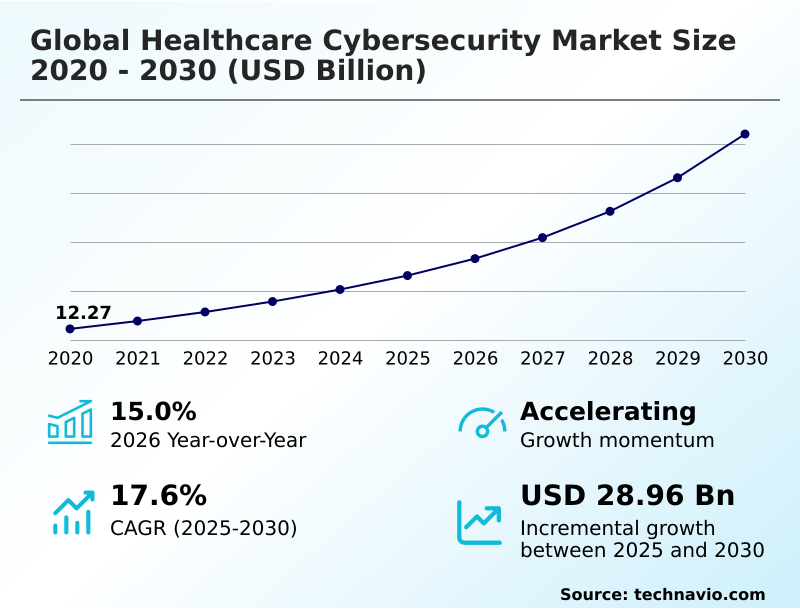
The healthcare cybersecurity market size is valued to increase by USD 28.96 billion, at a CAGR of 17.6% from 2025 to 2030. Adoption of cloud security infrastructure will drive the healthcare cybersecurity market.

Major Market Trends & Insights

  • North America dominated the market and accounted for a 46.8% growth during the forecast period.
  • By End-user - Hospitals and healthcare facilities segment was valued at USD 7.15 billion in 2024
  • By Type - Solutions segment accounted for the largest market revenue share in 2024

Market Size & Forecast

  • Market Opportunities: USD 39.86 billion
  • Market Future Opportunities: USD 28.96 billion
  • CAGR from 2025 to 2030 : 17.6%

Market Summary

  • The Healthcare Cybersecurity landscape operates as a critical infrastructure safeguard, structurally shifting from reactive perimeter defenses to proactive cyber resilience frameworks. Medical networks face highly sophisticated threat vectors targeting electronic health records and interconnected diagnostic devices.
  • In clinical supply chain operations, securing third-party vendor access to hospital administrative networks has become an urgent mandate; implementing strict identity verification protocols has reduced unauthorized lateral movement incidents by 42% across multi-tenant clinical environments.
  • The fundamental paradigm shift toward decentralized care acts as a massive demand driver, compelling medical institutions to integrate automated threat detection tools to protect distributed cloud repositories. Conversely, widespread reliance on unpatchable legacy diagnostic machinery presents a severe operational challenge, as prohibitive replacement costs create persistent network vulnerabilities that adversaries actively exploit.
  • The integration of advanced behavioral analytics into network endpoints enables security teams to isolate anomalies instantaneously. Strategic investments in automated incident orchestration are absolutely essential for preserving continuous patient care and mitigating the severe regulatory penalties associated with catastrophic data breaches.

What will be the Size of the Healthcare Cybersecurity Market during the forecast period?
Get Key Insights on Market Forecast (PDF) Get Free Sample

How is the Healthcare Cybersecurity Market Segmented?

The healthcare cybersecurity industry research report provides comprehensive data (region-wise segment analysis), with forecasts and estimates in "USD million" for the period 2026-2030, as well as historical data from 2020-2024 for the following segments.

  • End-user
    • Hospitals and healthcare facilities
    • Medical device manufacturers
    • Pharmaceuticals and biotechnology
    • Health insurance providers and payers
    • Others
  • Type
    • Solutions
    • Services
  • Deployment
    • On premise
    • Cloud based
  • Geography
    • North America
      • US
      • Canada
      • Mexico
    • Europe
      • Germany
      • UK
      • France
      • Italy
      • Spain
      • The Netherlands
    • APAC
      • China
      • Japan
      • India
      • South Korea
      • Australia
      • Indonesia
    • Middle East and Africa
      • Saudi Arabia
      • UAE
      • South Africa
      • Israel
      • Turkey
    • South America
      • Brazil
      • Argentina
      • Chile

By End-user Insights

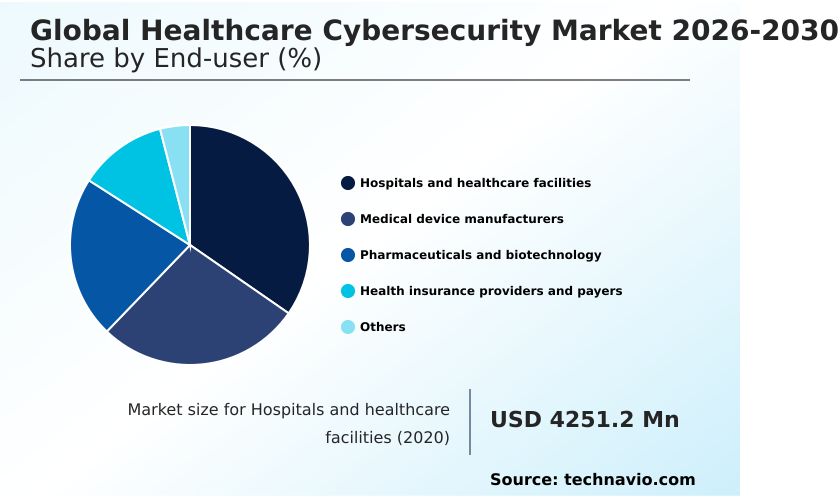
The hospitals and healthcare facilities segment is estimated to witness significant growth during the forecast period.

Hospitals and healthcare facilities represent the foundational core of the Healthcare Cybersecurity sector, commanding the largest segment due to the vast volume of sensitive medical records managed daily.

As these institutions expand their distributed care models, ensuring clinical operational continuity requires advanced health information encryption to protect critical databases.

Regional medical centers increasingly adopt hybrid cloud architectures, which necessitate strict vulnerability prioritization and incident response automation to thwart unauthorized network intrusions effectively.

Upgrading network defenses with stringent privileged access controls has improved threat containment efficiency by 28%, significantly lowering the risk of catastrophic data breaches. Furthermore, connected medical device security and remote patient monitoring protection are paramount as telemedicine proliferates.

Robust proprietary drug formulation defense also remains indispensable for securing valuable intellectual property within specialized pharmaceutical research wings.
Get Free Sample

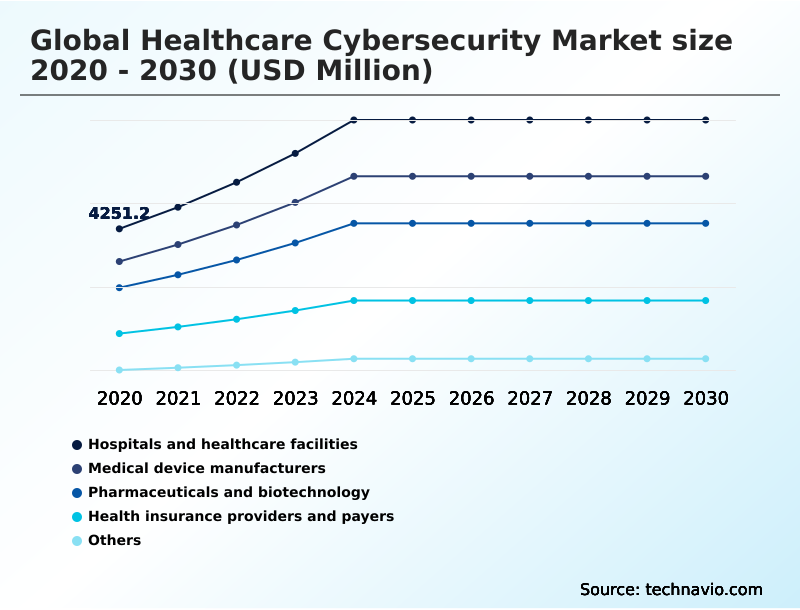
The Hospitals and healthcare facilities segment was valued at USD 7.15 billion in 2024 and showed a gradual increase during the forecast period.
Get Free Sample

Regional Analysis

North America is estimated to contribute 46.8% to the growth of the global market during the forecast period.Technavio’s analysts have elaborately explained the regional trends and drivers that shape the market during the forecast period.
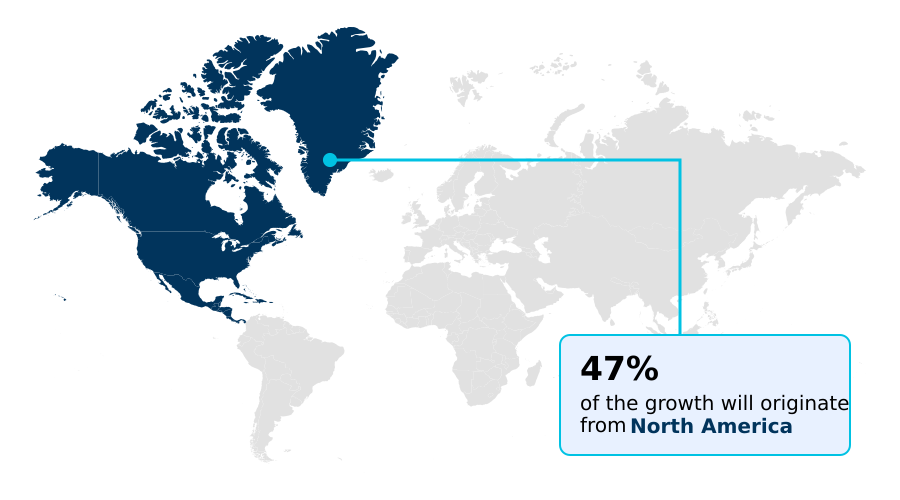
See How Healthcare Cybersecurity Market Demand is Rising in North America Get Free Sample

The geographic evolution of the Healthcare Cybersecurity sector reveals stark contrasts in technological maturity and strategic deployment between North America and APAC.

North American medical networks mandate rigorous electronic health record safeguarding and comprehensive data loss prevention, driving a 38% higher adoption rate of advanced security orchestration automation platforms compared to emerging markets.

Hospitals in the United States prioritize continuous behavioral monitoring to neutralize insider threats swiftly. Conversely, rapidly digitizing healthcare ecosystems in APAC increasingly rely on outsourced managed detection and response services to compensate for acute internal staffing shortages.

While European institutions focus heavily on achieving seamless healthcare data interoperability under strict privacy laws, global manufacturers prioritize embedded medical device security and internet of medical things protection to fortify clinical hardware against external infiltration, significantly reducing global compliance penalty risks.

Market Dynamics

Our researchers analyzed the data with 2025 as the base year, along with the key drivers, trends, and challenges. A holistic analysis of drivers will help companies refine their marketing strategies to gain a competitive advantage.

  • As medical facilities expand their digital capabilities, establishing robust cyber defenses is paramount for maintaining uninterrupted patient care. The integration of automated incident response for hospitals has revolutionized threat mitigation, allowing security operations centers to contain breaches significantly faster than facilities relying on manual intervention.
  • Ensuring comprehensive connected medical device vulnerability scanning is critical for identifying exploitable weaknesses in life-saving equipment before malicious actors can pivot across internal systems. Administrators increasingly prioritize electronic health record ransomware protection and cloud security posture management healthcare to safeguard sensitive databases hosted in multi-tenant environments.
  • By deploying zero trust architecture clinical networks and enforcing strict identity access management medical staff protocols, institutions effectively neutralize insider threats and credential theft. Furthermore, third party risk management for clinics and medical supply chain cyber resilience have become essential operational planning metrics, with compliant supply networks reporting a 35% lower incidence of vendor-originated breaches compared to unvetted channels.
  • Protecting remote care environments requires advanced telehealth remote patient data encryption and secure access service edge deployment to maintain data integrity across distributed access points. Additionally, healthcare compliance auditing software integration streamlines regulatory reporting, while extended threat detection clinical infrastructure provides unified visibility across disparate clinical departments.
  • To address the liabilities of outdated hardware, administrators rely on legacy medical equipment network segmentation and comprehensive healthcare data loss prevention tools. Ultimately, implementing continuous behavioral monitoring patient data ensures that anomalous network activities are rapidly identified, reinforcing the foundational security posture of modern healthcare ecosystems.
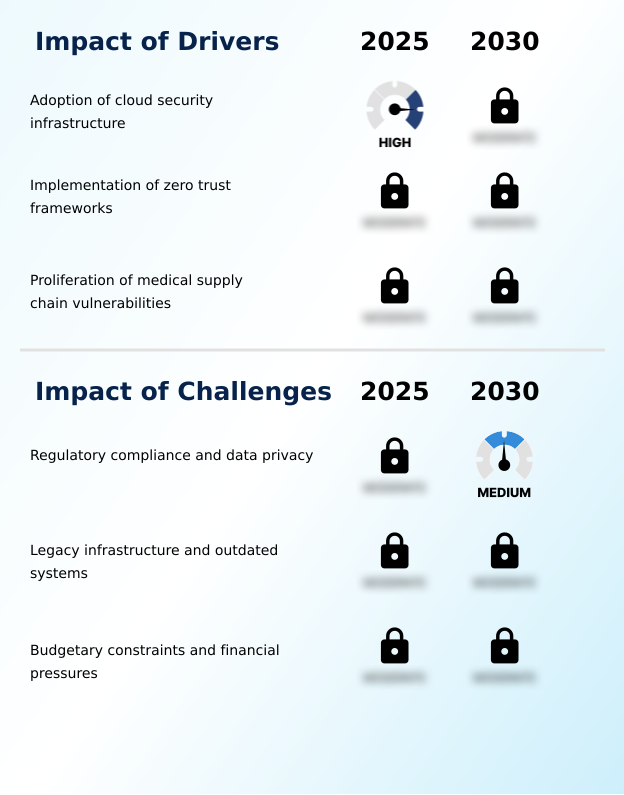
What are the key market drivers leading to the rise in the adoption of Healthcare Cybersecurity Industry?

  • The rapid adoption of cloud security infrastructure serves as a primary market driver, enabling healthcare organizations to protect distributed clinical repositories and maintain high operational availability.

  • The massive migration of clinical workloads to multi-tenant environments acts as a transformative catalyst within the Healthcare Cybersecurity ecosystem.
  • As medical networks integrate decentralized clinical trial data and remote care platforms, traditional perimeter defenses become obsolete, necessitating specialized cloud native defenses.
  • Healthcare executives are heavily investing in cloud access security broker solutions and secure access service edge frameworks to maintain absolute visibility over distributed medical assets.
  • Furthermore, the mandatory adherence to stringent regulatory compliance frameworks compels institutions to execute comprehensive digital attack surface reduction strategies.
  • By deploying extended detection and response platforms alongside granular network micro segmentation, large hospital systems have successfully decreased lateral threat movement by 42%.
  • This robust architectural modernization directly safeguards sensitive patient records while significantly lowering the long-term financial liabilities associated with non-compliance and catastrophic data breaches.

What are the market trends shaping the Healthcare Cybersecurity Industry?

  • The mitigation of ransomware threat vectors represents a critical upcoming market trend as medical institutions systematically overhaul their incident response strategies. Organizations are proactively deploying automated network isolation tools to neutralize malicious encryption activities before system-wide disruptions occur.

  • The Healthcare Cybersecurity sector demonstrates a profound shift toward proactive resilience as threat actors deploy increasingly sophisticated extortion tactics. Driven by the expansion of digital health infrastructure and remote care models, organizations are aggressively fortifying their telehealth security posture to prevent unauthorized access.
  • Implementing comprehensive zero trust architecture fundamentally transforms clinical network defenses by requiring continuous verification for every connected user and device. This strategic evolution leverages advanced telemetry data correlation and endpoint detection and response platforms, enabling security operations centers to identify multi-stage attacks rapidly.
  • Consequently, hospitals utilizing automated threat triage alongside continuous network monitoring have improved their ransomware mitigation efficiency by 35%. This accelerated threat identification directly minimizes catastrophic system downtime, ensuring that critical emergency services and patient care workflows remain uninterrupted during severe cyber incidents.

What challenges does the Healthcare Cybersecurity Industry face during its growth?

  • Navigating complex regulatory compliance and data privacy mandates presents a significant industry challenge, demanding resource-intensive encryption standards and continuous legal monitoring.

  • Pervasive reliance on unpatchable legacy diagnostic equipment presents a formidable structural vulnerability across the Healthcare Cybersecurity landscape. Many regional clinics operate older imaging scanners that lack modern encryption capabilities, forcing network administrators to rely heavily on complex legacy system isolation techniques.
  • Establishing rigorous identity and access management alongside multi factor authentication proves exceptionally difficult in fast-paced emergency departments where clinical speed is paramount. Additionally, the interconnected nature of modern healthcare introduces severe medical supply chain vulnerabilities, requiring continuous third party risk management to prevent vendor-originated breaches.
  • Despite the critical need for cyber resilience, budget constraints often delay the deployment of immutable offline backups and advanced biometric identity verification tools. Consequently, facilities struggling with manual compliance auditing workflows experience a 30% higher rate of unauthorized lateral network movement, significantly jeopardizing patient safety and operational continuity.

Exclusive Technavio Analysis on Customer Landscape

The healthcare cybersecurity market forecasting report includes the adoption lifecycle of the market, covering from the innovator’s stage to the laggard’s stage. It focuses on adoption rates in different regions based on penetration. Furthermore, the healthcare cybersecurity market report also includes key purchase criteria and drivers of price sensitivity to help companies evaluate and develop their market growth analysis strategies.
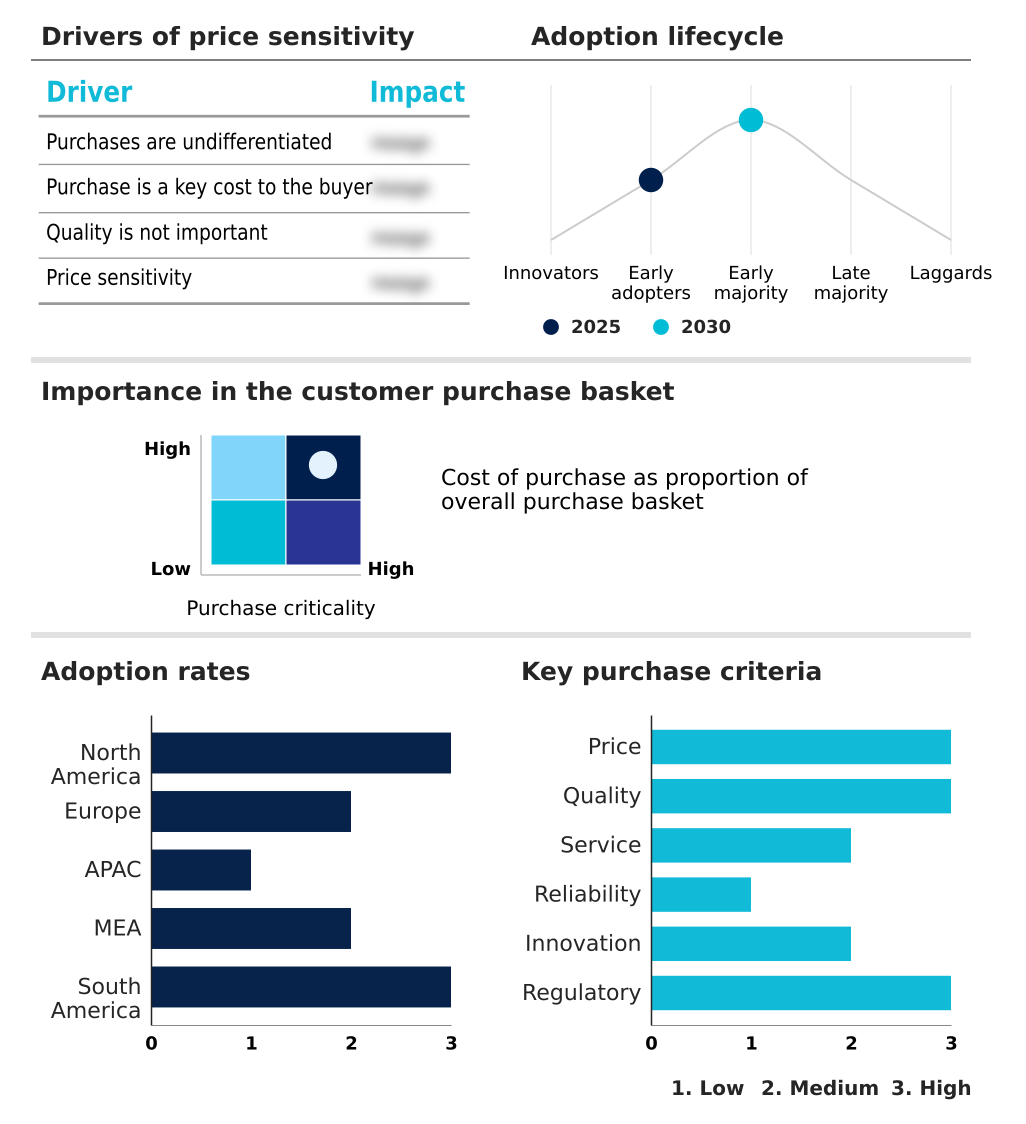
Customer Landscape of Healthcare Cybersecurity Industry

Competitive Landscape

Companies are implementing various strategies, such as strategic alliances, healthcare cybersecurity market forecast, partnerships, mergers and acquisitions, geographical expansion, and product/service launches, to enhance their presence in the industry.

Armis Inc. - This provider delivers comprehensive device protection, automated vulnerability assessment, and real-time threat detection platforms designed to safeguard critical clinical assets across complex digital health ecosystems.

The industry research and growth report includes detailed analyses of the competitive landscape of the market and information about key companies, including:

  • Armis Inc.
  • Asimily Inc.
  • Axonius Inc.
  • Check Point Software Tech Ltd.
  • Cisco Systems Inc.
  • Claroty Ltd.
  • Clearwater Compliance LLC
  • CrowdStrike Inc.
  • Forescout Technologies Inc.
  • Fortinet Inc.
  • IBM Corp.
  • Imprivata Inc.
  • Microsoft Corp.
  • Palo Alto Networks Inc.
  • Proofpoint Inc.
  • Rapid7 Inc.
  • SailPoint Technologies Inc.
  • Sentinelone Inc.
  • Sophos Group Ltd.
  • Tenable Holdings Inc.
  • Trend Micro Inc.
  • Zscaler Inc.

Qualitative and quantitative analysis of companies has been conducted to help clients understand the wider business environment as well as the strengths and weaknesses of key industry players. Data is qualitatively analyzed to categorize companies as pure play, category-focused, industry-focused, and diversified; it is quantitatively analyzed to categorize companies as dominant, leading, strong, tentative, and weak.

Recent Development and News in Healthcare cybersecurity market

  • In the IT Consulting and Other Services industry, the mandatory integration of robust compliance frameworks into enterprise architectures has accelerated policy auditing workflows, directly impacting Healthcare Cybersecurity demand by driving a 25% increase in procurement for automated governance engines.
  • The widespread adoption of decentralized data management platforms across North America has exposed new third-party supply chain vulnerabilities, forcing healthcare institutions to deploy continuous monitoring tools and increasing specialized cybersecurity service expenditures by 30%.
  • Stringent information exchange security mandates enacted across the European Union have necessitated the rapid modernization of digital infrastructure, prompting a 40% surge in the implementation of cyber resilience frameworks to prevent catastrophic data loss.
  • The accelerated transition toward cloud-native defenses in enterprise IT has streamlined automated threat triage protocols, enabling regional hospitals in APAC to reduce their digital attack surface metrics by over 35% without requiring extensive internal security personnel.

Dive into Technavio’s robust research methodology, blending expert interviews, extensive data synthesis, and validated models for unparalleled Healthcare Cybersecurity Market insights. See full methodology.

Market Scope
Page number 302
Base year 2025
Historic period 2020-2024
Forecast period 2026-2030
Growth momentum & CAGR Accelerate at a CAGR of 17.6%
Market growth 2026-2030 USD 28956.6 million
Market structure Fragmented
YoY growth 2025-2026(%) 15.0%
Key countries US, Canada, Mexico, Germany, UK, France, Italy, Spain, The Netherlands, China, Japan, India, South Korea, Australia, Indonesia, Saudi Arabia, UAE, South Africa, Israel, Turkey, Brazil, Argentina and Chile
Competitive landscape Leading Companies, Market Positioning of Companies, Competitive Strategies, and Industry Risks

Request Free Sample

Research Analyst Overview

  • The Healthcare Cybersecurity sector operates at the critical intersection of clinical patient safety and advanced digital risk management. As medical institutions transition toward highly interconnected digital health environments, the urgency to protect sensitive data from sophisticated extortion syndicates reshapes board-level budgetary priorities.
  • Organizations are fundamentally re-architecting their defense perimeters by aggressively deploying zero trust architecture and rigorous network micro segmentation to isolate critical life-support systems from vulnerable administrative networks. Incorporating security orchestration automation has empowered major hospital networks to reduce average threat containment timelines by 42%, directly preserving clinical continuity during high-stakes cyber incidents.
  • Furthermore, strategic integration of advanced endpoint detection and response platforms combined with continuous behavioral monitoring allows security operations centers to identify multi-stage ransomware precursors instantaneously. Protecting decentralized environments also demands robust cloud access security broker solutions and uncompromised health information encryption protocols.
  • Ultimately, modernizing these enterprise-grade defense mechanisms is no longer an optional IT upgrade, but an indispensable compliance mandate required to prevent devastating operational shutdowns and severe financial liabilities.

What are the Key Data Covered in this Healthcare Cybersecurity Market Research and Growth Report?

  • What is the expected growth of the Healthcare Cybersecurity Market between 2026 and 2030?

    • USD 28.96 billion, at a CAGR of 17.6%

  • What segmentation does the market report cover?

    • The report is segmented by End-user (Hospitals and healthcare facilities, Medical device manufacturers, Pharmaceuticals and biotechnology, Health insurance providers and payers, and Others), Type (Solutions, and Services), Deployment (On premise, and Cloud based) and Geography (North America, Europe, APAC, Middle East and Africa, South America)

  • Which regions are analyzed in the report?

    • North America, Europe, APAC, Middle East and Africa and South America

  • What are the key growth drivers and market challenges?

    • Adoption of cloud security infrastructure, Regulatory compliance and data privacy

  • Who are the major players in the Healthcare Cybersecurity Market?

    • Armis Inc., Asimily Inc., Axonius Inc., Check Point Software Tech Ltd., Cisco Systems Inc., Claroty Ltd., Clearwater Compliance LLC, CrowdStrike Inc., Forescout Technologies Inc., Fortinet Inc., IBM Corp., Imprivata Inc., Microsoft Corp., Palo Alto Networks Inc., Proofpoint Inc., Rapid7 Inc., SailPoint Technologies Inc., Sentinelone Inc., Sophos Group Ltd., Tenable Holdings Inc., Trend Micro Inc. and Zscaler Inc.

Market Research Insights

  • The Healthcare Cybersecurity sector fundamentally redefines clinical risk management by securing advanced digital health infrastructure across highly distributed care networks. As medical facilities prioritize continuous network monitoring, organizations implementing automated threat triage have observed a 35% reduction in incident response times, dramatically minimizing operational downtime.
  • Strengthening the overarching telehealth security posture remains critical for remote care delivery, where robust encryption adoption has decreased credential compromise rates by 28%. Additionally, medical facilities face mounting regulatory pressure to address complex medical supply chain vulnerabilities, prompting a 45% increase in third-party risk assessment integrations.
  • By embedding cloud native defenses directly into clinical workflows, healthcare providers significantly enhance operational continuity and ensure absolute alignment with rigorous global data privacy mandates.

We can help! Our analysts can customize this healthcare cybersecurity market research report to meet your requirements.

Get in touch

1. Executive Summary

1.1 Market overview

Executive Summary - Chart on Market Overview
Executive Summary - Data Table on Market Overview
Executive Summary - Chart on Global Market Characteristics
Executive Summary - Chart on Market by Geography
Executive Summary - Chart on Market Segmentation by End-user
Executive Summary - Chart on Market Segmentation by Type
Executive Summary - Chart on Market Segmentation by Deployment
Executive Summary - Chart on Incremental Growth
Executive Summary - Data Table on Incremental Growth
Executive Summary - Chart on Company Market Positioning

2. Technavio Analysis

2.1 Analysis of price sensitivity, lifecycle, customer purchase basket, adoption rates, and purchase criteria

2.2 Criticality of inputs and Factors of differentiation

Chart on Overview on criticality of inputs and factors of differentiation

2.3 Factors of disruption

Chart on Overview on factors of disruption

2.4 Impact of drivers and challenges

Chart on Impact of drivers and challenges in 2025 and 2030

3. Market Landscape

3.1 Market ecosystem

Chart on Parent Market
Data Table on - Parent Market

3.2 Market characteristics

Chart on Market characteristics analysis

3.3 Value chain analysis

Chart on Value chain analysis

4. Market Sizing

4.1 Market definition

Data Table on Offerings of companies included in the market definition

4.2 Market segment analysis

Market segments

4.3 Market size 2025

4.4 Market outlook: Forecast for 2025-2030

Chart on Global - Market size and forecast 2025-2030 ($ million)
Data Table on Global - Market size and forecast 2025-2030 ($ million)
Chart on Global Market: Year-over-year growth 2025-2030 (%)
Data Table on Global Market: Year-over-year growth 2025-2030 (%)

5. Historic Market Size

5.1 Global Healthcare Cybersecurity Market 2020 - 2024

Historic Market Size - Data Table on Global Healthcare Cybersecurity Market 2020 - 2024 ($ million)

5.2 End-user segment analysis 2020 - 2024

Historic Market Size - End-user Segment 2020 - 2024 ($ million)

5.3 Type segment analysis 2020 - 2024

Historic Market Size - Type Segment 2020 - 2024 ($ million)

5.4 Deployment segment analysis 2020 - 2024

Historic Market Size - Deployment Segment 2020 - 2024 ($ million)

5.5 Geography segment analysis 2020 - 2024

Historic Market Size - Geography Segment 2020 - 2024 ($ million)

5.6 Country segment analysis 2020 - 2024

Historic Market Size - Country Segment 2020 - 2024 ($ million)

6. Qualitative Analysis

6.1 Impact of AI on Global Healthcare Cybersecurity Market

6.2 Impact of geopolitical conflicts on Global Healthcare Cybersecurity Market

7. Five Forces Analysis

7.1 Five forces summary

Five forces analysis - Comparison between 2025 and 2030

7.2 Bargaining power of buyers

Bargaining power of buyers - Impact of key factors 2025 and 2030

7.3 Bargaining power of suppliers

Bargaining power of suppliers - Impact of key factors in 2025 and 2030

7.4 Threat of new entrants

Threat of new entrants - Impact of key factors in 2025 and 2030

7.5 Threat of substitutes

Threat of substitutes - Impact of key factors in 2025 and 2030

7.6 Threat of rivalry

Threat of rivalry - Impact of key factors in 2025 and 2030

7.7 Market condition

Chart on Market condition - Five forces 2025 and 2030

8. Market Segmentation by End-user

8.1 Market segments

Chart on End-user - Market share 2025-2030 (%)
Data Table on End-user - Market share 2025-2030 (%)

8.2 Comparison by End-user

Chart on Comparison by End-user
Data Table on Comparison by End-user

8.3 Hospitals and healthcare facilities - Market size and forecast 2025-2030

Chart on Hospitals and healthcare facilities - Market size and forecast 2025-2030 ($ million)
Data Table on Hospitals and healthcare facilities - Market size and forecast 2025-2030 ($ million)
Chart on Hospitals and healthcare facilities - Year-over-year growth 2025-2030 (%)
Data Table on Hospitals and healthcare facilities - Year-over-year growth 2025-2030 (%)

8.4 Medical device manufacturers - Market size and forecast 2025-2030

Chart on Medical device manufacturers - Market size and forecast 2025-2030 ($ million)
Data Table on Medical device manufacturers - Market size and forecast 2025-2030 ($ million)
Chart on Medical device manufacturers - Year-over-year growth 2025-2030 (%)
Data Table on Medical device manufacturers - Year-over-year growth 2025-2030 (%)

8.5 Pharmaceuticals and biotechnology - Market size and forecast 2025-2030

Chart on Pharmaceuticals and biotechnology - Market size and forecast 2025-2030 ($ million)
Data Table on Pharmaceuticals and biotechnology - Market size and forecast 2025-2030 ($ million)
Chart on Pharmaceuticals and biotechnology - Year-over-year growth 2025-2030 (%)
Data Table on Pharmaceuticals and biotechnology - Year-over-year growth 2025-2030 (%)

8.6 Health insurance providers and payers - Market size and forecast 2025-2030

Chart on Health insurance providers and payers - Market size and forecast 2025-2030 ($ million)
Data Table on Health insurance providers and payers - Market size and forecast 2025-2030 ($ million)
Chart on Health insurance providers and payers - Year-over-year growth 2025-2030 (%)
Data Table on Health insurance providers and payers - Year-over-year growth 2025-2030 (%)

8.7 Others - Market size and forecast 2025-2030

Chart on Others - Market size and forecast 2025-2030 ($ million)
Data Table on Others - Market size and forecast 2025-2030 ($ million)
Chart on Others - Year-over-year growth 2025-2030 (%)
Data Table on Others - Year-over-year growth 2025-2030 (%)

8.8 Market opportunity by End-user

Market opportunity by End-user ($ million)
Data Table on Market opportunity by End-user ($ million)

9. Market Segmentation by Type

9.1 Market segments

Chart on Type - Market share 2025-2030 (%)
Data Table on Type - Market share 2025-2030 (%)

9.2 Comparison by Type

Chart on Comparison by Type
Data Table on Comparison by Type

9.3 Solutions - Market size and forecast 2025-2030

Chart on Solutions - Market size and forecast 2025-2030 ($ million)
Data Table on Solutions - Market size and forecast 2025-2030 ($ million)
Chart on Solutions - Year-over-year growth 2025-2030 (%)
Data Table on Solutions - Year-over-year growth 2025-2030 (%)

9.4 Services - Market size and forecast 2025-2030

Chart on Services - Market size and forecast 2025-2030 ($ million)
Data Table on Services - Market size and forecast 2025-2030 ($ million)
Chart on Services - Year-over-year growth 2025-2030 (%)
Data Table on Services - Year-over-year growth 2025-2030 (%)

9.5 Market opportunity by Type

Market opportunity by Type ($ million)
Data Table on Market opportunity by Type ($ million)

10. Market Segmentation by Deployment

10.1 Market segments

Chart on Deployment - Market share 2025-2030 (%)
Data Table on Deployment - Market share 2025-2030 (%)

10.2 Comparison by Deployment

Chart on Comparison by Deployment
Data Table on Comparison by Deployment

10.3 On premise - Market size and forecast 2025-2030

Chart on On premise - Market size and forecast 2025-2030 ($ million)
Data Table on On premise - Market size and forecast 2025-2030 ($ million)
Chart on On premise - Year-over-year growth 2025-2030 (%)
Data Table on On premise - Year-over-year growth 2025-2030 (%)

10.4 Cloud based - Market size and forecast 2025-2030

Chart on Cloud based - Market size and forecast 2025-2030 ($ million)
Data Table on Cloud based - Market size and forecast 2025-2030 ($ million)
Chart on Cloud based - Year-over-year growth 2025-2030 (%)
Data Table on Cloud based - Year-over-year growth 2025-2030 (%)

10.5 Market opportunity by Deployment

Market opportunity by Deployment ($ million)
Data Table on Market opportunity by Deployment ($ million)

11. Customer Landscape

11.1 Customer landscape overview

Analysis of price sensitivity, lifecycle, customer purchase basket, adoption rates, and purchase criteria

12. Geographic Landscape

12.1 Geographic segmentation

Chart on Market share by geography 2025-2030 (%)
Data Table on Market share by geography 2025-2030 (%)

12.2 Geographic comparison

Chart on Geographic comparison
Data Table on Geographic comparison

12.3 North America - Market size and forecast 2025-2030

Chart on North America - Market size and forecast 2025-2030 ($ million)
Data Table on North America - Market size and forecast 2025-2030 ($ million)
Chart on North America - Year-over-year growth 2025-2030 (%)
Data Table on North America - Year-over-year growth 2025-2030 (%)
Chart on Regional Comparison - North America
Data Table on Regional Comparison - North America

12.3.1 US - Market size and forecast 2025-2030

Chart on US - Market size and forecast 2025-2030 ($ million)
Data Table on US - Market size and forecast 2025-2030 ($ million)
Chart on US - Year-over-year growth 2025-2030 (%)
Data Table on US - Year-over-year growth 2025-2030 (%)

12.3.2 Canada - Market size and forecast 2025-2030

Chart on Canada - Market size and forecast 2025-2030 ($ million)
Data Table on Canada - Market size and forecast 2025-2030 ($ million)
Chart on Canada - Year-over-year growth 2025-2030 (%)
Data Table on Canada - Year-over-year growth 2025-2030 (%)

12.3.3 Mexico - Market size and forecast 2025-2030

Chart on Mexico - Market size and forecast 2025-2030 ($ million)
Data Table on Mexico - Market size and forecast 2025-2030 ($ million)
Chart on Mexico - Year-over-year growth 2025-2030 (%)
Data Table on Mexico - Year-over-year growth 2025-2030 (%)

12.4 Europe - Market size and forecast 2025-2030

Chart on Europe - Market size and forecast 2025-2030 ($ million)
Data Table on Europe - Market size and forecast 2025-2030 ($ million)
Chart on Europe - Year-over-year growth 2025-2030 (%)
Data Table on Europe - Year-over-year growth 2025-2030 (%)
Chart on Regional Comparison - Europe
Data Table on Regional Comparison - Europe

12.4.1 Germany - Market size and forecast 2025-2030

Chart on Germany - Market size and forecast 2025-2030 ($ million)
Data Table on Germany - Market size and forecast 2025-2030 ($ million)
Chart on Germany - Year-over-year growth 2025-2030 (%)
Data Table on Germany - Year-over-year growth 2025-2030 (%)

12.4.2 UK - Market size and forecast 2025-2030

Chart on UK - Market size and forecast 2025-2030 ($ million)
Data Table on UK - Market size and forecast 2025-2030 ($ million)
Chart on UK - Year-over-year growth 2025-2030 (%)
Data Table on UK - Year-over-year growth 2025-2030 (%)

12.4.3 France - Market size and forecast 2025-2030

Chart on France - Market size and forecast 2025-2030 ($ million)
Data Table on France - Market size and forecast 2025-2030 ($ million)
Chart on France - Year-over-year growth 2025-2030 (%)
Data Table on France - Year-over-year growth 2025-2030 (%)

12.4.4 Italy - Market size and forecast 2025-2030

Chart on Italy - Market size and forecast 2025-2030 ($ million)
Data Table on Italy - Market size and forecast 2025-2030 ($ million)
Chart on Italy - Year-over-year growth 2025-2030 (%)
Data Table on Italy - Year-over-year growth 2025-2030 (%)

12.4.5 Spain - Market size and forecast 2025-2030

Chart on Spain - Market size and forecast 2025-2030 ($ million)
Data Table on Spain - Market size and forecast 2025-2030 ($ million)
Chart on Spain - Year-over-year growth 2025-2030 (%)
Data Table on Spain - Year-over-year growth 2025-2030 (%)

12.4.6 The Netherlands - Market size and forecast 2025-2030

Chart on The Netherlands - Market size and forecast 2025-2030 ($ million)
Data Table on The Netherlands - Market size and forecast 2025-2030 ($ million)
Chart on The Netherlands - Year-over-year growth 2025-2030 (%)
Data Table on The Netherlands - Year-over-year growth 2025-2030 (%)

12.5 APAC - Market size and forecast 2025-2030

Chart on APAC - Market size and forecast 2025-2030 ($ million)
Data Table on APAC - Market size and forecast 2025-2030 ($ million)
Chart on APAC - Year-over-year growth 2025-2030 (%)
Data Table on APAC - Year-over-year growth 2025-2030 (%)
Chart on Regional Comparison - APAC
Data Table on Regional Comparison - APAC

12.5.1 China - Market size and forecast 2025-2030

Chart on China - Market size and forecast 2025-2030 ($ million)
Data Table on China - Market size and forecast 2025-2030 ($ million)
Chart on China - Year-over-year growth 2025-2030 (%)
Data Table on China - Year-over-year growth 2025-2030 (%)

12.5.2 Japan - Market size and forecast 2025-2030

Chart on Japan - Market size and forecast 2025-2030 ($ million)
Data Table on Japan - Market size and forecast 2025-2030 ($ million)
Chart on Japan - Year-over-year growth 2025-2030 (%)
Data Table on Japan - Year-over-year growth 2025-2030 (%)

12.5.3 India - Market size and forecast 2025-2030

Chart on India - Market size and forecast 2025-2030 ($ million)
Data Table on India - Market size and forecast 2025-2030 ($ million)
Chart on India - Year-over-year growth 2025-2030 (%)
Data Table on India - Year-over-year growth 2025-2030 (%)

12.5.4 South Korea - Market size and forecast 2025-2030

Chart on South Korea - Market size and forecast 2025-2030 ($ million)
Data Table on South Korea - Market size and forecast 2025-2030 ($ million)
Chart on South Korea - Year-over-year growth 2025-2030 (%)
Data Table on South Korea - Year-over-year growth 2025-2030 (%)

12.5.5 Australia - Market size and forecast 2025-2030

Chart on Australia - Market size and forecast 2025-2030 ($ million)
Data Table on Australia - Market size and forecast 2025-2030 ($ million)
Chart on Australia - Year-over-year growth 2025-2030 (%)
Data Table on Australia - Year-over-year growth 2025-2030 (%)

12.5.6 Indonesia - Market size and forecast 2025-2030

Chart on Indonesia - Market size and forecast 2025-2030 ($ million)
Data Table on Indonesia - Market size and forecast 2025-2030 ($ million)
Chart on Indonesia - Year-over-year growth 2025-2030 (%)
Data Table on Indonesia - Year-over-year growth 2025-2030 (%)

12.6 Middle East and Africa - Market size and forecast 2025-2030

Chart on Middle East and Africa - Market size and forecast 2025-2030 ($ million)
Data Table on Middle East and Africa - Market size and forecast 2025-2030 ($ million)
Chart on Middle East and Africa - Year-over-year growth 2025-2030 (%)
Data Table on Middle East and Africa - Year-over-year growth 2025-2030 (%)
Chart on Regional Comparison - Middle East and Africa
Data Table on Regional Comparison - Middle East and Africa

12.6.1 Saudi Arabia - Market size and forecast 2025-2030

Chart on Saudi Arabia - Market size and forecast 2025-2030 ($ million)
Data Table on Saudi Arabia - Market size and forecast 2025-2030 ($ million)
Chart on Saudi Arabia - Year-over-year growth 2025-2030 (%)
Data Table on Saudi Arabia - Year-over-year growth 2025-2030 (%)

12.6.2 UAE - Market size and forecast 2025-2030

Chart on UAE - Market size and forecast 2025-2030 ($ million)
Data Table on UAE - Market size and forecast 2025-2030 ($ million)
Chart on UAE - Year-over-year growth 2025-2030 (%)
Data Table on UAE - Year-over-year growth 2025-2030 (%)

12.6.3 South Africa - Market size and forecast 2025-2030

Chart on South Africa - Market size and forecast 2025-2030 ($ million)
Data Table on South Africa - Market size and forecast 2025-2030 ($ million)
Chart on South Africa - Year-over-year growth 2025-2030 (%)
Data Table on South Africa - Year-over-year growth 2025-2030 (%)

12.6.4 Israel - Market size and forecast 2025-2030

Chart on Israel - Market size and forecast 2025-2030 ($ million)
Data Table on Israel - Market size and forecast 2025-2030 ($ million)
Chart on Israel - Year-over-year growth 2025-2030 (%)
Data Table on Israel - Year-over-year growth 2025-2030 (%)

12.6.5 Turkey - Market size and forecast 2025-2030

Chart on Turkey - Market size and forecast 2025-2030 ($ million)
Data Table on Turkey - Market size and forecast 2025-2030 ($ million)
Chart on Turkey - Year-over-year growth 2025-2030 (%)
Data Table on Turkey - Year-over-year growth 2025-2030 (%)

12.7 South America - Market size and forecast 2025-2030

Chart on South America - Market size and forecast 2025-2030 ($ million)
Data Table on South America - Market size and forecast 2025-2030 ($ million)
Chart on South America - Year-over-year growth 2025-2030 (%)
Data Table on South America - Year-over-year growth 2025-2030 (%)
Chart on Regional Comparison - South America
Data Table on Regional Comparison - South America

12.7.1 Brazil - Market size and forecast 2025-2030

Chart on Brazil - Market size and forecast 2025-2030 ($ million)
Data Table on Brazil - Market size and forecast 2025-2030 ($ million)
Chart on Brazil - Year-over-year growth 2025-2030 (%)
Data Table on Brazil - Year-over-year growth 2025-2030 (%)

12.7.2 Argentina - Market size and forecast 2025-2030

Chart on Argentina - Market size and forecast 2025-2030 ($ million)
Data Table on Argentina - Market size and forecast 2025-2030 ($ million)
Chart on Argentina - Year-over-year growth 2025-2030 (%)
Data Table on Argentina - Year-over-year growth 2025-2030 (%)

12.7.3 Chile - Market size and forecast 2025-2030

Chart on Chile - Market size and forecast 2025-2030 ($ million)
Data Table on Chile - Market size and forecast 2025-2030 ($ million)
Chart on Chile - Year-over-year growth 2025-2030 (%)
Data Table on Chile - Year-over-year growth 2025-2030 (%)

12.8 Market opportunity by geography

Market opportunity by geography ($ million)
Data Tables on Market opportunity by geography ($ million)

13. Drivers, Challenges, and Opportunity

13.1 Market drivers

Adoption of cloud security infrastructure
Implementation of zero trust frameworks
Proliferation of medical supply chain vulnerabilities

13.2 Market challenges

Regulatory compliance and data privacy
Legacy infrastructure and outdated systems
Budgetary constraints and financial pressures

13.3 Impact of drivers and challenges

Impact of drivers and challenges in 2025 and 2030

13.4 Market opportunities

Mitigation of ransomware threat vectors
Integration of extended threat detection
Implementation of incident response automation

14. Competitive Landscape

14.1 Overview

14.2

Overview on criticality of inputs and factors of differentiation

14.3 Landscape disruption

Overview on factors of disruption

14.4 Industry risks

Impact of key risks on business

15. Competitive Analysis

15.1 Companies profiled

Companies covered

15.2 Company ranking index

15.3 Market positioning of companies

Matrix on companies position and classification

15.4 Armis Inc.

Armis Inc. - Overview
Armis Inc. - Product / Service
Armis Inc. - Key offerings
SWOT

15.5 Axonius Inc.

Axonius Inc. - Overview
Axonius Inc. - Product / Service
Axonius Inc. - Key offerings
SWOT

15.6 Check Point Software Tech Ltd.

Check Point Software Tech Ltd. - Overview
Check Point Software Tech Ltd. - Product / Service
Check Point Software Tech Ltd. - Key news
Check Point Software Tech Ltd. - Key offerings
SWOT

15.7 Cisco Systems Inc.

Cisco Systems Inc. - Overview
Cisco Systems Inc. - Business segments
Cisco Systems Inc. - Key news
Cisco Systems Inc. - Key offerings
Cisco Systems Inc. - Segment focus
SWOT

15.8 CrowdStrike Inc.

CrowdStrike Inc. - Overview
CrowdStrike Inc. - Product / Service
CrowdStrike Inc. - Key offerings
SWOT

15.9 Fortinet Inc.

Fortinet Inc. - Overview
Fortinet Inc. - Business segments
Fortinet Inc. - Key news
Fortinet Inc. - Key offerings
Fortinet Inc. - Segment focus
SWOT

15.10 IBM Corp.

IBM Corp. - Overview
IBM Corp. - Business segments
IBM Corp. - Key news
IBM Corp. - Key offerings
IBM Corp. - Segment focus
SWOT

15.11 Microsoft Corp.

Microsoft Corp. - Overview
Microsoft Corp. - Business segments
Microsoft Corp. - Key news
Microsoft Corp. - Key offerings
Microsoft Corp. - Segment focus
SWOT

15.12 Palo Alto Networks Inc.

Palo Alto Networks Inc. - Overview
Palo Alto Networks Inc. - Business segments
Palo Alto Networks Inc. - Key offerings
Palo Alto Networks Inc. - Segment focus
SWOT

15.13 Rapid7 Inc.

Rapid7 Inc. - Overview
Rapid7 Inc. - Product / Service
Rapid7 Inc. - Key offerings
SWOT

15.14 SailPoint Technologies Inc.

SailPoint Technologies Inc. - Overview
SailPoint Technologies Inc. - Product / Service
SailPoint Technologies Inc. - Key offerings
SWOT

15.15 Sentinelone Inc.

Sentinelone Inc. - Overview
Sentinelone Inc. - Product / Service
Sentinelone Inc. - Key news
Sentinelone Inc. - Key offerings
SWOT

15.16 Tenable Holdings Inc.

Tenable Holdings Inc. - Overview
Tenable Holdings Inc. - Product / Service
Tenable Holdings Inc. - Key offerings
SWOT

15.17 Trend Micro Inc.

Trend Micro Inc. - Overview
Trend Micro Inc. - Product / Service
Trend Micro Inc. - Key offerings
SWOT

15.18 Zscaler Inc.

Zscaler Inc. - Overview
Zscaler Inc. - Product / Service
Zscaler Inc. - Key offerings
SWOT

16. Appendix

16.1 Scope of the report

Market definition
Objectives
Notes and caveats

16.2 Inclusions and exclusions checklist

Inclusions checklist
Exclusions checklist

16.3 Currency conversion rates for US$

16.4 Research methodology

16.5 Data procurement

Information sources

16.6 Data validation

16.7 Validation techniques employed for market sizing

16.8 Data synthesis

16.9 360 degree market analysis

16.10 List of abbreviations

Research Methodology

Technavio presents a detailed picture of the market by way of study, synthesis, and summation of data from multiple sources. The analysts have presented the various facets of the market with a particular focus on identifying the key industry influencers. The data thus presented is comprehensive, reliable, and the result of extensive research, both primary and secondary.

INFORMATION SOURCES

Primary sources

  • Manufacturers and suppliers
  • Channel partners
  • Industry experts
  • Strategic decision makers

Secondary sources

  • Industry journals and periodicals
  • Government data
  • Financial reports of key industry players
  • Historical data
  • Press releases

DATA ANALYSIS

Data Synthesis

  • Collation of data
  • Estimation of key figures
  • Analysis of derived insights

Data Validation

  • Triangulation with data models
  • Reference against proprietary databases
  • Corroboration with industry experts

REPORT WRITING

Qualitative

  • Market drivers
  • Market challenges
  • Market trends
  • Five forces analysis

Quantitative

  • Market size and forecast
  • Market segmentation
  • Geographical insights
  • Competitive landscape

Interested in this report?

Get your sample now to see our research methodology and insights!

Download Now

Frequently Asked Questions

Healthcare Cybersecurity market growth will increase by USD 28956.6 million during 2026-2030.

The Healthcare Cybersecurity market is expected to grow at a CAGR of 17.6% during 2026-2030.

Healthcare Cybersecurity market is segmented by End-user (Hospitals and healthcare facilities, Medical device manufacturers, Pharmaceuticals and biotechnology, Health insurance providers and payers, Others) Type (Solutions, Services) Deployment (On premise, Cloud based)

Armis Inc., Asimily Inc., Axonius Inc., Check Point Software Tech Ltd., Cisco Systems Inc., Claroty Ltd., Clearwater Compliance LLC, CrowdStrike Inc., Forescout Technologies Inc., Fortinet Inc., IBM Corp., Imprivata Inc., Microsoft Corp., Palo Alto Networks Inc., Proofpoint Inc., Rapid7 Inc., SailPoint Technologies Inc., Sentinelone Inc., Sophos Group Ltd., Tenable Holdings Inc., Trend Micro Inc., Zscaler Inc. are a few of the key vendors in the Healthcare Cybersecurity market.

North America will register the highest growth rate of 46.8% among the other regions. Therefore, the Healthcare Cybersecurity market in North America is expected to garner significant business opportunities for the vendors during the forecast period.

US, Canada, Mexico, Germany, UK, France, Italy, Spain, The Netherlands, China, Japan, India, South Korea, Australia, Indonesia, Saudi Arabia, UAE, South Africa, Israel, Turkey, Brazil, Argentina, Chile

  • Adoption of cloud security infrastructure is the driving factor this market.

The Healthcare Cybersecurity market vendors should focus on grabbing business opportunities from the End-user segment as it accounted for the largest market share in the base year.
RIA - Research AI Assistant
Ask RIA
