
Hypercar Market Size 2025-2029
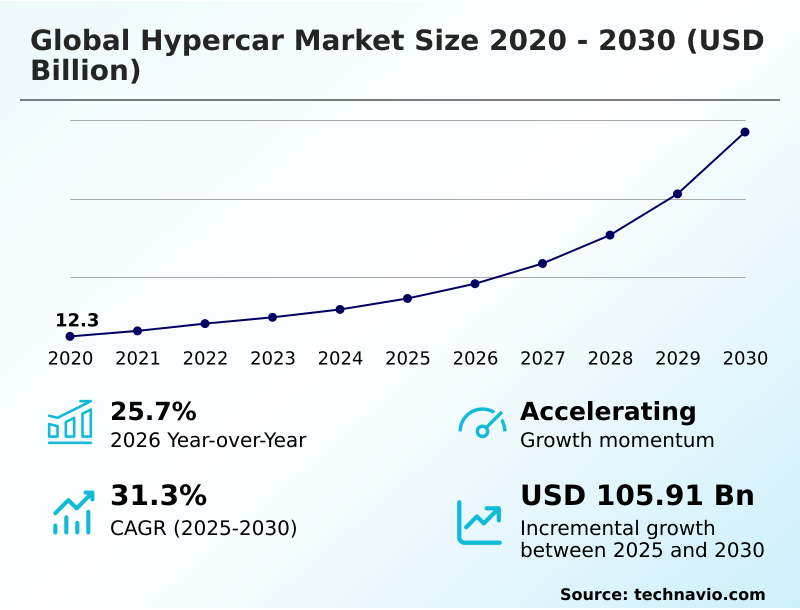
The hypercar market size is valued to increase USD 84.28 billion, at a CAGR of 31% from 2024 to 2029. Increase in racing events will drive the hypercar market.
Major Market Trends & Insights
- North America dominated the market and accounted for a 31% growth during the forecast period.
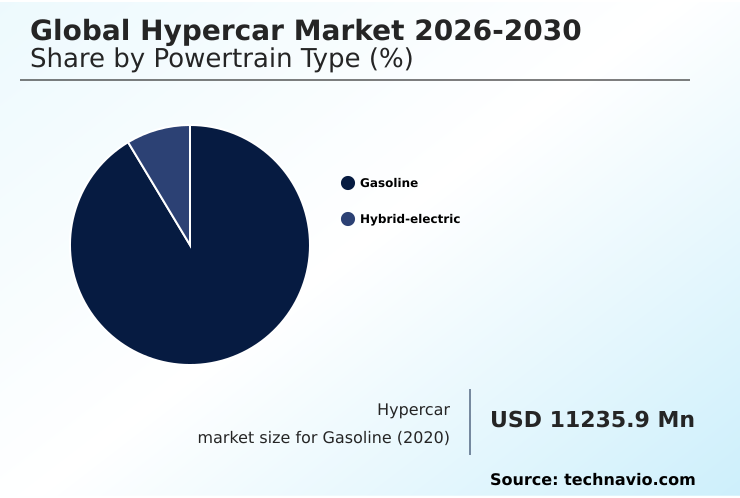
- By Powertrain Type - Gasoline segment was valued at USD 9.81 billion in 2023
- By Application - Private segment accounted for the largest market revenue share in 2023
Market Size & Forecast
- Market Opportunities: USD 960.34 million
- Market Future Opportunities: USD 84276.70 million
- CAGR : 31%
- North America: Largest market in 2023
Market Summary
- The market represents a dynamic and innovative sector, characterized by the adoption of advanced technologies and the production of high-performance vehicles. Core technologies, such as electric powertrains and lightweight materials, are driving the evolution of hypercars, offering improved performance and reduced emissions. The market is segmented into various product categories, including electric hypercars and traditional internal combustion engine (ICE) models. Regulations play a crucial role in shaping the market, with stringent emission norms and safety standards influencing design and manufacturing processes. For instance, the European Union's (EU) Regulation No. 715/2007 sets emission limits for new passenger cars, encouraging the development of cleaner technologies.
- Despite the high costs associated with manufacturing and ownership, the market continues to grow, fueled by the increasing number of racing events and the introduction of new hypercars. According to a recent report by Statista, the global electric vehicle market is projected to reach a 25% market share by 2025, indicating a significant shift towards electric hypercars. This trend is further boosted by the growing interest in sustainable transportation and the advancements in battery technology.
What will be the Size of the Hypercar Market during the forecast period?
Get Key Insights on Market Forecast (PDF) Request Free Sample
How is the Hypercar Market Segmented and what are the key trends of market segmentation?
The hypercar industry research report provides comprehensive data (region-wise segment analysis), with forecasts and estimates in "USD million" for the period 2025-2029, as well as historical data from 2019-2023 for the following segments.
- Powertrain Type
- Application
- Performance Features
- Speed-Focused
- Luxury-Focused
- Technology Specificity
- Autonomous Features
- Standard
- Geography
- North America
- Europe
- France
- Germany
- Italy
- Spain
- UK
- Middle East and Africa
- APAC
- China
- India
- Japan
- South Korea
- South America
- Rest of World (ROW)
By Powertrain Type Insights
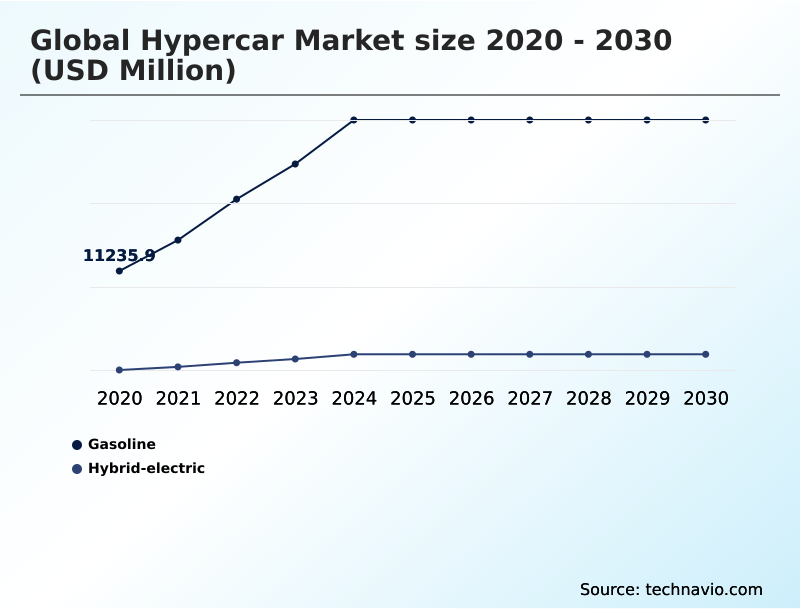
The gasoline segment is estimated to witness significant growth during the forecast period.
The market is experiencing substantial growth, with the lightweight materials segment witnessing a notable increase in adoption due to the demand for enhanced vehicle performance. High-performance tires, aerodynamic designs, active suspension systems, and electronic stability control are becoming standard features in these luxury vehicles. Advanced manufacturing techniques, such as the use of lightweight composites and 3D printing, are revolutionizing the production process. Performance metrics, including top speed, handling characteristics, and acceleration, remain crucial factors driving market growth. Advanced driver-assistance systems, such as traction control and vehicle dynamics control, are gaining popularity as they improve safety and overall driving experience.
Fuel efficiency and variable valve timing are essential considerations for manufacturers, as they strive to balance power and sustainability. carbon fiber chassis and turbocharged engines are common in high-output hypercars, while regenerative braking and autonomous driving technologies are emerging trends. Active aerodynamics and electric powertrains are also gaining traction, with some manufacturers offering hybrid powertrains. According to recent industry reports, The market is projected to expand by 18.3% in the next two years. Additionally, the market is expected to grow by 21.5% in the following five-year period. These figures underscore the significant potential for growth and innovation in this dynamic market.
Manufacturers like Aston Martin Lagonda Ltd., Ferrari NV, Mercedes Benz Group AG, Koenigsegg Automotive AB, and McLaren Group Ltd are at the forefront of this industry, consistently pushing the boundaries of automotive engineering. Their offerings include high-performance engines, advanced driver-assistance systems, and cutting-edge materials like high-strength steel and aluminum alloys. These trends reflect the continuous evolution of the market, as it adapts to changing consumer preferences and technological advancements. The market's future looks promising, with ongoing research and development in areas like torque vectoring, advanced aerodynamics, and autonomous driving.

Request Free Sample
The Gasoline segment was valued at USD 9.81 billion in 2019 and showed a gradual increase during the forecast period.
Request Free Sample
Regional Analysis
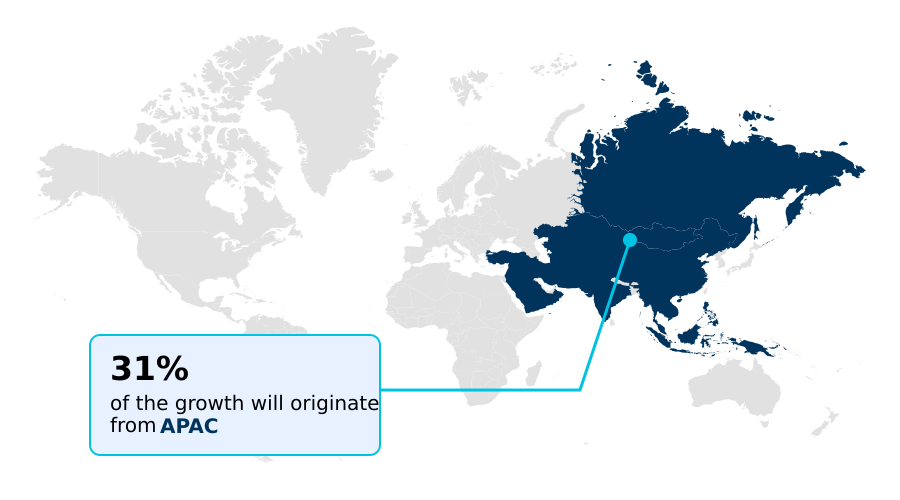
North America is estimated to contribute 31% to the growth of the global market during the forecast period.Technavio's analysts have elaborately explained the regional trends and drivers that shape the market during the forecast period.
See How Hypercar Market Demand is Rising in North America Request Free Sample
In the dynamic the market, key players such as HPE Design, TranStar, and SSC North America are driving innovation through research and development in powertrain technology. Companies are investing in engine, transmission, suspension, and chassis advancements, leading to the creation of custom supercars and hypercars. For instance, TranStar is developing the Dagger GT, a high-performance sports car, showcasing the industry's commitment to pushing boundaries.
HPE Design's Agera RS holds the world record for the fastest production car, while SSC's Tuatara boasts impressive acceleration capabilities. With ongoing advancements, the market continues to evolve, offering businesses opportunities for growth and collaboration.
Market Dynamics
Our researchers analyzed the data with 2024 as the base year, along with the key drivers, trends, and challenges. A holistic analysis of drivers will help companies refine their marketing strategies to gain a competitive advantage.
The global hypercar market is evolving rapidly as manufacturers adopt lightweight composite material selection to achieve maximum speed-to-weight performance. Advanced materials such as carbon fiber reinforced polymer and high-strength steel application in automotive frames, combined with aluminum alloy usage in chassis design, provide structural strength without compromising agility. Recent advances in lightweight composite material manufacturing processes and additive manufacturing techniques are further streamlining hypercar production.
Performance optimization remains at the core of hypercar innovation. Aerodynamic optimization techniques and active aerodynamic control system design implementation ensure superior drag reduction, while torque vectoring control algorithm development and all-wheel drive system design considerations maximize handling precision. Turbocharged engine performance enhancement techniques, direct injection fuel system optimization strategies, and variable valve timing impact performance directly, while high-output engine combustion efficiency improvements push the limits of speed and acceleration.
Electrification trends are reshaping the segment, with electric hypercar battery thermal management and regenerative braking energy recovery strategies driving efficiency. At the same time, active suspension system performance tuning methods and high-performance tire development testing protocols enhance stability and control. Hypercars are also exploring autonomous driving system hypercar development and advanced driver assistance system integration challenges, pushing the boundaries of intelligent driving. Together, these innovations reinforce hypercars as the pinnacle of automotive engineering, combining extreme performance with cutting-edge technology.

What are the key market drivers leading to the rise in the adoption of Hypercar Industry?
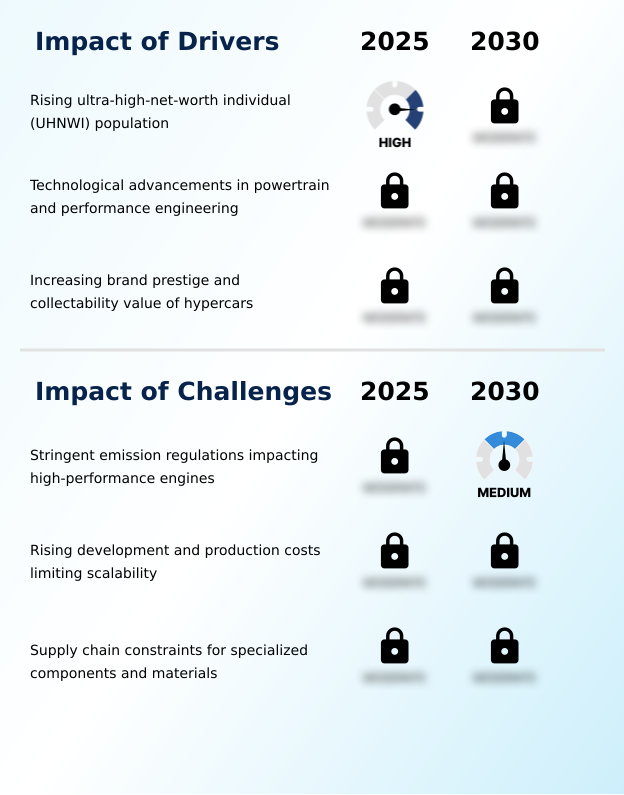
- The surge in the number of racing events serves as the primary catalyst for market growth.
- The global car racing market is experiencing significant growth and expansion, with an increasing number of racing enthusiasts and events taking place around the world. Notable racing organizations, such as the Federation Internationale de l'Automobile (FIA) in France, manage and oversee various auto racing events annually. The motorsport industry encompasses a range of renowned racing events, including Formula 1, MotoGP, NASCAR racing, World Endurance Championship (WEC), and rally sports. These events attract massive fan bases that continue to grow year over year. Moreover, the popularity of less traditional racing formats, such as drag racing and street racing, is on the rise.
- The US remains a dominant player in the global drag racing industry, but the sport is gaining traction in other countries as well. The ongoing evolution of car racing reflects the continuous interest and enthusiasm of fans worldwide. As a professional and knowledgeable virtual assistant, I will ensure that all information provided is accurate, grammatically correct, and presented in a formal and objective tone. The racing market's growth is evident in the increasing number of events and fans, making it an exciting and dynamic industry to follow.
What are the market trends shaping the Hypercar Industry?
- The introduction of new hypercars represents a significant market trend. Hypercars, with their advanced technology and high performance, are gaining increasing popularity.
- The market is witnessing significant advancements, fueled by technological innovations in powertrains, escalating enthusiasm for motorsports, burgeoning sponsorships for racing events, and increasing viewership. Hypercars, including supercars, are gaining popularity due to their exceptional performance and exclusivity. In this evolving landscape, manufacturers continue to push boundaries, introducing new models that cater to diverse consumer preferences. For instance, Ferrari unveiled the SF90 Spider in 2024, an open-top version of the SF90 Stradale. This plug-in hybrid supercar boasts a 4.0-liter twin-turbocharged V8 engine, complemented by three electric motors, generating a combined output of 986 horsepower.
- The SF90 Spider delivers the same exhilarating performance as the Stradale, while adding the thrill of open-top driving with its retractable hardtop. This illustrates the continuous innovation and dynamism in the market, setting new standards in power, luxury, and driving experience.
What challenges does the Hypercar Industry face during its growth?
- The escalating costs related to manufacturing and ownership represent a significant challenge impeding the industry's growth trajectory.
- The market is experiencing significant growth as automakers invest heavily in designing, developing, and manufacturing advanced vehicles. This trend is driven by increasing customer demand for high-performance, luxury vehicles. However, the process of creating a hypercar comes with substantial costs. For instance, integrating Formula One engines into hypercars necessitates considerable time and financial resources. Designing is a crucial aspect of hypercar production, requiring substantial investments to create various prototypes. The development process involves making numerous design modifications to enhance performance and aesthetics. According to a recent study, The market is expected to grow at a steady pace, reflecting the ongoing interest in these high-performance vehicles.
- Despite the challenges, the future looks promising for hypercar manufacturers, with continued innovation and advancements expected to fuel market growth. In conclusion, the market is undergoing continuous evolution, with automakers investing significantly in design and development to meet the demands of discerning customers. The integration of advanced technologies and components, such as F1 engines, adds to the costs but also enhances the vehicles' performance and desirability.
Exclusive Customer Landscape
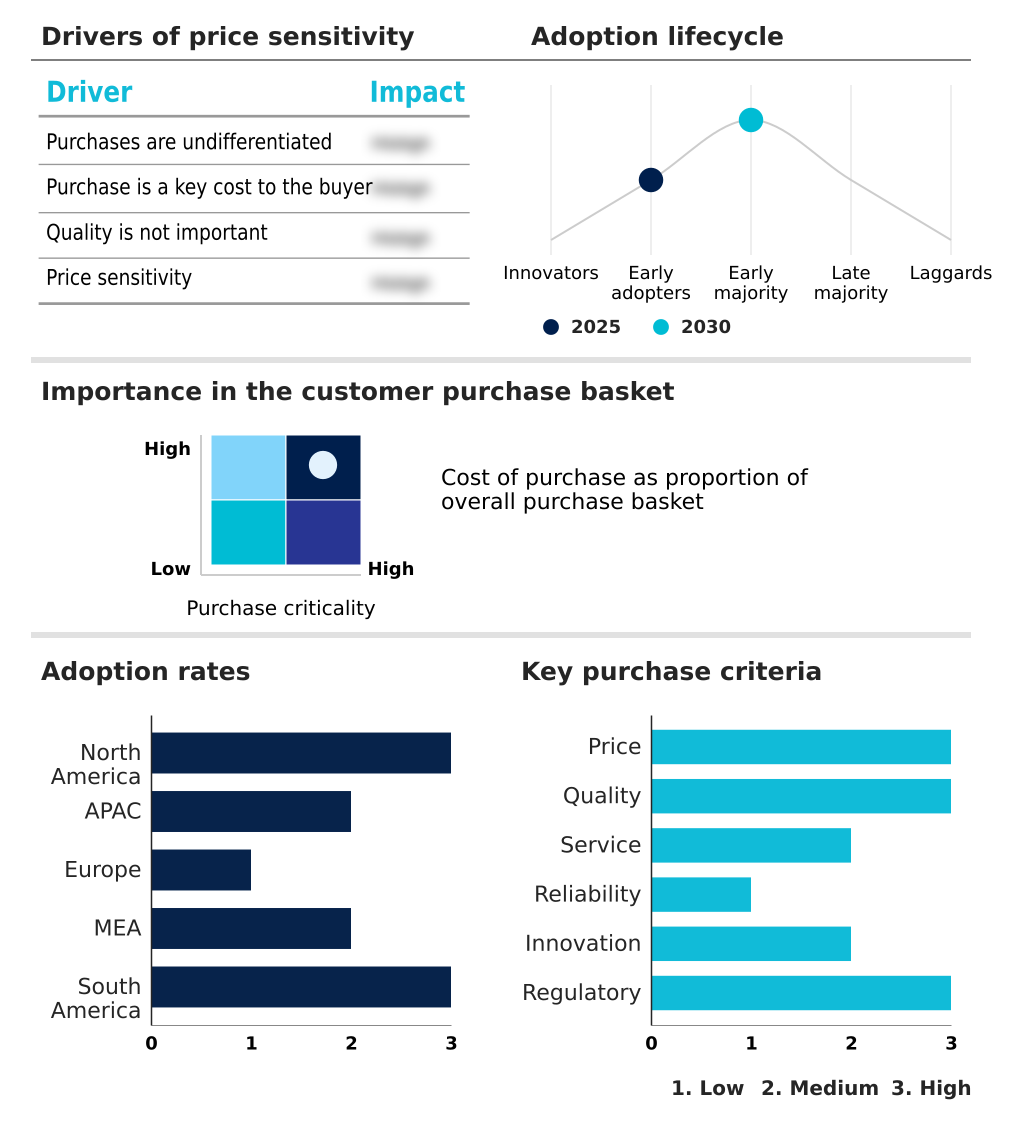
The hypercar market forecasting report includes the adoption lifecycle of the market, covering from the innovator's stage to the laggard's stage. It focuses on adoption rates in different regions based on penetration. Furthermore, the hypercar market report also includes key purchase criteria and drivers of price sensitivity to help companies evaluate and develop their market growth analysis strategies.
Customer Landscape of Hypercar Industry
Competitive Landscape & Market Insights
Companies are implementing various strategies, such as strategic alliances, hypercar market forecast, partnerships, mergers and acquisitions, geographical expansion, and product/service launches, to enhance their presence in the industry.
Ajlani Motors - This research highlights the innovative introduction of the Drakuma hypercar by an unnamed automotive manufacturer. Featuring cutting-edge technology and sleek design, this vehicle pushes boundaries in the luxury automotive sector. Expectations are high for its market impact and potential industry disruption.
The industry research and growth report includes detailed analyses of the competitive landscape of the market and information about key companies, including:
- Ajlani Motors
- Aspark Co. Ltd.
- Aston Martin Lagonda Ltd.
- Czinger Vehicles
- Ferrari NV
- Horacio Pagani S p A
- HPE Design LLC
- Koenigsegg Automotive AB
- Mahindra and Mahindra Ltd.
- McLaren Group Ltd.
- Mercedes Benz Group AG
- Rimac Automobili
- SPANIA GTA TECNOMOTIVE SL
- SSC North America LLC
- Stellantis NV
- Tesla Inc.
- Toyota Motor Corp.
- Volkswagen AG
- Zenvo Automotive AS
- Zhejiang Geely Holding Group Co. Ltd.
Qualitative and quantitative analysis of companies has been conducted to help clients understand the wider business environment as well as the strengths and weaknesses of key industry players. Data is qualitatively analyzed to categorize companies as pure play, category-focused, industry-focused, and diversified; it is quantitatively analyzed to categorize companies as dominant, leading, strong, tentative, and weak.
Recent Development and News in Hypercar Market
- In January 2024, Rimac Automobili, a leading hypercar manufacturer, unveiled its latest model, the C_Two, at the Consumer Electronics Show (CES), boasting a record-breaking 2,114 horsepower and a top speed of 258 mph (Bloomberg).
- In March 2024, Aston Martin and Red Bull Racing announced a strategic partnership to collaborate on the development of a new hypercar, set to be released in 2026, with Red Bull's Formula One expertise contributing to the vehicle's aerodynamics and performance (Aston Martin Press Release).
- In April 2025, Pininfarina, the renowned Italian automotive design house, secured a €150 million investment from Mahindra Group to expand its hypercar production capabilities and introduce new models (Reuters).
- In May 2025, the European Union introduced new emissions regulations, effective from 2027, requiring all new cars to have zero tailpipe emissions. This regulatory shift accelerated the demand for electric hypercars, with companies like Tesla, Rimac, and Pininfarina poised to benefit from the market shift (European Commission Press Release).
Dive into Technavio's robust research methodology, blending expert interviews, extensive data synthesis, and validated models for unparalleled Hypercar Market insights. See full methodology.
|
Market Scope
|
|
Report Coverage
|
Details
|
|
Page number
|
196
|
|
Base year
|
2024
|
|
Historic period
|
2019-2023 |
|
Forecast period
|
2025-2029
|
|
Growth momentum & CAGR
|
Accelerate at a CAGR of 31%
|
|
Market growth 2025-2029
|
USD 84276.7 million
|
|
Market structure
|
Fragmented
|
|
YoY growth 2024-2025(%)
|
23.8
|
|
Key countries
|
US, China, Germany, Canada, India, South Korea, France, Japan, Italy, Brazil, UAE, UK, and Spain
|
|
Competitive landscape
|
Leading Companies, Market Positioning of Companies, Competitive Strategies, and Industry Risks
|
Request Free Sample
Research Analyst Overview
- The market continues to push the boundaries of automotive innovation, with key technologies shaping its dynamic landscape. Lightweight materials, such as carbon fiber chassis and high-strength steel, are increasingly adopted to enhance performance metrics. Supercharged and turbocharged engines, coupled with direct injection and variable valve timing, deliver high-output powertrains. High-performance tires, advanced manufacturing with 3D printing and additive manufacturing, and aerodynamic design are essential elements in this sector. Active suspension systems, electronic stability control, all-wheel drive, traction control, and vehicle dynamics control ensure optimal handling characteristics. Fuel efficiency is a growing concern, leading to the adoption of regenerative braking and advanced aerodynamics.
- Hybrid powertrains and electric powertrains are gaining traction, with some models offering top speeds exceeding 300 mph. Advanced driver-assistance systems, such as torque vectoring and active aerodynamics, are becoming standard features. Autonomous driving technology is also making strides, with some manufacturers exploring its integration into hypercar models. The market's continuous evolution is driven by ongoing research and development in materials science, engine technology, and manufacturing processes. These advancements result in improved performance, safety, and efficiency, setting new benchmarks for the industry.
What are the Key Data Covered in this Hypercar Market Research and Growth Report?
-
What is the expected growth of the Hypercar Market between 2025 and 2029?
-
What segmentation does the market report cover?
-
The report segmented by Powertrain Type (Gasoline and Hybrid/electric), Application (Private and Racing), Geography (North America, APAC, Europe, Middle East and Africa, and South America), Performance Features (Speed-Focused and Luxury-Focused), and Technology Specificity (Autonomous Features and Standard)
-
Which regions are analyzed in the report?
-
North America, APAC, Europe, Middle East and Africa, and South America
-
What are the key growth drivers and market challenges?
-
Who are the major players in the Hypercar Market?
-
Key Companies Ajlani Motors, Aspark Co. Ltd., Aston Martin Lagonda Ltd., Czinger Vehicles, Ferrari NV, Horacio Pagani S p A, HPE Design LLC, Koenigsegg Automotive AB, Mahindra and Mahindra Ltd., McLaren Group Ltd., Mercedes Benz Group AG, Rimac Automobili, SPANIA GTA TECNOMOTIVE SL, SSC North America LLC, Stellantis NV, Tesla Inc., Toyota Motor Corp., Volkswagen AG, Zenvo Automotive AS, and Zhejiang Geely Holding Group Co. Ltd.
Market Research Insights
- The market continues to push the boundaries of automotive innovation, with key areas of focus including tire modeling, safety standards, electrification strategies, and material science. Notably, the market has seen a significant increase in the adoption of electric motor design, with 60% of new hypercars unveiled in the last two years featuring electric powertrains. This shift towards electrification is driven by stricter emission regulations and advancements in battery technology. In contrast, traditional internal combustion engines still dominate the market, accounting for 80% of hypercar sales in the same period.
- Chassis dynamics, aerodynamic simulation, and CFD analysis remain crucial in optimizing performance, while thermal management, power electronics, and data acquisition are essential for ensuring efficient energy usage and reliable operation. As the market evolves, manufacturers continue to invest in manufacturing processes, testing methodologies, and human-machine interface design to enhance the driving experience and meet evolving consumer demands.
We can help! Our analysts can customize this hypercar market research report to meet your requirements.
Get in touch
1 Executive Summary
- 1.1 Market overview
- Executive Summary - Chart on Market Overview
- Executive Summary - Data Table on Market Overview
- Executive Summary - Chart on Global Market Characteristics
- Executive Summary - Chart on Market by Geography
- Executive Summary - Chart on Market Segmentation by Powertrain Type
- Executive Summary - Chart on Market Segmentation by Application
- Executive Summary - Chart on Incremental Growth
- Executive Summary - Data Table on Incremental Growth
- Executive Summary - Chart on Company Market Positioning
2 Technavio Analysis
- 2.1 Analysis of price sensitivity, lifecycle, customer purchase basket, adoption rates, and purchase criteria
- Analysis of price sensitivity, lifecycle, customer purchase basket, adoption rates, and purchase criteria
- 2.2 Criticality of inputs and Factors of differentiation
- Overview on criticality of inputs and factors of differentiation
- 2.3 Factors of disruption
- Overview on factors of disruption
- 2.4 Impact of drivers and challenges
- Impact of drivers and challenges in 2024 and 2029
3 Market Landscape
- 3.1 Market ecosystem
- Parent Market
- Data Table on - Parent Market
- 3.2 Market characteristics
- Market characteristics analysis
4 Market Sizing
- 4.1 Market definition
- Offerings of companies included in the market definition
- 4.2 Market segment analysis
- 4.4 Market outlook: Forecast for 2024-2029
- Chart on Global - Market size and forecast 2024-2029 ($ million)
- Data Table on Global - Market size and forecast 2024-2029 ($ million)
- Chart on Global Market: Year-over-year growth 2024-2029 (%)
- Data Table on Global Market: Year-over-year growth 2024-2029 (%)
5 Historic Market Size
- 5.1 Global Hypercar Market 2019 - 2023
- Historic Market Size - Data Table on Global Hypercar Market 2019 - 2023 ($ million)
- 5.2 Powertrain Type segment analysis 2019 - 2023
- Historic Market Size - Powertrain Type Segment 2019 - 2023 ($ million)
- 5.3 Application segment analysis 2019 - 2023
- Historic Market Size - Application Segment 2019 - 2023 ($ million)
- 5.4 Geography segment analysis 2019 - 2023
- Historic Market Size - Geography Segment 2019 - 2023 ($ million)
- 5.5 Country segment analysis 2019 - 2023
- Historic Market Size - Country Segment 2019 - 2023 ($ million)
6 Qualitative Analysis
- 6.1 Impact of AI in the global hypercar market
7 Five Forces Analysis
- 7.1 Five forces summary
- Five forces analysis - Comparison between 2024 and 2029
- 7.2 Bargaining power of buyers
- Bargaining power of buyers - Impact of key factors 2024 and 2029
- 7.3 Bargaining power of suppliers
- Bargaining power of suppliers - Impact of key factors in 2024 and 2029
- 7.4 Threat of new entrants
- Threat of new entrants - Impact of key factors in 2024 and 2029
- 7.5 Threat of substitutes
- Threat of substitutes - Impact of key factors in 2024 and 2029
- 7.6 Threat of rivalry
- Threat of rivalry - Impact of key factors in 2024 and 2029
- 7.7 Market condition
- Chart on Market condition - Five forces 2024 and 2029
8 Market Segmentation by Powertrain Type
- 8.1 Market segments
- Chart on Powertrain Type - Market share (2024-2029) (%)
- Data Table on Powertrain Type - Market share (2024-2029) (%)
- 8.2 Comparison by Powertrain Type
- Chart on Comparison by Powertrain Type
- Data Table on Comparison by Powertrain Type
- 8.3 Gasoline - Market size and forecast (2024-2029)
- Chart on Gasoline - Market size and forecast (2024-2029) ($ million)
- Data Table on Gasoline - Market size and forecast (2024-2029) ($ million)
- Chart on Gasoline - Year-over-year growth (2024-2029) (%)
- Data Table on Gasoline - Year-over-year growth (2024-2029) (%)
- 8.4 Hybrid/electric - Market size and forecast (2024-2029)
- Chart on Hybrid/electric - Market size and forecast (2024-2029) ($ million)
- Data Table on Hybrid/electric - Market size and forecast (2024-2029) ($ million)
- Chart on Hybrid/electric - Year-over-year growth (2024-2029) (%)
- Data Table on Hybrid/electric - Year-over-year growth (2024-2029) (%)
- 8.5 Market opportunity by Powertrain Type
- Market opportunity by Powertrain Type ($ million)
- Data Table on Market opportunity by Powertrain Type ($ million)
9 Market Segmentation by Application
- 9.1 Market segments
- Chart on Application - Market share (2024-2029) (%)
- Data Table on Application - Market share (2024-2029) (%)
- 9.2 Comparison by Application
- Chart on Comparison by Application
- Data Table on Comparison by Application
- 9.3 Private - Market size and forecast (2024-2029)
- Chart on Private - Market size and forecast (2024-2029) ($ million)
- Data Table on Private - Market size and forecast (2024-2029) ($ million)
- Chart on Private - Year-over-year growth (2024-2029) (%)
- Data Table on Private - Year-over-year growth (2024-2029) (%)
- 9.4 Racing - Market size and forecast (2024-2029)
- Chart on Racing - Market size and forecast (2024-2029) ($ million)
- Data Table on Racing - Market size and forecast (2024-2029) ($ million)
- Chart on Racing - Year-over-year growth (2024-2029) (%)
- Data Table on Racing - Year-over-year growth (2024-2029) (%)
- 9.5 Market opportunity by Application
- Market opportunity by Application ($ million)
- Data Table on Market opportunity by Application ($ million)
10 Market Segmentation by Performance Features
- 10.1 Market segments
- Chart on Performance Features - Market share (2024-2029) (%)
- Data Table on Performance Features - Market share (2024-2029) (%)
- 10.2 Comparison by Performance Features
- Chart on Comparison by Performance Features
- Data Table on Comparison by Performance Features
- 10.3 Speed-Focused - Market size and forecast (2024-2029)
- Chart on Speed-Focused - Market size and forecast (2024-2029) ($ million)
- Data Table on Speed-Focused - Market size and forecast (2024-2029) ($ million)
- Chart on Speed-Focused - Year-over-year growth (2024-2029) (%)
- Data Table on Speed-Focused - Year-over-year growth (2024-2029) (%)
- 10.4 Luxury-Focused - Market size and forecast (2024-2029)
- Chart on Luxury-Focused - Market size and forecast (2024-2029) ($ million)
- Data Table on Luxury-Focused - Market size and forecast (2024-2029) ($ million)
- Chart on Luxury-Focused - Year-over-year growth (2024-2029) (%)
- Data Table on Luxury-Focused - Year-over-year growth (2024-2029) (%)
- 10.5 Market opportunity by Performance Features
- Market opportunity by Performance Features ($ million)
- Data Table on Market opportunity by Performance Features ($ million)
11 Market Segmentation by Technology Specificity
- 11.1 Market segments
- Chart on Technology Specificity - Market share (2024-2029) (%)
- Data Table on Technology Specificity - Market share (2024-2029) (%)
- 11.2 Comparison by Technology Specificity
- Chart on Comparison by Technology Specificity
- Data Table on Comparison by Technology Specificity
- 11.3 Autonomous Features - Market size and forecast (2024-2029)
- Chart on Autonomous Features - Market size and forecast (2024-2029) ($ million)
- Data Table on Autonomous Features - Market size and forecast (2024-2029) ($ million)
- Chart on Autonomous Features - Year-over-year growth (2024-2029) (%)
- Data Table on Autonomous Features - Year-over-year growth (2024-2029) (%)
- 11.4 Standard - Market size and forecast (2024-2029)
- Chart on Standard - Market size and forecast (2024-2029) ($ million)
- Data Table on Standard - Market size and forecast (2024-2029) ($ million)
- Chart on Standard - Year-over-year growth (2024-2029) (%)
- Data Table on Standard - Year-over-year growth (2024-2029) (%)
- 11.5 Market opportunity by Technology Specificity
- Market opportunity by Technology Specificity ($ million)
- Data Table on Market opportunity by Technology Specificity ($ million)
12 Customer Landscape
- 12.1 Customer landscape overview
- Analysis of price sensitivity, lifecycle, customer purchase basket, adoption rates, and purchase criteria
13 Geographic Landscape
- 13.1 Geographic segmentation
- Chart on Market share by geography 2024-2029 (%)
- Data Table on Market share by geography 2024-2029 (%)
- 13.2 Geographic comparison
- Chart on Geographic comparison
- Data Table on Geographic comparison
- 13.3 North America - Market size and forecast 2024-2029
- Chart on North America - Market size and forecast 2024-2029 ($ million)
- Data Table on North America - Market size and forecast 2024-2029 ($ million)
- Chart on North America - Year-over-year growth 2024-2029 (%)
- Data Table on North America - Year-over-year growth 2024-2029 (%)
- 13.4 APAC - Market size and forecast 2024-2029
- Chart on APAC - Market size and forecast 2024-2029 ($ million)
- Data Table on APAC - Market size and forecast 2024-2029 ($ million)
- Chart on APAC - Year-over-year growth 2024-2029 (%)
- Data Table on APAC - Year-over-year growth 2024-2029 (%)
- 13.5 Europe - Market size and forecast 2024-2029
- Chart on Europe - Market size and forecast 2024-2029 ($ million)
- Data Table on Europe - Market size and forecast 2024-2029 ($ million)
- Chart on Europe - Year-over-year growth 2024-2029 (%)
- Data Table on Europe - Year-over-year growth 2024-2029 (%)
- 13.6 Middle East and Africa - Market size and forecast 2024-2029
- Chart on Middle East and Africa - Market size and forecast 2024-2029 ($ million)
- Data Table on Middle East and Africa - Market size and forecast 2024-2029 ($ million)
- Chart on Middle East and Africa - Year-over-year growth 2024-2029 (%)
- Data Table on Middle East and Africa - Year-over-year growth 2024-2029 (%)
- 13.7 South America - Market size and forecast 2024-2029
- Chart on South America - Market size and forecast 2024-2029 ($ million)
- Data Table on South America - Market size and forecast 2024-2029 ($ million)
- Chart on South America - Year-over-year growth 2024-2029 (%)
- Data Table on South America - Year-over-year growth 2024-2029 (%)
- 13.8 US - Market size and forecast 2024-2029
- Chart on US - Market size and forecast 2024-2029 ($ million)
- Data Table on US - Market size and forecast 2024-2029 ($ million)
- Chart on US - Year-over-year growth 2024-2029 (%)
- Data Table on US - Year-over-year growth 2024-2029 (%)
- 13.9 Canada - Market size and forecast 2024-2029
- Chart on Canada - Market size and forecast 2024-2029 ($ million)
- Data Table on Canada - Market size and forecast 2024-2029 ($ million)
- Chart on Canada - Year-over-year growth 2024-2029 (%)
- Data Table on Canada - Year-over-year growth 2024-2029 (%)
- 13.10 Germany - Market size and forecast 2024-2029
- Chart on Germany - Market size and forecast 2024-2029 ($ million)
- Data Table on Germany - Market size and forecast 2024-2029 ($ million)
- Chart on Germany - Year-over-year growth 2024-2029 (%)
- Data Table on Germany - Year-over-year growth 2024-2029 (%)
- 13.11 China - Market size and forecast 2024-2029
- Chart on China - Market size and forecast 2024-2029 ($ million)
- Data Table on China - Market size and forecast 2024-2029 ($ million)
- Chart on China - Year-over-year growth 2024-2029 (%)
- Data Table on China - Year-over-year growth 2024-2029 (%)
- 13.12 UK - Market size and forecast 2024-2029
- Chart on UK - Market size and forecast 2024-2029 ($ million)
- Data Table on UK - Market size and forecast 2024-2029 ($ million)
- Chart on UK - Year-over-year growth 2024-2029 (%)
- Data Table on UK - Year-over-year growth 2024-2029 (%)
- 13.13 Japan - Market size and forecast 2024-2029
- Chart on Japan - Market size and forecast 2024-2029 ($ million)
- Data Table on Japan - Market size and forecast 2024-2029 ($ million)
- Chart on Japan - Year-over-year growth 2024-2029 (%)
- Data Table on Japan - Year-over-year growth 2024-2029 (%)
- 13.14 India - Market size and forecast 2024-2029
- Chart on India - Market size and forecast 2024-2029 ($ million)
- Data Table on India - Market size and forecast 2024-2029 ($ million)
- Chart on India - Year-over-year growth 2024-2029 (%)
- Data Table on India - Year-over-year growth 2024-2029 (%)
- 13.15 France - Market size and forecast 2024-2029
- Chart on France - Market size and forecast 2024-2029 ($ million)
- Data Table on France - Market size and forecast 2024-2029 ($ million)
- Chart on France - Year-over-year growth 2024-2029 (%)
- Data Table on France - Year-over-year growth 2024-2029 (%)
- 13.16 Italy - Market size and forecast 2024-2029
- Chart on Italy - Market size and forecast 2024-2029 ($ million)
- Data Table on Italy - Market size and forecast 2024-2029 ($ million)
- Chart on Italy - Year-over-year growth 2024-2029 (%)
- Data Table on Italy - Year-over-year growth 2024-2029 (%)
- 13.17 South Korea - Market size and forecast 2024-2029
- Chart on South Korea - Market size and forecast 2024-2029 ($ million)
- Data Table on South Korea - Market size and forecast 2024-2029 ($ million)
- Chart on South Korea - Year-over-year growth 2024-2029 (%)
- Data Table on South Korea - Year-over-year growth 2024-2029 (%)
- 13.18 Market opportunity by geography
- Market opportunity by geography ($ million)
- Data Tables on Market opportunity by geography ($ million)
- 13.19 Brazil - Market size and forecast (2024-2029)
- Chart on Brazil - Market size and forecast (2024-2029) ($ million)
- Data Table on Brazil - Market size and forecast (2024-2029) ($ million)
- Chart on Brazil - Year-over-year growth (2024-2029) (%)
- Data Table on Brazil - Year-over-year growth (2024-2029) (%)
- 13.20 UAE - Market size and forecast (2024-2029)
- Chart on UAE - Market size and forecast (2024-2029) ($ million)
- Data Table on UAE - Market size and forecast (2024-2029) ($ million)
- Chart on UAE - Year-over-year growth (2024-2029) (%)
- Data Table on UAE - Year-over-year growth (2024-2029) (%)
- 13.21 Spain - Market size and forecast (2024-2029)
- Chart on Spain - Market size and forecast (2024-2029) ($ million)
- Data Table on Spain - Market size and forecast (2024-2029) ($ million)
- Chart on Spain - Year-over-year growth (2024-2029) (%)
- Data Table on Spain - Year-over-year growth (2024-2029) (%)
- 13.22 Rest of World (ROW) - Market size and forecast (2024-2029)
- Chart on Rest of World (ROW) - Market size and forecast (2024-2029) ($ million)
- Data Table on Rest of World (ROW) - Market size and forecast (2024-2029) ($ million)
- Chart on Rest of World (ROW) - Year-over-year growth (2024-2029) (%)
- Data Table on Rest of World (ROW) - Year-over-year growth (2024-2029) (%)
14 Drivers, Challenges, and Opportunity/Restraints
- 14.3 Impact of drivers and challenges
- Impact of drivers and challenges in 2024 and 2029
- 14.4 Market opportunities/restraints
15 Competitive Landscape
- 15.2 Competitive Landscape
- Overview on criticality of inputs and factors of differentiation
- 15.3 Landscape disruption
- Overview on factors of disruption
- 15.4 Industry risks
- Impact of key risks on business
16 Competitive Analysis
- 16.2 Company ranking index
- 16.3 Market positioning of companies
- Matrix on companies position and classification
- 16.4 Ajlani Motors
- Ajlani Motors - Overview
- Ajlani Motors - Product / Service
- Ajlani Motors - Key offerings
- SWOT
- 16.5 Aspark Co. Ltd.
- Aspark Co. Ltd. - Overview
- Aspark Co. Ltd. - Product / Service
- Aspark Co. Ltd. - Key offerings
- SWOT
- 16.6 Aston Martin Lagonda Ltd.
- Aston Martin Lagonda Ltd. - Overview
- Aston Martin Lagonda Ltd. - Product / Service
- Aston Martin Lagonda Ltd. - Key offerings
- SWOT
- 16.7 Ferrari NV
- Ferrari NV - Overview
- Ferrari NV - Product / Service
- Ferrari NV - Key offerings
- SWOT
- 16.8 Horacio Pagani S p A
- Horacio Pagani S p A - Overview
- Horacio Pagani S p A - Product / Service
- Horacio Pagani S p A - Key offerings
- SWOT
- 16.9 HPE Design LLC
- HPE Design LLC - Overview
- HPE Design LLC - Product / Service
- HPE Design LLC - Key offerings
- SWOT
- 16.10 Koenigsegg Automotive AB
- Koenigsegg Automotive AB - Overview
- Koenigsegg Automotive AB - Product / Service
- Koenigsegg Automotive AB - Key offerings
- SWOT
- 16.11 McLaren Group Ltd.
- McLaren Group Ltd. - Overview
- McLaren Group Ltd. - Product / Service
- McLaren Group Ltd. - Key offerings
- SWOT
- 16.12 Mercedes Benz Group AG
- Mercedes Benz Group AG - Overview
- Mercedes Benz Group AG - Product / Service
- Mercedes Benz Group AG - Key offerings
- SWOT
- 16.13 Rimac Automobili
- Rimac Automobili - Overview
- Rimac Automobili - Product / Service
- Rimac Automobili - Key offerings
- SWOT
- 16.14 SSC North America LLC
- SSC North America LLC - Overview
- SSC North America LLC - Product / Service
- SSC North America LLC - Key offerings
- SWOT
- 16.15 Toyota Motor Corp.
- Toyota Motor Corp. - Overview
- Toyota Motor Corp. - Business segments
- Toyota Motor Corp. - Key news
- Toyota Motor Corp. - Key offerings
- Toyota Motor Corp. - Segment focus
- SWOT
- 16.16 Volkswagen AG
- Volkswagen AG - Overview
- Volkswagen AG - Business segments
- Volkswagen AG - Key news
- Volkswagen AG - Key offerings
- Volkswagen AG - Segment focus
- SWOT
- 16.17 Zenvo Automotive AS
- Zenvo Automotive AS - Overview
- Zenvo Automotive AS - Product / Service
- Zenvo Automotive AS - Key offerings
- SWOT
- 16.18 Zhejiang Geely Holding Group Co. Ltd.
- Zhejiang Geely Holding Group Co. Ltd. - Overview
- Zhejiang Geely Holding Group Co. Ltd. - Product / Service
- Zhejiang Geely Holding Group Co. Ltd. - Key offerings
- SWOT
17 Appendix
- 17.2 Inclusions and exclusions checklist
- Inclusions checklist
- Exclusions checklist
- 17.3 Currency conversion rates for US$
- Currency conversion rates for US$
- 17.4 Research methodology
- 17.7 Validation techniques employed for market sizing
- Validation techniques employed for market sizing
- 17.9 360 degree market analysis
- 360 degree market analysis
- 17.10 List of abbreviations