



Saudi Arabia IT Market Size 2026-2030
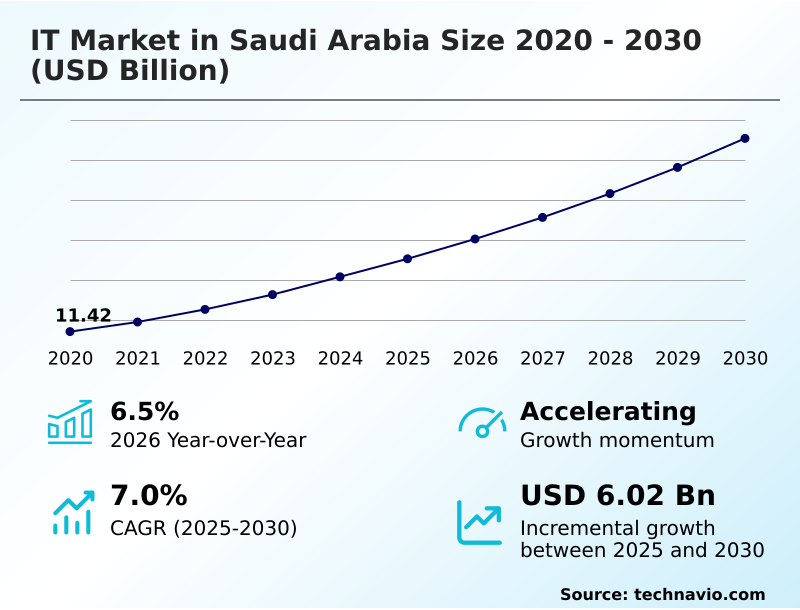
The saudi arabia it market size is valued to increase by USD 6.02 billion, at a CAGR of 7% from 2025 to 2030. Government digital transformation initiatives growth will drive the saudi arabia it market.
Major Market Trends & Insights
- By Component - Hardware segment was valued at USD 6.88 billion in 2024
- By End-user - Government segment accounted for the largest market revenue share in 2024
Market Size & Forecast
- Market Opportunities: USD 9.66 billion
- Market Future Opportunities: USD 6.02 billion
- CAGR from 2025 to 2030 : 7%
Market Summary
- The IT market in Saudi Arabia is foundational to the nation's economic diversification and modernization, operating through a complex ecosystem of hardware, software, and services. This market enables digital transformation initiatives across all sectors by providing the infrastructure for everything from enterprise resource planning to high-performance computing.
- Key applications include cloud-based platforms for scalable operations and enterprise software that optimizes business processes. For instance, a logistics company can leverage edge computing architectures and connected sensors for real-time tracking, improving supply chain efficiency. However, progress is often moderated by challenges like legacy infrastructure integration and a shortage of specialized talent.
- Innovations are focused on sovereign cloud solutions to meet data residency regulations and the development of Arabic large language models to enhance localized services, underscoring the market's dynamic response to both opportunities and constraints. This constant evolution ensures IT remains a critical enabler of national strategic goals.
What will be the Size of the Saudi Arabia IT Market during the forecast period?
Get Key Insights on Market Forecast (PDF) Get Free Sample
How is the Saudi Arabia IT Market Segmented?
The saudi arabia it industry research report provides comprehensive data (region-wise segment analysis), with forecasts and estimates in "USD million" for the period 2026-2030, as well as historical data from 2020-2024 for the following segments.
- Component
- Hardware
- Services
- Software
- End-user
- Government
- Telecommunication
- BFSI
- Oil and gas
- Others
- Deployment
- Cloud-based
- On-premises
- Geography
- Middle East and Africa
- Saudi Arabia
- Middle East and Africa
By Component Insights
The hardware segment is estimated to witness significant growth during the forecast period.
The hardware segment is expanding to create a robust digital foundation for long-term economic goals. Organizations are heavily investing in high-performance computing assets and advanced networking equipment to manage massive data volumes from smart city initiatives and support AI workloads.
This shift moves from traditional legacy systems toward modern high-density enterprise servers and versatile storage systems that enable localized data processing.
The integration of internet of things devices into industrial operations, which has improved operational uptime by over 15%, is another critical factor driving purchases of specialized hardware.
This foundational ICT infrastructure provides the necessary tools for businesses to innovate and maintain a competitive edge, ensuring the physical layer of the IT ecosystem remains resilient and capable of supporting future technological advancements.
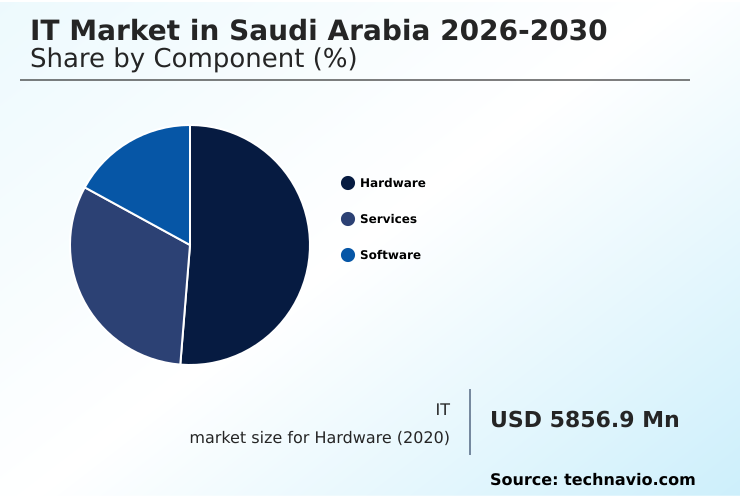
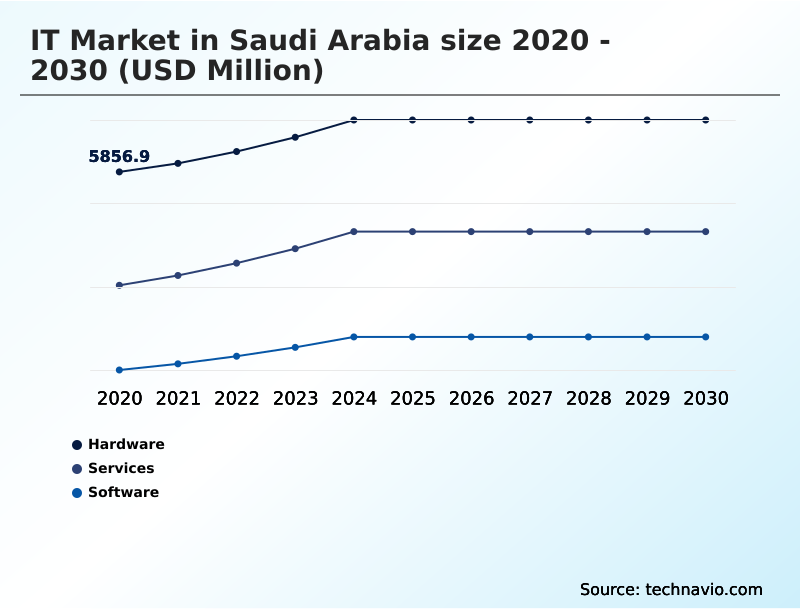
The Hardware segment was valued at USD 6.88 billion in 2024 and showed a gradual increase during the forecast period.
Market Dynamics
Our researchers analyzed the data with 2025 as the base year, along with the key drivers, trends, and challenges. A holistic analysis of drivers will help companies refine their marketing strategies to gain a competitive advantage.
- The strategic direction of the market is increasingly specialized, focusing on targeted outcomes and complex integrations. The push for sovereign cloud adoption for data residency compliance is reshaping how multinational corporations operate, while the development of an arabic large language model for sentiment analysis is creating new opportunities in customer engagement.
- Simultaneously, edge computing deployment for industrial logistics optimization is transforming supply chains. The overarching government digital transformation for public services provides a steady demand pipeline, complemented by the rapid fintech expansion for cashless society development. Protecting these new digital assets requires a robust national cybersecurity framework for critical infrastructure protection.
- However, a primary constraint is the specialized technical professional skills gap mitigation, which companies are actively addressing. The challenge of ensuring data residency compliance for global technology firms is being met with localized solutions, even as the complex task of legacy infrastructure integration with modern platforms continues.
- To address security, firms are investing in managed detection and response for infrastructure security. Internally, the adoption of AI-powered productivity tools with language integration has been shown to improve project turnaround times by over 50% compared to traditional methods.
- Firms are also deploying hyperconverged infrastructure for on-premises datacenters, exploring open banking frameworks for fintech collaboration, and using AI-driven reservoir modeling in the energy sector. Digital health platforms for patient record management and omnichannel shopping experiences in modern retail are becoming standard.
- This is all supported by 5G standalone networks for enhanced mobile connectivity, cloud-based backup services for business continuity, AI-powered fraud detection in financial services, and the use of autonomous drones for remote pipeline inspection.
What are the key market drivers leading to the rise in the adoption of Saudi Arabia IT Industry?
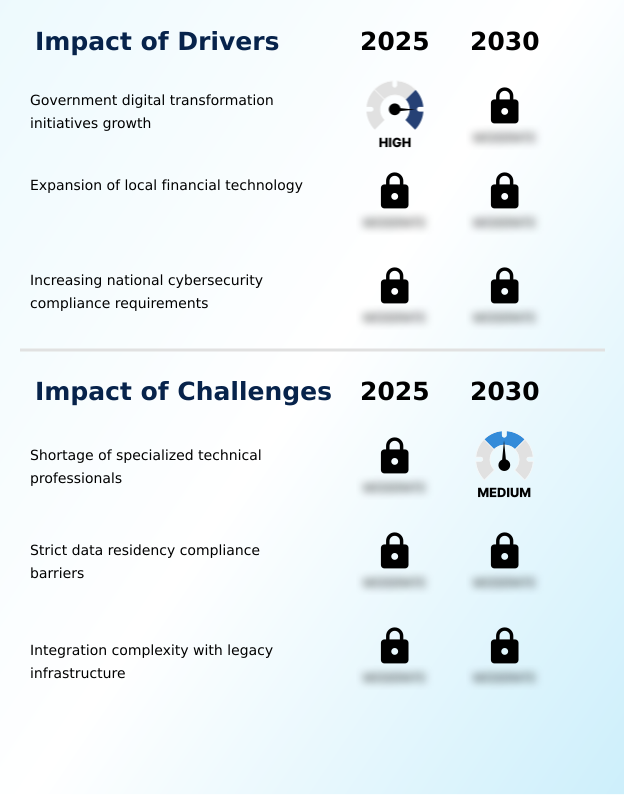
- The growth in government-led digital transformation initiatives is a key driver for the IT market.
- Market growth is propelled by a trio of powerful drivers. Foremost are the government's digital transformation initiatives, which have streamlined public services and cut administrative processing times by over 50%.
- This top-down push creates sustained demand for advanced software and infrastructure services.
- Secondly, the rapid expansion of local financial technology, supported by a favorable regulatory sandbox, is accelerating the transition to a cashless society, with digital transactions increasing by more than 70% in the last two years.
- Finally, an increasing emphasis on national cybersecurity compliance compels both public and private entities to invest heavily in threat detection systems and incident response services, making security a fundamental component of all IT expenditure and ensuring robust protection of critical digital assets.
What are the market trends shaping the Saudi Arabia IT Industry?
- A significant market trend is the adoption of sovereign cloud infrastructure. This shift is driven by organizations prioritizing data residency and local control over their digital assets.
- Market trends are characterized by a strategic shift towards technological self-reliance and operational intelligence. The adoption of sovereign cloud solutions is paramount, driven by a need for data sovereignty and compliance with local regulations; this move improves data access speeds by up to 30% for domestic users.
- Concurrently, the development of sophisticated Arabic large language models addresses a critical gap in natural language processing, enabling firms to achieve over 95% accuracy in customer sentiment analysis within regional dialects.
- In the industrial and logistics sectors, the deployment of edge computing architectures facilitates real-time decision-making by processing data locally, which can reduce network bandwidth consumption by as much as 60%. These trends collectively indicate a move towards highly localized, efficient, and intelligent digital ecosystems.
What challenges does the Saudi Arabia IT Industry face during its growth?
- A shortage of specialized technical professionals presents a key challenge affecting the industry's growth.
- The market's rapid expansion is tempered by several significant challenges. A persistent shortage of specialized technical professionals creates a talent gap, leading to project delays in over 35% of large-scale digital initiatives and increasing reliance on external consultants.
- Strict data residency regulations, while crucial for digital sovereignty, present compliance barriers for global firms, often increasing infrastructure setup costs by up to 20%. Furthermore, the complexity of legacy infrastructure integration remains a major hurdle.
- Many established organizations struggle to merge modern cloud-native applications with aging on-premises systems, resulting in data silos and preventing them from fully realizing the benefits of their technology investments. These challenges require strategic workforce development and architectural modernization to overcome.
Exclusive Technavio Analysis on Customer Landscape
The saudi arabia it market forecasting report includes the adoption lifecycle of the market, covering from the innovator’s stage to the laggard’s stage. It focuses on adoption rates in different regions based on penetration. Furthermore, the saudi arabia it market report also includes key purchase criteria and drivers of price sensitivity to help companies evaluate and develop their market growth analysis strategies.
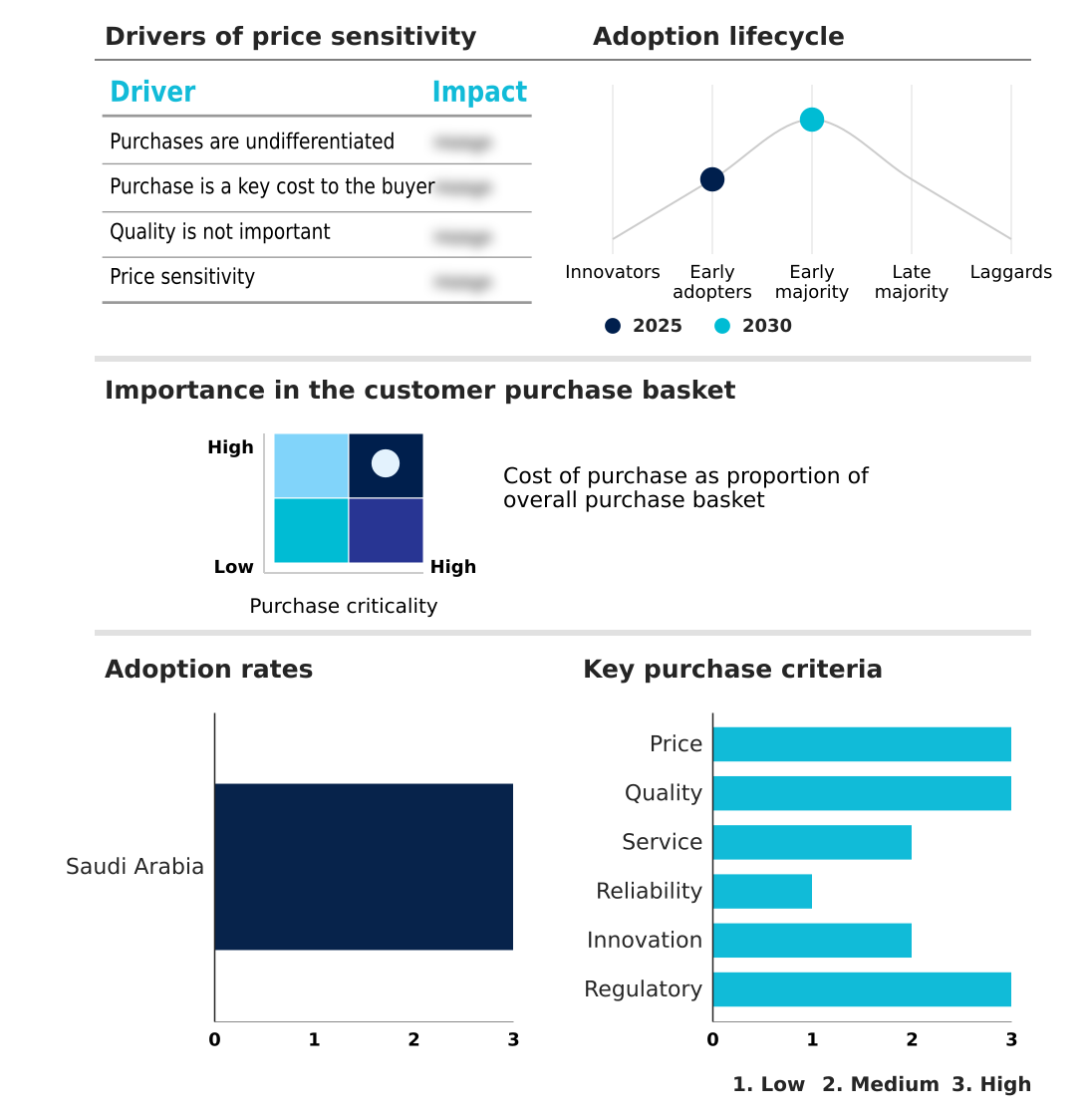
Customer Landscape of Saudi Arabia IT Industry
Competitive Landscape
Companies are implementing various strategies, such as strategic alliances, saudi arabia it market forecast, partnerships, mergers and acquisitions, geographical expansion, and product/service launches, to enhance their presence in the industry.
Accenture Plc - Provides strategic digital transformation consulting and cloud migration services, enabling enterprises to modernize operations and enhance technological capabilities.
The industry research and growth report includes detailed analyses of the competitive landscape of the market and information about key companies, including:
- Accenture Plc
- Amazon.com Inc.
- AT and T Inc.
- Cisco Systems Inc.
- Cognizant Technology Solution
- Comprehensive Technology Co.
- DataFlow Services FZ LLC
- Easy World Automation LLC
- Ejada Systems Co. Ltd.
- Google LLC
- Hewlett Packard Entp Co.
- Huawei Technologies Co. Ltd.
- IBM Corp.
- IQVIA Holdings Inc.
- Microsoft Corp.
- Moammar Information Systems
- NEC Corp.
- Oracle Corp.
- SAP SE
- SAS Institute Inc.
Qualitative and quantitative analysis of companies has been conducted to help clients understand the wider business environment as well as the strengths and weaknesses of key industry players. Data is qualitatively analyzed to categorize companies as pure play, category-focused, industry-focused, and diversified; it is quantitatively analyzed to categorize companies as dominant, leading, strong, tentative, and weak.
Recent Development and News in Saudi arabia it market
- In September 2024, Microsoft Corp announced the expansion of its cloud region in the kingdom to include advanced availability zones, providing local organizations with enhanced disaster recovery and data residency capabilities.
- In October 2024, IBM Corp collaborated with the Saudi Data and AI Authority to integrate advanced generative capabilities into the national intelligence platform, focusing on enhancing the performance of Arabic language applications.
- In February 2025, Amazon.com Inc collaborated with a major Saudi bank to migrate its core banking operations to a high-performance cloud platform, enabling faster transaction processing and improved scalability.
- In March 2025, Cisco Systems Inc launched a specialized cybersecurity center in Riyadh to provide local organizations with real-time threat intelligence and incident response services.
Dive into Technavio’s robust research methodology, blending expert interviews, extensive data synthesis, and validated models for unparalleled Saudi Arabia IT Market insights. See full methodology.
| Market Scope | |
|---|---|
| Page number | 199 |
| Base year | 2025 |
| Historic period | 2020-2024 |
| Forecast period | 2026-2030 |
| Growth momentum & CAGR | Accelerate at a CAGR of 7% |
| Market growth 2026-2030 | USD 6021.7 million |
| Market structure | Fragmented |
| YoY growth 2025-2026(%) | 6.5% |
| Key countries | Saudi Arabia |
| Competitive landscape | Leading Companies, Market Positioning of Companies, Competitive Strategies, and Industry Risks |
Research Analyst Overview
- The market is undergoing a structural evolution, driven by comprehensive digital transformation initiatives. Boardroom decisions increasingly center on balancing investment in sovereign cloud solutions to meet stringent data residency regulations against leveraging global cloud computing platforms. This requires sophisticated consulting services for cloud migration services and managing hybrid cloud solutions.
- Firms are deploying enterprise resource planning and business analytics software, supported by robust ICT infrastructure, including enterprise servers and storage systems. The adoption of enterprise AI and data analytics solutions, often on platforms like Google Cloud Platform or Oracle Cloud Infrastructure with enterprise database management, is critical. For instance, implementing such systems has reduced data processing cycles by 30%.
- Key offerings include managed IT services, managed network services, and specialized application development services utilizing digital engineering solutions. The ecosystem also includes HPE GreenLake cloud services, personal computing solutions, and software platforms for productivity and business processes. In specialized sectors, demand is high for technology and analytics solutions, contract sales and medical solutions, and research and development solutions.
- Security is paramount, with a focus on national cybersecurity compliance, biometric identification systems, and social infrastructure solutions. The market also sees activity in digital power solutions and intelligent automotive systems, reflecting broad-based enterprise software implementation across all industries.
What are the Key Data Covered in this Saudi Arabia IT Market Research and Growth Report?
-
What is the expected growth of the Saudi Arabia IT Market between 2026 and 2030?
-
USD 6.02 billion, at a CAGR of 7%
-
-
What segmentation does the market report cover?
-
The report is segmented by Component (Hardware, Services, and Software), End-user (Government, Telecommunication, BFSI, Oil and gas, and Others), Deployment (Cloud-based, and On-premises) and Geography (Middle East and Africa)
-
-
Which regions are analyzed in the report?
-
Middle East and Africa
-
-
What are the key growth drivers and market challenges?
-
Government digital transformation initiatives growth, Shortage of specialized technical professionals
-
-
Who are the major players in the Saudi Arabia IT Market?
-
Accenture Plc, Amazon.com Inc., AT and T Inc., Cisco Systems Inc., Cognizant Technology Solution, Comprehensive Technology Co., DataFlow Services FZ LLC, Easy World Automation LLC, Ejada Systems Co. Ltd., Google LLC, Hewlett Packard Entp Co., Huawei Technologies Co. Ltd., IBM Corp., IQVIA Holdings Inc., Microsoft Corp., Moammar Information Systems, NEC Corp., Oracle Corp., SAP SE and SAS Institute Inc.
-
Market Research Insights
- Market dynamics are shaped by a push for digital sovereignty and data localization, mandating a cloud-first policy and advanced disaster recovery capabilities. The talent gap necessitates a focus on hybrid cloud modernization and new application management services. A regulatory sandbox is fostering a cashless society, while a focus on data-driven governance and a paperless government drives adoption.
- This environment requires robust threat detection systems and incident response services, moving beyond simple credentials verification. Firms leverage natural language processing for sentiment analysis and content generation to improve engagement. Technologies like tensor processing units and AI-native cloud infrastructure support autonomous systems and connected sensors, enabling real-time decision making and automated operations.
- The use of big data platforms for clinical data management and vehicle-cloud services for intelligent driving systems shows sector-specific adoption. For example, implementing business process management has increased administrative efficiency by 25%, while digital archiving has reduced document retrieval times by 40%.
We can help! Our analysts can customize this saudi arabia it market research report to meet your requirements.
 RIA -
RIA - 
