


Medical Equipment Maintenance Market Size 2025-2029
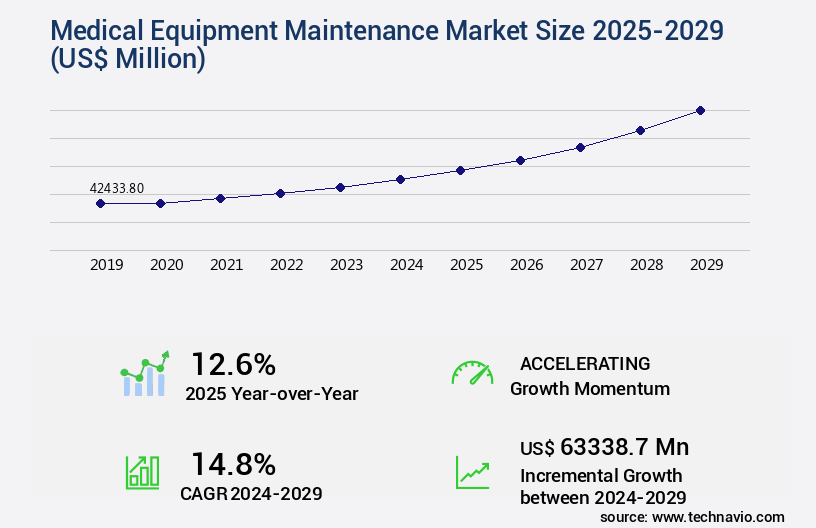
The medical equipment maintenance market size is valued to increase USD 63.34 billion, at a CAGR of 14.8% from 2024 to 2029. Rising focus on preventive maintenance of medical equipment will drive the medical equipment maintenance market.
Major Market Trends & Insights
- North America dominated the market and accounted for a 33% growth during the forecast period.
- By Type - Healthcare systems segment was valued at USD 24.78 billion in 2023
- By End-user - Public sector organizations segment accounted for the largest market revenue share in 2023
Market Size & Forecast
- Market Opportunities: USD 199.93 million
- Market Future Opportunities: USD 63338.70 million
- CAGR from 2024 to 2029 : 14.8%
Market Summary
- The market is experiencing significant growth due to the increasing adoption of advanced medical technologies in emerging economies and the rising focus on preventive maintenance to ensure optimal functionality and patient safety. According to a recent study, The market is projected to reach a value of USD50.5 billion by 2026, underscoring its importance in the healthcare sector. Advanced medical technologies, such as telemedicine, remote monitoring, and robotic surgery, are increasingly being implemented in healthcare facilities worldwide. These technologies require specialized maintenance to ensure their proper functioning, driving demand for medical equipment maintenance services.
- Moreover, the high cost of medical equipment necessitates regular maintenance to prolong their lifespan and reduce replacement costs. Despite these opportunities, the market faces challenges, including the complexity of medical equipment, the need for specialized skills, and the high cost of maintenance services. To address these challenges, market players are investing in research and development to create more efficient and cost-effective maintenance solutions. Additionally, there is a growing trend towards outsourcing medical equipment maintenance to third-party providers to reduce operational costs and improve efficiency. In conclusion, the market is a critical component of the healthcare sector, driven by the increasing adoption of advanced medical technologies and the need for preventive maintenance.
- With a projected value of USD50.5 billion by 2026, this market offers significant opportunities for growth and innovation. However, challenges such as the complexity of medical equipment and the high cost of maintenance services must be addressed to fully realize its potential.
What will be the Size of the Medical Equipment Maintenance Market during the forecast period?
Get Key Insights on Market Forecast (PDF) Request Free Sample
How is the Medical Equipment Maintenance Market Segmented ?
The medical equipment maintenance industry research report provides comprehensive data (region-wise segment analysis), with forecasts and estimates in "USD million" for the period 2025-2029, as well as historical data from 2019-2023 for the following segments.
- Type
- Healthcare systems
- Pharmaceutical diagnostics
- Others
- End-user
- Public sector organizations
- Private sector organizations
- Service
- Preventive
- Corrective
- Product
- Imaging equipment
- Surgical instruments
- Geography
- North America
- US
- Canada
- Europe
- France
- Germany
- UK
- APAC
- China
- India
- Japan
- South Korea
- South America
- Brazil
- Rest of World (ROW)
- North America
By Type Insights
The healthcare systems segment is estimated to witness significant growth during the forecast period.
In the dynamic and complex landscape of healthcare, the market plays a pivotal role in ensuring the optimal performance and longevity of essential medical devices. With a focus on inventory optimization techniques and maintenance cost optimization, preventive maintenance schedules, extended service warranties, and technical support services are integral components of this market. Compliance certifications, biomedical engineering technicians, and safety protocols implementation are crucial for maintaining regulatory compliance standards. Calibration verification procedures, performance optimization strategies, and repair management software facilitate efficient and effective maintenance processes. Medical device sterilization, predictive maintenance models, infection control protocols, and equipment sanitation procedures are essential for maintaining the highest levels of patient safety.
Key performance indicators, such as equipment downtime reduction, are closely monitored through health information technology, preventive maintenance procedures, and service contract management. Real-time equipment monitoring, asset tracking systems, remote diagnostics technology, maintenance contract negotiations, risk assessment methodologies, corrective maintenance protocols, and equipment lifecycle management are all integral parts of this evolving market. For instance, preventive maintenance procedures on diagnostic imaging equipment, such as X-ray machines, CT scanners, and MRI machines, can reduce downtime by up to 40%. This market continues to adapt and innovate, with ongoing advancements in regulatory compliance standards, diagnostic imaging maintenance, and equipment performance metrics.
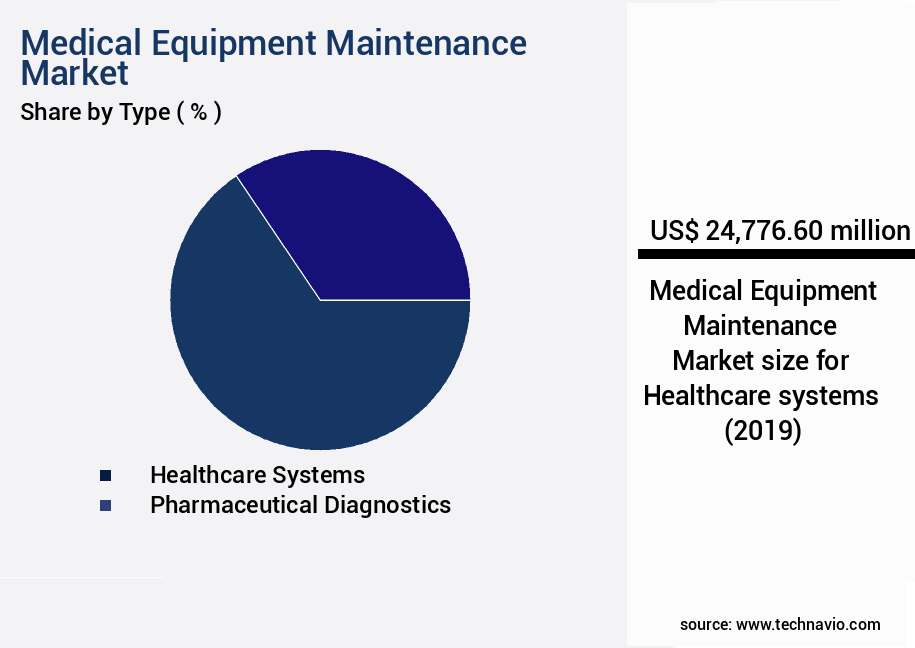
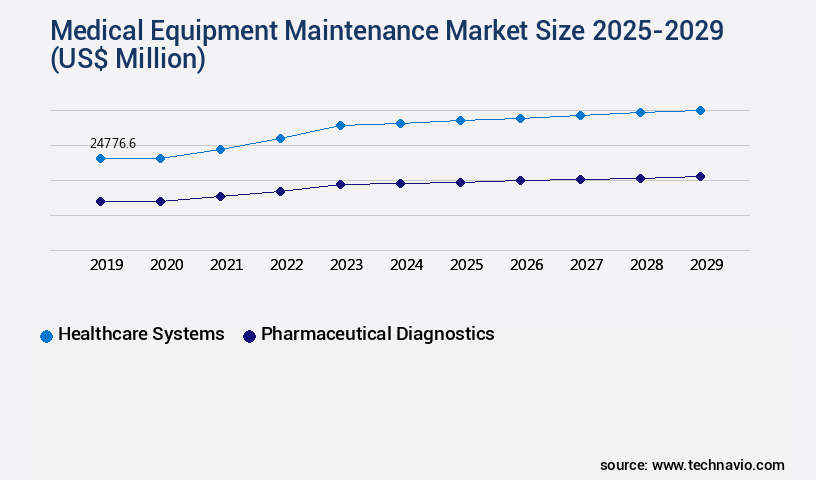
The Healthcare systems segment was valued at USD 24.78 billion in 2019 and showed a gradual increase during the forecast period.
Regional Analysis
North America is estimated to contribute 33% to the growth of the global market during the forecast period.Technavio's analysts have elaborately explained the regional trends and drivers that shape the market during the forecast period.
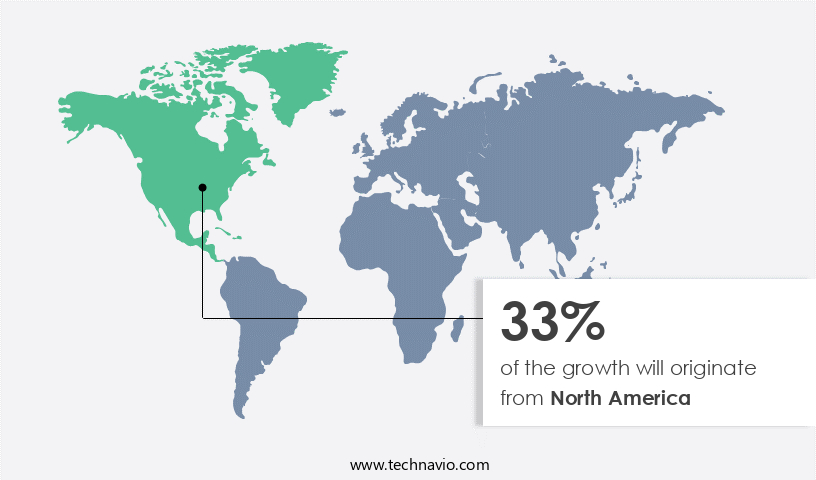
See How Medical Equipment Maintenance Market Demand is Rising in North America Request Free Sample
The North American medical equipment market is led by the United States, which is the world's largest medical equipment market and a significant contributor to the global industry's growth. According to recent reports, the US accounts for a considerable market share in North America, with Canada following suit. The US is the world's largest consumer of medical equipment, with over 6,500 companies, most of which are small and medium-sized enterprises. In 2024, GE HealthCare Technologies reported robust demand for its medical devices in the US, contributing to an adjusted profit forecast of USD4.61 to USD4.75 per share for 2025.
This figure surpasses Wall Street's average estimate, underscoring the market's potential. Despite the dominance of the US, the global medical equipment market is experiencing a surge in demand due to aging populations, increasing healthcare expenditures, and technological advancements. These factors are driving the market's evolution and creating new opportunities for key applications, such as diagnostic imaging, patient monitoring, and therapeutic equipment.
Market Dynamics
Our researchers analyzed the data with 2024 as the base year, along with the key drivers, trends, and challenges. A holistic analysis of drivers will help companies refine their marketing strategies to gain a competitive advantage.
The market is a critical sector that ensures the optimal performance and longevity of healthcare technology. Hospitals and healthcare providers worldwide are increasingly focusing on implementing preventive maintenance schedules for medical devices to minimize downtime and enhance patient care. Optimizing spare parts inventory for medical equipment is another key strategy to streamline maintenance processes and reduce repair costs. Managing maintenance service level agreements (SLAs) in healthcare settings is essential for ensuring timely and effective maintenance services. Developing effective risk assessment methodologies for medical equipment is crucial to identify potential issues before they escalate into major problems. Improving medical equipment repair and maintenance efficiency is a top priority, which can be achieved by streamlining work order management systems and employing predictive maintenance models. Ensuring regulatory compliance in medical equipment maintenance is a legal requirement and a critical aspect of patient safety. Comprehensive training programs for biomedical technicians are necessary to maintain high-quality maintenance standards. Analyzing and reducing medical equipment downtime costs is a significant challenge, which can be addressed by implementing effective strategies for managing maintenance contracts, employing robust quality control procedures, and leveraging remote diagnostics technology. Maintaining medical equipment sterilization and sanitation protocols is essential for infection control, while using data analytics to optimize medical equipment maintenance can provide valuable insights into maintenance trends and patterns. Effective processes for managing equipment lifecycle and optimizing maintenance resource allocation are also crucial for maximizing the value of healthcare technology investments. In summary, the market is a complex and dynamic sector that requires a holistic approach to ensure the optimal performance and longevity of healthcare technology. Effective strategies include implementing preventive maintenance schedules, optimizing spare parts inventory, managing SLAs, developing risk assessment methodologies, improving repair and maintenance efficiency, ensuring regulatory compliance, employing predictive maintenance models, providing comprehensive training, reducing downtime costs, maintaining sterilization protocols, using data analytics, managing contracts, implementing quality control procedures, leveraging remote diagnostics technology, managing risks, and optimizing equipment lifecycle and resource allocation.
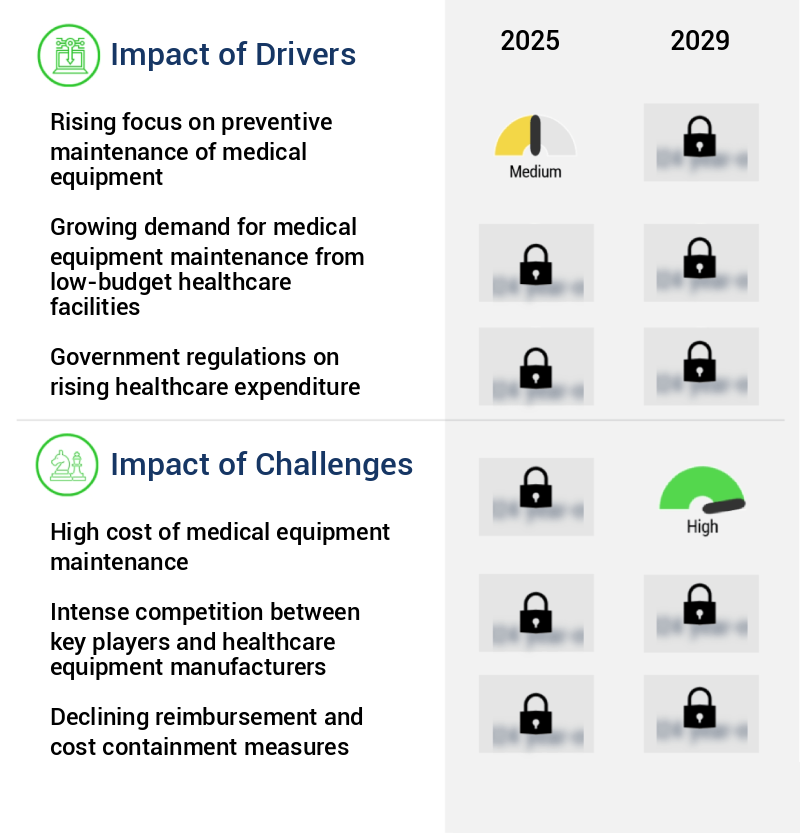
What are the key market drivers leading to the rise in the adoption of Medical Equipment Maintenance Industry?
- The increasing prioritization of proactive maintenance for medical equipment serves as the primary market catalyst.
- Medical equipment maintenance has emerged as a critical aspect of healthcare operations, with preventive measures gaining prominence in recent years. This approach involves scheduled inspections and routine maintenance tasks to prevent larger, costlier repairs and equipment downtime. The importance of preventive maintenance is underscored by its role in enhancing patient safety and care quality. According to recent studies, preventive maintenance accounts for over 50% of the total the market, with this figure projected to reach approximately two-thirds within the next decade.
- Regular maintenance not only ensures the safety and efficacy of medical devices but also contributes to their long-term use. By reducing equipment downtime and improving device reliability, preventive maintenance significantly enhances day-to-day healthcare operations.
What are the market trends shaping the Medical Equipment Maintenance Industry?
- In emerging countries, the adoption of advanced medical technologies is becoming increasingly prevalent, representing a notable market trend.
- The market is experiencing a significant evolution, driven by the introduction of innovative technologies and devices. Regenerative medicine, surgical robots, liquid biopsy, and wearable medical devices are some of the recent advancements enhancing disease diagnosis and treatment. Regenerative medicine, in particular, is gaining prominence due to its potential in repairing or replacing damaged human cells, tissues, and organs using therapeutic stem cells, tissue engineering, and artificial organ production. Three-dimensional (3D) bioprinting or additive manufacturing is being adopted for producing regenerative medicines, providing researchers control over the size, shape, pore size, geometry, and mechanical properties of the products.
- This technology is utilized in studying the potential effects of drugs and treatments on human tissues, allowing for more accurate and personalized treatments. The integration of these advanced technologies is transforming the healthcare sector, improving patient outcomes and overall efficiency.
What challenges does the Medical Equipment Maintenance Industry face during its growth?
- The escalating costs of maintaining medical equipment represent a significant challenge to the growth of the healthcare industry.
- Medical equipment maintenance programs have gained significance in the healthcare sector, allowing providers to optimally utilize and maintain the condition of their equipment, ensuring maximum uptime. Amidst cost pressures and preventive maintenance focus, these programs are essential for controlling expenditures. Advanced asset management solutions, a part of these programs, employ cutting-edge technologies. However, their implementation involves high initial installation costs and substantial ongoing maintenance expenses.
- Similarly, the installation of advanced medical equipment necessitates annual service contracts. Consequently, the service costs paid throughout the equipment's lifespan often surpass the initial investment.
Exclusive Technavio Analysis on Customer Landscape
The medical equipment maintenance market forecasting report includes the adoption lifecycle of the market, covering from the innovator's stage to the laggard's stage. It focuses on adoption rates in different regions based on penetration. Furthermore, the medical equipment maintenance market report also includes key purchase criteria and drivers of price sensitivity to help companies evaluate and develop their market growth analysis strategies.
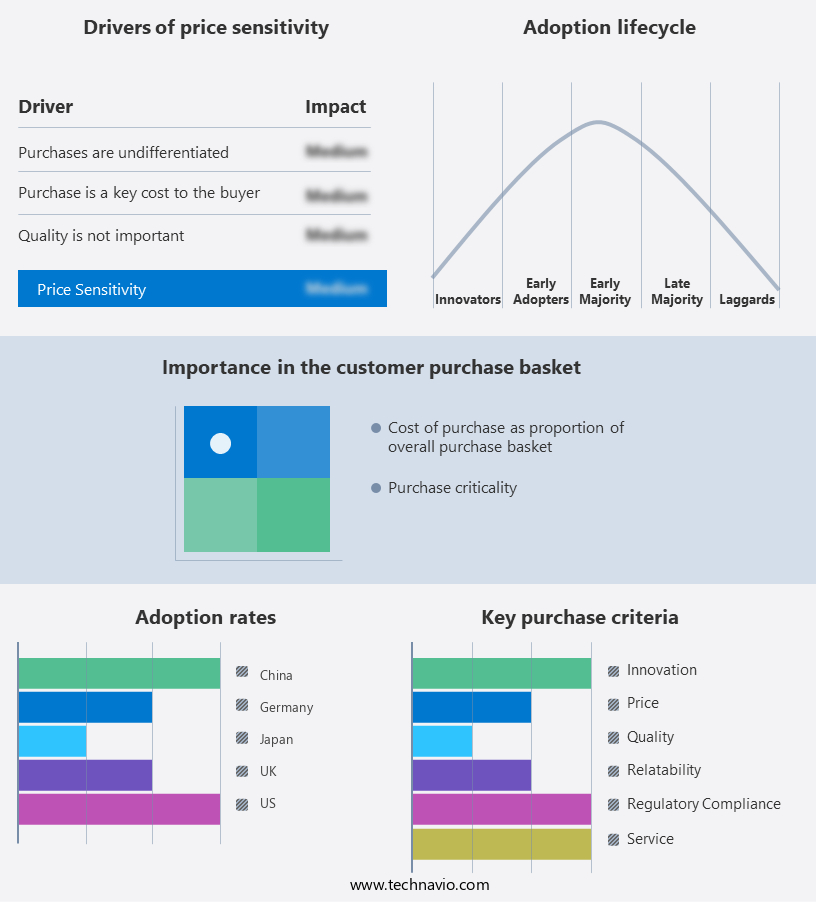
Customer Landscape of Medical Equipment Maintenance Industry
Competitive Landscape
Companies are implementing various strategies, such as strategic alliances, medical equipment maintenance market forecast, partnerships, mergers and acquisitions, geographical expansion, and product/service launches, to enhance their presence in the industry.
Agfa Gevaert NV - Agfa Service Maintenance is a division of Agfa, providing specialized medical equipment maintenance services to ensure optimal performance and longevity for healthcare facilities. Their expert team utilizes advanced tools and techniques to diagnose and resolve technical issues, enabling seamless operations and improved patient care.
The industry research and growth report includes detailed analyses of the competitive landscape of the market and information about key companies, including:
- Agfa Gevaert NV
- AlphaSource Group
- Althea Group S.p.A.
- Aramark
- B.Braun SE
- Boston Scientific Corp.
- Canon Inc.
- Carestream Health Inc.
- Dragerwerk AG and Co. KGaA
- Edwards Lifesciences Corp.
- FUJIFILM Holdings Corp.
- General Electric Co.
- Hitachi Ltd.
- HOYA Corp.
- Koninklijke Philips NV
- Medtronic Plc
- Samsung Electronics Co. Ltd.
- Siemens AG
- Stryker Corp.
- Terumo Corp.
Qualitative and quantitative analysis of companies has been conducted to help clients understand the wider business environment as well as the strengths and weaknesses of key industry players. Data is qualitatively analyzed to categorize companies as pure play, category-focused, industry-focused, and diversified; it is quantitatively analyzed to categorize companies as dominant, leading, strong, tentative, and weak.
Recent Development and News in Medical Equipment Maintenance Market
- In January 2024, Medtronic plc, a global healthcare solutions company, announced the acquisition of Patriot Medical Education & Services, a leading provider of medical equipment maintenance and repair services in the US. This strategic move aimed to expand Medtronic's after-sales service offerings and strengthen its position in the market (Medtronic Press Release, 2024).
- In March 2024, Siemens Healthineers, a German medical technology company, launched its new ServiceBridge solution, an advanced remote monitoring and predictive maintenance system for medical imaging equipment. This technological advancement allows for proactive maintenance, reducing downtime and improving overall equipment performance (Siemens Healthineers Press Release, 2024).
- In April 2025, GE Healthcare, a global healthcare technology company, entered into a partnership with IBM Watson Health to offer predictive maintenance services for medical imaging equipment using AI and machine learning technologies. This collaboration aims to improve equipment performance, reduce downtime, and enhance patient care (GE Healthcare Press Release, 2025).
- In May 2025, Philips, a Dutch technology company, secured regulatory approval from the US Food and Drug Administration (FDA) for its new IntelliSpace Enterprise Edition 6.0, an advanced imaging informatics platform that includes predictive maintenance capabilities. This approval marks a significant step in the adoption of AI and predictive maintenance in the medical imaging market (Philips Press Release, 2025).
Dive into Technavio's robust research methodology, blending expert interviews, extensive data synthesis, and validated models for unparalleled Medical Equipment Maintenance Market insights. See full methodology.
|
Market Scope |
|
|
Report Coverage |
Details |
|
Page number |
237 |
|
Base year |
2024 |
|
Historic period |
2019-2023 |
|
Forecast period |
2025-2029 |
|
Growth momentum & CAGR |
Accelerate at a CAGR of 14.8% |
|
Market growth 2025-2029 |
USD 63338.7 million |
|
Market structure |
Fragmented |
|
YoY growth 2024-2025(%) |
12.6 |
|
Key countries |
US, Germany, China, UK, Japan, Canada, France, India, South Korea, and Brazil |
|
Competitive landscape |
Leading Companies, Market Positioning of Companies, Competitive Strategies, and Industry Risks |
Research Analyst Overview
- The market continues to evolve, driven by the constant need for optimal performance and safety in healthcare facilities. Inventory optimization techniques play a crucial role in minimizing maintenance costs by ensuring the right equipment is available at the right time. Preventive maintenance schedules and extended service warranties help reduce unexpected downtime and maintenance expenses. Technical support services, compliance certifications, and biomedical engineering technicians are essential for implementing safety protocols and calibration verification procedures. Performance optimization strategies, repair management software, and predictive maintenance models enable early detection and resolution of potential issues. Medical device sterilization and infection control protocols are critical for maintaining patient safety.
- Regulatory compliance standards, such as those related to diagnostic imaging maintenance, equipment performance metrics, and quality control procedures, are non-negotiable. Real-time equipment monitoring, asset tracking systems, and remote diagnostics technology facilitate efficient maintenance contract negotiations and risk assessment methodologies. Corrective maintenance protocols and equipment downtime reduction strategies are essential for minimizing disruptions and maintaining optimal operational efficiency. Health information technology and preventive maintenance procedures are increasingly important for service contract management and technical documentation updates. Medical device calibration and equipment lifecycle management are key considerations for ensuring the longevity and effectiveness of medical equipment.
- For instance, a leading hospital system implemented a predictive maintenance model for its MRI machines, resulting in a 20% reduction in maintenance costs and a 15% decrease in downtime. According to industry reports, the market is expected to grow by over 5% annually in the coming years, reflecting the ongoing demand for innovative solutions in this sector.
What are the Key Data Covered in this Medical Equipment Maintenance Market Research and Growth Report?
-
What is the expected growth of the Medical Equipment Maintenance Market between 2025 and 2029?
-
USD 63.34 billion, at a CAGR of 14.8%
-
-
What segmentation does the market report cover?
-
The report is segmented by Type (Healthcare systems, Pharmaceutical diagnostics, and Others), End-user (Public sector organizations and Private sector organizations), Service (Preventive and Corrective), Product (Imaging equipment and Surgical instruments), and Geography (North America, Europe, Asia, and Rest of World (ROW))
-
-
Which regions are analyzed in the report?
-
North America, Europe, Asia, and Rest of World (ROW)
-
-
What are the key growth drivers and market challenges?
-
Rising focus on preventive maintenance of medical equipment, High cost of medical equipment maintenance
-
-
Who are the major players in the Medical Equipment Maintenance Market?
-
Agfa Gevaert NV, AlphaSource Group, Althea Group S.p.A., Aramark, B.Braun SE, Boston Scientific Corp., Canon Inc., Carestream Health Inc., Dragerwerk AG and Co. KGaA, Edwards Lifesciences Corp., FUJIFILM Holdings Corp., General Electric Co., Hitachi Ltd., HOYA Corp., Koninklijke Philips NV, Medtronic Plc, Samsung Electronics Co. Ltd., Siemens AG, Stryker Corp., and Terumo Corp.
-
Market Research Insights
- The market is a dynamic and essential sector that continuously evolves to meet the demands of healthcare providers. Two significant figures illustrate its significance. First, over 70% of hospital budgets are allocated to maintaining and servicing medical equipment, highlighting the financial importance of effective maintenance strategies. Second, industry experts anticipate a growth rate of approximately 5% annually in the coming years, underpinned by the increasing adoption of advanced technologies and regulatory requirements. For instance, a hospital implementing a proactive maintenance strategy experienced a 20% increase in equipment uptime, resulting in improved patient care and reduced operational costs.
- This success can be attributed to the integration of predictive maintenance software, inventory control systems, and work order prioritization techniques. Additionally, the industry's focus on regulatory compliance, infection prevention, and safety training programs further underscores the market's ongoing development.
We can help! Our analysts can customize this medical equipment maintenance market research report to meet your requirements.
 RIA -
RIA - 
