



Propolis Market Size 2025-2029
The propolis market size is forecast to increase by USD 135 million, at a CAGR of 3.3% between 2024 and 2029.
- The market is driven by the growing recognition of its health benefits, primarily as a natural antioxidant and antimicrobial agent. This has led to an increase in research activities aimed at enhancing propolis production in beehives to meet rising demand. However, a significant challenge facing the market is the declining number of honey bee colonies, which may impact the availability and sustainability of propolis supply. This trend necessitates the adoption of innovative beekeeping practices and the exploration of alternative sources to ensure a steady supply of propolis.
- Companies seeking to capitalize on market opportunities should focus on developing value-added propolis products and establishing strategic partnerships with beekeepers and research institutions. Effective navigation of these challenges requires a deep understanding of market dynamics, consumer preferences, and regulatory requirements.
What will be the Size of the Propolis Market during the forecast period?

Explore in-depth regional segment analysis with market size data - historical 2019-2023 and forecasts 2025-2029 - in the full report.
Request Free Sample
The market continues to evolve, driven by ongoing research and development in various sectors. Propolis, a resin-like substance collected by bees from tree buds, bark, or other botanical sources, is known for its antioxidant activity and diverse bioactive compounds, including flavonoids, phenolic acids, and phenolic esters. These compounds contribute to propolis' antiviral, antifungal, antibacterial, antioxidant, anti-inflammatory, and wound healing properties. Standardization of propolis is a critical aspect of the market, ensuring consistent total phenolic content and bioactive compound profiles. Extraction methods, such as water, ethanol, and supercritical CO2, influence the chemical composition and quality of propolis extracts. Regulatory compliance and safety assessment are essential considerations for propolis products, which are available in various dosage forms, including tinctures, capsules, ointments, and topical applications.
Consumer products, such as propolis lozenges, lip balms, and sprays, offer convenience and versatility. However, potential adverse effects and allergic reactions necessitate careful quality control and ethical sourcing. Ongoing clinical trials explore the therapeutic potential of propolis in drug delivery systems, pharmacokinetic studies, and wound healing applications. HPLC analysis and GC-MS provide valuable insights into the complex chemical composition of propolis, contributing to its continued market growth and dynamism.
How is this Propolis Industry segmented?
The propolis industry research report provides comprehensive data (region-wise segment analysis), with forecasts and estimates in "USD million" for the period 2025-2029, as well as historical data from 2019-2023 for the following segments.
- Application
- Healthcare
- Personal care and cosmetics
- Food and beverages
- Distribution Channel
- Offline
- Online
- Product Type
- Capsules and tablets
- Liquids
- Creams
- Sprays
- Others
- Geography
- North America
- US
- Canada
- Europe
- France
- Germany
- Italy
- Spain
- UK
- APAC
- China
- India
- Japan
- Rest of World (ROW)
- North America
By Application Insights
The healthcare segment is estimated to witness significant growth during the forecast period.
Propolis, a natural resin produced by honey bees, is renowned for its antioxidant, antiviral, antifungal, and antibacterial properties. Derived from various plants and buds, this complex mixture of resin, wax, essential oils, pollens, and minerals is widely used in the healthcare industry for developing new drugs. Propolis drugs, available in the market, are utilized to treat ailments such as diabetes, throat cancer, oral health issues, and tuberculosis. Companies like NaturaNectar provide standardized propolis supplements with added vitamin and vitamin C, enhancing their bioavailability through bioflavonoids. Extraction methods, such as water, ethanol, and supercritical CO2, are employed to obtain raw propolis, which is then standardized to ensure consistent quality.
Propolis extracts undergo HPLC analysis to determine their total phenolic content and bioactive compounds, including phenolic acids and flavonoids. Propolis products are available in various dosage forms, including capsules, creams, ointments, sprays, lozenges, and lip balms, catering to diverse consumer preferences and applications. Despite its numerous benefits, propolis may cause allergic reactions in some individuals. Adherence to regulatory compliance and ethical sourcing is crucial to ensure product safety and efficacy. Propolis's chemical composition and storage conditions significantly impact its shelf life and potency. Ongoing research explores propolis's potential in wound healing, drug delivery systems, and clinical trials.
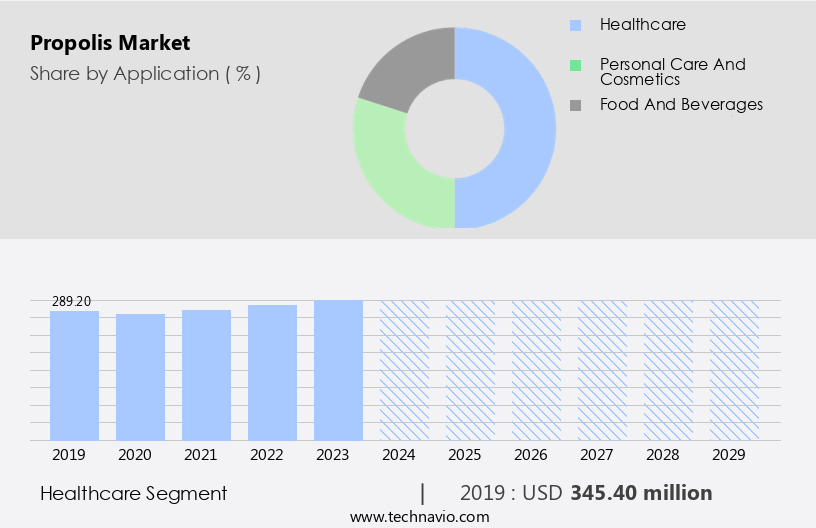
The Healthcare segment was valued at USD 345.40 million in 2019 and showed a gradual increase during the forecast period.
Regional Analysis
North America is estimated to contribute 37% to the growth of the global market during the forecast period. Technavio's analysts have elaborately explained the regional trends and drivers that shape the market during the forecast period.
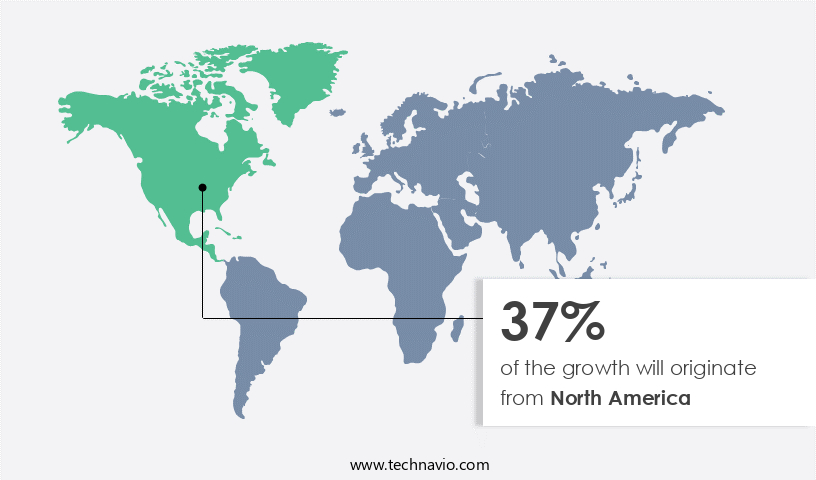
The North American market for propolis, a resin-like substance collected by bees, is experiencing growth due to the increasing number of honey bee colonies in countries like the US, Canada, and Mexico. According to the US Department of Agriculture, the total number of bee colonies for operations in the US reached approximately 2.7 million as of January 2024. This growth in bee populations is anticipated to boost the supply of raw propolis, which is used in various industries, including healthcare, personal care and cosmetics, and food and beverages. Propolis is known for its antioxidant activity, antiviral and antifungal properties, and anti-inflammatory effects.
It contains flavonoids, phenolic acids, and other bioactive compounds, making it a valuable ingredient in health supplements, topical applications, and food products. The extraction methods, such as water, ethanol, and supercritical CO2, are crucial in ensuring standardization and maintaining the chemical composition of propolis. Quality control measures and regulatory compliance are essential to ensure the safety and efficacy of propolis products. Despite its numerous benefits, adverse effects, such as allergic reactions, may occur in some individuals. Propolis is used in various dosage forms, including capsules, creams, ointments, sprays, lozenges, and tinctures. Propolis extracts undergo HPLC analysis to determine their total phenolic content and bioactive compounds.
Clinical trials have shown propolis to be effective in wound healing and drug delivery systems. Propolis's geographical origin and ethical sourcing are also essential factors in its market value. Propolis resin, royal jelly, and bee propolis are other related products with similar properties and uses. The shelf life and storage conditions of propolis products must be carefully managed to preserve their quality.
Market Dynamics
Our researchers analyzed the data with 2024 as the base year, along with the key drivers, trends, and challenges. A holistic analysis of drivers will help companies refine their marketing strategies to gain a competitive advantage.
The propolis market is flourishing due to the versatile applications of propolis, a natural resin collected by bees, valued for its antibacterial properties, anti-inflammatory effects, antioxidant benefits, antiviral properties, and therapeutic efficacy. Products like raw propolis, propolis extract, propolis capsules, propolis tablets, propolis tinctures, propolis sprays, propolis creams, propolis ointments, propolis powder, alcohol-free propolis, propolis lozenges, propolis gummies, propolis-based supplements, and organic propolis cater to diverse needs in healthcare, pharmaceuticals, cosmetics and personal care, food and beverages, dietary supplements, veterinary medicine, traditional medicine, apitherapy, nutraceuticals, and natural health products.
These are used in skincare products, hair care products, oral care products, functional foods, pharmaceutical formulations, wound healing treatments, respiratory health products, veterinary care products, anti-acne treatments, cancer treatment support, cold sore remedies, dental care products, and food preservatives.Specialized equipment like extraction reactors, supercritical CO2 extractors, filtration systems, mixing and blending units, spray dryers, freeze dryers, encapsulation machines, quality testing equipment, packaging machinery, beekeeping harvesting tools, homogenizers, and sterilization equipment ensures efficient production, aligning with the market's focus on immune system support and skin health improvement.
What are the key market drivers leading to the rise in the adoption of Propolis Industry?
- The significant health benefits associated with propolis consumption serve as the primary driver for the market's growth.
- Propolis, a resin-like substance produced by bees, is renowned for its diverse health benefits due to its anti-viral, antifungal, antibacterial, and anti-inflammatory properties. These properties make propolis an essential component in various consumer products. Propolis extracts, obtained through methods such as ethanol extraction or HPLC analysis, are used in healthcare applications. Propolis tincture, another form of propolis extract, is commonly used for oral applications. The botanical origin of propolis varies, with different types derived from various plant sources. Quality control is crucial in the production of propolis products to ensure their efficacy and safety. Adverse effects of propolis consumption are minimal but may include allergic reactions in some individuals.
- Propolis has numerous health benefits. Diabetic individuals may experience improved blood sugar levels by consuming propolis. Cold sores can be alleviated by applying propolis-based ointments. Propolis creams are effective in preventing skin infections and treating minor burns. Periodontitis, a common gum disease, can be controlled using propolis extract solutions. Additionally, propolis consumption is believed to enhance the immune response, prevent inflammation, and offer protection against infections, nose and throat cancer, intestinal disorders, ulcers, and tuberculosis. Proper storage conditions are essential to maintain the chemical composition and efficacy of propolis products. Despite its numerous benefits, it is important to consult a healthcare professional before using propolis for medicinal purposes.
What are the market trends shaping the Propolis Industry?
- The trend in the market is toward heightened research efforts to boost propolis production in beehives. This increase in research activities is a significant development in the beekeeping industry.
- Propolis, a resinous substance collected by bees from various tree buds and poplar sap, has gained significant attention due to its potential health benefits. Ethically sourced propolis is primarily produced by bees for use in their hives to protect against intruders and seal cracks. The geographical origin of propolis can influence its chemical composition, particularly the phenolic acid content, which is responsible for its antibacterial properties. Researchers have conducted numerous studies to assess the safety and efficacy of propolis. Toxicity studies have shown that propolis is generally safe for human use, with minimal side effects.
- Pharmacokinetic studies have provided insights into how propolis is absorbed, distributed, metabolized, and excreted in the body. Propolis is available in various forms, including ointment, cream, and capsules, for therapeutic use. Propolis ointment and cream are commonly used topically for wound healing and infection prevention, while propolis capsules are taken orally for various health conditions. The shelf life of propolis products depends on their formulation and storage conditions. Despite the growing interest in propolis, further research is required to fully understand its mechanisms of action, optimal dosages, and long-term safety. Ongoing studies aim to enhance the production of propolis through innovative collection methods and breeding practices.
- For instance, a study conducted between 2022 and 2023 in Egypt evaluated the effectiveness of different honey bee races and collection traps in enhancing propolis production. The results demonstrated that fiber mesh sheets were the most effective collection method, yielding an average of 14 grams of propolis per hive per year.
What challenges does the Propolis Industry face during its growth?
- The decline in the number of honey bee colonies poses a significant challenge to the growth of the industry. This trend is a major concern for beekeepers and agricultural sectors that rely on honey bees for pollination and honey production. The health and survival of honey bee colonies are crucial for maintaining the sustainability and productivity of various agricultural systems. Consequently, ongoing research and initiatives are essential to address the root causes of colony decline and promote the health and resilience of honey bee populations.
- Propolis, a resin-like substance produced by honey bees, has gained significant attention in the global market due to its potential health benefits. The standardization of propolis is a critical aspect of its production and utilization, ensuring consistent total phenolic content and bioactive compounds. Clinical trials have shown propolis to be effective in wound healing and can be used in topical applications. Advancements in technology, such as supercritical CO2 extraction and GC-MS analysis, have improved the production and quality of propolis. These methods help preserve the natural compounds and enhance the therapeutic properties of propolis. Drug delivery systems, including propolis lozenges, offer an alternative method for consuming propolis as dietary supplements.
- However, potential allergic reactions are a concern, and further research is needed to understand their prevalence and severity. The market for propolis is expected to grow as more research is conducted on its bioactive compounds and their potential applications. The use of propolis in various industries, such as pharmaceuticals and cosmetics, is also expanding. In conclusion, the standardization of propolis, advancements in production methods, and ongoing clinical trials are driving the growth of the market. Its potential applications in wound healing, drug delivery systems, and various industries offer significant opportunities for innovation and development.
Exclusive Customer Landscape
The propolis market forecasting report includes the adoption lifecycle of the market, covering from the innovator's stage to the laggard's stage. It focuses on adoption rates in different regions based on penetration. Furthermore, the propolis market report also includes key purchase criteria and drivers of price sensitivity to help companies evaluate and develop their market growth analysis strategies.
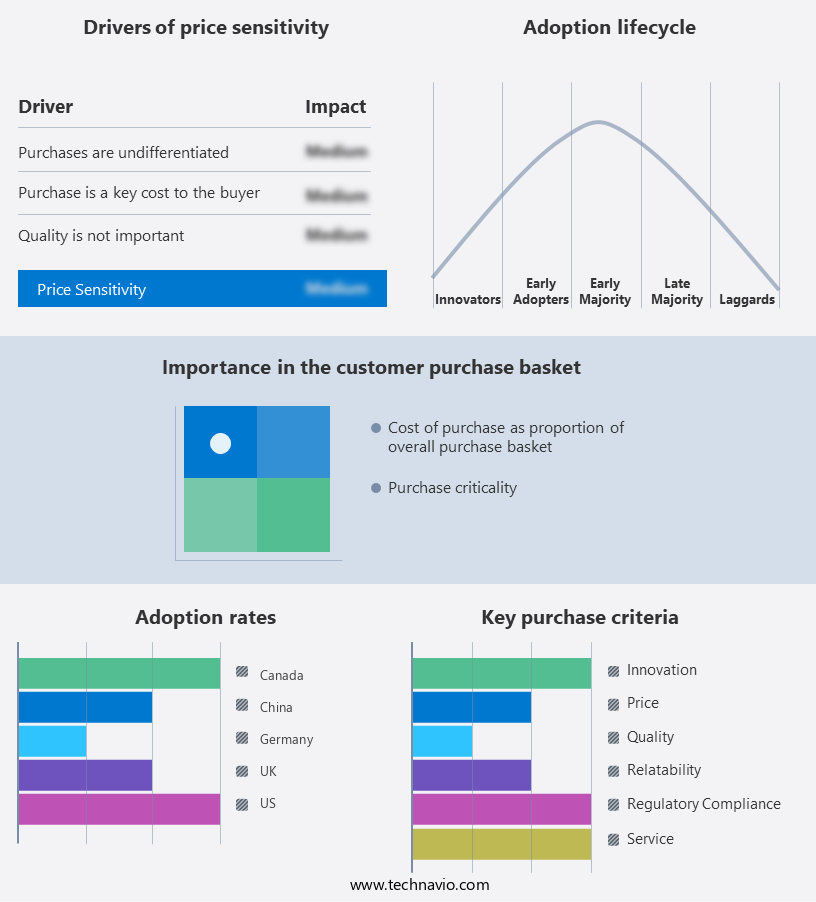
Customer Landscape
Key Companies & Market Insights
Companies are implementing various strategies, such as strategic alliances, propolis market forecast, partnerships, mergers and acquisitions, geographical expansion, and product/service launches, to enhance their presence in the industry.
Apis Flora Industrial e Comercial Ltda. - This company specializes in the production and distribution of propolis extracts, including the popular Green Extract 70.
The industry research and growth report includes detailed analyses of the competitive landscape of the market and information about key companies, including:
- Apis Flora Industrial e Comercial Ltda.
- Associated British Foods Plc
- Bio Botanica Inc.
- Comvita Ltd.
- Country Life Vitamins LLC
- Herb Pharm
- Hi Tech Natural Products India Ltd.
- iHerb LLC
- INW Manufacturing LLC
- Laprell Beehive Products Inc.
- Manuka Health New Zealand Ltd.
- Natural Factors Nutritional Products Ltd.
- NaturaNectar LLC
- Natures Goodness Australia Pty Ltd
- NOW Foods
- Nutraceutical Corp.
- Sunyata Productos Alternativos Ltda.
- Uniflora Nutraceutica Ltda.
- Wax Green USA
- YS Organic Bee Farms
Qualitative and quantitative analysis of companies has been conducted to help clients understand the wider business environment as well as the strengths and weaknesses of key industry players. Data is qualitatively analyzed to categorize companies as pure play, category-focused, industry-focused, and diversified; it is quantitatively analyzed to categorize companies as dominant, leading, strong, tentative, and weak.
Recent Development and News in Propolis Market
- In January 2024, Propolis Health Sciences, a leading propolis extract manufacturer, announced the launch of their new product line, Propolis Plus, which includes a proprietary blend of propolis extract and vitamin C, aimed at boosting immune system function (Propolis Health Sciences Press Release).
- In March 2024, Propolis Extraction Technologies (PET), a major propolis extract producer, entered into a strategic partnership with BioMedical Research Laboratories (BML), a leading biotech company, to develop and commercialize new propolis-based pharmaceutical products (PET Press Release).
- In July 2024, the market Leader, a significant market player, raised USD30 million in a Series C funding round, led by New York-based investment firm, Greenfield Partners, to expand its production capacity and accelerate research and development efforts (Crunchbase).
- In May 2025, the European Food Safety Authority (EFSA) granted a health claim for propolis, recognizing its antioxidant properties and potential role in supporting the immune system, marking a significant regulatory milestone for the market (EFSA Press Release).
Research Analyst Overview
- Propolis, a natural resin produced by bees, has gained significant attention in the health and wellness industry due to its antimicrobial, antioxidant, and anti-inflammatory properties. The market for propolis-based products continues to evolve, with an increasing focus on quality assurance and standardization. Propropalis microcapsules and propolis-enriched foods are popular forms of consumption, undergoing rigorous statistical analysis and human clinical trials to evaluate their efficacy and safety. In vitro studies and animal models are used to assess the antimicrobial activity and antioxidant capacity assays of propolis-based formulations. Product testing, including ABTS assay, DPPH assay, and ORAC assay, provides valuable data for market trends.
- Propolis resinoids, emulsions, powders, and granules are also gaining traction, with regional market differences influencing consumer preferences. Side effect monitoring and adverse event reporting are crucial components of product development, ensuring the safety and efficacy of propolis-infused products. Double-blind trials and placebo-controlled studies are essential for data interpretation and validating the benefits of propolis. Overall, the global market for propolis continues to grow, driven by scientific research and consumer demand for natural health solutions.
Dive into Technavio's robust research methodology, blending expert interviews, extensive data synthesis, and validated models for unparalleled Propolis Market insights. See full methodology.
|
Market Scope |
|
|
Report Coverage |
Details |
|
Page number |
222 |
|
Base year |
2024 |
|
Historic period |
2019-2023 |
|
Forecast period |
2025-2029 |
|
Growth momentum & CAGR |
Accelerate at a CAGR of 3.3% |
|
Market growth 2025-2029 |
USD 135 million |
|
Market structure |
Fragmented |
|
YoY growth 2024-2025(%) |
3.2 |
|
Key countries |
US, UK, Germany, Canada, China, France, Italy, Spain, Japan, and India |
|
Competitive landscape |
Leading Companies, Market Positioning of Companies, Competitive Strategies, and Industry Risks |
What are the Key Data Covered in this Propolis Market Research and Growth Report?
- CAGR of the Propolis industry during the forecast period
- Detailed information on factors that will drive the growth and forecasting between 2025 and 2029
- Precise estimation of the size of the market and its contribution of the industry in focus to the parent market
- Accurate predictions about upcoming growth and trends and changes in consumer behaviour
- Growth of the market across North America, Europe, APAC, South America, and Middle East and Africa
- Thorough analysis of the market's competitive landscape and detailed information about companies
- Comprehensive analysis of factors that will challenge the propolis market growth of industry companies
We can help! Our analysts can customize this propolis market research report to meet your requirements.
 RIA -
RIA - 
