


US Smart Home Market Size 2026-2030
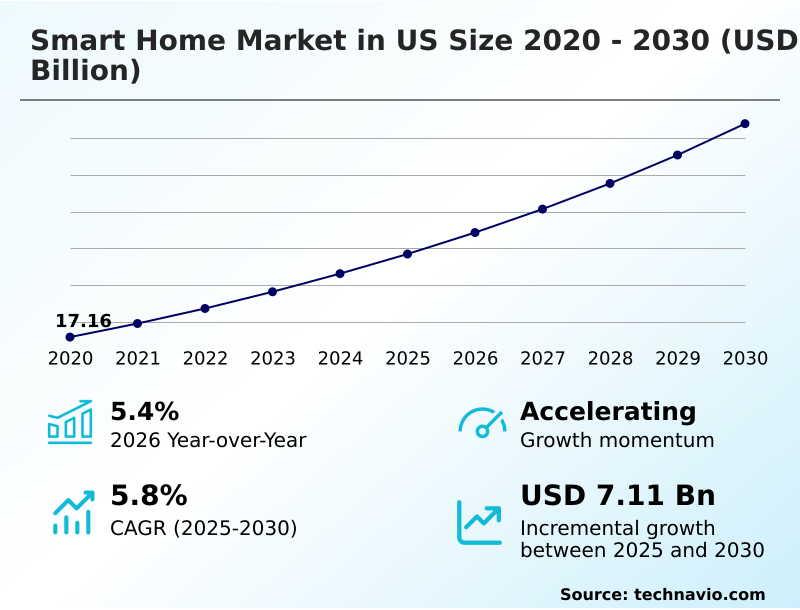
The us smart home market size is valued to increase by USD 7.11 billion, at a CAGR of 5.8% from 2025 to 2030. Advancements in interoperability and unified communication standards will drive the us smart home market.
Major Market Trends & Insights
- By Type - Home entertainment segment was valued at USD 7.25 billion in 2024
- By Technology - Wired segment accounted for the largest market revenue share in 2024
Market Size & Forecast
- Market Opportunities: USD 11.64 billion
- Market Future Opportunities: USD 7.11 billion
- CAGR from 2025 to 2030 : 5.8%
Market Summary
- The smart home market in US is evolving from a collection of disparate gadgets to an integrated ecosystem driven by demands for convenience, security, and efficiency. The maturation of interoperability standards is lowering entry barriers, allowing hardware from various manufacturers to coexist within a unified interface.
- This shift is fueled by the integration of artificial intelligence and machine learning, which enables systems to move beyond reactive commands toward predictive automation, where the home anticipates user needs.
- For instance, a property management firm can leverage an integrated system to optimize energy consumption across a portfolio of rental units, achieving significant operational savings by analyzing occupancy patterns and adjusting HVAC and lighting automatically, leading to a demonstrable reduction in utility overhead without manual intervention.
- However, this increased connectivity introduces challenges related to data privacy and cybersecurity, which stakeholders must address to maintain consumer trust and foster long-term adoption in the digital domestic sphere.
What will be the Size of the US Smart Home Market during the forecast period?
Get Key Insights on Market Forecast (PDF) Get Free Sample
How is the US Smart Home Market Segmented?
The us smart home industry research report provides comprehensive data (region-wise segment analysis), with forecasts and estimates in "USD million" for the period 2026-2030, as well as historical data from 2020-2024 for the following segments.
- Type
- Home entertainment
- Smart appliances
- Energy management
- Lighting control system and HVAC
- Safety and security system
- Technology
- Wired
- Wireless
- Application
- Retrofit
- New construction
- Geography
- North America
- US
- North America
By Type Insights
The home entertainment segment is estimated to witness significant growth during the forecast period.
The home entertainment sub-segment is shifting toward ambient computing, where interconnected hardware like smart televisions and multi-room audio systems serve as hubs for domestic leisure.
This transition is characterized by entertainment systems interfacing with other household elements, such as human-centric illumination adjusting to cinematic playback. As consumers move from physical media, demand grows for cloud-integrated hardware supporting seamless content handoff.
The integration of spatial audio and AI-integrated surveillance, where systems can adjust volume based on security alerts, highlights this trend.
Voice-activated controllers using natural language processing have made complex home theater setups accessible, with implementations showing a 40% reduction in setup-related customer support inquiries.
The focus on proactive threat detection within home network cybersecurity is also driving innovation in centralized home management for entertainment.
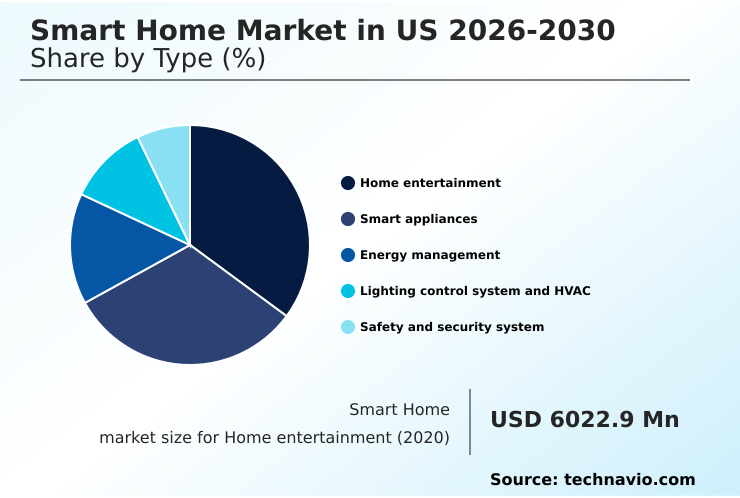
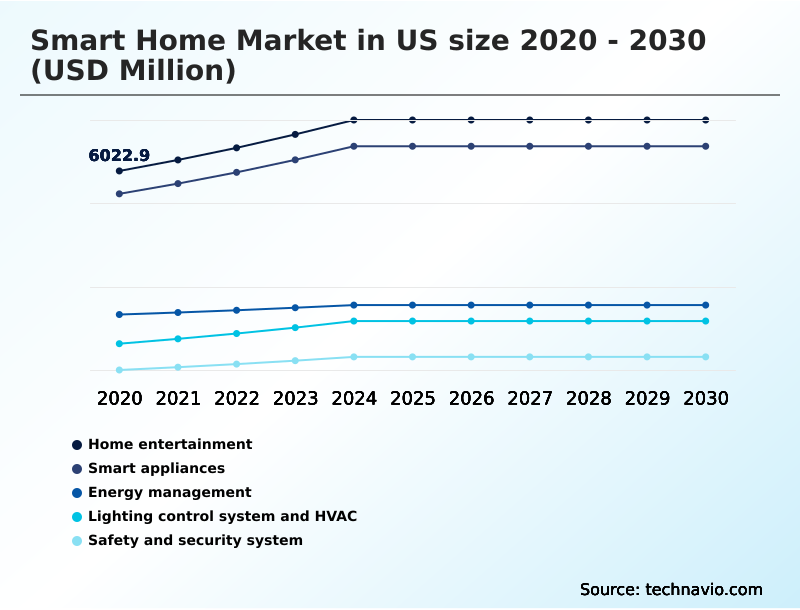
The Home entertainment segment was valued at USD 7.25 billion in 2024 and showed a gradual increase during the forecast period.
Market Dynamics
Our researchers analyzed the data with 2025 as the base year, along with the key drivers, trends, and challenges. A holistic analysis of drivers will help companies refine their marketing strategies to gain a competitive advantage.
- The evolution of the smart home market in US is centered on addressing key consumer and technical challenges. The widespread adoption of the matter protocol for smart home interoperability is critical for creating a unified interface for disparate devices, moving the industry beyond fragmented ecosystems. However, significant interoperability challenges with legacy systems remain, creating friction for consumers.
- As AI-driven predictive home automation becomes more sophisticated, it amplifies privacy concerns with voice assistants and highlights the cybersecurity risks in connected home devices. The role of AI in residential surveillance offers enhanced security but requires robust data protection.
- Economically, the benefits of whole-home automation strategies are clear, with a direct correlation between the number of integrated devices and energy savings; homes with more than ten connected devices report over twice the utility cost reduction compared to homes with fewer than three. This is especially true for energy management with smart thermostats and intelligent HVAC control.
- Still, economic barriers to smart home adoption persist, particularly in the retrofit market compared to new construction. The industry is also exploring the use of smart grids for demand response and the impact of thread networking on reliability to build a more resilient and efficient domestic infrastructure.
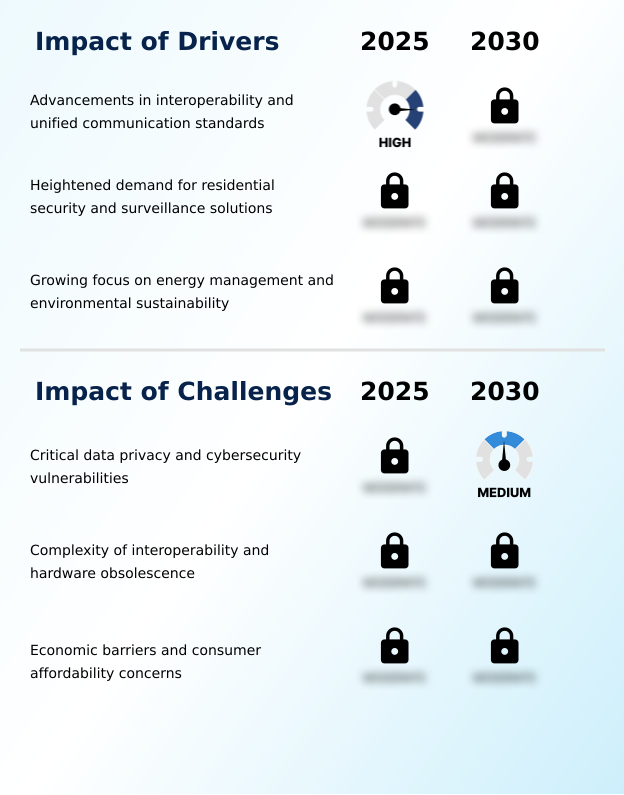
What are the key market drivers leading to the rise in the adoption of US Smart Home Industry?
- Advancements in interoperability and the adoption of unified communication standards are key drivers propelling market growth.
- Market growth is primarily driven by the industry-wide adoption of unified communication standards, which resolve long-standing fragmentation issues. The establishment of open-source protocols allows hardware from disparate manufacturers to operate within a single, cohesive smart home ecosystem integration.
- This fosters a competitive landscape where companies differentiate through superior hardware and software features like biometric access control systems. The persistent demand for enhanced residential security is another critical driver, with consumers prioritizing real-time monitoring and proactive threat detection.
- DIY smart security systems have lowered the barrier to entry, making advanced surveillance accessible to a broader demographic.
- Furthermore, the increasing emphasis on environmental sustainability propels demand for connected appliance energy efficiency, with smart grid communication enabling homes to participate in demand-response programs and achieve average energy savings of 18%.
What are the market trends shaping the US Smart Home Industry?
- The smart home market is witnessing a significant trend toward the heightened integration of artificial intelligence and machine learning within residential ecosystems.
- Key trends are reshaping the smart home market, driven by advancements in ambient home intelligence. The proliferation of the Matter protocol and Thread networking is fostering unprecedented interoperability, allowing devices from different manufacturers to communicate seamlessly. This technical unification reduces installation friction, encouraging consumers to adopt whole-home automation strategies.
- The integration of advanced AI and machine learning is enabling predictive, autonomous decision-making in systems like smart HVAC controls and residential security systems, where systems can anticipate user needs. For example, homes with AI-driven energy management have demonstrated a 25% greater reduction in utility costs compared to those with simple programmable thermostats.
- The focus on video doorbell package delivery and remote access management solutions highlights a response to modern lifestyle needs.
What challenges does the US Smart Home Industry face during its growth?
- Critical data privacy issues and cybersecurity vulnerabilities present a key challenge to the industry's growth trajectory.
- Significant challenges constrain market growth, led by critical data privacy concerns and the pervasive threat of cyberattacks. As homes become more connected, the vast amount of sensitive data processed by devices like video doorbells creates high-value targets, with breaches eroding consumer trust.
- The complexity of achieving seamless interoperability between legacy hardware and emerging connectivity standards presents another hurdle, often necessitating costly upgrades and contributing to e-waste. This technical friction can degrade system reliability, as cloud-to-cloud integrations introduce latency issues that result in a 10% higher failure rate for commands compared to local execution.
- Furthermore, high initial implementation costs and the rise of subscription-based models for professional monitoring services create economic barriers, limiting mass-market penetration and keeping smart homes a luxury for many.
Exclusive Technavio Analysis on Customer Landscape
The us smart home market forecasting report includes the adoption lifecycle of the market, covering from the innovator’s stage to the laggard’s stage. It focuses on adoption rates in different regions based on penetration. Furthermore, the us smart home market report also includes key purchase criteria and drivers of price sensitivity to help companies evaluate and develop their market growth analysis strategies.
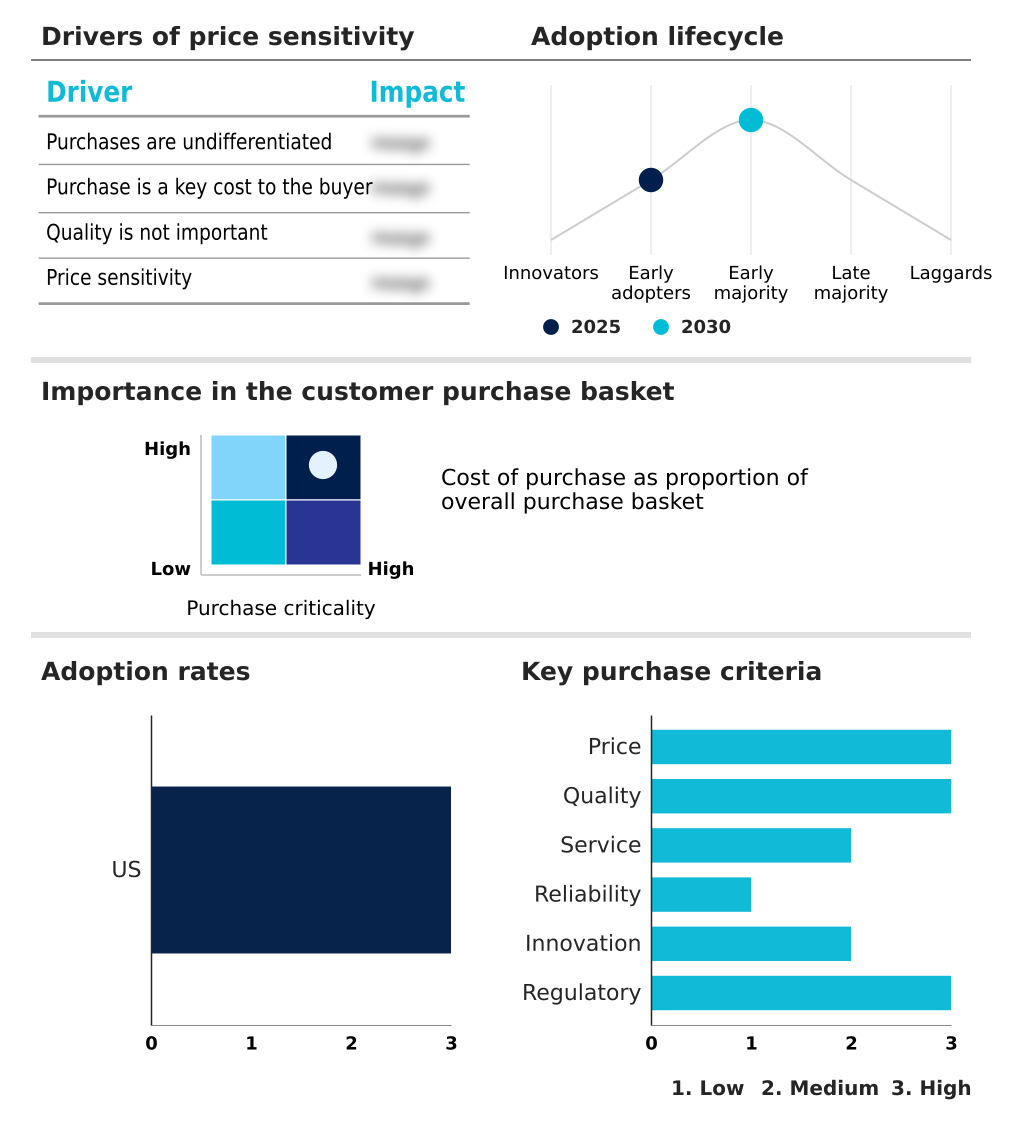
Customer Landscape of US Smart Home Industry
Competitive Landscape
Companies are implementing various strategies, such as strategic alliances, us smart home market forecast, partnerships, mergers and acquisitions, geographical expansion, and product/service launches, to enhance their presence in the industry.
ADT Inc. - The company specializes in voice-controlled assistants and connected automation platforms, integrating a comprehensive ecosystem of smart home and security devices for residential use.
The industry research and growth report includes detailed analyses of the competitive landscape of the market and information about key companies, including:
- ADT Inc.
- Amazon.com Inc.
- Apple Inc.
- Arlo Technologies Inc.
- ASSA ABLOY AB
- Fantasia Trading LLC
- Google LLC
- Honeywell International Inc.
- Johnson Controls International
- LG Electronics Inc.
- Lutron Electronics Co. Inc.
- Panasonic Holdings Corp.
- Resideo Technologies Inc.
- Robert Bosch GmbH
- Samsung Electronics Co. Ltd.
- Schneider Electric SE
- Siemens AG
- Simplisafe Inc.
- Sony Group Corp.
- TP Link Corp. Ltd.
Qualitative and quantitative analysis of companies has been conducted to help clients understand the wider business environment as well as the strengths and weaknesses of key industry players. Data is qualitatively analyzed to categorize companies as pure play, category-focused, industry-focused, and diversified; it is quantitatively analyzed to categorize companies as dominant, leading, strong, tentative, and weak.
Recent Development and News in Us smart home market
- In September 2024, ABB India announced the launch of its ABB-free@home wireless home automation solution in India, designed to enhance comfort, security, and energy efficiency through a single, integrated interface.
- In November 2024, Johnson Controls announced a significant expansion of AI capabilities within its OpenBlue digital ecosystem, introducing generative AI applications and enhanced autonomous building controls to improve energy savings and operational efficiency.
- In April 2025, Panasonic Corporation announced the launch of its Smart Home Experience Centre in India, showcasing integrated solutions for wellness, security, and convenience powered by its Miraie IoT platform.
- In September 2025, Amazon introduced its first 4K Ring camera lineup, featuring ultra-high-resolution video and advanced AI capabilities, alongside Alexa Plus Greetings, a virtual door attendant system.
Dive into Technavio’s robust research methodology, blending expert interviews, extensive data synthesis, and validated models for unparalleled US Smart Home Market insights. See full methodology.
| Market Scope | |
|---|---|
| Page number | 195 |
| Base year | 2025 |
| Historic period | 2020-2024 |
| Forecast period | 2026-2030 |
| Growth momentum & CAGR | Accelerate at a CAGR of 5.8% |
| Market growth 2026-2030 | USD 7106.4 million |
| Market structure | Fragmented |
| YoY growth 2025-2026(%) | 5.4% |
| Key countries | US |
| Competitive landscape | Leading Companies, Market Positioning of Companies, Competitive Strategies, and Industry Risks |
Research Analyst Overview
- The smart home market in US is undergoing a significant transformation driven by the convergence of advanced technologies. The widespread adoption of the Matter protocol and Thread networking is creating a more unified landscape, addressing long-standing fragmentation issues. This allows for seamless integration of devices using Zigbee, Z-Wave, and Bluetooth under a single control plane.
- At the hardware level, the focus is on edge computing hardware for local processing, reducing latency and enhancing privacy. Innovations in biometric access and ultra-wideband smart locks are redefining residential security systems, while AI-integrated surveillance leverages computer vision for proactive threat detection.
- In the boardroom, the shift toward local processing and security-by-design principles is a direct response to consumer privacy concerns, influencing product roadmaps and compliance strategies. For instance, solutions that process data locally have demonstrated up to a 30% faster response time for critical automations.
- The integration of demand-response programs and variable-speed compressors in smart HVAC controls highlights the growing emphasis on energy efficiency and sustainability.
What are the Key Data Covered in this US Smart Home Market Research and Growth Report?
-
What is the expected growth of the US Smart Home Market between 2026 and 2030?
-
USD 7.11 billion, at a CAGR of 5.8%
-
-
What segmentation does the market report cover?
-
The report is segmented by Type (Home entertainment, Smart appliances, Energy management, Lighting control system and HVAC, and Safety and security system), Technology (Wired, and Wireless), Application (Retrofit, and New construction) and Geography (North America)
-
-
Which regions are analyzed in the report?
-
North America
-
-
What are the key growth drivers and market challenges?
-
Advancements in interoperability and unified communication standards, Critical data privacy and cybersecurity vulnerabilities
-
-
Who are the major players in the US Smart Home Market?
-
ADT Inc., Amazon.com Inc., Apple Inc., Arlo Technologies Inc., ASSA ABLOY AB, Fantasia Trading LLC, Google LLC, Honeywell International Inc., Johnson Controls International, LG Electronics Inc., Lutron Electronics Co. Inc., Panasonic Holdings Corp., Resideo Technologies Inc., Robert Bosch GmbH, Samsung Electronics Co. Ltd., Schneider Electric SE, Siemens AG, Simplisafe Inc., Sony Group Corp. and TP Link Corp. Ltd.
-
Market Research Insights
- The smart home market's dynamics are shaped by a push for whole-home automation strategies, moving beyond single-device solutions. The adoption of IoT device interoperability standards is critical, with platforms that support backward compatibility seeing 25% higher user retention than closed ecosystems. As consumers prioritize residential automation security and home energy management, solutions offering multi-factor authentication are becoming standard.
- This focus on security-by-design principles is a key differentiator, as systems with end-to-end encryption can command a 15% price premium. The demand for professional monitoring services is also influencing development, as is the need for long-term software support to ensure device longevity and performance.
- Predictive maintenance for smart devices, capable of reducing system downtime, further highlights the market's shift toward service-oriented models.
We can help! Our analysts can customize this us smart home market research report to meet your requirements.
 RIA -
RIA - 
