



Workspace Delivery Network Market Size 2025-2029
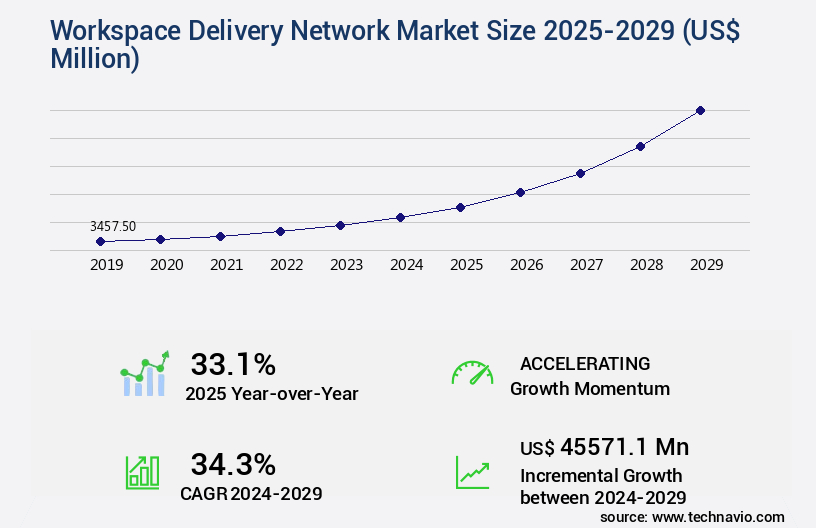
The workspace delivery network market size is valued to increase USD 45.57 billion, at a CAGR of 34.3% from 2024 to 2029. Increasing demand for cloud-based solutions will drive the workspace delivery network market.
Major Market Trends & Insights
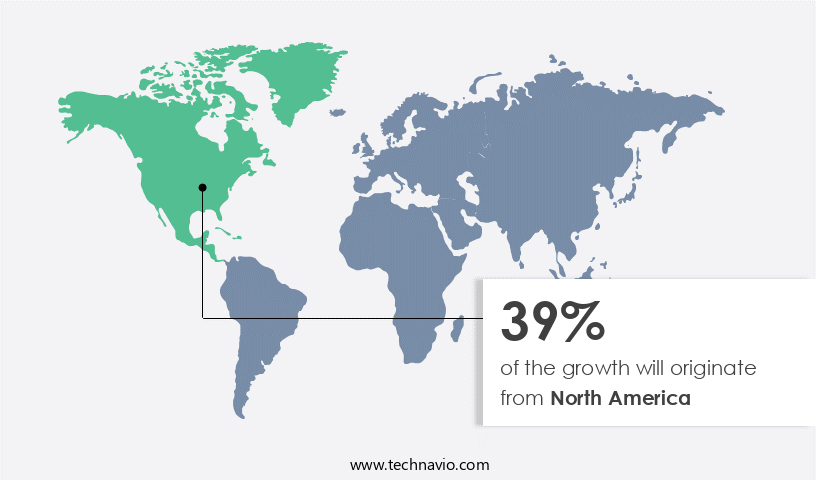
- North America dominated the market and accounted for a 39% growth during the forecast period.
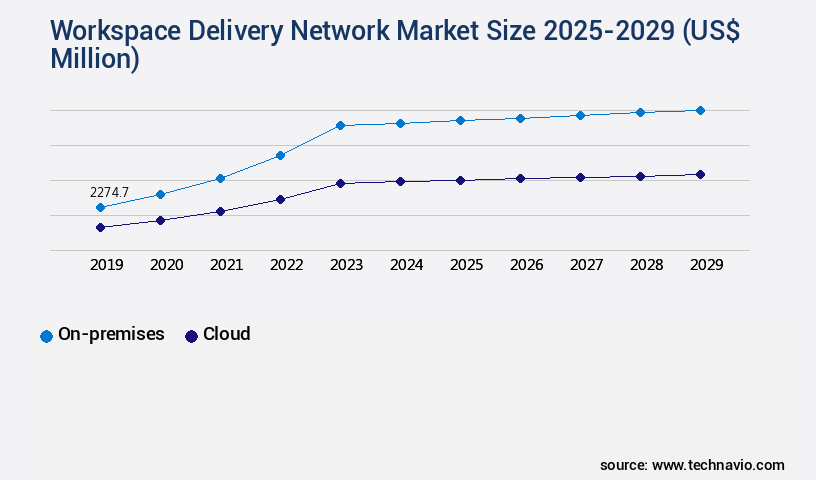
- By Deployment - On-premises segment was valued at USD 2.27 billion in 2023
- By Type - SD-WAN segment accounted for the largest market revenue share in 2023
Market Size & Forecast
- Market Opportunities: USD 1.00 million
- Market Future Opportunities: USD 45571.10 million
- CAGR from 2024 to 2029 : 34.3%
Market Summary
- In the dynamic digital landscape, the Workspace Delivery Network (WDN) market has emerged as a critical solution for businesses seeking to optimize their application delivery and enhance user experience. According to recent estimates, the global WDN market is projected to reach a value of USD 12.5 billion by 2025, underscoring its growing importance. The primary driver behind this growth is the increasing demand for cloud-based solutions, as businesses look to streamline their IT infrastructure and improve application accessibility. Additionally, the popularity of Software-Defined Wide Area Networking (SD-WAN) as a service is fueling the adoption of WDN, as it offers more efficient and cost-effective alternatives to traditional network delivery appliances.
- Despite these opportunities, the WDN market faces challenges. High costs associated with network delivery appliances and the complexity of implementing and managing these solutions can hinder adoption. However, advancements in technology and increasing competition among companies are expected to mitigate these challenges, enabling the market to continue its upward trajectory. In conclusion, the WDN market is poised for significant growth, driven by the shift to cloud-based solutions and the adoption of SD-WAN. While challenges remain, the market's potential to enhance application delivery and improve user experience makes it an essential consideration for businesses seeking to stay competitive in today's digital economy.
What will be the Size of the Workspace Delivery Network Market during the forecast period?
Get Key Insights on Market Forecast (PDF) Request Free Sample
How is the Workspace Delivery Network Market Segmented?
The workspace delivery network industry research report provides comprehensive data (region-wise segment analysis), with forecasts and estimates in "USD million" for the period 2025-2029, as well as historical data from 2019-2023 for the following segments.
- Deployment
- On-premises
- Cloud
- Type
- SD-WAN
- Traditional WAN
- Application
- IT and telecommunication
- Government institutions
- Research and consulting services
- Others
- Geography
- North America
- US
- Canada
- Europe
- France
- Germany
- Italy
- The Netherlands
- UK
- APAC
- China
- India
- Japan
- Rest of World (ROW)
- North America
By Deployment Insights
The on-premises segment is estimated to witness significant growth during the forecast period.
The market is characterized by its continuous evolution, with ongoing activities and emerging patterns shaping its landscape. Traditional on-premises solutions, which involve purchasing and installing software on an organization's servers, account for a significant market share. However, this segment is projected to decline due to the high cost of implementation and limited scalability. Conversely, cloud-based solutions, offering scalable infrastructure, secure remote access via site-to-site VPN and remote access protocols, and high availability design, are gaining traction. Network performance monitoring, application delivery, and data center optimization are key functionalities driving market growth. Hybrid cloud deployments, edge computing solutions, and software-defined networking are emerging trends, with elastic compute resources, content caching, and data loss prevention enhancing user experience.
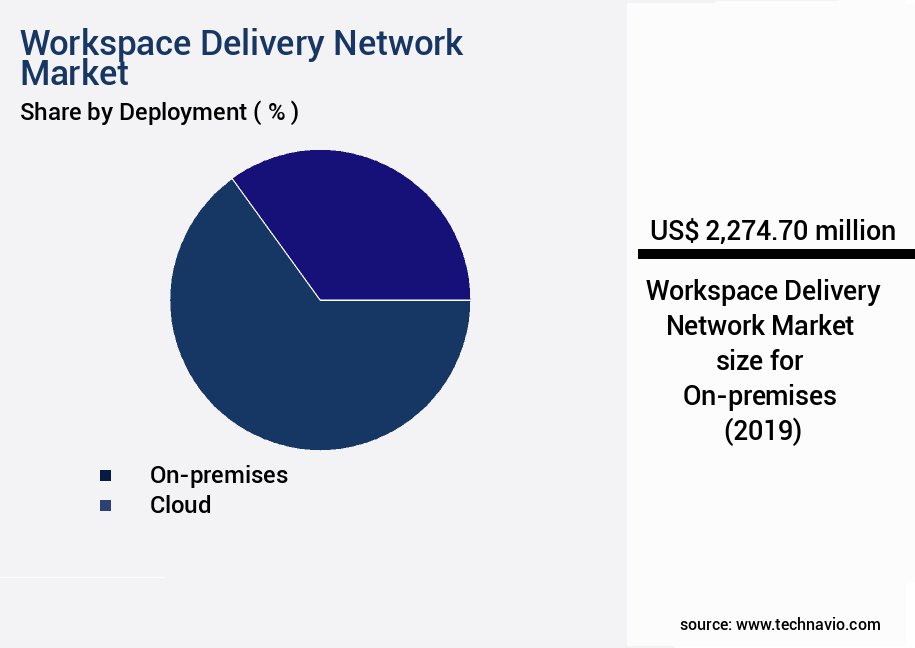
The On-premises segment was valued at USD 2.27 billion in 2019 and showed a gradual increase during the forecast period.
Network security protocols, network traffic analysis, and network virtualization ensure quality of service, while centralized management and server load balancing optimize IT infrastructure. This growth is attributed to the increasing demand for application performance management, network topology design, and disaster recovery planning. Despite the advantages of cloud-based solutions, on-premises solutions remain popular due to their enhanced security and control over critical data.
Regional Analysis
North America is estimated to contribute 39% to the growth of the global market during the forecast period. Technavio's analysts have elaborately explained the regional trends and drivers that shape the market during the forecast period.
See How Workspace Delivery Network Market Demand is Rising in North America Request Free Sample
The market in North America is experiencing significant growth due to the robust presence of industries such as IT, BFSI, and retail in the US and Canada. This region's consumer and enterprise data traffic are primary drivers for the expansion of data centers, fueled by the increasing demand for Internet of Things (IoT) devices, escalating investments in Artificial Intelligence (AI), and the implementation of autonomous technologies across various enterprises.
Moreover, the proliferation of autonomous vehicles and high-bandwidth applications are contributing to the exponential growth of IP traffic, thereby propelling the growth of the market in North America during the forecast period. The market's expansion is a testament to the region's commitment to digital transformation and innovation.
Market Dynamics
Our researchers analyzed the data with 2024 as the base year, along with the key drivers, trends, and challenges. A holistic analysis of drivers will help companies refine their marketing strategies to gain a competitive advantage.
The market is experiencing significant growth as businesses continue to prioritize improving remote application performance for their dispersed workforces. This requires optimizing network bandwidth for Virtual Desktop Infrastructure (VDI) and ensuring secure access through Service Edge Deployment. A robust disaster recovery plan is essential to maintain business continuity, especially when managing network traffic in hybrid cloud environments. Enhancing user experience for remote workers is crucial, and centralized management of remote endpoints enables IT teams to effectively implement a zero trust security model. Measuring application performance metrics and implementing data loss prevention in remote access solutions are critical network security best practices for remote work. Configuring VPNs for optimal performance and improving application availability and reliability are key considerations for businesses. In addition, real-time network performance monitoring and optimizing cloud-based application delivery are essential for cost optimization strategies for cloud resources. Capacity planning for remote user growth and compliance regulations for remote data access are also important factors in the market. Multi-factor authentication and secure remote access for sensitive data are necessary to maintain security and protect against potential threats. Implementing these solutions effectively requires a deep understanding of network security best practices and the ability to adapt to the evolving landscape of remote work.
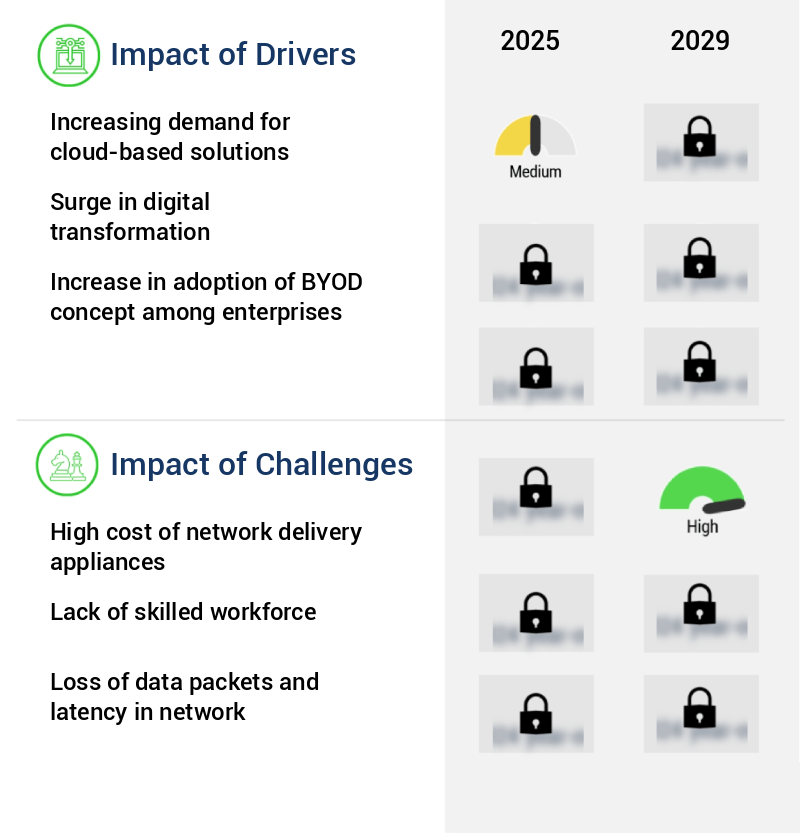
What are the key market drivers leading to the rise in the adoption of Workspace Delivery Network Industry?
- The surge in demand for cloud-based solutions serves as the primary catalyst for market growth.
- The market is experiencing significant evolution, driven by the increasing adoption of cloud computing and the growing demand for cost-effective, flexible IT solutions. Enterprises are turning to cloud services to reduce capital expenditures, with flexible payment options like pay-as-you-go and monthly subscriptions enabling substantial savings. Additionally, the heightened focus on data privacy and security has fueled the demand for economical solutions, making cloud computing an attractive option.
- IT usage within enterprises is on the rise, leading to a surge in demand for cloud services. This shift is not limited to any specific sector but is a global trend, with numerous industries reaping the benefits of cloud computing's agility, security, and cost savings.
What are the market trends shaping the Workspace Delivery Network Industry?
- The growing popularity of SD-WAN as a service represents the latest market trend in network technology. SD-WAN's increasing adoption signifies a significant shift in networking preferences.
- Enterprises are increasingly investing in optimizing their Wide Area Network (WAN) architecture and applications, leading to a significant rise in demand for managed services for Software-Defined Wide Area Networks (SD-WAN). Managed SD-WAN, also known as SD-WAN as a service, has emerged as a lucrative revenue stream for service providers. These companies partner with SD-WAN technology companies to offer comprehensive SD-WAN solutions to enterprises. Managed SD-WAN services offer several advantages to end-users and enterprises. They include the management of routing protocols and an Service Level Agreement (SLA) that ensures network quality and reduces in-house costs such as manpower.
- Some leading service providers offering managed SD-WAN services are AT&T, known for its SD-WAN solution designed to enhance network performance, efficiency, and security. By adopting managed SD-WAN services, enterprises can focus on their core business functions while benefiting from reliable and cost-effective network solutions.
What challenges does the Workspace Delivery Network Industry face during its growth?
- The escalating costs of network delivery appliances pose a significant challenge to the industry's growth trajectory.
- The Workspace Delivery Network (WDN) market is undergoing significant evolution due to the increasing demand for efficient and cost-effective network solutions. Traditional methods, such as WAN optimization appliances, have high capital and ongoing maintenance costs. For instance, the cost of deploying a WAN optimization application and annual software maintenance can be substantial. Moreover, the expense of skilled personnel for managing and maintaining these appliances is a further financial burden. These costs pose a challenge for many organizations, making WDN solutions an attractive alternative.
- For example, ARYAKA NETWORKS offers WDN alliances with costs exceeding USD 50,000 for a branch office and over USD 100,000 for a head office or data center.
Exclusive Technavio Analysis on Customer Landscape
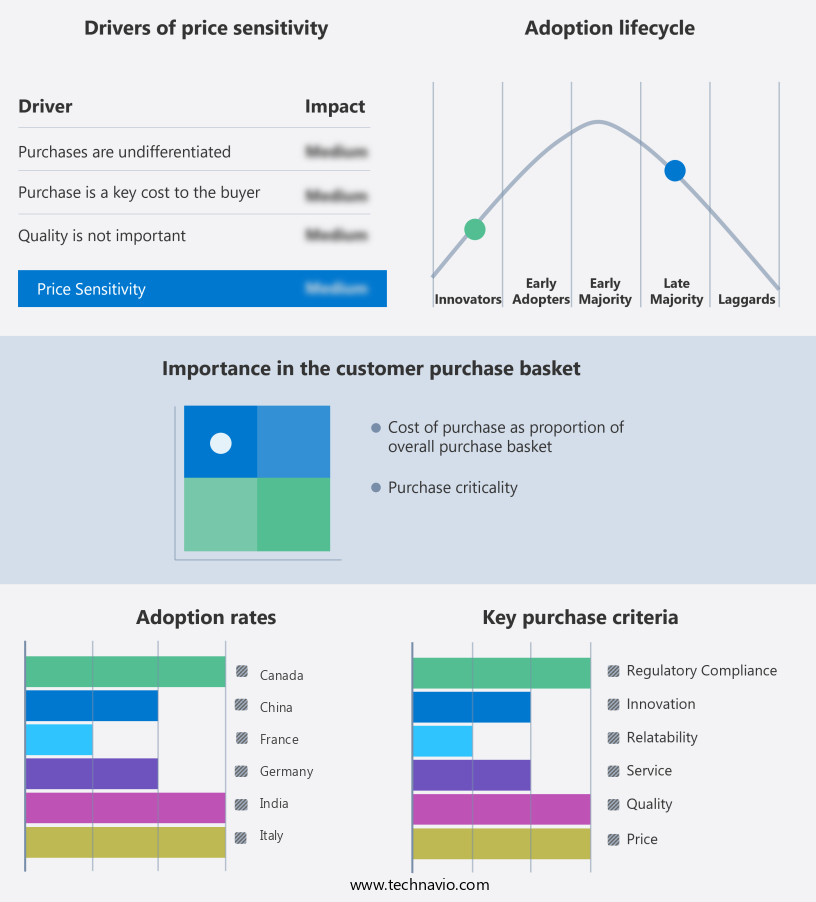
The workspace delivery network market forecasting report includes the adoption lifecycle of the market, covering from the innovator's stage to the laggard's stage. It focuses on adoption rates in different regions based on penetration. Furthermore, the workspace delivery network market report also includes key purchase criteria and drivers of price sensitivity to help companies evaluate and develop their market growth analysis strategies.
Customer Landscape of Workspace Delivery Network Industry
Competitive Landscape
Companies are implementing various strategies, such as strategic alliances, workspace delivery network market forecast, partnerships, mergers and acquisitions, geographical expansion, and product/service launches, to enhance their presence in the industry.
A10 Networks Inc. - A workspace delivery network, such as A10 Networks' cloud access proxy, empowers organizations to optimize SaaS application performance and ensure security.
The industry research and growth report includes detailed analyses of the competitive landscape of the market and information about key companies, including:
- A10 Networks Inc.
- Arista Networks Inc.
- Aryaka Networks Inc.
- Bigleaf Networks Inc.
- Cato Networks Ltd.
- Check Point Software Technologies Ltd.
- Cisco Systems Inc.
- Cloud Software Group Inc.
- F5 Inc.
- FatPipe Networks Inc.
- Fortinet Inc.
- Hewlett Packard Enterprise Co.
- Huawei Technologies Co. Ltd.
- Juniper Networks Inc.
- Oracle Corp.
- Palo Alto Networks Inc.
- Riverbed Technology Inc.
- Versa Networks Inc.
- VMware Inc.
- Zscaler Inc.
Qualitative and quantitative analysis of companies has been conducted to help clients understand the wider business environment as well as the strengths and weaknesses of key industry players. Data is qualitatively analyzed to categorize companies as pure play, category-focused, industry-focused, and diversified; it is quantitatively analyzed to categorize companies as dominant, leading, strong, tentative, and weak.
Recent Development and News in Workspace Delivery Network Market
- In January 2024, Cloudflare, a leading internet infrastructure company, announced the launch of its Workers' KV (Key-Value) store, an addition to their Workers platform, which now includes a Workspace Delivery Network (WDN) feature. This new service allows developers to cache and serve static assets directly from Cloudflare's edge network, improving website performance and reducing latency (Cloudflare Press Release, 2024).
- In March 2024, Akamai Technologies, a global leader in content delivery network services, partnered with Microsoft Azure to expand Akamai's WDN offerings. This collaboration enabled Azure customers to access Akamai's edge network through Azure's portal, streamlining the content delivery process and enhancing performance (Akamai Press Release, 2024).
- In May 2024, Fastly, a competitive player in the WDN market, secured a USD 100 million funding round led by Sequoia Capital and Meritech Capital Partners. This investment was aimed at accelerating the company's product development and expanding its global footprint (Fastly Press Release, 2024).
- In April 2025, Amazon Web Services (AWS) introduced its new WDN, Amazon CloudFront, which supported Amazon S3 Object Retrieval for Serverless Functions. This feature enabled developers to serve dynamic content directly from Amazon S3 buckets, enhancing the performance and functionality of their applications (AWS Press Release, 2025).
Dive into Technavio's robust research methodology, blending expert interviews, extensive data synthesis, and validated models for unparalleled Workspace Delivery Network Market insights. See full methodology.
|
Market Scope |
|
|
Report Coverage |
Details |
|
Page number |
219 |
|
Base year |
2024 |
|
Historic period |
2019-2023 |
|
Forecast period |
2025-2029 |
|
Growth momentum & CAGR |
Accelerate at a CAGR of 34.3% |
|
Market growth 2025-2029 |
USD 45571.1 million |
|
Market structure |
Fragmented |
|
YoY growth 2024-2025(%) |
33.1 |
|
Key countries |
US, China, Germany, Canada, UK, France, Japan, Italy, India, and The Netherlands |
|
Competitive landscape |
Leading Companies, Market Positioning of Companies, Competitive Strategies, and Industry Risks |
Research Analyst Overview
- The market continues to evolve, driven by the increasing demand for remote work and the need for scalable infrastructure to support it. User experience metrics, such as network latency and application performance, are critical factors in ensuring productivity and satisfaction for remote workers. Site-to-site VPNs and secure remote access protocols provide the necessary security for accessing sensitive data and applications. Network traffic analysis and network performance monitoring are essential tools for optimizing network resources and identifying potential bottlenecks. Hybrid cloud deployment and edge computing solutions enable organizations to balance the need for centralized management and elastic compute resources with the need for low-latency, local processing.
- Quality of service and application delivery are key considerations for ensuring high availability design and server load balancing. Network security protocols and data loss prevention are crucial components of disaster recovery planning, which is becoming increasingly important as more organizations adopt cloud-based delivery and virtual desktop infrastructure. Network topology design and IT infrastructure management are ongoing challenges, requiring continuous optimization and adaptation to changing business needs. According to recent industry reports, the market is expected to grow by over 15% annually in the coming years, driven by the increasing adoption of remote work and the need for more efficient and secure IT infrastructure solutions.
- For instance, a leading financial services company reported a 30% increase in remote workstation access and a 25% reduction in network bandwidth utilization after implementing a new workspace delivery network solution.
What are the Key Data Covered in this Workspace Delivery Network Market Research and Growth Report?
-
What is the expected growth of the Workspace Delivery Network Market between 2025 and 2029?
-
USD 45.57 billion, at a CAGR of 34.3%
-
-
What segmentation does the market report cover?
-
The report is segmented by Deployment (On-premises and Cloud), Type (SD-WAN and Traditional WAN), Application (IT and telecommunication, Government institutions, Research and consulting services, and Others), and Geography (North America, Europe, APAC, South America, and Middle East and Africa)
-
-
Which regions are analyzed in the report?
-
North America, Europe, APAC, South America, and Middle East and Africa
-
-
What are the key growth drivers and market challenges?
-
Increasing demand for cloud-based solutions, High cost of network delivery appliances
-
-
Who are the major players in the Workspace Delivery Network Market?
-
A10 Networks Inc., Arista Networks Inc., Aryaka Networks Inc., Bigleaf Networks Inc., Cato Networks Ltd., Check Point Software Technologies Ltd., Cisco Systems Inc., Cloud Software Group Inc., F5 Inc., FatPipe Networks Inc., Fortinet Inc., Hewlett Packard Enterprise Co., Huawei Technologies Co. Ltd., Juniper Networks Inc., Oracle Corp., Palo Alto Networks Inc., Riverbed Technology Inc., Versa Networks Inc., VMware Inc., and Zscaler Inc.
-
Market Research Insights
- The market is a dynamic and ever-evolving landscape that enables organizations to deliver applications and services to their employees in a secure and efficient manner. Two key aspects of this market are the increasing demand for remote work and the continuous advancement of technology. According to recent studies, over 60% of the global workforce will be working remotely by 2025. This trend is driving the growth of workspace delivery networks, which allow businesses to provide their employees with secure access to critical applications and data from anywhere. Furthermore, the market is expected to grow at a compound annual growth rate of over 15% through 2027.
- This growth is fueled by the increasing adoption of cloud services, the need for improved security and performance, and the rise of the remote workforce. For instance, a leading financial services company reported a 30% increase in application performance and a 25% reduction in network latency after implementing a workspace delivery network solution. This outcome highlights the significant impact of these solutions on the user experience and productivity. In summary, the market is a critical component of modern business infrastructure, enabling organizations to securely and efficiently deliver applications and services to their remote workforce.
- With the continued growth of remote work and the advancement of technology, this market is poised for significant expansion in the coming years.
We can help! Our analysts can customize this workspace delivery network market research report to meet your requirements.
 RIA -
RIA - 
