


Aircraft Electrification Market Analysis Europe, North America, APAC, Middle East and Africa, South America - US, Germany, UK, China, France - Size and Forecast 2024-2028

Aircraft Electrification Market Analysis Europe, North America, APAC, Middle East and Africa, South America - US, Germany, UK, China, France - Size and Forecast 2024-2028

Published: Jul 2024 164 Pages SKU: IRTNTR75062

Market Overview at a Glance

$10.20 B
Market Opportunity
18.52%
CAGR
15.18
YoY growth 2023-2024(%)

Aircraft Electrification Market Size 2024-2028

The aircraft electrification market size is forecast to increase by USD 10.2 billion at a CAGR of 18.52% between 2023 and 2028.

  • The market is experiencing significant growth due to the increase in technological advancements and the demand for electric aircraft. The integration of electric propulsion systems in aircraft is gaining momentum as it offers numerous benefits such as reduced fuel consumption, lower emissions, and improved performance. However, the high development cost of aircraft electrification remains a major challenge for market growth. Manufacturers are investing heavily in research and development to overcome this challenge and bring down the costs. Additionally, the increasing focus on sustainability and the need to reduce carbon emissions are driving the market forward. The market is expected to witness steady growth In the coming years as these trends continue to shape the aviation industry.
  • What will be the Size of the Aircraft Electrification Market During the Forecast Period?
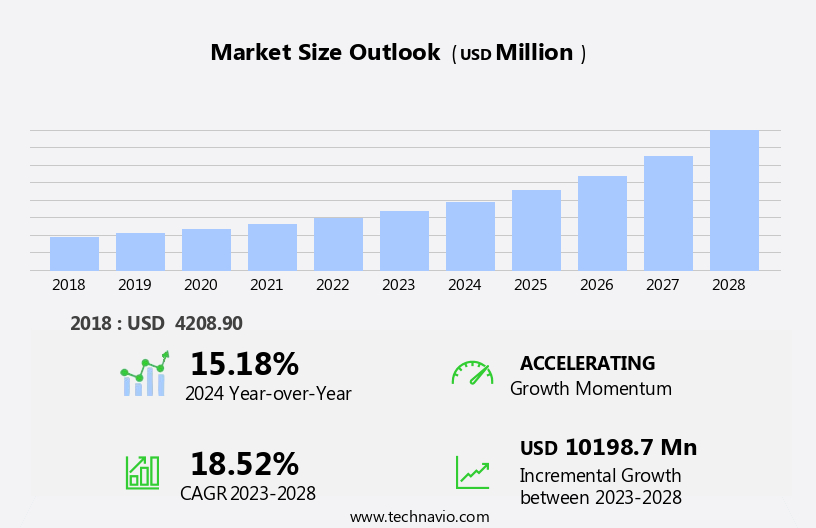
    Aircraft Electrification Market Size

     Request Free Sample

  • The market is experiencing significant growth as the aviation industry seeks to reduce operational costs and minimize environmental impact. Electric aircraft, including hybrid and fully electric variants, are gaining traction due to their potential for increased operational cost efficiency compared to traditional fuel-powered counterparts. This trend is driven by the increasing demand for sustainable air travel and the need to address maintenance requirements associated with mechanical components in aircraft. Electric propulsion systems, energy storage systems, and charging points are key components of this market, with STMicroelectronics and other industry players contributing with advanced power electronics solutions. Airports are also investing in infrastructure to support the charging and maintenance of electric aircraft, further bolstering market growth.
  • Emissions, noise, and fuel consumption are key areas where electric aircraft offer improvements, making them an attractive option for airlines and operators. The general aviation segment, including business jets, is also expected to benefit from these trends, contributing to the overall growth of the aerospace electrification market.
  • How is this Aircraft Electrification Industry segmented and which is the largest segment?

    The aircraft electrification industry research report provides comprehensive data (region-wise segment analysis), with forecasts and estimates in "USD million" for the period 2024-2028, as well as historical data from 2018-2022 for the following segments.

    • Platform
      • Commercial and general aircraft
      • Military aircraft
    • Technology
      • More electric
      • Fully electric
      • Hybrid electric
    • Geography
      • Europe
        • Germany
        • UK
        • France
      • North America
        • US
      • APAC
        • China
      • Middle East and Africa
        • South America

        By Platform Insights

        • The commercial and general aircraft segment is estimated to witness significant growth during the forecast period.

        The market encompasses the design and implementation of electric propulsion systems in both commercial and general aviation sectors. Commercial aircraft, including passenger airlines and cargo carriers, are transitioning towards electric propulsion systems, utilizing electric motors, batteries, and power electronics. These systems offer operational cost efficiency, reduced emissions, and noise reduction. The general aviation segment, consisting of private jets, helicopters, and small regional aircraft, is also adopting hybrid-electric or fully electric propulsion systems. Regulatory initiatives and environmental regulations, such as emission standards, are driving the electrification trend In the aviation industry. Key players in this market include STMicroelectronics, focusing on power electronics, and various electric aviation ventures receiving venture capital funding.

        The commercial segment is expected to dominate the market due to its larger fleet size and the potential for significant emissions reduction. The power distribution segment, including mechanical systems, hydraulic systems, and electrical architectures, is a crucial aspect of aircraft electrification.
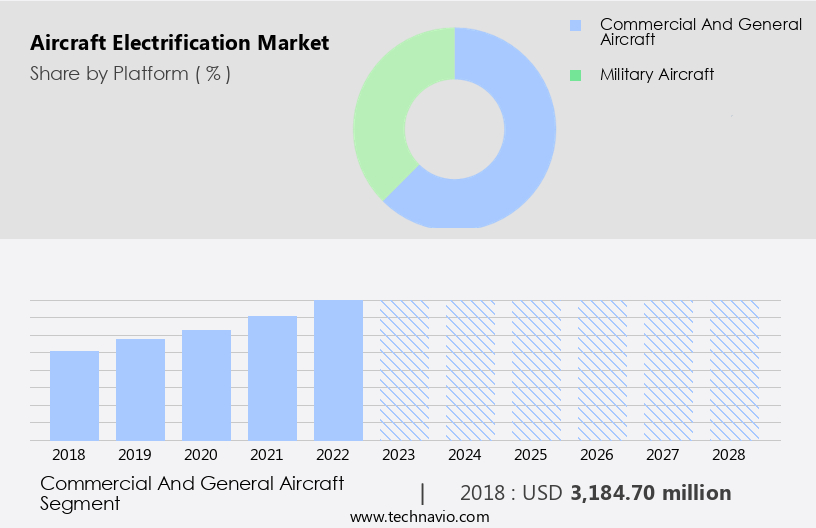
        Aircraft Electrification Market Size

        Get a glance at the  Aircraft Electrification Industry report of share of various segments Request Free Sample

        The Commercial and general aircraft segment was valued at USD 3.18 billion in 2018 and showed a gradual increase during the forecast period.

        Regional Analysis

        • Europe is estimated to contribute 37% to the growth of the global market during the forecast period.

        Technavio’s analysts have elaborately explained the regional trends and drivers that shape the market during the forecast period.
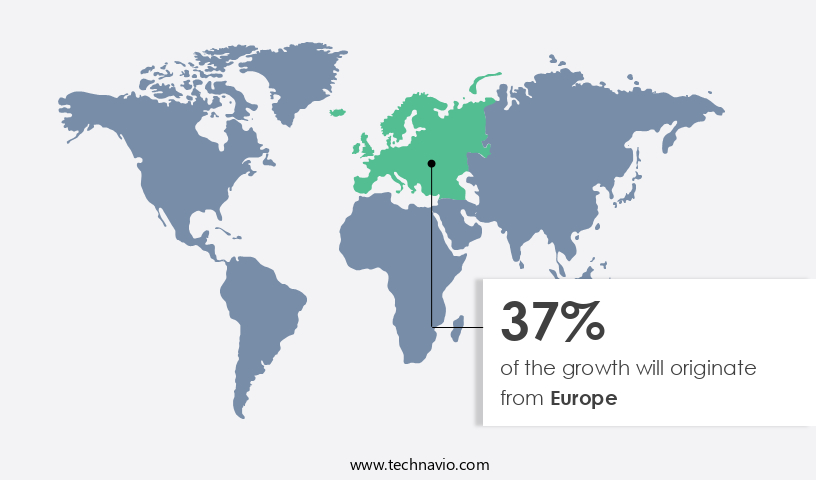
        Aircraft Electrification Market Share by Geography

        For more insights on the market share of various regions, Request Free Sample

        The European the market is poised for substantial growth due to the escalating demand for fuel-efficient and eco-friendly aviation solutions. This trend is fueled by the increasing adoption of electric and hybrid-electric propulsion systems, as part of the aviation industry's ongoing commitment to reducing carbon emissions and noise. Notable European players, such as Airbus, Safran, and Rolls-Royce, are spearheading this transition. Regulatory initiatives, including the European Union's Clean Sky program, are also catalyzing innovation in electric and hybrid-electric aircraft technology. The power electronics sector, including companies like STMicroelectronics, plays a crucial role In the development of electric propulsion systems and energy storage systems.

        The aviation industry's shift towards electric aviation ventures is driven by operational cost efficiency, environmental sustainability, and the need to address climate change. This transition encompasses the design of hybrid powered aircraft, fully electric aircraft, and energy storage systems, as well as the development of charging infrastructure at airports and charging points. The aerospace sector's evolution includes the integration of electric vertical takeoff, battery technologies, and modular design options for precision control, rapid response, and agility in unmanned aerial systems.

        Market Dynamics

        Our  researchers analyzed the data with 2023 as the base year, along with the key drivers, trends, and challenges. A holistic analysis of drivers will help companies refine their marketing strategies to gain a competitive advantage.

        What are the key market drivers leading to the rise In the adoption of Aircraft Electrification Industry?

        Increase in technological advancements is the key driver of the market.

      • The market is experiencing significant advancements due to the development of electric motors, battery technology, and power electronics. Electric motors, more efficient and reliable than traditional combustion engines, require less maintenance and offer improved performance. Battery technology innovations have resulted in batteries with higher energy densities, longer lifetimes, and faster charging times, enabling electric aircraft with extended ranges. Power electronics have facilitated efficient power management in electric and hybrid-electric aircraft. These advancements contribute to operational cost efficiency, environmental sustainability, and regulatory compliance In the aviation industry. STMicroelectronics, among other industry players, is a catalyst in this sector, focusing on power electronics for electric propulsion systems.
      • Regulatory initiatives, such as environmental regulations and emission standards, are driving the adoption of electric aviation ventures. Venture capital funding is pouring into electric aviation startups, with a focus on electric air transportation and sustainable air travel. The power distribution segment, including mechanical systems and hydraulic systems, is transitioning to electrical architectures. The hybrid electric segment, which combines traditional combustion engines with electric propulsion, offers a transitional solution for reducing fuel consumption and emissions. Regenerative energy capture, flexible power management, noise reduction, and modular design options are additional benefits of aircraft electrification. The UAV segment, including unmanned aerospace systems, is also experiencing growth In the electrification market.
      • Battery technologies, such as lithium-ion batteries, and fuel cells, are key components In the electrification of aircraft. The aerospace sector, including government agencies and research institutions, is collaborating to advance electric aircraft design and onboard systems.
      • What are the market trends shaping the Aircraft Electrification Industry?

        Increased demand for electric aircraft is the upcoming market trend.

      • The market is experiencing significant growth as the aviation industry prioritizes sustainable air travel. Electric aircraft, which utilize electric propulsion systems instead of traditional fuel, offer numerous advantages such as lower operational cost efficiency, reduced maintenance requirements for mechanical components, and minimal noise pollution. Companies like Airbus, Boeing, and startups such as Eviation are investing in this sector, developing electric and hybrid-powered aircraft. Regulatory initiatives and environmental regulations, including emission standards set by aviation authorities, are catalysts for this shift. Battery technology, specifically lithium-ion batteries with high energy storage capacities and lightweight solutions, plays a crucial role In the power distribution segment.
      • The hybrid electric segment, which combines traditional combustion engines with electric propulsion, offers a transitional solution for fuel efficiency and emissions reduction. The power electronics industry, with companies like STMicroelectronics, is essential for the development of flexible power management systems. The aviation industry's focus on environmental sustainability, climate change mitigation, and reducing carbon emissions is driving the demand for electric aviation ventures. The UAV segment, including electric-powered drones for surveillance, reconnaissance, and precision control, is also a growing market. Charging infrastructure for electric aircraft and eVTOLs is a critical consideration, as is the development of batteries and fuel cells with extended endurance and range.
      • The aerospace sector, including government agencies and research institutions, is collaborating to advance electric aviation technology. Modular design options, rapid response, agility, and noise reduction are additional benefits of electric aircraft, making them an attractive alternative to conventional aviation.
      • What challenges does the Aircraft Electrification Industry face during its growth?

        High development cost of aircraft electrification is a key challenge affecting the industry growth.

      • The market faces substantial challenges due to the high development costs associated with creating electric aircraft. The design and manufacturing of new components, such as advanced batteries, electric propulsion systems, and power electronics, carry a premium price tag compared to traditional mechanical components. These costs are further amplified by the intricate certification process for electric aircraft, which mandates rigorous safety and reliability testing. Regulatory initiatives, driven by environmental regulations and emission standards, are catalysts for the growth of the market. Key players In the aviation industry, including airlines and operators, are increasingly focusing on operational cost efficiency and environmental sustainability.
      • STMicroelectronics, a leading player in power electronics, is spearheading innovation in this space with lightweight and high-performance solutions. The Hybrid powered aircraft segment is gaining traction as it offers a middle ground between traditional fuel consumption and fully electric aircraft. The Power Distribution segment, which includes Mechanical systems, Hydraulic systems, and Electrical architectures, is undergoing a significant transformation. The Hybrid electric segment, which combines traditional combustion engines with electric propulsion, is another area of focus for reducing fuel consumption and emissions. The UAV segment, including drones and unmanned aerial systems, is also witnessing rapid growth, driven by advances in battery technology, energy storage capacities, and flexible power management.
      • The Aerospace sector is embracing electric aviation ventures, with venture capital funding pouring in to support innovation in Electric air transportation. The shift towards environmental sustainability, driven by concerns over climate change, is a major catalyst for the growth of the market. The market dynamics are further influenced by the development of new technologies, such as Lithium-ion batteries, fuel cells, and modular design options, which offer precision control, rapid response, agility, and noise reduction. The charging infrastructure for electric aircraft is also evolving, with airports and charging points being integrated into the aviation ecosystem. The future of the market is promising, with opportunities in various segments, including Business jets, General aviation, and Aerospace components, such as security solutions, avionics, aerostructures, and onboard systems.
      • The market is expected to grow significantly, driven by the need for emissions reduction, regenerative energy capture, and the desire for sustainable aviation solutions.
      • Exclusive Customer Landscape

        The aircraft electrification market forecasting report includes the adoption lifecycle of the market, covering from the innovator’s stage to the laggard’s stage. It focuses on adoption rates in different regions based on penetration. Furthermore, the aircraft electrification market report also includes key purchase criteria and drivers of price sensitivity to help companies evaluate and develop their market growth analysis strategies.
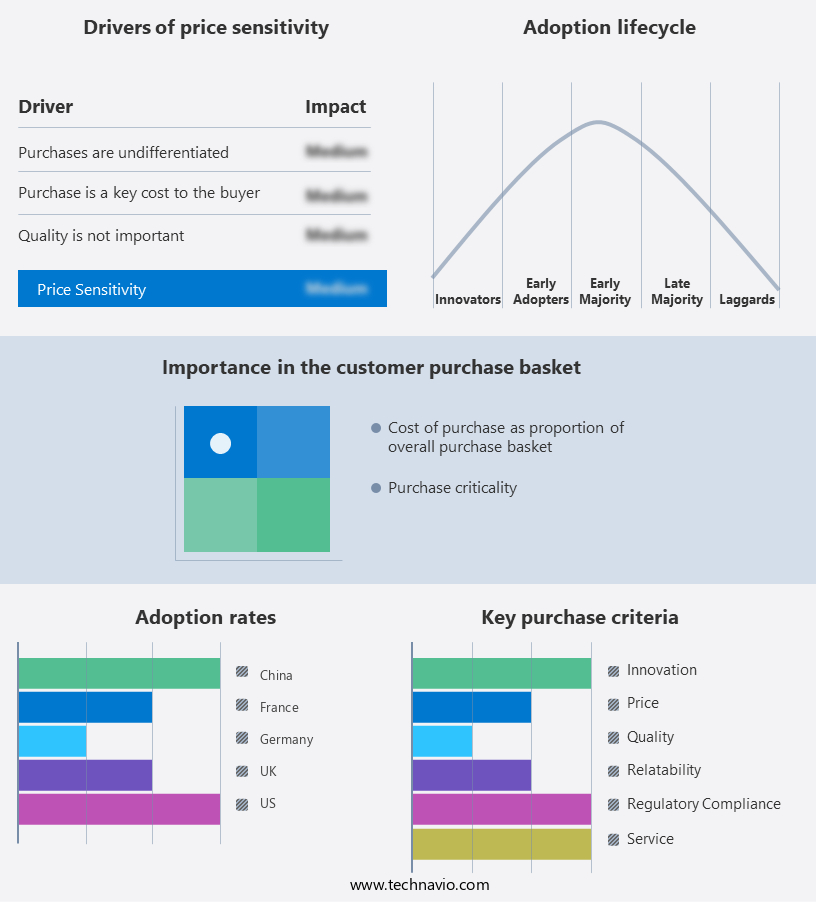
        Aircraft Electrification Market Share by Geography

         Customer Landscape

        Key Companies & Market Insights

        Companies are implementing various strategies, such as strategic alliances, aircraft electrification market forecast, partnerships, mergers and acquisitions, geographical expansion, and product/service launches, to enhance their presence In the industry.

        Acme Aerospace Inc and Avionic Instruments LLC - Aircraft electrification, a significant trend in aviation, encompasses advanced technologies such as DC power converters that facilitate the conversion and distribution of electrical power on board. These systems enable aircraft to operate more efficiently and reduce emissions, aligning with industry efforts to promote sustainability and reduce environmental impact. DC power converters convert direct current (DC) power from the aircraft's batteries or external power sources into usable power for various onboard systems. The adoption of these systems is poised to revolutionize aircraft design and operation, offering enhanced performance, improved fuel efficiency, and reduced carbon emissions.

        The industry research and growth report includes detailed analyses of the competitive landscape of the market and information about key companies, including:

        • Acme Aerospace Inc and Avionic Instruments LLC
        • Aegis Power Systems Inc.
        • AMETEK Inc.
        • Astronics Corp.
        • BAE Systems Plc
        • Carlisle Companies Inc.
        • Crane Holdings Co.
        • EaglePicher Technologies LLC
        • General Electric Co.
        • Hartzell Propeller Inc.
        • Honeywell International Inc.
        • Lee Air Inc.
        • magniX
        • Nabtesco Corp.
        • Parker Hannifin Corp.
        • PBS Aerospace Inc.
        • RTX Corp.
        • Safran SA
        • Thales Group
        • U.S. Technologies

        Qualitative and quantitative analysis of companies has been conducted to help clients understand the wider business environment as well as the strengths and weaknesses of key industry players. Data is qualitatively analyzed to categorize companies as pure play, category-focused, industry-focused, and diversified; it is quantitatively analyzed to categorize companies as dominant, leading, strong, tentative, and weak.

        Research Analyst Overview

        The aircraft industry is witnessing a significant shift towards electrification as the global focus on sustainable air travel intensifies. This transition is driven by the need for operational cost efficiency, reduced carbon emissions, and regulatory initiatives aimed at mitigating the environmental impact of conventional aviation. Electric aircraft, which utilize electric propulsion systems instead of traditional fuel-powered engines, are gaining traction as a viable alternative. The mechanical components of electric aircraft are distinct from their conventional counterparts, with fewer moving parts and more reliance on power electronics. Maintenance requirements for electric aircraft differ from those of traditional aircraft due to the absence of mechanical engines.

        Instead, maintenance protocols focus on the electrical architectures and energy storage systems. These systems require regular inspections to ensure optimal performance and safety. The aviation industry, comprised of airlines and operators, is exploring the potential of electric aviation ventures to reduce fuel consumption, emissions, and operational costs. STMicroelectronics, a leading player in power electronics, is one of the companies investing in this space. Regulatory initiatives and environmental regulations are catalysts for the growth of the market. Emission standards and noise reduction requirements are driving the demand for electric and hybrid-powered aircraft. Aviation authorities worldwide are working on certifying these new aircraft types for commercial use.

        Startups and venture capital funding are playing a crucial role In the development of electric aviation. Companies are investing in research and development to improve battery technology, energy storage capacities, and lightweight solutions for high-performance electric aircraft. The power distribution segment of the market is expected to grow significantly as the industry shifts towards electric propulsion systems. Traditional combustion engines will continue to be used in some applications, but the focus is on improving fuel efficiency and reducing emissions through regenerative energy capture and flexible power management. The unmanned aerial systems (UAS) segment, including drones and electric vertical takeoff and landing (eVTOL) aircraft, is another area where electrification is gaining popularity.

        UAS are used in various industries, including healthcare, security solutions, and aerospace, and their electric powertrains offer advantages in terms of noise reduction, agility, and precision control. The aerospace sector is also exploring the use of electric propulsion systems for rocket engines and aerospace components. These applications require high energy density batteries and advanced power management systems to ensure optimal performance and safety. The charging infrastructure for electric aircraft and UAS is an essential consideration for their widespread adoption. Airports and charging points are being developed to support the growing fleet of electric aircraft and UAS. In conclusion, the market is experiencing significant growth due to the need for operational cost efficiency, reduced carbon emissions, and regulatory initiatives.

        Electric aircraft, hybrid-powered aircraft, and UAS are leading the way in this transition, with advancements in battery technology, energy storage systems, and power electronics driving innovation In the industry. The future of aviation is electric, and the opportunities for growth and investment are vast.

        Market Scope

        Report Coverage

        Details

        Page number

        164

        Base year

        2023

        Historic period

        2018-2022

        Forecast period

        2024-2028

        Growth momentum & CAGR

        Accelerate at a CAGR of 18.52%

        Market growth 2024-2028

        USD 10198.7 million

        Market structure

        Fragmented

        YoY growth 2023-2024(%)

        15.18

        Key countries

        US, Germany, UK, China, and France

        Competitive landscape

        Leading Companies, Market Positioning of Companies, Competitive Strategies, and Industry Risks

        Request Free Sample

        What are the Key Data Covered in this Aircraft Electrification Market Research and Growth Report?

        • CAGR of the Aircraft Electrification industry during the forecast period
        • Detailed information on factors that will drive the growth and forecasting between 2024 and 2028
        • Precise estimation of the size of the market and its contribution of the industry in focus to the parent market
        • Accurate predictions about upcoming growth and trends and changes in consumer behaviour
        • Growth of the market across Europe, North America, APAC, Middle East and Africa, and South America
        • Thorough analysis of the market’s competitive landscape and detailed information about companies
        • Comprehensive analysis of factors that will challenge the aircraft electrification market growth of industry companies

        We can help! Our analysts can customize this aircraft electrification market research report to meet your requirements.

        Get in touch


        1 Executive Summary

        • 1.1 Market overview
          • Executive Summary - Chart on Market Overview
          • Executive Summary - Data Table on Market Overview
          • Executive Summary - Chart on Global Market Characteristics
          • Executive Summary - Chart on Market by Geography
          • Executive Summary - Chart on Market Segmentation by Platform
          • Executive Summary - Chart on Market Segmentation by Technology
          • Executive Summary - Chart on Incremental Growth
          • Executive Summary - Data Table on Incremental Growth
          • Executive Summary - Chart on Company Market Positioning

        2 Market Landscape

        • 2.1 Market ecosystem
          • Parent Market
          • Data Table on - Parent Market
        • 2.2 Market characteristics
          • Market characteristics analysis
        • 2.3 Value chain analysis
          • Value Chain Analysis

        3 Market Sizing

        • 3.1 Market definition
          • Offerings of companies included in the market definition
        • 3.2 Market segment analysis
          • Market segments
        • 3.3 Market size 2023
          • 3.4 Market outlook: Forecast for 2023-2028
            • Chart on Global - Market size and forecast 2023-2028 ($ million)
            • Data Table on Global - Market size and forecast 2023-2028 ($ million)
            • Chart on Global Market: Year-over-year growth 2023-2028 (%)
            • Data Table on Global Market: Year-over-year growth 2023-2028 (%)

          4 Historic Market Size

          • 4.1 Global Aircraft Electrification Market 2018 - 2022
            • Historic Market Size - Data Table on Global Aircraft Electrification Market 2018 - 2022 ($ million)
          • 4.2 Platform segment analysis 2018 - 2022
            • Historic Market Size - Platform Segment 2018 - 2022 ($ million)
          • 4.3 Technology segment analysis 2018 - 2022
            • Historic Market Size - Technology Segment 2018 - 2022 ($ million)
          • 4.4 Geography segment analysis 2018 - 2022
            • Historic Market Size - Geography Segment 2018 - 2022 ($ million)
          • 4.5 Country segment analysis 2018 - 2022
            • Historic Market Size - Country Segment 2018 - 2022 ($ million)

          5 Five Forces Analysis

          • 5.1 Five forces summary
            • Five forces analysis - Comparison between 2023 and 2028
          • 5.2 Bargaining power of buyers
            • Bargaining power of buyers - Impact of key factors 2023 and 2028
          • 5.3 Bargaining power of suppliers
            • Bargaining power of suppliers - Impact of key factors in 2023 and 2028
          • 5.4 Threat of new entrants
            • Threat of new entrants - Impact of key factors in 2023 and 2028
          • 5.5 Threat of substitutes
            • Threat of substitutes - Impact of key factors in 2023 and 2028
          • 5.6 Threat of rivalry
            • Threat of rivalry - Impact of key factors in 2023 and 2028
          • 5.7 Market condition
            • Chart on Market condition - Five forces 2023 and 2028

          6 Market Segmentation by Platform

          • 6.1 Market segments
            • Chart on Platform - Market share 2023-2028 (%)
            • Data Table on Platform - Market share 2023-2028 (%)
          • 6.2 Comparison by Platform
            • Chart on Comparison by Platform
            • Data Table on Comparison by Platform
          • 6.3 Commercial and general aircraft - Market size and forecast 2023-2028
            • Chart on Commercial and general aircraft - Market size and forecast 2023-2028 ($ million)
            • Data Table on Commercial and general aircraft - Market size and forecast 2023-2028 ($ million)
            • Chart on Commercial and general aircraft - Year-over-year growth 2023-2028 (%)
            • Data Table on Commercial and general aircraft - Year-over-year growth 2023-2028 (%)
          • 6.4 Military aircraft - Market size and forecast 2023-2028
            • Chart on Military aircraft - Market size and forecast 2023-2028 ($ million)
            • Data Table on Military aircraft - Market size and forecast 2023-2028 ($ million)
            • Chart on Military aircraft - Year-over-year growth 2023-2028 (%)
            • Data Table on Military aircraft - Year-over-year growth 2023-2028 (%)
          • 6.5 Market opportunity by Platform
            • Market opportunity by Platform ($ million)
            • Data Table on Market opportunity by Platform ($ million)

          7 Market Segmentation by Technology

          • 7.1 Market segments
            • Chart on Technology - Market share 2023-2028 (%)
            • Data Table on Technology - Market share 2023-2028 (%)
          • 7.2 Comparison by Technology
            • Chart on Comparison by Technology
            • Data Table on Comparison by Technology
          • 7.3 More electric - Market size and forecast 2023-2028
            • Chart on More electric - Market size and forecast 2023-2028 ($ million)
            • Data Table on More electric - Market size and forecast 2023-2028 ($ million)
            • Chart on More electric - Year-over-year growth 2023-2028 (%)
            • Data Table on More electric - Year-over-year growth 2023-2028 (%)
          • 7.4 Fully electric - Market size and forecast 2023-2028
            • Chart on Fully electric - Market size and forecast 2023-2028 ($ million)
            • Data Table on Fully electric - Market size and forecast 2023-2028 ($ million)
            • Chart on Fully electric - Year-over-year growth 2023-2028 (%)
            • Data Table on Fully electric - Year-over-year growth 2023-2028 (%)
          • 7.5 Hybrid electric - Market size and forecast 2023-2028
            • Chart on Hybrid electric - Market size and forecast 2023-2028 ($ million)
            • Data Table on Hybrid electric - Market size and forecast 2023-2028 ($ million)
            • Chart on Hybrid electric - Year-over-year growth 2023-2028 (%)
            • Data Table on Hybrid electric - Year-over-year growth 2023-2028 (%)
          • 7.6 Market opportunity by Technology
            • Market opportunity by Technology ($ million)
            • Data Table on Market opportunity by Technology ($ million)

          8 Customer Landscape

          • 8.1 Customer landscape overview
            • Analysis of price sensitivity, lifecycle, customer purchase basket, adoption rates, and purchase criteria

          9 Geographic Landscape

          • 9.1 Geographic segmentation
            • Chart on Market share by geography 2023-2028 (%)
            • Data Table on Market share by geography 2023-2028 (%)
          • 9.2 Geographic comparison
            • Chart on Geographic comparison
            • Data Table on Geographic comparison
          • 9.3 Europe - Market size and forecast 2023-2028
            • Chart on Europe - Market size and forecast 2023-2028 ($ million)
            • Data Table on Europe - Market size and forecast 2023-2028 ($ million)
            • Chart on Europe - Year-over-year growth 2023-2028 (%)
            • Data Table on Europe - Year-over-year growth 2023-2028 (%)
          • 9.4 North America - Market size and forecast 2023-2028
            • Chart on North America - Market size and forecast 2023-2028 ($ million)
            • Data Table on North America - Market size and forecast 2023-2028 ($ million)
            • Chart on North America - Year-over-year growth 2023-2028 (%)
            • Data Table on North America - Year-over-year growth 2023-2028 (%)
          • 9.5 APAC - Market size and forecast 2023-2028
            • Chart on APAC - Market size and forecast 2023-2028 ($ million)
            • Data Table on APAC - Market size and forecast 2023-2028 ($ million)
            • Chart on APAC - Year-over-year growth 2023-2028 (%)
            • Data Table on APAC - Year-over-year growth 2023-2028 (%)
          • 9.6 Middle East and Africa - Market size and forecast 2023-2028
            • Chart on Middle East and Africa - Market size and forecast 2023-2028 ($ million)
            • Data Table on Middle East and Africa - Market size and forecast 2023-2028 ($ million)
            • Chart on Middle East and Africa - Year-over-year growth 2023-2028 (%)
            • Data Table on Middle East and Africa - Year-over-year growth 2023-2028 (%)
          • 9.7 South America - Market size and forecast 2023-2028
            • Chart on South America - Market size and forecast 2023-2028 ($ million)
            • Data Table on South America - Market size and forecast 2023-2028 ($ million)
            • Chart on South America - Year-over-year growth 2023-2028 (%)
            • Data Table on South America - Year-over-year growth 2023-2028 (%)
          • 9.8 US - Market size and forecast 2023-2028
            • Chart on US - Market size and forecast 2023-2028 ($ million)
            • Data Table on US - Market size and forecast 2023-2028 ($ million)
            • Chart on US - Year-over-year growth 2023-2028 (%)
            • Data Table on US - Year-over-year growth 2023-2028 (%)
          • 9.9 Germany - Market size and forecast 2023-2028
            • Chart on Germany - Market size and forecast 2023-2028 ($ million)
            • Data Table on Germany - Market size and forecast 2023-2028 ($ million)
            • Chart on Germany - Year-over-year growth 2023-2028 (%)
            • Data Table on Germany - Year-over-year growth 2023-2028 (%)
          • 9.10 UK - Market size and forecast 2023-2028
            • Chart on UK - Market size and forecast 2023-2028 ($ million)
            • Data Table on UK - Market size and forecast 2023-2028 ($ million)
            • Chart on UK - Year-over-year growth 2023-2028 (%)
            • Data Table on UK - Year-over-year growth 2023-2028 (%)
          • 9.11 China - Market size and forecast 2023-2028
            • Chart on China - Market size and forecast 2023-2028 ($ million)
            • Data Table on China - Market size and forecast 2023-2028 ($ million)
            • Chart on China - Year-over-year growth 2023-2028 (%)
            • Data Table on China - Year-over-year growth 2023-2028 (%)
          • 9.12 France - Market size and forecast 2023-2028
            • Chart on France - Market size and forecast 2023-2028 ($ million)
            • Data Table on France - Market size and forecast 2023-2028 ($ million)
            • Chart on France - Year-over-year growth 2023-2028 (%)
            • Data Table on France - Year-over-year growth 2023-2028 (%)
          • 9.13 Market opportunity by geography
            • Market opportunity by geography ($ million)
            • Data Tables on Market opportunity by geography ($ million)

          10 Drivers, Challenges, and Opportunity/Restraints

          • 10.1 Market drivers
            • 10.2 Market challenges
              • 10.3 Impact of drivers and challenges
                • Impact of drivers and challenges in 2023 and 2028
              • 10.4 Market opportunities/restraints

                11 Competitive Landscape

                • 11.1 Overview
                  • 11.2 Competitive Landscape
                    • Overview on criticality of inputs and factors of differentiation
                  • 11.3 Landscape disruption
                    • Overview on factors of disruption
                  • 11.4 Industry risks
                    • Impact of key risks on business

                  12 Competitive Analysis

                  • 12.1 Companies profiled
                    • Companies covered
                  • 12.2 Market positioning of companies
                    • Matrix on companies position and classification
                  • 12.3 Aegis Power Systems Inc.
                    • Aegis Power Systems Inc. - Overview
                    • Aegis Power Systems Inc. - Product / Service
                    • Aegis Power Systems Inc. - Key offerings
                  • 12.4 AMETEK Inc.
                    • AMETEK Inc. - Overview
                    • AMETEK Inc. - Business segments
                    • AMETEK Inc. - Key news
                    • AMETEK Inc. - Key offerings
                    • AMETEK Inc. - Segment focus
                  • 12.5 Astronics Corp.
                    • Astronics Corp. - Overview
                    • Astronics Corp. - Business segments
                    • Astronics Corp. - Key news
                    • Astronics Corp. - Key offerings
                    • Astronics Corp. - Segment focus
                  • 12.6 BAE Systems Plc
                    • BAE Systems Plc - Overview
                    • BAE Systems Plc - Business segments
                    • BAE Systems Plc - Key news
                    • BAE Systems Plc - Key offerings
                    • BAE Systems Plc - Segment focus
                  • 12.7 Crane Holdings Co.
                    • Crane Holdings Co. - Overview
                    • Crane Holdings Co. - Business segments
                    • Crane Holdings Co. - Key news
                    • Crane Holdings Co. - Key offerings
                    • Crane Holdings Co. - Segment focus
                  • 12.8 EaglePicher Technologies LLC
                    • EaglePicher Technologies LLC - Overview
                    • EaglePicher Technologies LLC - Product / Service
                    • EaglePicher Technologies LLC - Key news
                    • EaglePicher Technologies LLC - Key offerings
                  • 12.9 General Electric Co.
                    • General Electric Co. - Overview
                    • General Electric Co. - Business segments
                    • General Electric Co. - Key news
                    • General Electric Co. - Key offerings
                    • General Electric Co. - Segment focus
                  • 12.10 Honeywell International Inc.
                    • Honeywell International Inc. - Overview
                    • Honeywell International Inc. - Business segments
                    • Honeywell International Inc. - Key news
                    • Honeywell International Inc. - Key offerings
                    • Honeywell International Inc. - Segment focus
                  • 12.11 Lee Air Inc.
                    • Lee Air Inc. - Overview
                    • Lee Air Inc. - Product / Service
                    • Lee Air Inc. - Key offerings
                  • 12.12 magniX
                    • magniX - Overview
                    • magniX - Product / Service
                    • magniX - Key offerings
                  • 12.13 Parker Hannifin Corp.
                    • Parker Hannifin Corp. - Overview
                    • Parker Hannifin Corp. - Business segments
                    • Parker Hannifin Corp. - Key news
                    • Parker Hannifin Corp. - Key offerings
                    • Parker Hannifin Corp. - Segment focus
                  • 12.14 PBS Aerospace Inc.
                    • PBS Aerospace Inc. - Overview
                    • PBS Aerospace Inc. - Product / Service
                    • PBS Aerospace Inc. - Key offerings
                  • 12.15 RTX Corp.
                    • RTX Corp. - Overview
                    • RTX Corp. - Business segments
                    • RTX Corp. - Key news
                    • RTX Corp. - Key offerings
                    • RTX Corp. - Segment focus
                  • 12.16 Safran SA
                    • Safran SA - Overview
                    • Safran SA - Business segments
                    • Safran SA - Key news
                    • Safran SA - Key offerings
                    • Safran SA - Segment focus
                  • 12.17 Thales Group
                    • Thales Group - Overview
                    • Thales Group - Business segments
                    • Thales Group - Key news
                    • Thales Group - Key offerings
                    • Thales Group - Segment focus

                  13 Appendix

                  • 13.1 Scope of the report
                    • 13.2 Inclusions and exclusions checklist
                      • Inclusions checklist
                      • Exclusions checklist
                    • 13.3 Currency conversion rates for US$
                      • Currency conversion rates for US$
                    • 13.4 Research methodology
                      • Research methodology
                    • 13.5 Data procurement
                      • Information sources
                    • 13.6 Data validation
                      • Data validation
                    • 13.7 Validation techniques employed for market sizing
                      • Validation techniques employed for market sizing
                    • 13.8 Data synthesis
                      • Data synthesis
                    • 13.9 360 degree market analysis
                      • 360 degree market analysis
                    • 13.10 List of abbreviations
                      • List of abbreviations

                    Research Methodology

                    Technavio presents a detailed picture of the market by way of study, synthesis, and summation of data from multiple sources. The analysts have presented the various facets of the market with a particular focus on identifying the key industry influencers. The data thus presented is comprehensive, reliable, and the result of extensive research, both primary and secondary.

                    INFORMATION SOURCES

                    Primary sources

                    • Manufacturers and suppliers
                    • Channel partners
                    • Industry experts
                    • Strategic decision makers

                    Secondary sources

                    • Industry journals and periodicals
                    • Government data
                    • Financial reports of key industry players
                    • Historical data
                    • Press releases

                    DATA ANALYSIS

                    Data Synthesis

                    • Collation of data
                    • Estimation of key figures
                    • Analysis of derived insights

                    Data Validation

                    • Triangulation with data models
                    • Reference against proprietary databases
                    • Corroboration with industry experts

                    REPORT WRITING

                    Qualitative

                    • Market drivers
                    • Market challenges
                    • Market trends
                    • Five forces analysis

                    Quantitative

                    • Market size and forecast
                    • Market segmentation
                    • Geographical insights
                    • Competitive landscape

                    Interested in this report?

                    Get your sample now to see our research methodology and insights!

                    Download Now

                    Frequently Asked Questions

                    Aircraft Electrification market growth will increase by $ 10198.7 mn during 2024-2028 .

                    The Aircraft Electrification market is expected to grow at a CAGR of 18.52% during 2024-2028 .

                    Aircraft Electrification market is segmented by Platform( Commercial and general aircraft, Military aircraft, Military aircraft) Technology( More electric, Fully electric, Hybrid electric)

                    Acme Aerospace Inc and Avionic Instruments LLC, Aegis Power Systems Inc., AMETEK Inc., Astronics Corp., BAE Systems Plc, Carlisle Companies Inc., Crane Holdings Co., EaglePicher Technologies LLC, General Electric Co., Hartzell Propeller Inc., Honeywell International Inc., Lee Air Inc., magniX, Nabtesco Corp., Parker Hannifin Corp., PBS Aerospace Inc., RTX Corp., Safran SA, Thales Group, U.S. Technologies are a few of the key vendors in the Aircraft Electrification market.

                    Europe will register the highest growth rate of 37% among the other regions. Therefore, the Aircraft Electrification market in Europe is expected to garner significant business opportunities for the vendors during the forecast period.

                    US, Germany, UK, China, France

                    • Increase in technological advancementsThere have been several technological advancements in the aircraft electrification market is the driving factor this market.
                    • including: Electric Motors: Advances in electric motor technology have made it possible to develop high-power electric motors that can be used in aircraft. These motors are more efficient and reliable than traditional combustion engines and require less maintenance. Battery Technology: Improvements in battery technology have made it possible to develop batteries with higher energy densities is the driving factor this market.
                    • longer lifetimes is the driving factor this market.
                    • and faster charging times. These advancements have made it possible to develop electric aircraft with ranges and performance that were previously not possible. Power Electronics: The development of advanced power electronics has made it possible to efficiently control and manage the flow of electrical power in electric and hybrid-electric aircraft. This technology is essential for optimizing the performance and efficiency of electric propulsion systems. Lightweight Materials: The use of lightweight materials such as carbon fiber composites and 3D printed parts has enabled the development of lighter and more efficient aircraft structures is the driving factor this market.
                    • which are critical for achieving the range and performance required for commercial aviation. Distributed Electric Propulsion: Distributed electric propulsion (DEP) is a technology that uses multiple small electric motors to power an aircraft rather than a single large engine. DEP can provide greater efficiency is the driving factor this market.
                    • safety is the driving factor this market.
                    • and reliability compared to traditional engines and can also enable new aircraft configurations. Overall is the driving factor this market.
                    • these technological advancements have made it possible to develop electric and hybrid-electric aircraft with the range and performance required for commercial aviation and have opened up new opportunities for more sustainable air travel. These advancements may lead to an increase in the demand for aircraft electrification services is the driving factor this market.
                    • which will propel the growth of the global aircraft electrification market during the forecast period. is the driving factor this market.

                    The Aircraft Electrification market vendors should focus on grabbing business opportunities from the Commercial and general aircraft segment as it accounted for the largest market share in the base year.
