



Cargo Transportation Market Size 2026-2030
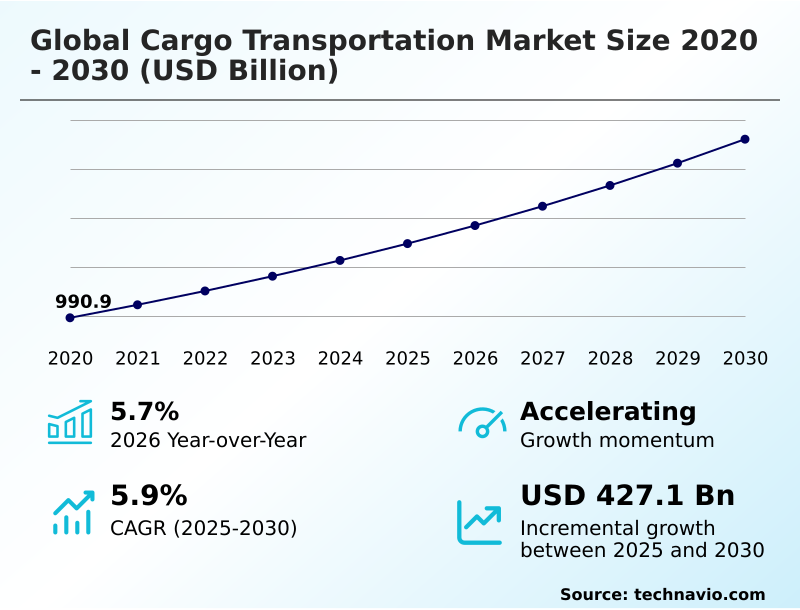
The cargo transportation market size is valued to increase by USD 427.1 billion, at a CAGR of 5.9% from 2025 to 2030. Escalation of global cross-border e-commerce transactions will drive the cargo transportation market.
Major Market Trends & Insights
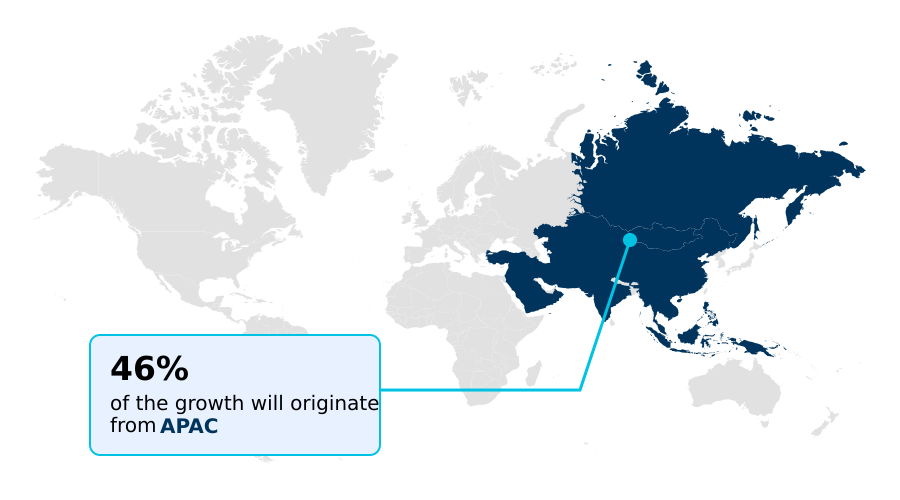
- APAC dominated the market and accounted for a 45.6% growth during the forecast period.
- By Mode of Transportation - Road freight segment was valued at USD 620.8 billion in 2024
- By End-user - Retail and e-commerce segment accounted for the largest market revenue share in 2024
Market Size & Forecast
- Market Opportunities: USD 730.6 billion
- Market Future Opportunities: USD 427.1 billion
- CAGR from 2025 to 2030 : 5.9%
Market Summary
- The cargo transportation market is a critical enabler of global commerce, defined by the intricate coordination of multimodal transport networks. This sector is undergoing a profound transformation driven by digitalization and a heightened focus on supply chain resilience.
- Key trends include the adoption of digital twin technology to simulate and optimize logistics networks and the use of real-time shipment tracking to enhance supply chain visibility. The surge in cross-border e-commerce logistics is a significant driver, intensifying the demand for efficient last-mile delivery and sophisticated route optimization.
- For instance, a pharmaceutical distributor leverages integrated cold chain logistics and tracking to ensure temperature-sensitive vaccines meet strict regulatory compliance standards from factory to clinic, preventing spoilage and ensuring public safety. Concurrently, the industry faces the challenge of decarbonization of logistics, pushing investment toward autonomous freight solutions and cleaner fuels.
- This evolution requires constant adaptation to maintain efficiency amidst shifting trade dynamics and technological advancements, solidifying its role in the global economy.
What will be the Size of the Cargo Transportation Market during the forecast period?
Get Key Insights on Market Forecast (PDF) Get Free Sample
How is the Cargo Transportation Market Segmented?
The cargo transportation industry research report provides comprehensive data (region-wise segment analysis), with forecasts and estimates in "USD billion" for the period 2026-2030, as well as historical data from 2020-2024 for the following segments.
- Mode of transportation
- Road freight
- Sea freight
- Rail freight
- Air freight
- Others
- End-user
- Retail and e-commerce
- Manufacturing and automotive
- Energy and oil and gas
- Agriculture and food products
- Others
- Type
- Dry cargo
- Liquid bulk
- Dry bulk
- Refrigerated cargo
- Special cargo
- Geography
- APAC
- China
- India
- Japan
- North America
- US
- Canada
- Mexico
- Europe
- Germany
- UK
- France
- Middle East and Africa
- Saudi Arabia
- UAE
- South Africa
- South America
- Brazil
- Argentina
- Colombia
- Rest of World (ROW)
- APAC
By Mode of Transportation Insights
The road freight segment is estimated to witness significant growth during the forecast period.
The road freight segment is essential to the cargo transportation market, offering critical door-to-door connectivity for both cold chain logistics and general goods. Its flexibility underpins complex supply chains, from heavy-lift transport vessel offloads to final distribution.
The rise of digital freight brokerage platforms has significantly improved asset utilization, with some operators reporting a reduction in empty miles by up to 15%.
These platforms enhance supply chain visibility and integrate with advanced inventory management systems to streamline operations.
As e-commerce expands, the demand for efficient reverse logistics solutions is also growing, further cementing road transport's vital role in a responsive and modern logistics framework, crucial for timely deliveries.
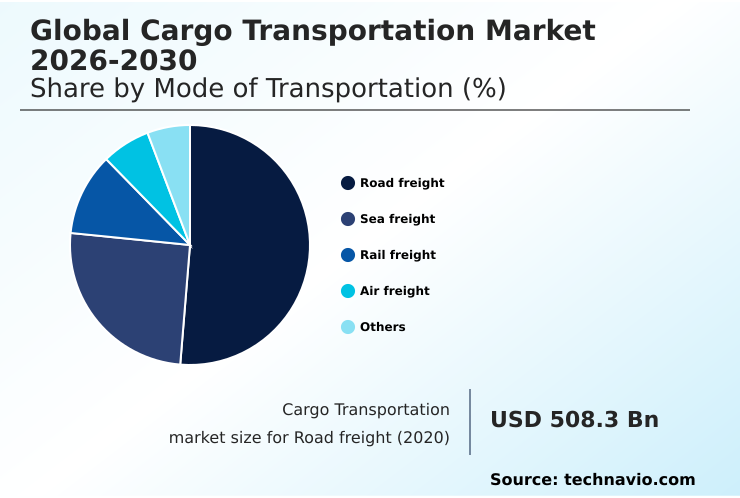
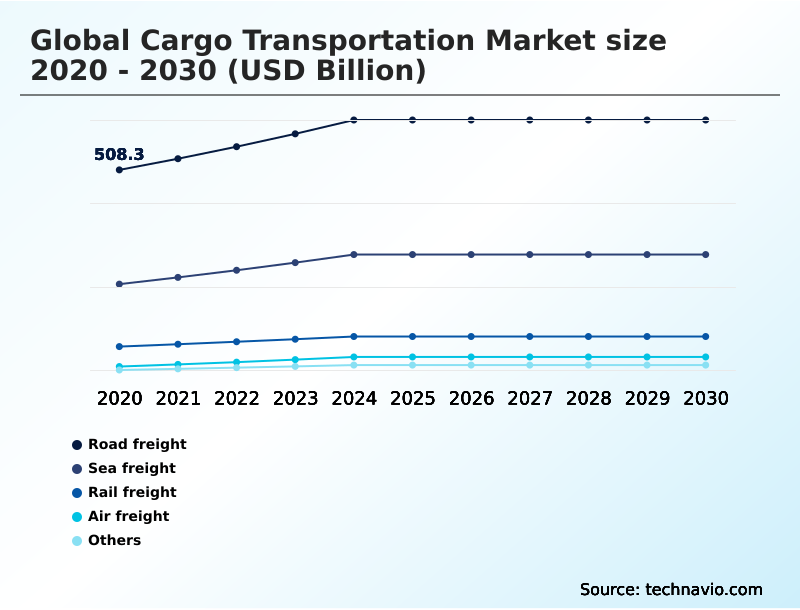
The Road freight segment was valued at USD 620.8 billion in 2024 and showed a gradual increase during the forecast period.
Regional Analysis
APAC is estimated to contribute 45.6% to the growth of the global market during the forecast period.Technavio’s analysts have elaborately explained the regional trends and drivers that shape the market during the forecast period.
See How Cargo Transportation Market Demand is Rising in APAC Get Free Sample
The geographic landscape of the cargo transportation market is dynamic, with APAC accounting for over 45% of incremental growth, driven by its expanding manufacturing base.
This region is heavily investing in multimodal transport infrastructure, including inland waterway transport, to support its dominant role in the global automotive supply chain.
In North America, sophisticated freight forwarding and road haulage operations are critical, with firms focusing on freight consolidation to improve efficiency. Europe leads in sustainability, promoting shore-to-ship power at ports and optimizing the end-to-end supply chain.
Meanwhile, the Middle East is expanding its air cargo capacity and building advanced automated sorting facility hubs.
The widespread use of containerization for everything from dry goods to refrigerated cargo container shipments underpins trade across all regions, supplemented by specialized pipeline transport systems for energy products.
Market Dynamics
Our researchers analyzed the data with 2025 as the base year, along with the key drivers, trends, and challenges. A holistic analysis of drivers will help companies refine their marketing strategies to gain a competitive advantage.
- Strategic decision-making in the cargo transportation sector is increasingly complex, focusing on the impact of digitalization on logistics and optimizing last-mile delivery services. The challenges in cross-border e-commerce demand innovative solutions, with many firms exploring the role of AI in route planning to enhance efficiency.
- A major industry-wide initiative involves the transition to sustainable aviation fuels and broader strategies for green logistics implementation to meet environmental mandates. The ability to manage supply chain disruptions effectively has become a key competitive differentiator, leading to the implementing digital twin for ports to model and mitigate risks.
- Automation in warehouse management systems is now standard for large operators, directly reducing carbon footprint in shipping by optimizing loads and routes. Firms are also heavily investing in securing freight against cyber threats. The ongoing effort in addressing labor shortages in trucking is being supplemented by evaluating the cost-benefit of autonomous vehicles.
- Concurrently, improving cold chain integrity for sensitive goods is a top priority, supported by real-time cargo condition monitoring benefits. The challenge of multimodal transport network integration challenges is being addressed through standardizing electronic documentation in freight. These initiatives, coupled with infrastructure investment for freight corridors, are crucial for enhancing schedule reliability in maritime shipping.
- Companies that successfully navigate these changes report operational efficiencies that are twice as high as their slower-moving peers, particularly in navigating geopolitical risks in trade.
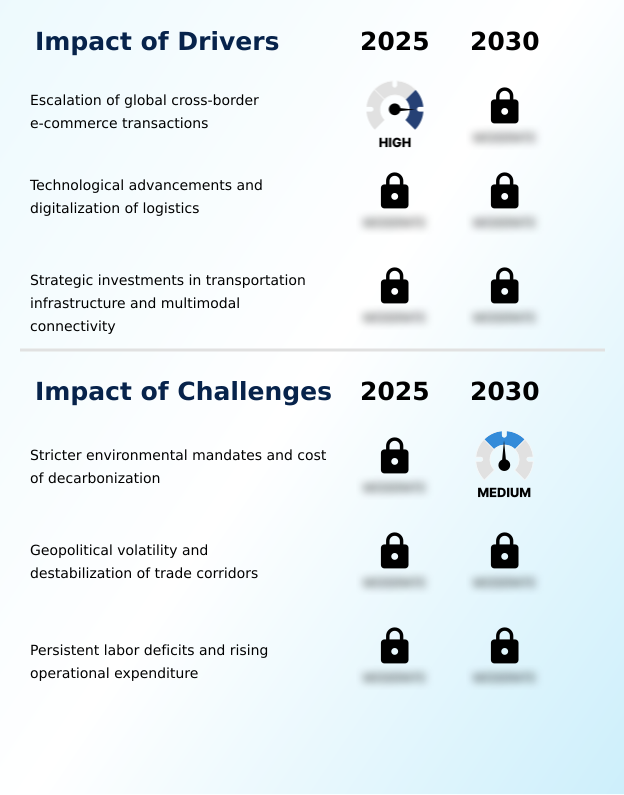
What are the key market drivers leading to the rise in the adoption of Cargo Transportation Industry?
- The escalation of global cross-border e-commerce transactions serves as a key driver propelling the growth of the cargo transportation market.
- The expansion of cross-border e-commerce logistics is a primary market driver, necessitating advanced e-commerce fulfillment and efficient last-mile delivery services.
- To manage this demand, firms are focusing on logistics network optimization, which has led to a 20% improvement in asset utilization for some operators. Infrastructure investments in dedicated freight corridor projects are enhancing rail freight connectivity and intermodal transport capabilities.
- Concurrently, the deployment of automated port terminals is boosting cargo handling efficiency by over 30% and aiding in port congestion management.
- The adoption of sophisticated route optimization software and real-time shipment tracking provides the supply chain transparency required to meet modern consumer expectations for speed and reliability.
What are the market trends shaping the Cargo Transportation Industry?
- The integration of digital twin technology with predictive supply chain modeling is emerging as a transformative market trend, enhancing operational visibility and strategic foresight.
- The cargo transportation market is rapidly evolving, driven by the adoption of digital twin technology and predictive supply chain modeling, which have improved forecast accuracy by up to 25%. This shift toward decarbonization of logistics is materializing through investments in green hydrogen propulsion and other alternative propulsion systems.
- The deployment of zero-emission vessels and the increased use of sustainable aviation fuels are becoming critical. Furthermore, smart port technology is enhancing schedule reliability, with some terminals reporting a 15% reduction in vessel turnaround times. The integration of logistics data analytics supports predictive maintenance, while the standardization of electronic bills of lading streamlines documentation.
- These advancements, including the rise of autonomous freight solutions, are reshaping operational frameworks for greater efficiency.
What challenges does the Cargo Transportation Industry face during its growth?
- Stricter environmental mandates and the associated high cost of decarbonization present a significant challenge affecting the industry's growth trajectory.
- The market faces considerable headwinds from rising operational expenditure and the high cost of regulatory compliance with new environmental mandates. For instance, the adoption of fuels like hydrotreated vegetable oil to achieve fuel consumption reduction goals has increased fuel costs by up to 18% for some fleets.
- The geopolitical volatility impact disrupts traditional maritime shipping routes and complicates transshipment hub operations, leading to delays. Businesses also contend with the tariff policy impact on bulk commodity shipping and less-than-truckload services.
- Furthermore, persistent challenges in labor deficit management and an increasing need for robust cybersecurity in logistics to protect the customs clearance process add layers of operational complexity and financial pressure.
Exclusive Technavio Analysis on Customer Landscape
The cargo transportation market forecasting report includes the adoption lifecycle of the market, covering from the innovator’s stage to the laggard’s stage. It focuses on adoption rates in different regions based on penetration. Furthermore, the cargo transportation market report also includes key purchase criteria and drivers of price sensitivity to help companies evaluate and develop their market growth analysis strategies.
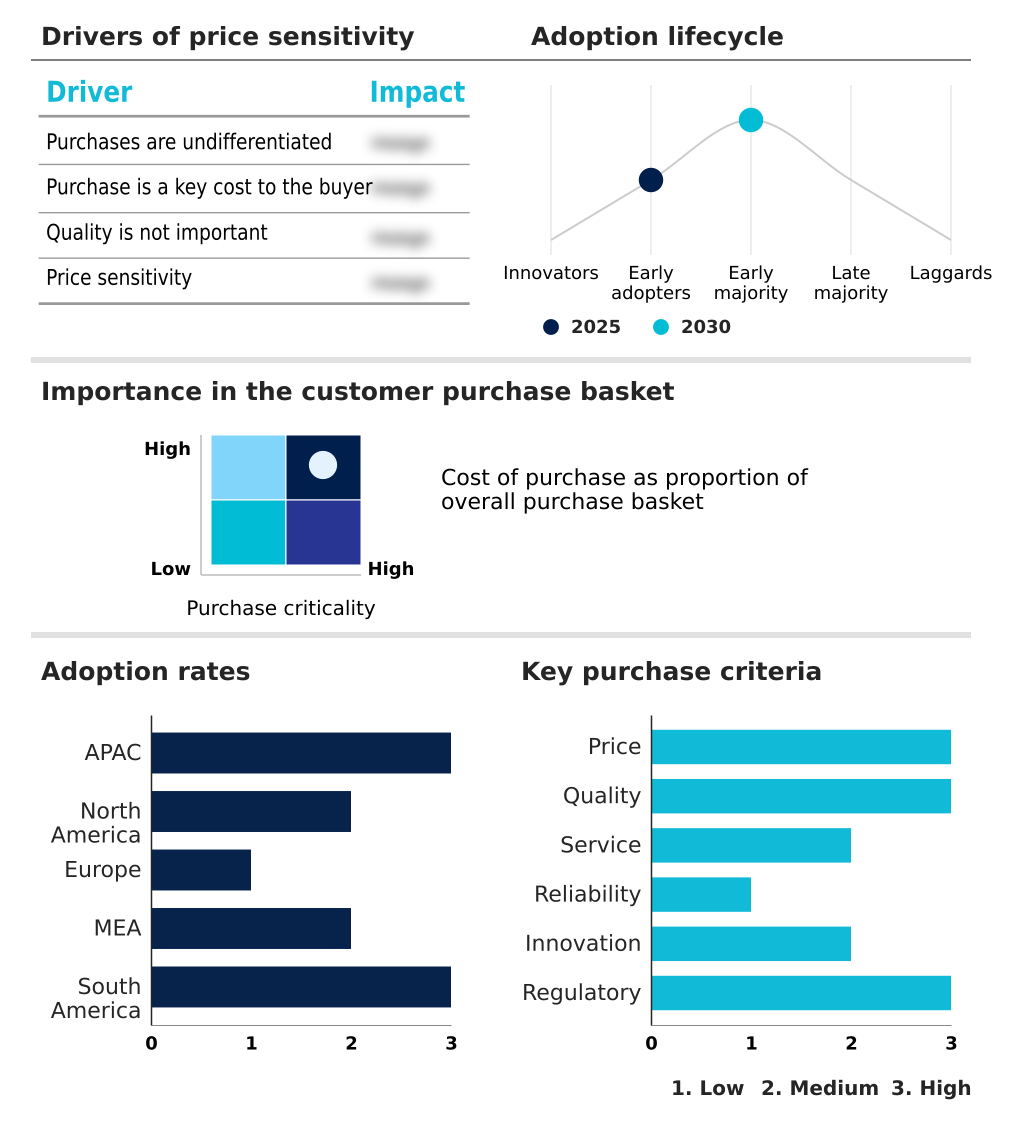
Customer Landscape of Cargo Transportation Industry
Competitive Landscape
Companies are implementing various strategies, such as strategic alliances, cargo transportation market forecast, partnerships, mergers and acquisitions, geographical expansion, and product/service launches, to enhance their presence in the industry.
Agility Global PLC - Offerings include multimodal cargo transportation, freight forwarding, and integrated logistics support services, enabling comprehensive end-to-end supply chain management for global trade.
The industry research and growth report includes detailed analyses of the competitive landscape of the market and information about key companies, including:
- Agility Global PLC
- AP Moller Maersk AS
- Bollore Logistics
- C H Robinson Worldwide Inc.
- CEVA Logistics SA
- CMA CGM Group
- DB Schenker
- DHL International GmbH
- DSV AS
- Expeditors International Inc.
- FedEx Corp.
- GEODIS
- Hapag Lloyd AG
- Hellmann Worldwide Logistics
- KLN Logistics Group Ltd.
- Kuehne Nagel Management AG
- Nippon Express Holdings Inc.
- United Parcel Service Inc.
- XPO Inc.
- Yusen Logistics Co. Ltd.
Qualitative and quantitative analysis of companies has been conducted to help clients understand the wider business environment as well as the strengths and weaknesses of key industry players. Data is qualitatively analyzed to categorize companies as pure play, category-focused, industry-focused, and diversified; it is quantitatively analyzed to categorize companies as dominant, leading, strong, tentative, and weak.
Recent Development and News in Cargo transportation market
- In May 2025, FedEx Express officially inaugurated a new regional distribution center in South Korea to facilitate faster cross-border trade between Asia and North America.
- In October 2025, a major consortium of European maritime operators and technology firms launched a unified digital platform designed to standardize data exchange across diverse shipping lines.
- In July 2025, Aurora Innovation officially expanded its commercial autonomous trucking service to include a major freight lane between Dallas and Houston using a fleet of Class Eight trucks.
- In June 2025, the European Union officially began the enforcement of the FuelEU Maritime regulation, mandating a progressive reduction in the greenhouse gas intensity of energy used on board ships.
Dive into Technavio’s robust research methodology, blending expert interviews, extensive data synthesis, and validated models for unparalleled Cargo Transportation Market insights. See full methodology.
| Market Scope | |
|---|---|
| Page number | 322 |
| Base year | 2025 |
| Historic period | 2020-2024 |
| Forecast period | 2026-2030 |
| Growth momentum & CAGR | Accelerate at a CAGR of 5.9% |
| Market growth 2026-2030 | USD 427.1 billion |
| Market structure | Fragmented |
| YoY growth 2025-2026(%) | 5.7% |
| Key countries | China, India, Japan, Australia, South Korea, Indonesia, US, Canada, Mexico, Germany, UK, France, Italy, Spain, The Netherlands, Saudi Arabia, UAE, South Africa, Turkey, Israel, Brazil, Argentina and Colombia |
| Competitive landscape | Leading Companies, Market Positioning of Companies, Competitive Strategies, and Industry Risks |
Research Analyst Overview
- The cargo transportation market is navigating a complex transformation, balancing operational expenditure with innovation. Core operations like freight forwarding and multimodal transport are being redefined by technology. Digital freight brokerage and predictive supply chain modeling are boosting asset utilization, while digital twin technology provides enhanced supply chain visibility. Investments in infrastructure, such as a dedicated freight corridor, are vital.
- The rise of e-commerce has amplified the need for efficient last-mile delivery, cross-border e-commerce logistics, and robust reverse logistics solutions. Sustainability is a major focus, driving the adoption of green hydrogen propulsion, sustainable aviation fuels, zero-emission vessels, and even hydrotreated vegetable oil, alongside initiatives like shore-to-ship power. Technologies like real-time shipment tracking and electronic bills of lading are becoming standard.
- In specialized sectors, cold chain logistics and the use of refrigerated cargo container systems are critical, as is the handling of unique cargo with a heavy-lift transport vessel. Operational shifts toward less-than-truckload services and autonomous freight solutions are underway, supported by automated port terminals and automated sorting facility infrastructure, which have shown to improve processing speeds by over 20%.
- Managing inventory management systems amidst the geopolitical volatility impact is a key challenge, impacting everything from bulk commodity shipping to transshipment hub operations and the customs clearance process.
What are the Key Data Covered in this Cargo Transportation Market Research and Growth Report?
-
What is the expected growth of the Cargo Transportation Market between 2026 and 2030?
-
USD 427.1 billion, at a CAGR of 5.9%
-
-
What segmentation does the market report cover?
-
The report is segmented by Mode of Transportation (Road freight, Sea freight, Rail freight, Air freight, and Others), End-user (Retail and e-commerce, Manufacturing and automotive, Energy and oil and gas, Agriculture and food products, and Others), Type (Dry cargo, Liquid bulk, Dry bulk, Refrigerated cargo, and Special cargo) and Geography (APAC, North America, Europe, Middle East and Africa, South America)
-
-
Which regions are analyzed in the report?
-
APAC, North America, Europe, Middle East and Africa and South America
-
-
What are the key growth drivers and market challenges?
-
Escalation of global cross-border e-commerce transactions, Stricter environmental mandates and cost of decarbonization
-
-
Who are the major players in the Cargo Transportation Market?
-
Agility Global PLC, AP Moller Maersk AS, Bollore Logistics, C H Robinson Worldwide Inc., CEVA Logistics SA, CMA CGM Group, DB Schenker, DHL International GmbH, DSV AS, Expeditors International Inc., FedEx Corp., GEODIS, Hapag Lloyd AG, Hellmann Worldwide Logistics, KLN Logistics Group Ltd., Kuehne Nagel Management AG, Nippon Express Holdings Inc., United Parcel Service Inc., XPO Inc. and Yusen Logistics Co. Ltd.
-
Market Research Insights
- Market dynamics are shaped by a push for greater supply chain resilience and efficiency. Firms are implementing logistics network optimization and advanced logistics data analytics to improve end-to-end supply chain performance, with some achieving a 15% reduction in fuel consumption reduction. The focus on decarbonization of logistics is encouraging modal shift strategies toward rail freight connectivity and pipeline transport systems.
- Managing e-commerce fulfillment, automotive supply chain, and pharmaceutical logistics requires high schedule reliability and robust supply chain transparency. Smart port technology and better cargo handling efficiency are crucial for port congestion management, reducing wait times by over 10%. Meanwhile, road haulage operations and air cargo capacity are strained by labor deficit management and the tariff policy impact.
- Addressing challenges in regulatory compliance and cybersecurity in logistics is paramount for all stakeholders, from freight consolidation specialists to operators of maritime shipping routes. Predictive maintenance and optimized intermodal container transfer are key to boosting operational throughput in this competitive environment.
We can help! Our analysts can customize this cargo transportation market research report to meet your requirements.
 RIA -
RIA - 
