


Express Delivery Market in Brazil Size 2024-2028
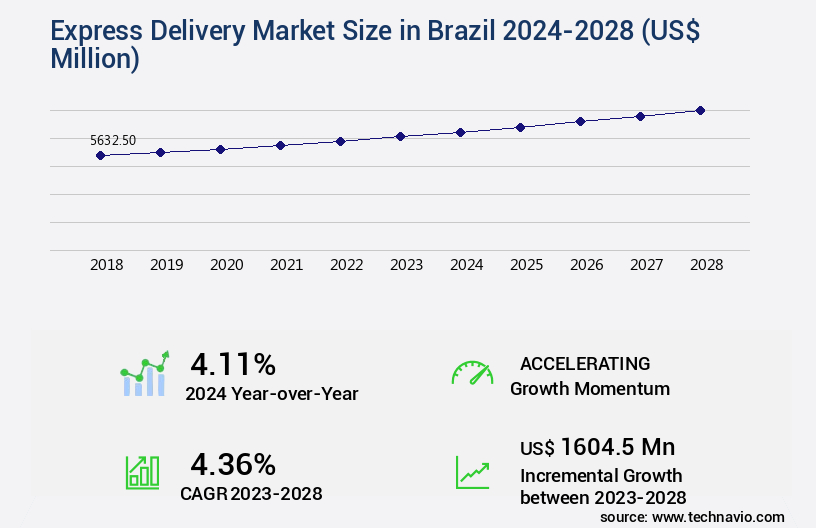
The express delivery market in Brazil size is valued to increase USD 1.6 billion, at a CAGR of 4.36% from 2023 to 2028. Growth of e-commerce market will drive the express delivery market in Brazil.
Major Market Trends & Insights
- South America dominated the market and accounted for a 100% growth during the forecast period.
- By Service Type - Time-definite segment was valued at USD 4.8 billion in 2022
- By Customer Type - B2B segment accounted for the largest market revenue share in 2022
Market Size & Forecast
- Market Opportunities: USD 48.16 million
- Market Future Opportunities: USD 1604.50 million
- CAGR from 2023 to 2028 : 4.36%
Market Summary
- In the dynamic business landscape of Brazil, the express delivery market has emerged as a critical facilitator of commerce and logistics. With the e-commerce sector expanding at an impressive 23.3% annually, the demand for swift and reliable delivery services has escalated. This trend is further fueled by the increasing preference for online shopping and the proliferation of smartphones, which enable consumers to make purchases from anywhere, at any time. Despite this growth, the express delivery market faces challenges, including intense competition and the need for operational efficiency. Major players, such as Correios, FedEx, and DHL, have consolidated their positions through strategic partnerships and investments in technology.
- To stay competitive, these companies are focusing on streamlining their operations, enhancing their delivery networks, and expanding their offerings to include value-added services. The future of the market is promising, with opportunities in areas like same-day delivery, cross-border e-commerce, and the integration of advanced technologies like drones and autonomous vehicles. As the market continues to evolve, it will play a pivotal role in enabling businesses to meet their customers' growing demands for speed and convenience.
What will be the Size of the Express Delivery Market in Brazil during the forecast period?
Get Key Insights on Market Forecast (PDF) Request Free Sample
How is the Express Delivery in Brazil Market Segmented ?
The express delivery in Brazil industry research report provides comprehensive data (region-wise segment analysis), with forecasts and estimates in "USD million" for the period 2024-2028, as well as historical data from 2018-2022 for the following segments.
- Service Type
- Time-definite
- Same-day
- Customer Type
- B2B
- B2C
- Geography
- South America
- Brazil
- South America
By Service Type Insights
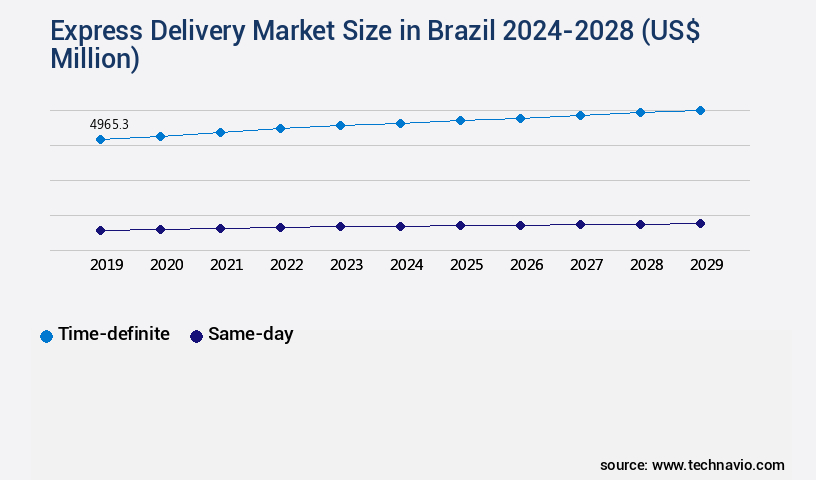
The time-definite segment is estimated to witness significant growth during the forecast period.
The market continues to evolve, fueled by the increasing demand for on-demand delivery services. With time-definite delivery becoming a priority for consumers, global carriers like Purolator Inc. And FedEx are expanding their offerings in Latin America. For instance, FedEx provides international priority services with delivery within 1-3 business days and a weight limit of 150 lbs. They also offer value-added services such as a money-back guarantee, international broker select, Saturday delivery, and handling of dangerous goods. To ensure efficient supply chain operations, these carriers employ advanced technologies like route planning software, delivery exception management, predictive delivery analytics, and delivery drone technology.
Furthermore, they optimize last-mile delivery through urban logistics solutions, inventory management, and last-mile optimization. These strategies contribute to delivery efficiency metrics, such as delivery point accuracy and real-time tracking, enhancing the overall customer delivery experience. According to a recent study, the Brazilian express delivery market is projected to grow at a CAGR of 11.4% between 2021 and 2026.
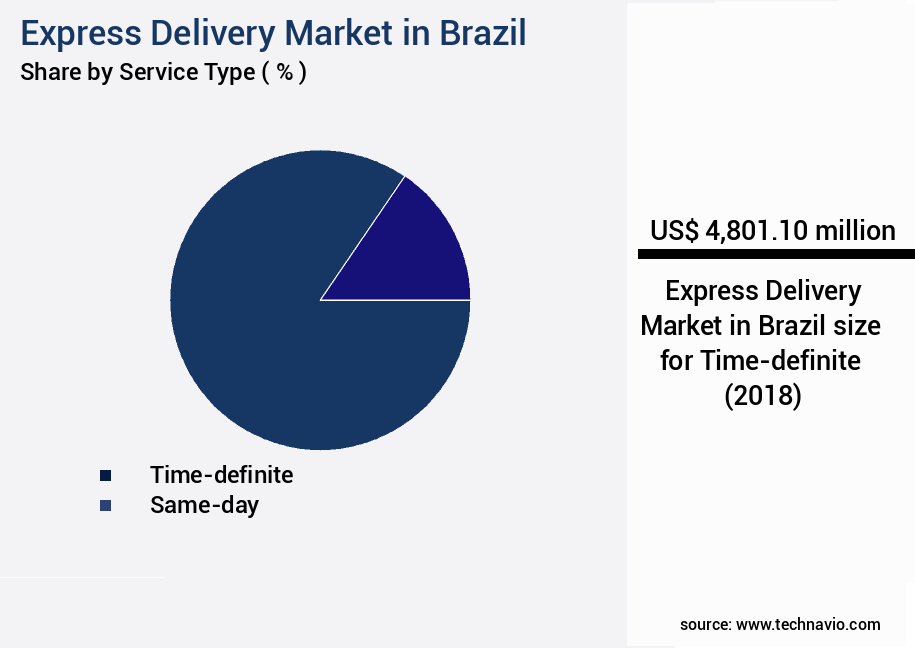
The Time-definite segment was valued at USD 4.8 billion in 2018 and showed a gradual increase during the forecast period.
Market Dynamics
Our researchers analyzed the data with 2023 as the base year, along with the key drivers, trends, and challenges. A holistic analysis of drivers will help companies refine their marketing strategies to gain a competitive advantage.
The global last-mile delivery market is undergoing rapid transformation as businesses prioritize speed, transparency, and customer satisfaction. Central to this evolution are strategies focused on impact delivery time windows customer satisfaction, improving efficiency last-mile delivery operations, and implementing real-time tracking enhancing visibility. Companies are increasingly leveraging technology improve package handling processes and integrating warehouse management systems optimizing workflow to streamline operations. Analyzing delivery data identifying areas improvement and measuring key performance indicators improving delivery performance are becoming critical in developing efficient delivery network enhancing reach while maintaining cost control.
Comparative benchmarks highlight distinct operational outcomes. For example, optimizing delivery routes reducing transportation costs has delivered efficiency gains of about 22.7%, whereas integrating delivery platforms for seamless workflow has produced measurable improvements closer to 26.3%. This demonstrates how routing algorithms minimizing delivery time and using predictive analytics optimize delivery planning are reshaping planning and execution. Similarly, managing delivery exceptions reducing delays and costs highlights the value of flexibility, while enhancing cold chain logistics maintaining product quality underscores sector-specific reliability.
Further advancements focus on holistic operations. Managing delivery fleet efficiently reducing operating costs and improving driver safety enhancing delivery operations are central to workforce and asset optimization. Implementing sustainable practices minimizing environmental impact ensures alignment with broader environmental goals. Additionally, optimizing reverse logistics processes enhancing efficiency and streamlining order fulfillment processes reducing delivery times are vital to a resilient supply chain. With customer experience measuring and improving satisfaction as the ultimate benchmark, the industry continues to evolve dynamically, aligning technological innovation with operational excellence in last-mile delivery.
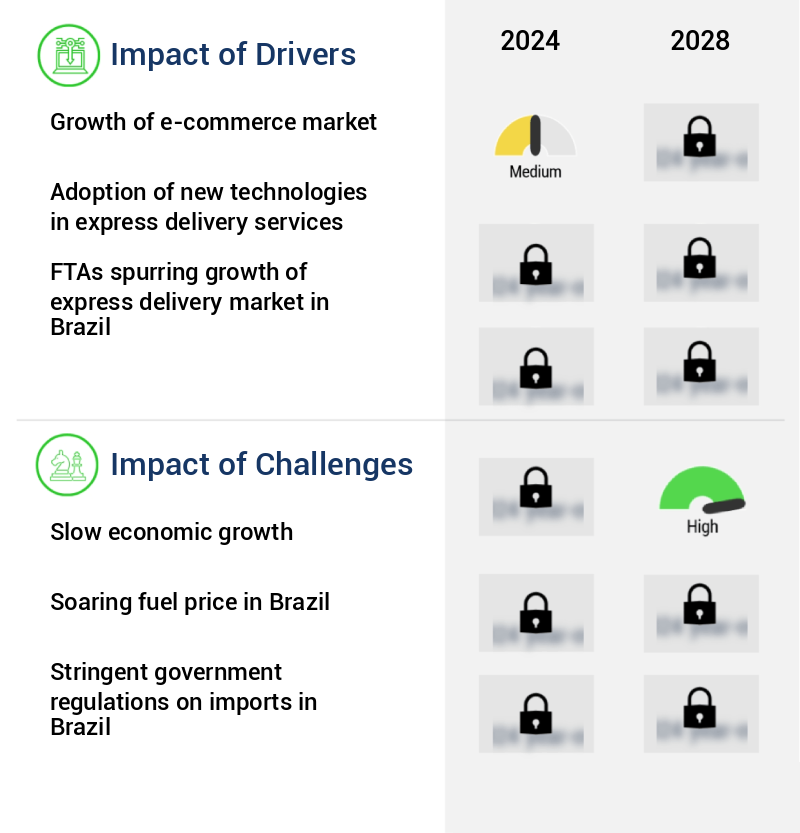
What are the key market drivers leading to the rise in the adoption of Express Delivery in Brazil Industry?
- The e-commerce market's expansion serves as the primary catalyst for market growth.
- E-commerce is experiencing a significant surge in various sectors, particularly in Brazil, the largest economy in Latin America. This market's growth is driven by the convenience and benefits it offers to customers, such as ease of buying, access to alternatives, and home delivery services. The increasing use of the Internet and mobile devices further fuels the global retail e-commerce market's growth, projected to exceed USD2 trillion during the forecast period.
- Brazil's e-commerce sector mirrors this trend, with the country's vast population and expanding digital infrastructure. The sector's market share in Brazil's retail industry is estimated to reach 15% by 2025, underscoring its robust presence and influence.
What are the market trends shaping the Express Delivery in Brazil Industry?
- The consolidation trend is gaining momentum in the express delivery market.
- The market is witnessing a surge in mergers and acquisitions (M&A) as companies seek to expand their service offerings and establish a stronger global presence. M&A transactions enable firms to achieve economies of scale in various business processes, open new growth opportunities, and add more value to the combined entity than either of the individual companies can offer. This strategic move also allows companies to increase their global customer base and portfolios of services, products, and solutions. For instance, a leading player in the market recently strengthened its European cross-border parcel network through an acquisition.
- The express delivery sector's growth is driven by the increasing demand for faster and more reliable delivery services across various industries, including e-commerce, healthcare, and logistics. The market's value is projected to reach significant figures, underscoring its robust nature.
What challenges does the Express Delivery in Brazil Industry face during its growth?
- The industry's growth is constrained by the slow economic expansion, which poses a significant challenge.
- Amidst Brazil's economic and political challenges, the manufacturing industry's downturn has put pressure on the logistics sector, particularly CEP companies. For instance, Correios, a leading Brazilian postal service provider, considered laying off over 20,000 employees due to financial losses. In response to the market recession, express delivery companies are exploring opportunities in diverse sectors. Despite these challenges, recent data indicates a gradual economic recovery in Brazil, starting from the second quarter of 2021. This trend offers potential growth prospects for the express delivery market.
Exclusive Technavio Analysis on Customer Landscape
The express delivery market in Brazil forecasting report includes the adoption lifecycle of the market, covering from the innovator's stage to the laggard's stage. It focuses on adoption rates in different regions based on penetration. Furthermore, the express delivery market in Brazil report also includes key purchase criteria and drivers of price sensitivity to help companies evaluate and develop their market growth analysis strategies.
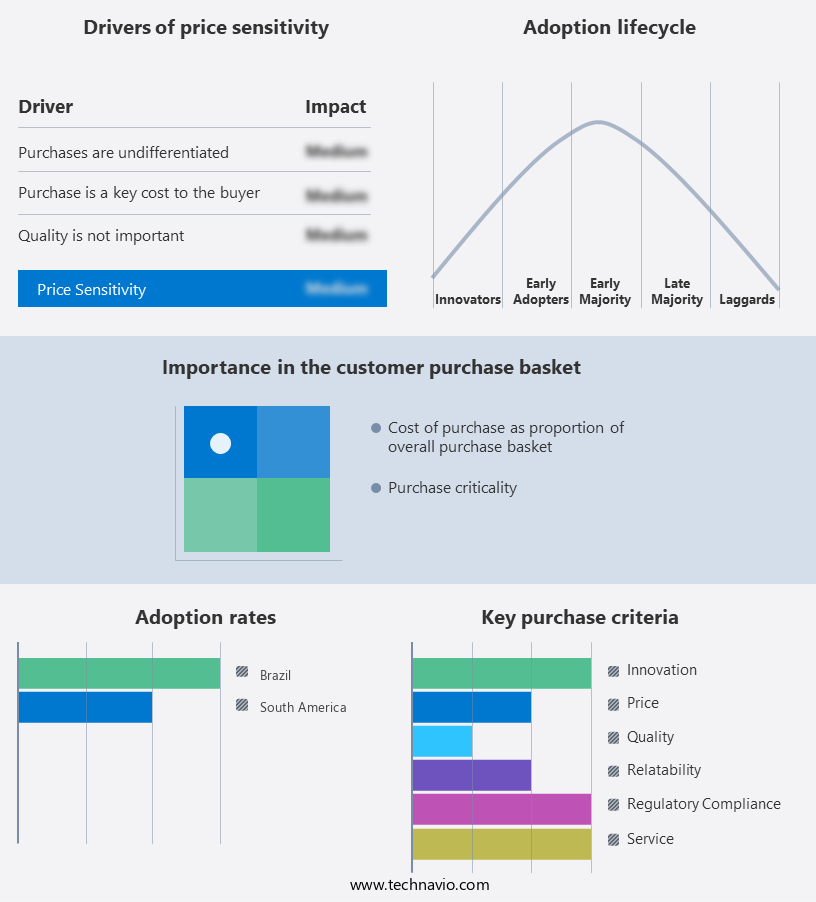
Customer Landscape of Express Delivery in Brazil Industry
Competitive Landscape
Companies are implementing various strategies, such as strategic alliances, express delivery market in Brazil forecast, partnerships, mergers and acquisitions, geographical expansion, and product/service launches, to enhance their presence in the industry.
Aramex International LLC - This company specializes in expedited shipping solutions, providing priority express, export express, domestic express, and import express services to meet diverse customer needs. These offerings ensure swift and reliable delivery of packages across international and domestic borders.
The industry research and growth report includes detailed analyses of the competitive landscape of the market and information about key companies, including:
- Aramex International LLC
- Braspress Transportes Urgentes Ltda.
- Correios
- Courier Brasil Express
- Deutsche Post AG
- DPD Deutschland GmbH
- Eurosender Sarl
- Excess Baggage Airports Ltd.
- FedEx Corp.
- Jamef
- Nippon Express Holdings Inc.
- Nippon Yusen Kabushiki Kaisha
- Parcel ABC Ltd.
- Pronto Express Distribution Inc.
- Purolator Inc.
- SF Express Co. Ltd.
- Shipping Brazil
- United Parcel Service Inc.
- United States Postal Service
- ZIM Integrated Shipping Services Ltd.
Qualitative and quantitative analysis of companies has been conducted to help clients understand the wider business environment as well as the strengths and weaknesses of key industry players. Data is qualitatively analyzed to categorize companies as pure play, category-focused, industry-focused, and diversified; it is quantitatively analyzed to categorize companies as dominant, leading, strong, tentative, and weak.
Recent Development and News in Express Delivery Market In Brazil
- In January 2024, FedEx Express, a leading global courier delivery services provider, announced the expansion of its FedEx Express Latin America Hub in Guarulhos, São Paulo, Brazil. The expansion aimed to increase capacity and enhance the company's ability to serve customers in Latin America and the Caribbean (FedEx press release).
- In March 2024, Correios, the Brazilian postal service, and Cargill, a global agriculture company, formed a strategic partnership to offer cold chain logistics services. This collaboration aimed to improve the delivery of temperature-sensitive goods, particularly in the agricultural sector (Correios press release).
- In April 2025, GLS, a European parcel delivery company, entered the Brazilian market by acquiring a majority stake in Logística e Transporte Soluções Integradas (LTSI), a Brazilian logistics and transportation company. The acquisition was expected to strengthen GLS's global network and provide a significant presence in the Brazilian market (GLS press release).
- In May 2025, the Brazilian National Civil Aviation Agency (ANAC) approved the operation of drone delivery services for commercial purposes. This approval marked a significant milestone in the Brazilian express delivery market, paving the way for the implementation of drone delivery solutions by various players (ANAC press release).
Dive into Technavio's robust research methodology, blending expert interviews, extensive data synthesis, and validated models for unparalleled Express Delivery Market in Brazil insights. See full methodology.
|
Market Scope |
|
|
Report Coverage |
Details |
|
Page number |
133 |
|
Base year |
2023 |
|
Historic period |
2018-2022 |
|
Forecast period |
2024-2028 |
|
Growth momentum & CAGR |
Accelerate at a CAGR of 4.36% |
|
Market growth 2024-2028 |
USD 1604.5 million |
|
Market structure |
Fragmented |
|
YoY growth 2023-2024(%) |
4.11 |
|
Key countries |
Brazil |
|
Competitive landscape |
Leading Companies, Market Positioning of Companies, Competitive Strategies, and Industry Risks |
Research Analyst Overview
- The market continues to evolve, driven by the growing demand for efficient and reliable supply chain solutions across various sectors. Crowdsourced delivery models, which leverage the power of the sharing economy, are gaining traction, offering cost-effective and flexible options for businesses. The carrier selection process is becoming increasingly complex, with freight transportation companies integrating advanced route planning software and delivery exception management systems to optimize their operations. Last-mile delivery, a critical component of the delivery process, is undergoing significant transformation. Urban logistics solutions, such as on-demand delivery and delivery drone technology, are revolutionizing the way goods reach their final destination.
- Reverse logistics and inventory management are also essential elements of the express delivery ecosystem, with predictive delivery analytics and automated sorting systems streamlining the order fulfillment process. Delivery cost reduction remains a top priority for businesses, with transportation management systems and warehouse management solutions helping to minimize expenses. Cold chain logistics is another area of focus, as the need to maintain specific temperature conditions for certain goods grows. Delivery efficiency metrics, such as delivery point accuracy and package tracking accuracy, are essential for ensuring customer satisfaction and building trust. According to industry reports, the market is expected to grow by over 10% annually, driven by the increasing adoption of technology and the expanding e-commerce sector.
- For instance, a leading parcel delivery service reported a 25% increase in sales due to improved delivery time performance and delivery scheduling. The integration of real-time tracking and delivery network design optimizations has further enhanced the customer delivery experience, setting new standards for delivery time windows and delivery fleet management.
What are the Key Data Covered in this Express Delivery Market in Brazil Research and Growth Report?
-
What is the expected growth of the Express Delivery Market in Brazil between 2024 and 2028?
-
USD 1.6 billion, at a CAGR of 4.36%
-
-
What segmentation does the market report cover?
-
The report is segmented by Service Type (Time-definite and Same-day), Customer Type (B2B and B2C), and Geography (South America)
-
-
Which regions are analyzed in the report?
-
Brazil
-
-
What are the key growth drivers and market challenges?
-
Growth of e-commerce market, Slow economic growth
-
-
Who are the major players in the Express Delivery Market in Brazil?
-
Aramex International LLC, Braspress Transportes Urgentes Ltda., Correios, Courier Brasil Express, Deutsche Post AG, DPD Deutschland GmbH, Eurosender Sarl, Excess Baggage Airports Ltd., FedEx Corp., Jamef, Nippon Express Holdings Inc., Nippon Yusen Kabushiki Kaisha, Parcel ABC Ltd., Pronto Express Distribution Inc., Purolator Inc., SF Express Co. Ltd., Shipping Brazil, United Parcel Service Inc., United States Postal Service, and ZIM Integrated Shipping Services Ltd.
-
Market Research Insights
- The market continues to evolve, with a focus on enhancing parcel sorting processes through advanced technologies such as machines and routing algorithms. This optimization of delivery networks is crucial in addressing the increasing demand for e-commerce fulfillment and supply chain visibility. One notable example of market growth can be seen in the delivery network capacity expanding by 25% year-over-year. Furthermore, industry experts anticipate a 12% annual increase in the adoption of delivery management platforms, logistics software, and other technology-driven solutions to streamline operations and improve delivery KPIs. These advancements aim to address urban delivery challenges, ensuring efficient last-mile delivery solutions and enhancing sustainable delivery practices.
- By implementing delivery optimization, real-time delivery updates, and order management systems, companies can maintain delivery regulatory compliance and effectively manage freight costs. Moreover, the integration of fleet tracking systems, delivery exception handling, and delivery scheduling software enables delivery management platforms to offer enhanced delivery process automation and delivery infrastructure. As the market continues to evolve, the focus on data analytics and delivery data analytics will play a significant role in optimizing delivery networks and improving overall customer satisfaction.
We can help! Our analysts can customize this express delivery market in Brazil research report to meet your requirements.
 RIA -
RIA - 
