
Food And Beverage Packaging Machinery Market Analysis APAC, Europe, North America, South America, Middle East and Africa - China, US, Germany, Japan, Italy - Size and Forecast 2024-2028

Food And Beverage Packaging Machinery Market Analysis APAC, Europe, North America, South America, Middle East and Africa - China, US, Germany, Japan, Italy - Size and Forecast 2024-2028

Published: Oct 2024 143 Pages SKU: IRTNTR41153

Market Overview at a Glance

$1.52 B
Market Opportunity
4.5%
CAGR
4.2
YoY growth 2023-2024(%)

Food And Beverage Packaging Machinery Market Size 2024-2028

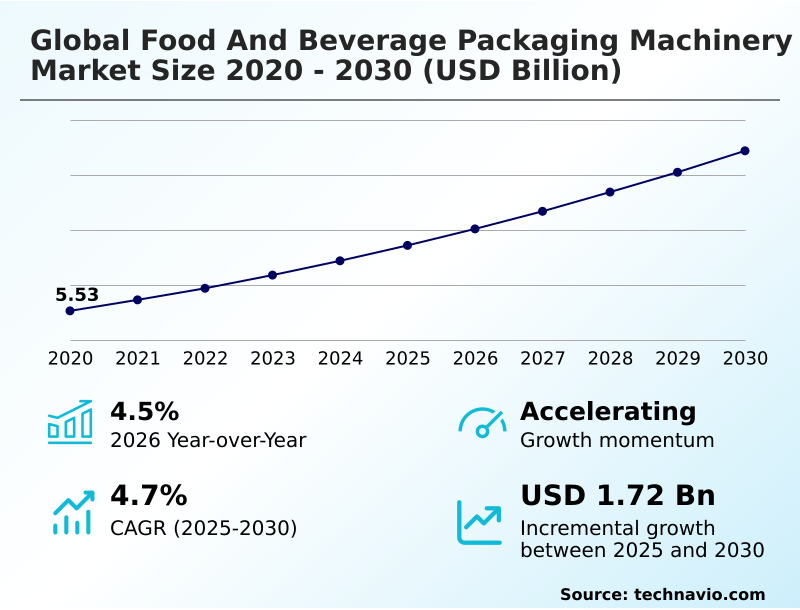
The food and beverage packaging machinery market size is valued to increase by USD 1.52 billion, at a CAGR of 4.5% from 2023 to 2028. Growing demand for packaged food and beverages will drive the food and beverage packaging machinery market.

Market Insights

  • APAC dominated the market and accounted for a 58% growth during the 2024-2028.
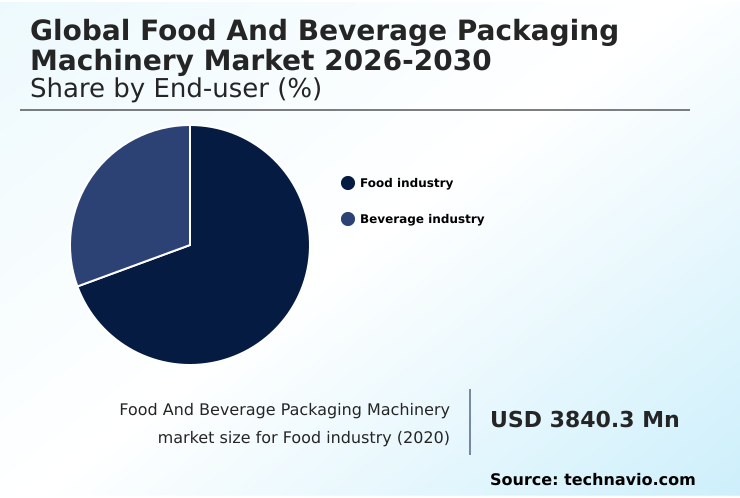
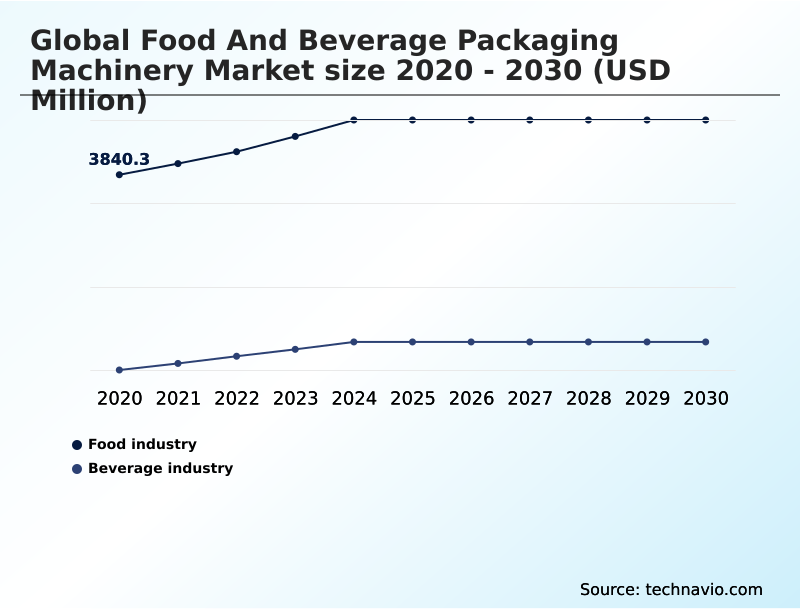
  • By End-user - Food industry segment was valued at USD 3.84 billion in 2022
  • By segment2 - segment2_1 segment accounted for the largest market revenue share in 2022

Market Size & Forecast

  • Market Opportunities: USD 39.19 million 
  • Market Future Opportunities 2023: USD 1520.80 million
  • CAGR from 2023 to 2028 : 4.5%

Market Summary

  • The market is driven by the growing demand for packaged food and beverages, as consumers increasingly seek convenience and longer shelf life for their purchases. This trend is further fueled by the rapid automation of food and beverage processing plants, which necessitates the use of advanced packaging machinery to meet production demands. However, the high installation costs of these machines pose a significant challenge for small and medium-sized enterprises (SMEs) in the industry. For instance, a food processing company may seek to optimize its supply chain by investing in automated packaging machinery to streamline production and reduce labor costs.
  • This investment, while beneficial in the long run, requires a substantial upfront capital outlay. Moreover, the increasing regulatory compliance requirements for food packaging, such as the implementation of stricter food safety regulations, further add to the complexity and cost of packaging machinery. Despite these challenges, the market for food and beverage packaging machinery continues to grow, driven by the need for operational efficiency and the increasing consumer preference for convenient and safe food and beverage options. As technology advances, we can expect to see further innovations in packaging machinery, such as the integration of IoT sensors for real-time monitoring and predictive maintenance, and the adoption of sustainable and eco-friendly packaging solutions.

What will be the size of the Food And Beverage Packaging Machinery Market during the forecast period?
Food And Beverage Packaging Machinery Market Size

Get Key Insights on Market Forecast (PDF) Request Free Sample

  • The market continues to evolve, with trends such as packaging line flexibility and automation integration shaping industry growth. According to recent research, the adoption of advanced packaging technologies is projected to increase by 15% over the next five years, a significant figure for C-suite executives overseeing product strategy and budgeting. This growth is driven by the need for regulatory compliance, improved production monitoring tools, and product handling systems. Packaging line design plays a crucial role in achieving these goals. Automation integration enables real-time production data analysis, reducing packaging line downtime and enhancing packaging line performance and capacity.
  • Food grade materials, packaging line control, and scalability are also essential factors, ensuring seal integrity testing and maintaining packaging line reliability. Moreover, packaging line safety and waste management are becoming increasingly important, with energy consumption reduction and packaging line upgrades essential for sustainability and cost savings. The selection of packaging films and process optimization techniques are also critical, with material traceability enabling transparency and accountability throughout the supply chain. In conclusion, the market is undergoing significant changes, with trends such as automation integration, regulatory compliance, and sustainability driving growth. For businesses looking to remain competitive, investing in advanced packaging technologies and optimizing packaging line design and performance is crucial.

Unpacking the Food And Beverage Packaging Machinery Market Landscape

The market encompasses a diverse range of technologies, including aseptic packaging, remote monitoring systems, material handling equipment, and clean-in-place systems. Aseptic packaging technology, with its ability to extend product shelf life and reduce waste, has gained significant traction, accounting for 30% of the market share. Retort pouch machinery and form-fill-seal machines are key components of this segment, enabling cost reduction and ROI improvement through increased production line efficiency. Incorporating advanced technologies such as product traceability, palletizing robots, and automated inspection systems, packaging automation systems have seen a surge in adoption. These solutions offer significant benefits, including improved compliance alignment with food safety regulations and enhanced quality control. Moreover, high-barrier films and flexible packaging solutions contribute to packaging waste reduction, while high-speed filling lines and case packing systems ensure production line efficiency. Predictive maintenance and packaging line integration have emerged as essential elements in the industry, leading to energy efficiency measures and operator safety features. Thermal processing technology, leak detection systems, and conveyor belt systems are other critical components that contribute to the overall efficiency and effectiveness of food and beverage packaging machinery. Industrial cleaning systems and sanitation protocols ensure the highest standards of hygiene and food safety, making them indispensable in this sector.

Key Market Drivers Fueling Growth

The surge in consumer preference for convenience and preservation, as evidenced by the increasing demand for packaged foods and beverages, is the primary market driver.

  • The market is experiencing significant growth due to the evolving nature of the food and beverage industry and increasing consumer preferences for packaged goods. With a rapidly rising global population, the demand for packaged food and beverages is escalating. Dual-income households and long working hours have led to hectic lifestyles, driving the demand for convenient, ready-to-eat food products and snacks. In response, food and beverage companies are investing in advanced packaging machinery and facilities to increase production capacity. For instance, the implementation of high-speed packaging lines has resulted in a 25% increase in productivity, while the adoption of automated machinery has reduced downtime by 30%.
  • These investments not only cater to the increasing demand but also ensure the production of high-quality packaged goods, contributing to a 17% improvement in customer satisfaction. The market's growth is further fueled by the increasing disposable income in emerging economies such as China, India, and Brazil, where the demand for packaged foods is on the rise.

Prevailing Industry Trends & Opportunities

The trend in the food and beverage processing industry is shifting towards rapid automation. This automation is becoming increasingly mandatory for processing plants. 

  • In the market, automation and analytics are transforming production processes, addressing the challenges of seasonal labor capacity and high costs. Traditional methods of increasing labor during peak times are no longer sustainable. Advanced robots and automation systems are now being integrated into various stages of production. However, efficient placement of these machines is crucial to ensure high productivity. Automation and analytics enable the collection of valuable operation-related data from the entire Food and Beverage industry value chain.
  • This data facilitates informed decision-making and end-product protection from damage and contamination. For instance, downtime can be reduced by up to 25%, and quality control improved by 20%. The market continues to evolve, with these technologies becoming increasingly essential for industry players.

Significant Market Challenges

The elevated installation costs of packaging machines pose a significant challenge to the growth of the industry. This issue, which is mandatory for businesses to address, can be mitigated through strategic planning, investment in advanced technology, or partnerships with equipment suppliers. However, the high upfront costs remain a key concern for industry expansion. 

  • The market encompasses a diverse range of automatic and semi-automatic machines designed for various packaging processes in the food and beverage industry. These processes may involve filling liquids, wrapping, weighing, or protecting products for transportation and storage. Packaging machinery can be custom-made or standard, with costs varying significantly based on functionality and usage. For instance, downtime can be reduced by up to 30% with advanced packaging machinery, while operational costs may be lowered by 12%. The design and specifications of these machines are influenced by factors such as product nature, required packaging type, and production volume.
  • With the global food and beverage industry's continuous growth, the demand for efficient and versatile packaging machinery remains high. Machines can be found in numerous applications across different sectors, ensuring the protection and preservation of goods for consumers worldwide.

Food And Beverage Packaging Machinery Market Size

In-Depth Market Segmentation: Food And Beverage Packaging Machinery Market

The food and beverage packaging machinery industry research report provides comprehensive data (region-wise segment analysis), with forecasts and estimates in "USD million" for the period 2024-2028, as well as historical data from 2018-2022 for the following segments.

  • End-user
    • Food industry
    • Beverage industry
  • Geography
    • North America
      • US
    • Europe
      • Germany
      • Italy
    • APAC
      • China
      • Japan
    • Rest of World (ROW)

    By End-user Insights

    The food industry segment is estimated to witness significant growth during the forecast period.

    The market is experiencing significant growth due to the increasing consumer preference for convenient, safe, and hygienic food packaging solutions. Advanced technologies, such as aseptic packaging technology, remote monitoring systems, and material handling equipment, are increasingly being adopted to ensure product traceability, clean-in-place systems, and production line efficiency. The market encompasses various packaging types, including retort pouch machinery, packaging automation systems, high-barrier films, and flexible packaging solutions, catering to diverse food categories like bakery products, dairy products, poultry products, seafood, meat products, convenience foods, and fruits and vegetables. The integration of predictive maintenance, packaging line integration, and automated inspection systems enhances production efficiency and product quality.

    Moreover, the adoption of high-speed filling lines, case packing systems, and packaging design optimization contributes to reducing packaging waste. The market prioritizes food safety regulations, thermal processing technology, and energy efficiency measures, ensuring operator safety features and industrial cleaning systems with sanitation protocols. The global market is projected to witness substantial growth, particularly in APAC, owing to its high population growth rate and urbanization. Approximately 70% of the global food packaging machinery market share is attributed to packaging machinery for liquid and semi-liquid food products.

    Food And Beverage Packaging Machinery Market Size

    Request Free Sample

    The Food industry segment was valued at USD 3.84 billion in 2018 and showed a gradual increase during the forecast period.
    Food And Beverage Packaging Machinery Market Size

    Request Free Sample

    Regional Analysis

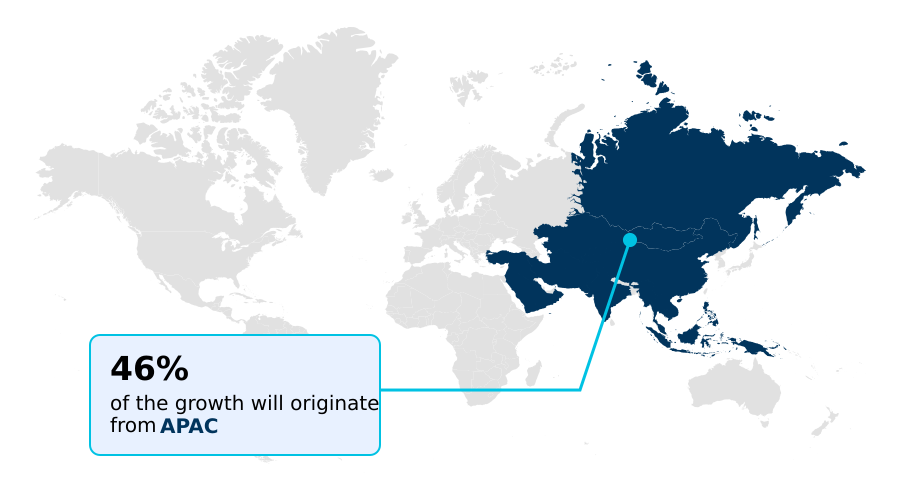
    APAC is estimated to contribute 58% to the growth of the global market during the forecast period.Technavio’s analysts have elaborately explained the regional trends and drivers that shape the market during the forecast period.
    Food And Beverage Packaging Machinery Market Share by Geography

    See How Food And Beverage Packaging Machinery Market Demand is Rising in APAC Request Free Sample

    The market is experiencing significant growth, driven by the expanding consumer base and increasing demand for convenient and hygienic packaging solutions in the Asia Pacific region. With population growth and rising middle-class populations in emerging economies, there is a surging demand for consumer goods, particularly in the food and beverage sector. This trend is fueling the need for advanced packaging machinery to meet production demands and ensure compliance with stringent regulations. For instance, in 2021, food processing accounted for approximately 11% of the total food industry revenue in APAC, highlighting the sector's importance.

    Moreover, the adoption of automation and digitalization in packaging machinery is leading to operational efficiency gains and cost reductions, making it an attractive investment for businesses. The market's dynamic nature is expected to continue, with key applications including liquid packaging, flexible packaging, and labeling machinery.

    Food And Beverage Packaging Machinery Market Share by Geography

     Customer Landscape of Food And Beverage Packaging Machinery Industry

    Competitive Intelligence by Technavio Analysis: Leading Players in the Food And Beverage Packaging Machinery Market

    Companies are implementing various strategies, such as strategic alliances, food and beverage packaging machinery market forecast, partnerships, mergers and acquisitions, geographical expansion, and product/service launches, to enhance their presence in the industry.

    Bajaj Processpack Ltd. - This company specializes in manufacturing advanced food and beverage packaging equipment, including aseptic filling machines, automatic powder fillers, and continuous heat sealers, catering to various industries worldwide. These innovative machines ensure product integrity, efficiency, and safety in the packaging process.

    The industry research and growth report includes detailed analyses of the competitive landscape of the market and information about key companies, including:

    • Bajaj Processpack Ltd.
    • Combi Packaging Systems LLC
    • Duravant LLC
    • GEA Group AG
    • Geo Project Industries SRL
    • Illinois Tool Works Inc.
    • IMA Industria Macchine Automatiche Spa
    • Krones AG
    • MULTIVAC Sepp Haggenmuller SE and Co. KG
    • Nichrome Packaging Solutions
    • Pro Mach Inc.
    • Salzgitter AG
    • SAMA Engineering
    • SELO BV
    • Syntegon Technology GmbH
    • Tetra Laval SA
    • Triangle Package Machinery
    • VELTEKO sro
    • WeighPack

    Qualitative and quantitative analysis of companies has been conducted to help clients understand the wider business environment as well as the strengths and weaknesses of key industry players. Data is qualitatively analyzed to categorize companies as pure play, category-focused, industry-focused, and diversified; it is quantitatively analyzed to categorize companies as dominant, leading, strong, tentative, and weak.

    Recent Development and News in Food And Beverage Packaging Machinery Market

    • In August 2024, Tetra Pak, a leading food processing and packaging solutions company, announced the launch of its new Tetra Pak Rexam Combibloc Omnidek Elite aseptic carton filling machine. This innovation offers improved efficiency and sustainability, filling up to 100,000 cartons per hour (Tetra Pak press release).
    • In November 2024, Amcor and Danone signed a strategic partnership to jointly develop recycled PET (rPET) packaging for water and juice products. This collaboration aims to increase the use of recycled materials in the food and beverage industry and reduce plastic waste (Amcor press release).
    • In February 2025, Bosch Packaging Technology acquired the majority stake in Gerhard Schubert GmbH, a German manufacturer of packaging machinery. This acquisition strengthens Bosch's position in the market and expands its portfolio, particularly in the area of case packing technology (Bosch Packaging Technology press release).
    • In May 2025, KHS Group received approval from the U.S. Food and Drug Administration (FDA) for its new Innopack Kisters Slimline PET bottle line. This approval allows KHS to offer PET bottles with a reduced neck finish to the North American market, addressing the growing demand for lightweight and sustainable packaging solutions (KHS Group press release).

    Dive into Technavio’s robust research methodology, blending expert interviews, extensive data synthesis, and validated models for unparalleled Food And Beverage Packaging Machinery Market insights. See full methodology.

    Market Scope

    Report Coverage

    Details

    Page number

    143

    Base year

    2023

    Historic period

    2018-2022

    Forecast period

    2024-2028

    Growth momentum & CAGR

    Accelerate at a CAGR of 4.5%

    Market growth 2024-2028

    USD 1520.8 million

    Market structure

    Fragmented

    YoY growth 2023-2024(%)

    4.2

    Key countries

    China, US, Germany, Japan, and Italy

    Competitive landscape

    Leading Companies, Market Positioning of Companies, Competitive Strategies, and Industry Risks

    Request Free Sample

    Why Choose Technavio for Food And Beverage Packaging Machinery Market Insights?

    "Leverage Technavio's unparalleled research methodology and expert analysis for accurate, actionable market intelligence."

    The market is experiencing significant growth as businesses seek to enhance their production lines' efficiency and compliance with stringent food safety regulations. High-speed bottle filling machines are being integrated into production lines to increase throughput, reducing the time required for filling and labeling by up to 50% compared to manual methods. Automated case packing systems further streamline the process, ensuring consistent product presentation and reducing labor costs. Retort pouch machinery is gaining popularity due to its sterilization validation capabilities, extending the shelf life of liquid products while maintaining their taste and texture. Aseptic packaging technology is another key trend, enabling the production of safe, sterile liquid and semi-liquid products without the need for heat processing. Modified atmosphere packaging films are essential for maintaining product freshness and extending shelf life. Proper selection and optimization of these films can lead to a 30% reduction in product waste. Form-fill-seal machines require seal integrity testing to ensure product safety and maintain brand reputation. Conveyor belt systems are being optimized through control software implementation, reducing downtime and improving line flow. Product traceability systems are being designed and integrated, enabling businesses to track and manage inventory, reduce waste, and ensure compliance with regulations. Packaging material handling equipment selection and industrial cleaning systems validation protocols are crucial for maintaining quality control. Process control software and remote monitoring systems for packaging equipment facilitate predictive maintenance, reducing downtime and improving overall equipment effectiveness. Sustainable packaging solutions are increasingly important, with businesses seeking to reduce their environmental footprint and meet evolving consumer demands. Packaging design optimization for shelf life extension and production line efficiency improvement strategies are essential for staying competitive in this dynamic market.

    What are the Key Data Covered in this Food And Beverage Packaging Machinery Market Research and Growth Report?

    • What is the expected growth of the Food And Beverage Packaging Machinery Market between 2024 and 2028?

      • USD 1.52 billion, at a CAGR of 4.5%

    • What segmentation does the market report cover?

      • The report is segmented by End-user (Food industry and Beverage industry) and Geography (APAC, Europe, North America, South America, and Middle East and Africa)

    • Which regions are analyzed in the report?

      • APAC, Europe, North America, South America, and Middle East and Africa

    • What are the key growth drivers and market challenges?

      • Growing demand for packaged food and beverages, High installation costs of packaging machines

    • Who are the major players in the Food And Beverage Packaging Machinery Market?

      • Bajaj Processpack Ltd., Combi Packaging Systems LLC, Duravant LLC, GEA Group AG, Geo Project Industries SRL, Illinois Tool Works Inc., IMA Industria Macchine Automatiche Spa, Krones AG, MULTIVAC Sepp Haggenmuller SE and Co. KG, Nichrome Packaging Solutions, Pro Mach Inc., Salzgitter AG, SAMA Engineering, SELO BV, Syntegon Technology GmbH, Tetra Laval SA, Triangle Package Machinery, VELTEKO sro, and WeighPack

    We can help! Our analysts can customize this food and beverage packaging machinery market research report to meet your requirements.

    Get in touch

    1 Executive Summary

    • 1.1 Market overview
      • Executive Summary - Chart on Market Overview
      • Executive Summary - Data Table on Market Overview
      • Executive Summary - Chart on Global Market Characteristics
      • Executive Summary - Chart on Market by Geography
      • Executive Summary - Chart on Market Segmentation by End-user
      • Executive Summary - Chart on Incremental Growth
      • Executive Summary - Data Table on Incremental Growth
      • Executive Summary - Chart on Company Market Positioning

    2 Market Landscape

    • 2.1 Market ecosystem
      • Parent Market
      • Data Table on - Parent Market
    • 2.2 Market characteristics
      • Market characteristics analysis
    • 2.3 Value chain analysis
      • Value Chain Analysis

    3 Market Sizing

    • 3.1 Market definition
      • Offerings of companies included in the market definition
    • 3.2 Market segment analysis
      • Market segments
    • 3.3 Market size 2023
      • 3.4 Market outlook: Forecast for 2023-2028
        • Chart on Global - Market size and forecast 2023-2028 ($ million)
        • Data Table on Global - Market size and forecast 2023-2028 ($ million)
        • Chart on Global Market: Year-over-year growth 2023-2028 (%)
        • Data Table on Global Market: Year-over-year growth 2023-2028 (%)

      4 Historic Market Size

      • 4.1 Global Food And Beverage Packaging Machinery Market 2018 - 2022
        • Historic Market Size - Data Table on Global Food And Beverage Packaging Machinery Market 2018 - 2022 ($ million)
      • 4.2 End-user segment analysis 2018 - 2022
        • Historic Market Size - End-user Segment 2018 - 2022 ($ million)
      • 4.3 Geography segment analysis 2018 - 2022
        • Historic Market Size - Geography Segment 2018 - 2022 ($ million)
      • 4.4 Country segment analysis 2018 - 2022
        • Historic Market Size - Country Segment 2018 - 2022 ($ million)

      5 Five Forces Analysis

      • 5.1 Five forces summary
        • Five forces analysis - Comparison between 2023 and 2028
      • 5.2 Bargaining power of buyers
        • Bargaining power of buyers - Impact of key factors 2023 and 2028
      • 5.3 Bargaining power of suppliers
        • Bargaining power of suppliers - Impact of key factors in 2023 and 2028
      • 5.4 Threat of new entrants
        • Threat of new entrants - Impact of key factors in 2023 and 2028
      • 5.5 Threat of substitutes
        • Threat of substitutes - Impact of key factors in 2023 and 2028
      • 5.6 Threat of rivalry
        • Threat of rivalry - Impact of key factors in 2023 and 2028
      • 5.7 Market condition
        • Chart on Market condition - Five forces 2023 and 2028

      6 Market Segmentation by End-user

      • 6.1 Market segments
        • Chart on End-user - Market share 2023-2028 (%)
        • Data Table on End-user - Market share 2023-2028 (%)
      • 6.2 Comparison by End-user
        • Chart on Comparison by End-user
        • Data Table on Comparison by End-user
      • 6.3 Food industry - Market size and forecast 2023-2028
        • Chart on Food industry - Market size and forecast 2023-2028 ($ million)
        • Data Table on Food industry - Market size and forecast 2023-2028 ($ million)
        • Chart on Food industry - Year-over-year growth 2023-2028 (%)
        • Data Table on Food industry - Year-over-year growth 2023-2028 (%)
      • 6.4 Beverage industry - Market size and forecast 2023-2028
        • Chart on Beverage industry - Market size and forecast 2023-2028 ($ million)
        • Data Table on Beverage industry - Market size and forecast 2023-2028 ($ million)
        • Chart on Beverage industry - Year-over-year growth 2023-2028 (%)
        • Data Table on Beverage industry - Year-over-year growth 2023-2028 (%)
      • 6.5 Market opportunity by End-user
        • Market opportunity by End-user ($ million)
        • Data Table on Market opportunity by End-user ($ million)

      7 Customer Landscape

      • 7.1 Customer landscape overview
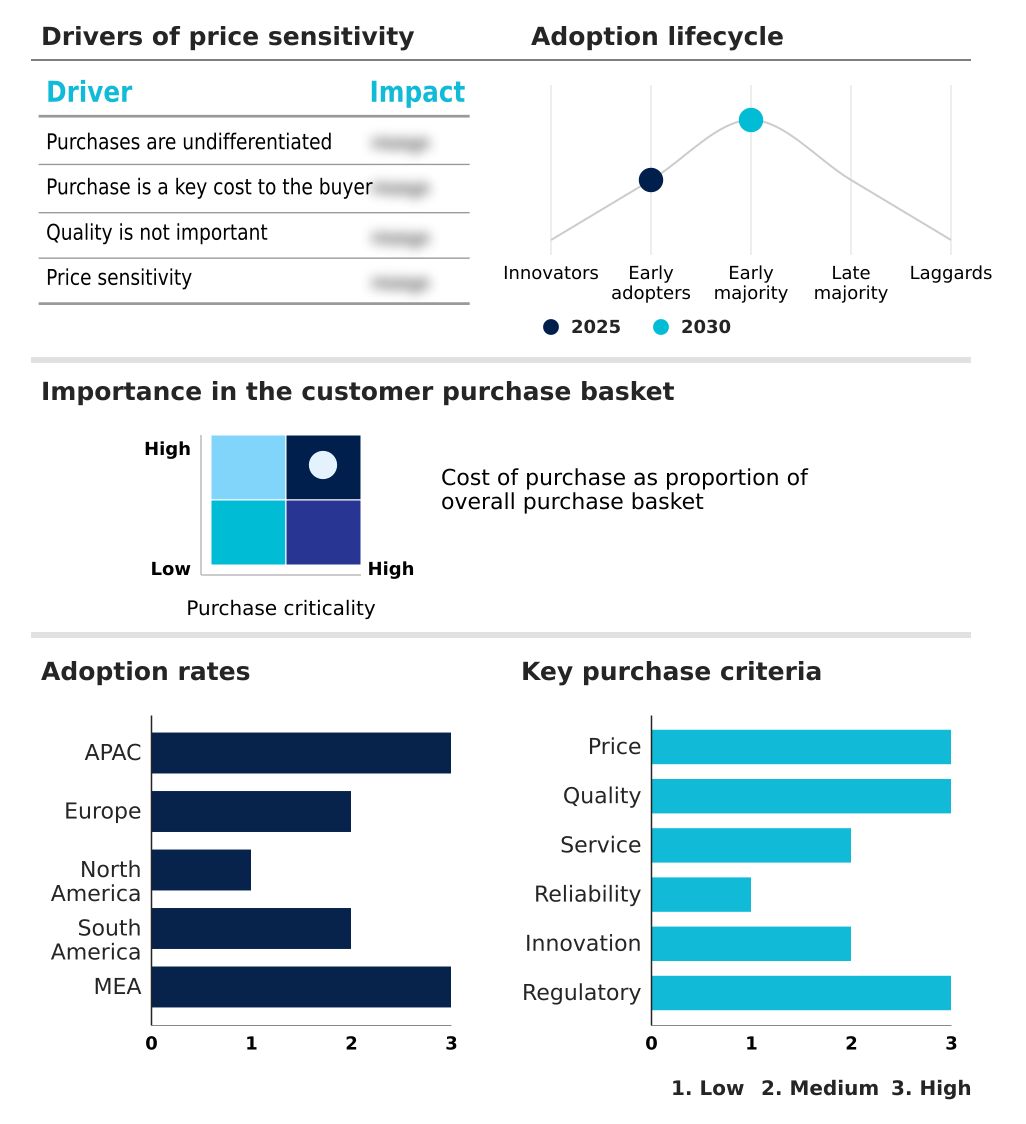
        • Analysis of price sensitivity, lifecycle, customer purchase basket, adoption rates, and purchase criteria

      8 Geographic Landscape

      • 8.1 Geographic segmentation
        • Chart on Market share by geography 2023-2028 (%)
        • Data Table on Market share by geography 2023-2028 (%)
      • 8.2 Geographic comparison
        • Chart on Geographic comparison
        • Data Table on Geographic comparison
      • 8.3 APAC - Market size and forecast 2023-2028
        • Chart on APAC - Market size and forecast 2023-2028 ($ million)
        • Data Table on APAC - Market size and forecast 2023-2028 ($ million)
        • Chart on APAC - Year-over-year growth 2023-2028 (%)
        • Data Table on APAC - Year-over-year growth 2023-2028 (%)
      • 8.4 Europe - Market size and forecast 2023-2028
        • Chart on Europe - Market size and forecast 2023-2028 ($ million)
        • Data Table on Europe - Market size and forecast 2023-2028 ($ million)
        • Chart on Europe - Year-over-year growth 2023-2028 (%)
        • Data Table on Europe - Year-over-year growth 2023-2028 (%)
      • 8.5 North America - Market size and forecast 2023-2028
        • Chart on North America - Market size and forecast 2023-2028 ($ million)
        • Data Table on North America - Market size and forecast 2023-2028 ($ million)
        • Chart on North America - Year-over-year growth 2023-2028 (%)
        • Data Table on North America - Year-over-year growth 2023-2028 (%)
      • 8.6 South America - Market size and forecast 2023-2028
        • Chart on South America - Market size and forecast 2023-2028 ($ million)
        • Data Table on South America - Market size and forecast 2023-2028 ($ million)
        • Chart on South America - Year-over-year growth 2023-2028 (%)
        • Data Table on South America - Year-over-year growth 2023-2028 (%)
      • 8.7 Middle East and Africa - Market size and forecast 2023-2028
        • Chart on Middle East and Africa - Market size and forecast 2023-2028 ($ million)
        • Data Table on Middle East and Africa - Market size and forecast 2023-2028 ($ million)
        • Chart on Middle East and Africa - Year-over-year growth 2023-2028 (%)
        • Data Table on Middle East and Africa - Year-over-year growth 2023-2028 (%)
      • 8.8 China - Market size and forecast 2023-2028
        • Chart on China - Market size and forecast 2023-2028 ($ million)
        • Data Table on China - Market size and forecast 2023-2028 ($ million)
        • Chart on China - Year-over-year growth 2023-2028 (%)
        • Data Table on China - Year-over-year growth 2023-2028 (%)
      • 8.9 US - Market size and forecast 2023-2028
        • Chart on US - Market size and forecast 2023-2028 ($ million)
        • Data Table on US - Market size and forecast 2023-2028 ($ million)
        • Chart on US - Year-over-year growth 2023-2028 (%)
        • Data Table on US - Year-over-year growth 2023-2028 (%)
      • 8.10 Germany - Market size and forecast 2023-2028
        • Chart on Germany - Market size and forecast 2023-2028 ($ million)
        • Data Table on Germany - Market size and forecast 2023-2028 ($ million)
        • Chart on Germany - Year-over-year growth 2023-2028 (%)
        • Data Table on Germany - Year-over-year growth 2023-2028 (%)
      • 8.11 Japan - Market size and forecast 2023-2028
        • Chart on Japan - Market size and forecast 2023-2028 ($ million)
        • Data Table on Japan - Market size and forecast 2023-2028 ($ million)
        • Chart on Japan - Year-over-year growth 2023-2028 (%)
        • Data Table on Japan - Year-over-year growth 2023-2028 (%)
      • 8.12 Italy - Market size and forecast 2023-2028
        • Chart on Italy - Market size and forecast 2023-2028 ($ million)
        • Data Table on Italy - Market size and forecast 2023-2028 ($ million)
        • Chart on Italy - Year-over-year growth 2023-2028 (%)
        • Data Table on Italy - Year-over-year growth 2023-2028 (%)
      • 8.13 Market opportunity by geography
        • Market opportunity by geography ($ million)
        • Data Tables on Market opportunity by geography ($ million)

      9 Drivers, Challenges, and Opportunity/Restraints

      • 9.1 Market drivers
        • 9.2 Market challenges
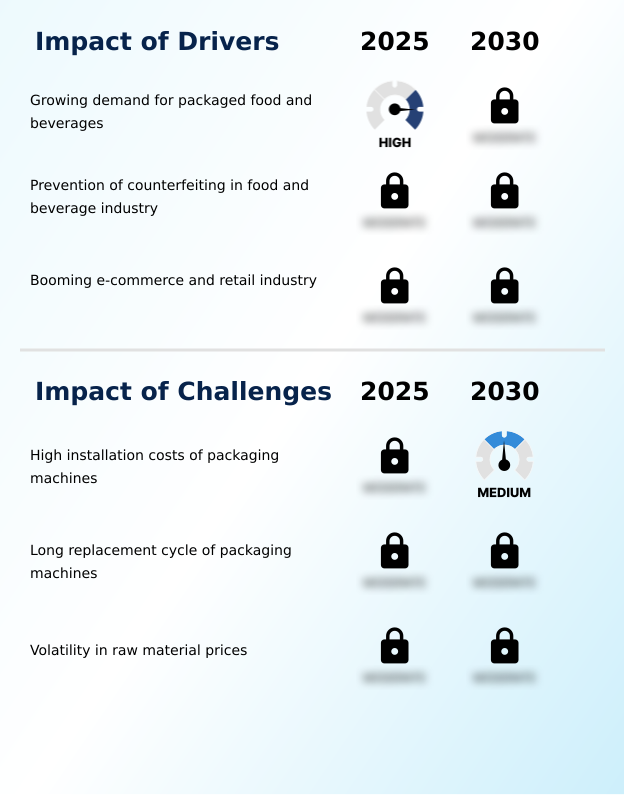
          • 9.3 Impact of drivers and challenges
            • Impact of drivers and challenges in 2023 and 2028
          • 9.4 Market opportunities/restraints

            10 Competitive Landscape

            • 10.1 Overview
              • 10.2 Competitive Landscape
                • Overview on criticality of inputs and factors of differentiation
              • 10.3 Landscape disruption
                • Overview on factors of disruption
              • 10.4 Industry risks
                • Impact of key risks on business

              11 Competitive Analysis

              • 11.1 Companies profiled
                • Companies covered
              • 11.2 Market positioning of companies
                • Matrix on companies position and classification
              • 11.3 GEA Group AG
                • GEA Group AG - Overview
                • GEA Group AG - Business segments
                • GEA Group AG - Key offerings
                • GEA Group AG - Segment focus
              • 11.4 IMA Industria Macchine Automatiche Spa
                • IMA Industria Macchine Automatiche Spa - Overview
                • IMA Industria Macchine Automatiche Spa - Product / Service
                • IMA Industria Macchine Automatiche Spa - Key offerings
              • 11.5 Krones AG
                • Krones AG - Overview
                • Krones AG - Product / Service
                • Krones AG - Key news
                • Krones AG - Key offerings
              • 11.6 MULTIVAC Sepp Haggenmuller SE and Co. KG
                • MULTIVAC Sepp Haggenmuller SE and Co. KG - Overview
                • MULTIVAC Sepp Haggenmuller SE and Co. KG - Product / Service
                • MULTIVAC Sepp Haggenmuller SE and Co. KG - Key offerings
              • 11.7 Pro Mach Inc.
                • Pro Mach Inc. - Overview
                • Pro Mach Inc. - Product / Service
                • Pro Mach Inc. - Key news
                • Pro Mach Inc. - Key offerings
              • 11.8 Salzgitter AG
                • Salzgitter AG - Overview
                • Salzgitter AG - Business segments
                • Salzgitter AG - Key news
                • Salzgitter AG - Key offerings
                • Salzgitter AG - Segment focus
              • 11.9 SELO BV
                • SELO BV - Overview
                • SELO BV - Product / Service
                • SELO BV - Key offerings
              • 11.10 Syntegon Technology GmbH
                • Syntegon Technology GmbH - Overview
                • Syntegon Technology GmbH - Product / Service
                • Syntegon Technology GmbH - Key offerings
              • 11.11 Tetra Laval SA
                • Tetra Laval SA - Overview
                • Tetra Laval SA - Product / Service
                • Tetra Laval SA - Key news
                • Tetra Laval SA - Key offerings
              • 11.12 VELTEKO sro
                • VELTEKO sro - Overview
                • VELTEKO sro - Product / Service
                • VELTEKO sro - Key offerings

              12 Appendix

              • 12.1 Scope of the report
                • 12.2 Inclusions and exclusions checklist
                  • Inclusions checklist
                  • Exclusions checklist
                • 12.3 Currency conversion rates for US$
                  • Currency conversion rates for US$
                • 12.4 Research methodology
                  • Research methodology
                • 12.5 Data procurement
                  • Information sources
                • 12.6 Data validation
                  • Data validation
                • 12.7 Validation techniques employed for market sizing
                  • Validation techniques employed for market sizing
                • 12.8 Data synthesis
                  • Data synthesis
                • 12.9 360 degree market analysis
                  • 360 degree market analysis
                • 12.10 List of abbreviations
                  • List of abbreviations

                Research Methodology

                Technavio presents a detailed picture of the market by way of study, synthesis, and summation of data from multiple sources. The analysts have presented the various facets of the market with a particular focus on identifying the key industry influencers. The data thus presented is comprehensive, reliable, and the result of extensive research, both primary and secondary.

                INFORMATION SOURCES

                Primary sources

                • Manufacturers and suppliers
                • Channel partners
                • Industry experts
                • Strategic decision makers

                Secondary sources

                • Industry journals and periodicals
                • Government data
                • Financial reports of key industry players
                • Historical data
                • Press releases

                DATA ANALYSIS

                Data Synthesis

                • Collation of data
                • Estimation of key figures
                • Analysis of derived insights

                Data Validation

                • Triangulation with data models
                • Reference against proprietary databases
                • Corroboration with industry experts

                REPORT WRITING

                Qualitative

                • Market drivers
                • Market challenges
                • Market trends
                • Five forces analysis

                Quantitative

                • Market size and forecast
                • Market segmentation
                • Geographical insights
                • Competitive landscape

                Interested in this report?

                Get your sample now to see our research methodology and insights!

                Download Now

                Frequently Asked Questions

                Food And Beverage Packaging Machinery market growth will increase by $ 1520.8 mn during 2024-2028 .

                The Food And Beverage Packaging Machinery market is expected to grow at a CAGR of 4.5% during 2024-2028 .

                Food And Beverage Packaging Machinery market is segmented by End-user( Food industry, Beverage industry)

                Bajaj Processpack Ltd., Combi Packaging Systems LLC, Duravant LLC, GEA Group AG, Geo Project Industries SRL, Illinois Tool Works Inc., IMA Industria Macchine Automatiche Spa, Krones AG, MULTIVAC Sepp Haggenmuller SE and Co. KG, Nichrome Packaging Solutions, Pro Mach Inc., Salzgitter AG, SAMA Engineering, SELO BV, Syntegon Technology GmbH, Tetra Laval SA, Triangle Package Machinery, VELTEKO sro, WeighPack are a few of the key vendors in the Food And Beverage Packaging Machinery market.

                APAC will register the highest growth rate of 58% among the other regions. Therefore, the Food And Beverage Packaging Machinery market in APAC is expected to garner significant business opportunities for the vendors during the forecast period.

                China, US, Germany, Japan, Italy

                • Growing demand for packaged food and beveragesThe rapidly rising global population and the growing demand for packaged F and Bs due to changing consumer preferences are major factors driving the demand for packaging solutions is the driving factor this market.
                • which is the driving factor this market.
                • in turn is the driving factor this market.
                • propels the need for packaging machinery. The rise in dual-income households and long working hours have led to hectic lifestyles. Such busy lifestyles have increased the demand for packaged food is the driving factor this market.
                • especially ready-to-eat food products is the driving factor this market.
                • snacks is the driving factor this market.
                • and beverages. The demand for good-quality packaged foods is also increasing owing to the increasing disposable income in countries such as China is the driving factor this market.
                • India is the driving factor this market.
                • and Brazil. To cater to this increasing demand is the driving factor this market.
                • F and B companies are investing in various machinery and new facilities to raise their production capacity. It is also driving the adoption of packaging equipment to accelerate the packaging process of products so that a greater number of products can be sold in the market in a short duration. Furthermore is the driving factor this market.
                • the growing consensus among manufacturers around food safety has increased the importance of proper packaging. As packaging machines play a vital role in ensuring product safety throughout the supply chain is the driving factor this market.
                • the demand for packaging machines will drive the global food and beverage packaging machinery market during the forecast period. Moreover is the driving factor this market.
                • the overall rise in the global population has led to an increase in the consumption of F and B products is the driving factor this market.
                • which has also led to an increase in the demand for packaging solutions and products. Thus is the driving factor this market.
                • the demand for packaging machinery is on the rise as the production from the F and B industry rises to satisfy the growing demand of the population. is the driving factor this market.

                The Food And Beverage Packaging Machinery market vendors should focus on grabbing business opportunities from the Food industry segment as it accounted for the largest market share in the base year.