



Internet Of Things (Iot) Data Management Market Size 2024-2028
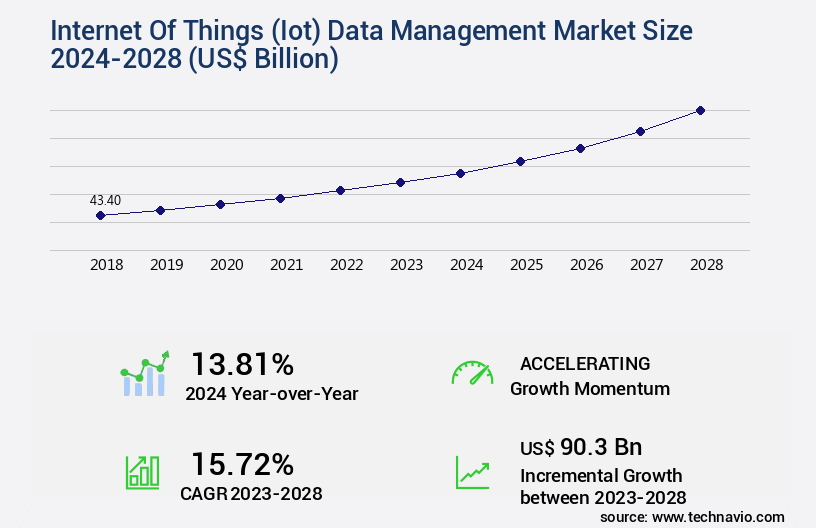
The internet of things (iot) data management market size is valued to increase USD 90.3 billion, at a CAGR of 15.72% from 2023 to 2028. Growth in industrial automation will drive the internet of things (iot) data management market.
Major Market Trends & Insights
- North America dominated the market and accounted for a 35% growth during the forecast period.
- By Component - Solutions segment was valued at USD 34.60 billion in 2022
- By Deployment - Private/hybrid segment accounted for the largest market revenue share in 2022
Market Size & Forecast
- Market Opportunities: USD 301.61 billion
- Market Future Opportunities: USD 90.30 billion
- CAGR from 2023 to 2028 : 15.72%
Market Summary
- The market is a dynamic and evolving landscape, driven by the increasing adoption of IoT technologies in various industries. Core technologies, such as edge computing and machine learning, are enabling the collection, processing, and analysis of vast amounts of data generated by interconnected devices. This data is fueling innovative applications, from predictive maintenance in manufacturing to real-time supply chain optimization. However, managing IoT data effectively remains a challenge for many organizations. A recent survey revealed that over 50% of companies struggle with efficiently managing their IoT initiatives and investments. Despite this, the market continues to grow, with industrial automation being a significant driver.
- In fact, it's estimated that by 2025, over 50% of industrial companies will have implemented IoT solutions for predictive maintenance. Regulations, such as GDPR and HIPAA, also play a crucial role in shaping the market. Regional differences in regulatory frameworks and data privacy laws add complexity to the market landscape. As the IoT Data Management Market continues to unfold, stakeholders must stay informed about the latest trends, technologies, and regulations to remain competitive.
What will be the Size of the Internet Of Things (Iot) Data Management Market during the forecast period?
Get Key Insights on Market Forecast (PDF) Request Free Sample
How is the Internet Of Things (Iot) Data Management Market Segmented ?
The internet of things (iot) data management industry research report provides comprehensive data (region-wise segment analysis), with forecasts and estimates in "USD billion" for the period 2024-2028, as well as historical data from 2018-2022 for the following segments.
- Component
- Solutions
- Services
- Deployment
- Private/hybrid
- Public
- Geography
- North America
- US
- Canada
- Europe
- Germany
- UK
- APAC
- China
- Rest of World (ROW)
- North America
By Component Insights
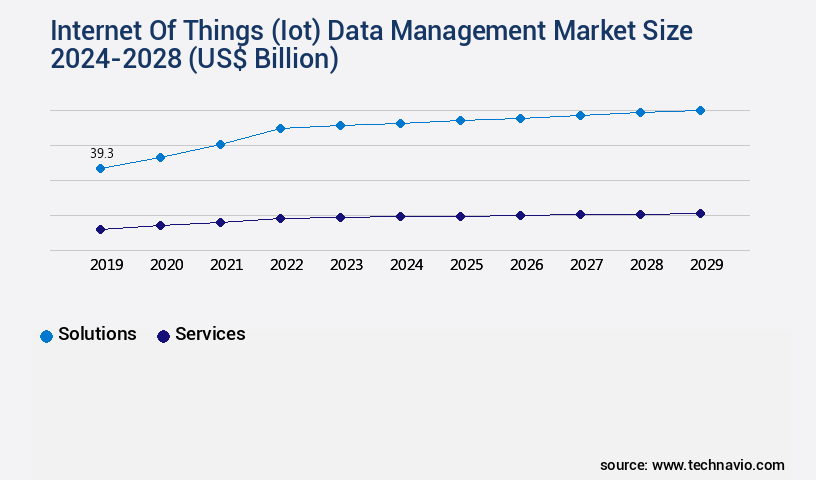
The solutions segment is estimated to witness significant growth during the forecast period.
In the dynamic and expanding IoT data management market, software solutions, encompassing both software and hardware offerings, hold a significant market share. This dominance is driven by the increasing globalization and IT expansion of industries, particularly in emerging economies like China, India, Brazil, Indonesia, and Mexico. The surge in SMEs in these regions necessitates business-centric insights, leading to a rising demand for software-based IoT data management solutions. companies catering to the global IoT data management market offer software tools to various end-user industries. These solutions facilitate data collection and analysis, enabling organizations to derive valuable insights from their operations. Metadata management systems, data modeling techniques, and IoT device integration are integral components of these software solutions.
Edge computing deployments, data versioning strategies, and data visualization dashboards further enhance their functionality. Compliance regulations adherence, time series databases, data streaming technologies, data mining procedures, data cleansing techniques, data aggregation platforms, machine learning algorithms, remote data acquisition, data transformation pipelines, data quality monitoring, data lifecycle management, data encryption methods, predictive maintenance models, and IoT sensor networks are essential features of advanced software solutions. Data warehousing techniques, real-time data processing, access control mechanisms, data schema design, deep learning applications, scalable data infrastructure, NoSQL database systems, security protocols implementation, anomaly detection algorithms, data governance frameworks, API integration methods, and network bandwidth optimization are additional capabilities that add value to these offerings.
Statistical modeling techniques play a crucial role in deriving actionable insights from the vast amounts of data generated by IoT devices. By 2026, it is projected that the market for public IoT data management solutions will grow by approximately 25%, as organizations increasingly recognize the value of data-driven decision-making. Meanwhile, the private IoT data management market is anticipated to expand by around 30% over the same period, driven by the growing adoption of IoT technologies in various sectors, including manufacturing, healthcare, transportation, and energy.
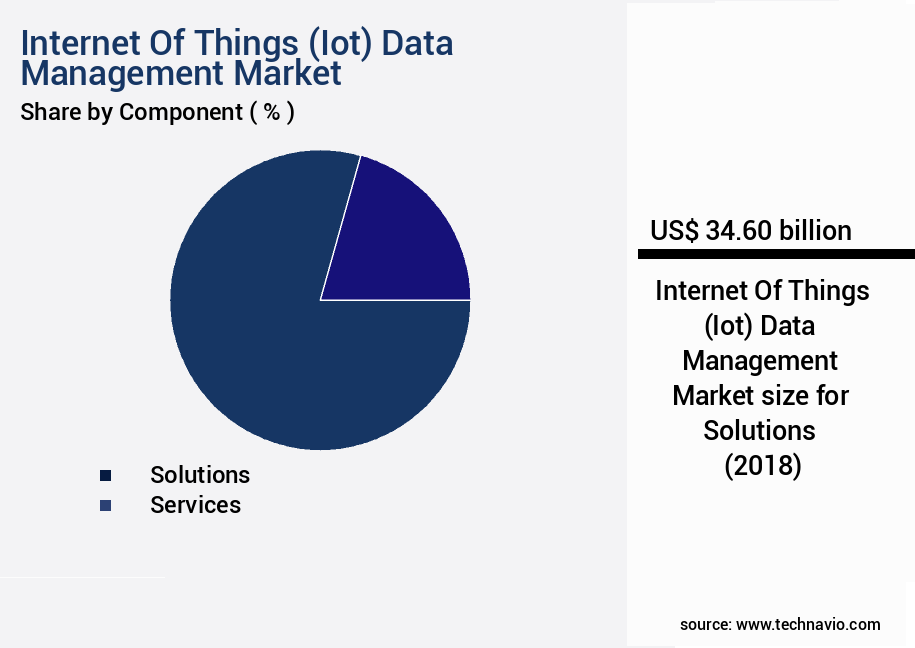
The Solutions segment was valued at USD 34.60 billion in 2018 and showed a gradual increase during the forecast period.
Regional Analysis
North America is estimated to contribute 35% to the growth of the global market during the forecast period.Technavio’s analysts have elaborately explained the regional trends and drivers that shape the market during the forecast period.
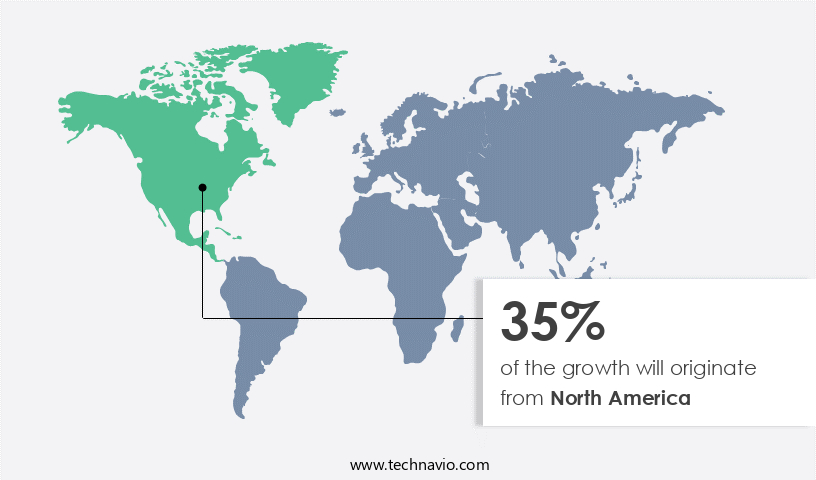
See How Internet Of Things (Iot) Data Management Market Demand is Rising in North America Request Free Sample
North America's IoT data management market is a significant contributor to the global industry, fueled by the region's early adoption of advanced technologies in sectors like manufacturing, retail, and BFSI. This technological readiness increases the demand for IoT data management solutions. Major players such as Microsoft Corp. And Oracle Corp., with a strong presence and penetration in the region, further propel the market's growth. With several advanced economies located in North America, the need for IoT data management, including data processing, outsourcing, internet services, and infrastructure, is heightened.
The integration of cloud-based services, automation solutions, and AI with operational and supply chain processes is fostering the development of new IoT data management applications in the region.
Market Dynamics
Our researchers analyzed the data with 2023 as the base year, along with the key drivers, trends, and challenges. A holistic analysis of drivers will help companies refine their marketing strategies to gain a competitive advantage.
The market is witnessing significant growth as businesses increasingly rely on real-time data analytics to optimize operations and enhance customer experiences. IoT sensor data streaming architecture plays a crucial role in this landscape, enabling seamless data transfer from edge devices to cloud-based storage. Cloud-based data storage optimization is essential for managing the massive volumes of data generated by IoT devices. Predictive maintenance using machine learning algorithms is another key application, helping organizations minimize downtime and reduce maintenance costs. Security is a top priority, with secure data transmission protocols for IoT devices ensuring data privacy and integrity. Data governance framework implementation is vital for effective data quality monitoring and ensuring compliance with data privacy regulations for IoT applications.
Scalable data infrastructure for IoT deployments and data pipeline design for high-volume data ingestion are critical to handling the increasing data deluge. Efficient data storage solutions for IoT, such as columnar databases and time-series databases, are gaining popularity due to their ability to handle large volumes of time-stamped data. Advanced anomaly detection for IoT is another essential component, helping organizations identify and respond to potential issues in real-time. Data visualization best practices for IoT are essential for making sense of the vast amounts of data generated. IoT data security risk assessment is a continuous process, with new threats emerging regularly.
Big data analytics for IoT deployments provide valuable insights, but effective data redundancy strategies are necessary to ensure business continuity. Despite the numerous benefits, IoT data management poses significant challenges, including data integration complexities and managing the data lifecycle. Market research indicates that more than 70% of IoT projects face data integration challenges, highlighting the need for robust solutions. In conclusion, the IoT data management market is a dynamic and evolving landscape, with a growing focus on real-time data processing, predictive analytics, and data security. Organizations must adopt a holistic approach, incorporating best practices for data pipeline design, data storage optimization, and data visualization to fully leverage the potential of IoT.
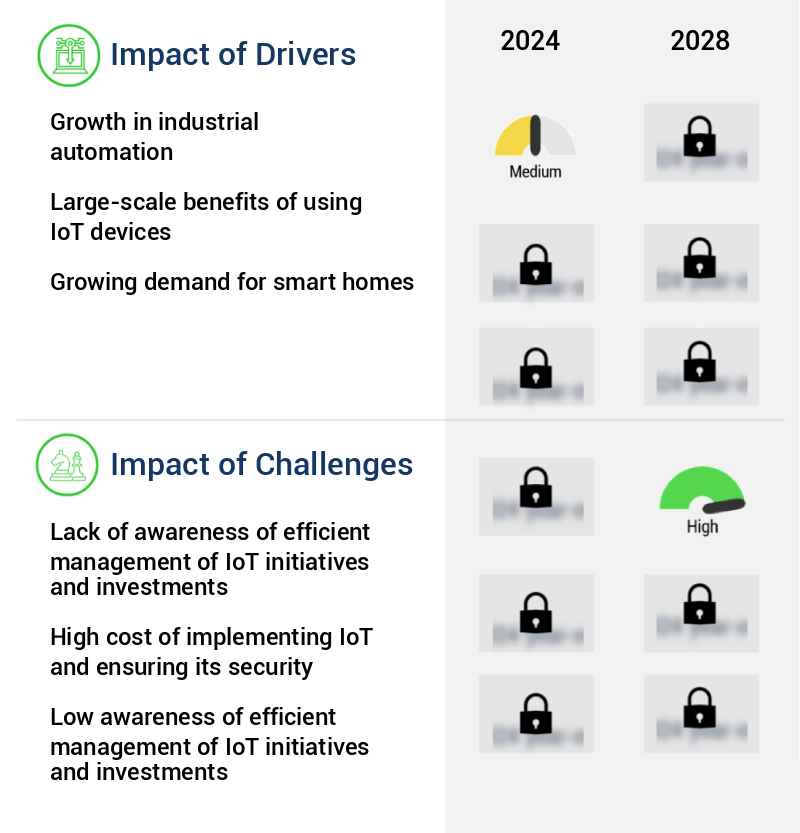
What are the key market drivers leading to the rise in the adoption of Internet Of Things (Iot) Data Management Industry?
- Industrial automation's growth is the primary catalyst for market expansion. With advancements in technology and increasing demand for efficiency and productivity, businesses are investing heavily in automation solutions to streamline their operations and gain a competitive edge. This trend is expected to continue, driving significant growth in the industrial automation market.
- The industrial landscape is undergoing transformative changes, with the fusion of physical and digital systems shaping the next generation of manufacturing. Industry 4.0, a term defining the entire product lifecycle, encompasses smart machines executing manufacturing processes autonomously, human-robot collaboration, and self-operating logistics vehicles. This integration of cyber and physical systems brings about heightened efficiency, enhanced safety, predictive machine maintenance, and increased profitability. As a result, industries worldwide are embracing Industry 4.0 to revolutionize their operations.
- This evolution is not confined to any specific sector but is a global phenomenon, redefining the industrial manufacturing landscape.
What are the market trends shaping the Internet Of Things (Iot) Data Management Industry?
- Predictive maintenance using manufacturing data is an emerging market trend. This approach leverages data to anticipate equipment failures and schedule maintenance accordingly.
- The escalating significance of IoT data management is driven primarily by the requirement for data collection and analysis to tackle intricate maintenance challenges. IoT-integrated devices, including wireless acoustic transmitters and steam trap monitors, play a pivotal role in monitoring industrial processes. By leveraging data derived from machinery and systems, industrial operators can assess the productivity and effectiveness of all machines, thereby enabling them to schedule maintenance tasks judiciously and minimize unplanned machine malfunctions. The emphasis on predictive maintenance is on the rise, as it facilitates downtime reduction and enhances operational efficiency.
- Industries that heavily rely on automation control solutions and instruments in their operations particularly benefit from IoT-enabled devices. The proliferation of IoT technology in data management has revolutionized maintenance practices, offering valuable insights to optimize industrial operations.
What challenges does the Internet Of Things (Iot) Data Management Industry face during its growth?
- The absence of adequate understanding and effective management of Internet of Things (IoT) initiatives and investments is a significant challenge impeding industry growth.
- The IoT data management landscape is witnessing increasing adoption, particularly in industrial sectors, as they implement IoT in their facilities. However, managing, securing, and optimizing these investments poses a significant challenge for enterprises. A key issue is the scarcity of skilled personnel capable of handling IoT systems. To address this, training employees on IoT platforms is essential, enabling them to adapt efficiently and effectively.
- The importance of IoT expertise is underscored by the potential for enhanced operational efficiency and productivity. The dearth of proficient personnel, however, can hinder the full exploitation of IoT's capabilities. In the evolving IoT landscape, the need for a skilled workforce is a pressing concern for industries worldwide.
Exclusive Technavio Analysis on Customer Landscape
The internet of things (iot) data management market forecasting report includes the adoption lifecycle of the market, covering from the innovator’s stage to the laggard’s stage. It focuses on adoption rates in different regions based on penetration. Furthermore, the internet of things (iot) data management market report also includes key purchase criteria and drivers of price sensitivity to help companies evaluate and develop their market growth analysis strategies.
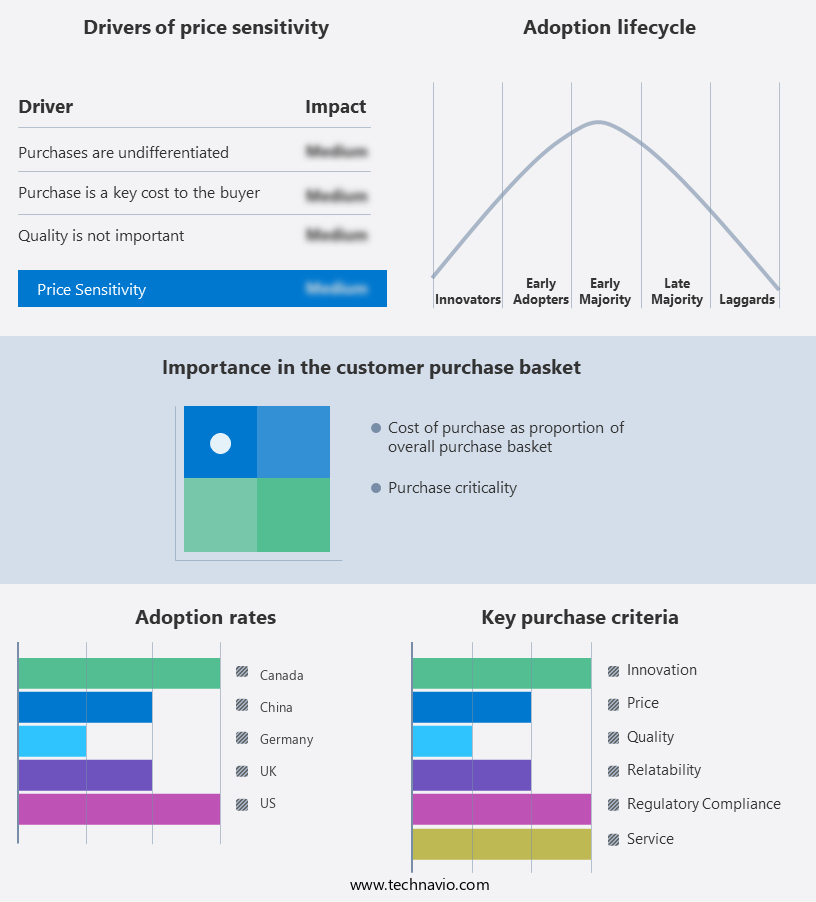
Customer Landscape of Internet Of Things (Iot) Data Management Industry
Competitive Landscape
Companies are implementing various strategies, such as strategic alliances, internet of things (iot) data management market forecast, partnerships, mergers and acquisitions, geographical expansion, and product/service launches, to enhance their presence in the industry.
Alphabet Inc. - The company partners with ClearObject, Softserve, Quantiphi, ClearBlade, Aeris, SOTEC, KORE, EMQ, and Dianomic to provide comprehensive IoT data management solutions. These technology providers offer innovative services that enable businesses to effectively collect, process, and analyze data from connected devices. By leveraging these partnerships, the company strengthens its position as a leading player in the IoT market.
The industry research and growth report includes detailed analyses of the competitive landscape of the market and information about key companies, including:
- Alphabet Inc.
- Avnet Inc.
- Cisco Systems Inc.
- Dell Technologies Inc.
- EUROTECH Spa
- Fujitsu Ltd.
- Hewlett Packard Enterprise Co.
- InfluxData Inc.
- International Business Machines Corp.
- LogFuze Inc.
- Oracle Corp.
- PTC Inc.
- Robert Bosch GmbH
- Salesforce Inc.
- SAP SE
- SAS Institute Inc.
- Siemens AG
- Singapore Telecommunications Ltd.
- Striim International Inc.
- Teradata Corp.
Qualitative and quantitative analysis of companies has been conducted to help clients understand the wider business environment as well as the strengths and weaknesses of key industry players. Data is qualitatively analyzed to categorize companies as pure play, category-focused, industry-focused, and diversified; it is quantitatively analyzed to categorize companies as dominant, leading, strong, tentative, and weak.
Recent Development and News in Internet Of Things (Iot) Data Management Market
- In January 2024, IBM announced the acquisition of Significant Technologies, a leading IoT data management company, strengthening IBM's position in the IoT data management market. The deal was valued at approximately USD400 million (IBM press release).
- In March 2024, Microsoft and Amazon Web Services (AWS) joined forces to collaborate on IoT solutions, allowing Microsoft Azure customers to easily move their IoT workloads to AWS. This strategic partnership aimed to provide seamless integration between the two platforms, enhancing their offerings and catering to a broader customer base (Microsoft and AWS press releases).
- In May 2024, Siemens announced the launch of its new MindSphere IoT operating system, which supports edge computing and offers advanced analytics capabilities. The company claimed that this development would enable real-time data processing and improved decision-making for industrial customers (Siemens press release).
- In April 2025, the European Union introduced new data protection regulations for IoT devices, requiring manufacturers to implement strong security measures and obtain explicit consent from users before collecting and processing their data. This initiative aimed to address privacy concerns and promote transparency in the IoT market (European Commission press release).
Dive into Technavio’s robust research methodology, blending expert interviews, extensive data synthesis, and validated models for unparalleled Internet Of Things (Iot) Data Management Market insights. See full methodology.
|
Market Scope |
|
|
Report Coverage |
Details |
|
Page number |
184 |
|
Base year |
2023 |
|
Historic period |
2018-2022 |
|
Forecast period |
2024-2028 |
|
Growth momentum & CAGR |
Accelerate at a CAGR of 15.72% |
|
Market growth 2024-2028 |
USD 90.3 billion |
|
Market structure |
Fragmented |
|
YoY growth 2023-2024(%) |
13.81 |
|
Key countries |
US, China, UK, Canada, and Germany |
|
Competitive landscape |
Leading Companies, Market Positioning of Companies, Competitive Strategies, and Industry Risks |
Research Analyst Overview
- In the dynamic and ever-evolving Internet of Things (IoT) landscape, data management has emerged as a critical cornerstone for businesses seeking to maximize the potential of their connected devices. This market is characterized by continuous innovation, with various trends and technologies shaping its contours. Metadata management systems have gained prominence, enabling organizations to efficiently manage and understand the vast amounts of data generated by IoT devices. Data modeling techniques have become essential for structuring and interpreting this data, while IoT device integration ensures seamless communication between various components. Edge computing deployments have emerged as a response to the latency challenges posed by real-time data processing, with time series databases and data streaming technologies playing pivotal roles.
- Compliance regulations adherence is another key focus area, with data versioning strategies, data visualization dashboards, and access control mechanisms ensuring data security and privacy. Data mining procedures and data cleansing techniques are employed to extract valuable insights from the raw data, while data aggregation platforms facilitate the integration of data from multiple sources. Machine learning algorithms and predictive maintenance models are used to analyze trends and anticipate potential issues, enhancing operational efficiency. IoT sensor networks, real-time data processing, and network bandwidth optimization are integral to ensuring the scalability and reliability of IoT data infrastructure. Security protocols implementation, anomaly detection algorithms, and data governance frameworks are essential for maintaining data security and ensuring data quality.
- APIs and data transformation pipelines facilitate seamless data integration, with deep learning applications and NOSQL database systems offering advanced capabilities for handling complex data structures. Scalable data infrastructure, data lifecycle management, and data encryption methods are crucial for managing the growing volume and diversity of IoT data.
What are the Key Data Covered in this Internet Of Things (Iot) Data Management Market Research and Growth Report?
-
What is the expected growth of the Internet Of Things (Iot) Data Management Market between 2024 and 2028?
-
USD 90.3 billion, at a CAGR of 15.72%
-
-
What segmentation does the market report cover?
-
The report is segmented by Component (Solutions and Services), Deployment (Private/hybrid and Public), and Geography (North America, Europe, APAC, South America, and Middle East and Africa)
-
-
Which regions are analyzed in the report?
-
North America, Europe, APAC, South America, and Middle East and Africa
-
-
What are the key growth drivers and market challenges?
-
Growth in industrial automation, Lack of awareness of efficient management of IoT initiatives and investments
-
-
Who are the major players in the Internet Of Things (Iot) Data Management Market?
-
Alphabet Inc., Avnet Inc., Cisco Systems Inc., Dell Technologies Inc., EUROTECH Spa, Fujitsu Ltd., Hewlett Packard Enterprise Co., InfluxData Inc., International Business Machines Corp., LogFuze Inc., Oracle Corp., PTC Inc., Robert Bosch GmbH, Salesforce Inc., SAP SE, SAS Institute Inc., Siemens AG, Singapore Telecommunications Ltd., Striim International Inc., and Teradata Corp.
-
Market Research Insights
- The market encompasses a range of technologies and practices designed to effectively collect, process, and analyze vast amounts of data generated by interconnected devices. With an estimated 50 billion IoT devices in use by 2030, managing this data has become a critical challenge for businesses. Two key aspects of IoT data management are data security and data efficiency. In 2020, IoT data security spending was projected to reach USD1.5 billion, while data pipeline optimization was estimated to save businesses USD1 trillion by 2025 through improved system performance and reduced network latency. Effective data management in the IoT landscape involves implementing data governance policies, data loss prevention, remote monitoring capabilities, data consistency checks, historical data analysis, data recovery mechanisms, and device connectivity management.
- Additionally, businesses utilize data pipeline optimization, system performance metrics, system uptime monitoring, data privacy compliance, data ingestion strategies, change data capture, automated data processing, business intelligence tools, network latency monitoring, sensor data integration, data validation rules, data archival procedures, data redundancy elimination, data retrieval methods, data usage agreements, data security measures, reporting and dashboards, system reliability assessment, data latency reduction, and data retention policies. By integrating these strategies, businesses can ensure data accuracy, security, and efficiency in their IoT operations.
We can help! Our analysts can customize this internet of things (iot) data management market research report to meet your requirements.
 RIA -
RIA - 
