
Telecom Services Market Size 2025-2029
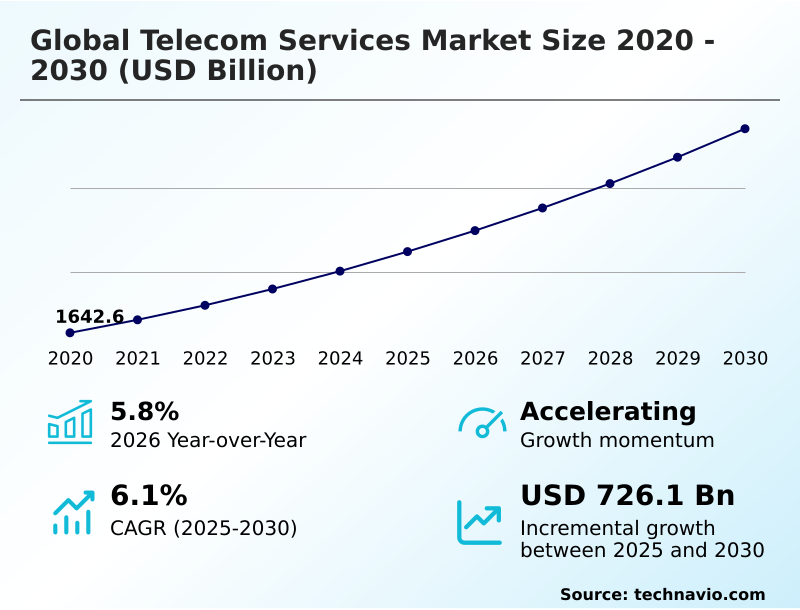
The telecom services market size is forecast to increase by USD 705.9 billion, at a CAGR of 6.2% between 2024 and 2029.
- The market is experiencing significant growth, driven by the surging demand for high-speed broadband services. This trend is fueled by the increasing adoption of digital technologies, remote work, and online education, which necessitate reliable and fast internet connections. Furthermore, technological advancements continue to shape the market, with innovations in 5G, IoT, and cloud computing transforming the way businesses and consumers communicate and access information. However, the market's landscape is not without challenges. Regulatory compliance remains a critical issue, with governments worldwide implementing stringent regulations to ensure data privacy and security. Compliance with these regulations can be costly and time-consuming, requiring significant resources and expertise.
- Additionally, the increasing competition in the market, driven by new entrants and technological advancements, puts pressure on service providers to differentiate themselves and offer competitive pricing and innovative services to retain customers. To capitalize on opportunities and navigate challenges effectively, companies must stay abreast of market trends and regulatory requirements, invest in cutting-edge technologies, and prioritize customer experience and satisfaction.
What will be the Size of the Telecom Services Market during the forecast period?
Explore in-depth regional segment analysis with market size data - historical 2019-2023 and forecasts 2025-2029 - in the full report.
Request Free Sample
The market continues to evolve, driven by advancements in technology and shifting consumer demands. Base stations form the backbone of cellular networks, providing connectivity for wireless telephony and mobile broadband. Telecommunications regulation plays a crucial role in shaping market dynamics, influencing spectrum allocation and network infrastructure development. Packet loss, a persistent challenge in data transmission, is addressed through innovations like 5G New Radio (NR) and 5G edge computing. These technologies enable real-time data analytics, powering applications in smart homes, high-speed internet, and business intelligence. Network security and remote monitoring are essential components of the evolving telecom landscape. Software-defined networking (SDN) and data centers facilitate cloud migration and digital transformation, reducing churn rate and enhancing customer experience.
5G Network Slicing and 4G LTE provide customized network solutions for various sectors, including satellite communication, cable internet, and IoT platforms. Telecom providers navigate these complexities while ensuring network capacity and efficient billing systems. The ongoing unfolding of market activities reveals a dynamic interplay between traditional fixed-line telephony and emerging technologies like cloud telephony and unified communications. The market continues to adapt, shaping the future of connectivity and communication.
How is this Telecom Services Industry segmented?
The telecom services industry research report provides comprehensive data (region-wise segment analysis), with forecasts and estimates in "USD billion" for the period 2025-2029, as well as historical data from 2019-2023 for the following segments.
- End-user
- Consumer/Residential
- Business
- Type
- Service Type
- Fixed Voice Services
- Fixed Internet Access Services
- Mobile Voice Services
- Mobile Data Services
- Pay TV Services
- Machine-to-Machine (Mobile IoT) Services
- Technology
- 5G Networks
- Fiber Optics
- Satellite Communication
- Geography
- North America
- Europe
- Middle East and Africa
- APAC
- South America
- Rest of World (ROW)
By End-user Insights
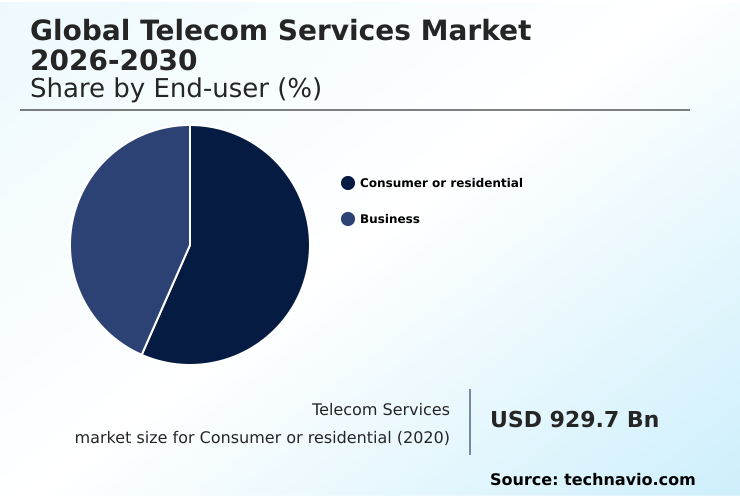
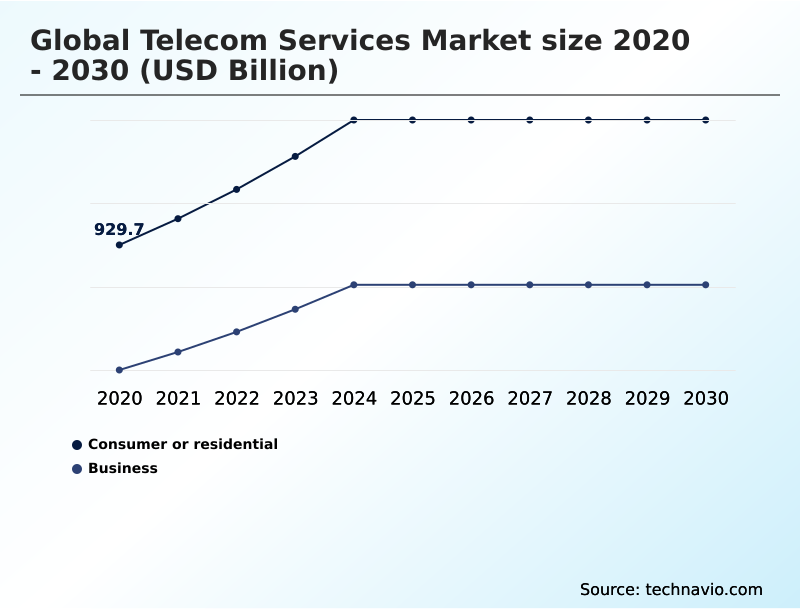
The consumer/residential segment is estimated to witness significant growth during the forecast period.
The market is experiencing significant growth, driven by the consumer/residential segment which held the largest share in 2024. This trend is attributed to the widespread use of smartphones, with over 8.5 billion mobile subscribers worldwide in 2023, representing approximately 90% of the global population. The increasing popularity of Over-The-Top (OTT) applications is further fueling the demand for wireless Internet services, enabling larger-scale communication network implementation. Network management, including 5G network slicing and software-defined networking (SDN), is a key area of focus for telecom providers. 5G networks, including private networks and 5G New Radio (NR), are being adopted for high-speed internet, edge computing, and IoT platforms.
Satellite communication and fiber optics are also essential components of the telecom infrastructure, ensuring network capacity and coverage in remote areas. Cloud telephony, digital wallets, and call centers are transforming the way businesses communicate with their customers. Network security, data analytics, and business intelligence are crucial elements for ensuring reliable and efficient services. Telecommunications regulation, packet loss, and churn rate are ongoing challenges that require continuous attention from industry players. The market is also witnessing the migration of data centers and server farms to the cloud, as well as the digital transformation of industries and the emergence of smart cities.
Unified communications, including voice, video, and messaging services, are becoming increasingly important for businesses to streamline their operations and enhance collaboration. In conclusion, the market is undergoing significant changes, driven by advancements in network technologies, the growing use of smart devices, and the increasing demand for reliable and efficient communication solutions. Telecom providers must adapt to these trends to remain competitive and meet the evolving needs of their customers.

Request Free Sample
The Consumer/Residential segment was valued at USD 906.20 billion in 2019 and showed a gradual increase during the forecast period.
Regional Analysis
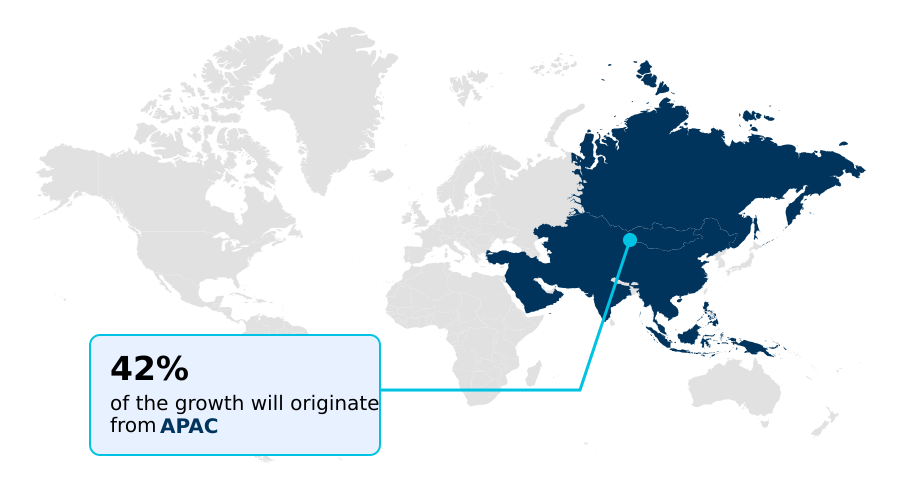
APAC is estimated to contribute 37% to the growth of the global market during the forecast period.Technavio's analysts have elaborately explained the regional trends and drivers that shape the market during the forecast period.
Request Free Sample
In the market, various technologies and trends are shaping the communication landscape. Mobile payments and digital wallets are transforming transactions, offering convenience and security. Call centers and customer service are evolving with advanced solutions, including AI and machine learning, to enhance user experience. Network management and virtualization ensure efficient service delivery and scalability. Private 5G networks and 5G slicing are revolutionizing industrial automation and IoT platforms, enabling real-time data processing. Wireless telephony and high-speed internet are essential for remote work and learning, fueling the demand for mobile broadband and satellite communication. Telecommunications regulation and network security are critical concerns, with data analytics and business intelligence solutions addressing packet loss and network capacity issues.
Smart homes and cities are integrating edge computing and 5G edge computing, enabling seamless connectivity and real-time data processing. Fixed-line telephony and fiber optics continue to provide reliable connectivity, while cloud telephony and cloud migration facilitate digital transformation. Network infrastructure, including base stations and switching equipment, is being modernized with software-defined networking (SDN) and open RAN. Churn rate and customer churn remain key challenges, with unified communications and contact centers offering solutions to improve customer engagement and retention. International calls and spectrum allocation are essential for global connectivity, while 4G LTE and 5G NR ensure network capacity and coverage.
Data centers and server farms are crucial for hosting critical applications and services, enabling seamless integration with various telecom services. In the business landscape, telecom services are essential for enabling remote work, digital transformation, and unified communications. The market continues to evolve, with innovation in areas like network slicing, cable internet, and billing systems driving growth. Companies are focusing on improving network infrastructure, enhancing network security, and offering advanced services to meet the evolving needs of businesses and consumers.
Market Dynamics
Our researchers analyzed the data with 2024 as the base year, along with the key drivers, trends, and challenges. A holistic analysis of drivers will help companies refine their marketing strategies to gain a competitive advantage.
In the dynamic and ever-evolving market, providers continually strive to deliver innovative solutions that cater to diverse consumer needs. From voice services and high-speed data plans to cloud communications and IoT connectivity, telecom companies offer a range of offerings designed to enhance connectivity and productivity. Advanced technologies like 5G, fiber optics, and VoIP are shaping the future of telecom services, enabling faster speeds, more reliable connections, and new applications. Telecom providers also prioritize network security, ensuring customer data is protected through encryption, firewalls, and other safeguards. Additionally, flexible pricing models, customizable plans, and exceptional customer service further distinguish telecom services in today's competitive landscape. By continually adapting to consumer demands and technological advancements, the market remains a vital and essential sector in our increasingly interconnected world.
What are the key market drivers leading to the rise in the adoption of Telecom Services Industry?
- The significant surge in broadband demand serves as the primary market catalyst.
- The market is experiencing significant growth due to the increasing reliance on high-speed connectivity for both personal and business use. The proliferation of mobile devices, such as smartphones and tablets, has driven the demand for mobile data services, including mobile payments, wireless telephony, and call centers. Telecom companies are responding by upgrading their network infrastructure to support faster speeds and higher bandwidths, such as 5G and 4G LTE. Additionally, advancements in network virtualization, 5G slicing, cloud telephony, digital wallets, and satellite communication are enhancing the telecom services landscape.
- Network management and security are becoming increasingly important as the number of connected devices grows. Private 5G networks are gaining traction for their ability to provide secure and reliable connectivity for mission-critical applications. Overall, the market is poised for continued growth as the world becomes more interconnected.
What are the market trends shaping the Telecom Services Industry?
- The trend in the market is shaped by technological advancements. Professionals and businesses are increasingly embracing new technologies to stay competitive.
- In 2024, the telecom services sector is witnessing significant advancements with the emergence of innovative technologies such as 5G networks, IoT, and AI. These technologies are revolutionizing telecommunications by introducing new services and enhancing the capabilities of existing ones. Artificial intelligence (AI) is playing a pivotal role in optimizing network management and customer service. It can predict and prevent potential network issues, ensure network efficiency, and offer personalized customer experiences. Moreover, the integration of Virtual Reality (VR) and Augmented Reality (AR) technologies in telecom services is transforming customer engagement and enabling remote collaboration. These technologies necessitate high-speed connectivity to deliver immersive experiences.
- 5G New Radio (NR) is a key technology driving the growth of telecom services by providing faster data transfer rates and lower latency. This technology is essential for supporting the increasing demand for high-speed internet and advanced services like 5G edge computing, data analytics, smart homes, and remote monitoring. Network security is another critical aspect of telecom services, with the increasing number of connected devices and the growing threat of cyber-attacks. Software-defined networking (SDN) and data centers are being adopted to ensure network security and improve overall network performance. In conclusion, the market is experiencing a period of dynamic growth, driven by technological advancements and evolving consumer demands.
- AI, 5G NR, VR/AR, and other emerging technologies are transforming the sector, offering new opportunities and challenges.
What challenges does the Telecom Services Industry face during its growth?
- Compliance with regulatory requirements poses a significant challenge to the industry's growth trajectory. It is essential for businesses to adhere to these regulations to maintain legitimacy and avoid potential penalties, thereby impacting their ability to expand and innovate.
- Telecom services are subject to various regulations and standards, ensuring data privacy, security, and consumer protection. Compliance with regulations, such as the General Data Protection Regulation (GDPR) and the California Consumer Privacy Act (CCPA), necessitates telecom services providers to secure user consent before collecting and utilizing data and implement robust security measures. Network security is essential to protect against cyber threats, including hacking and malware. Telecom services must adhere to industry standards and regulations, like the Payment Card Industry Data Security Standard (PCI DSS). Cloud migration and digital transformation are significant market trends, driving the demand for advanced telecom services.
- Businesses are increasingly relying on mobile broadband and contact centers for efficient communication and collaboration. Spectrum allocation and network slicing are essential for delivering high-quality services, including immersive experiences and harmonious network performance. Customer churn remains a critical concern for telecom services providers, with international calls being a significant factor. Business intelligence tools and analytics help providers understand customer behavior and preferences, enabling them to offer personalized services and reduce churn. In conclusion, telecom services providers must navigate regulatory requirements while addressing market trends and customer needs. Ensuring data privacy, network security, and compliance with industry standards are essential to maintaining customer trust and loyalty.
- Cloud migration, digital transformation, and advanced services, such as mobile broadband and contact centers, are driving market growth.
Exclusive Customer Landscape
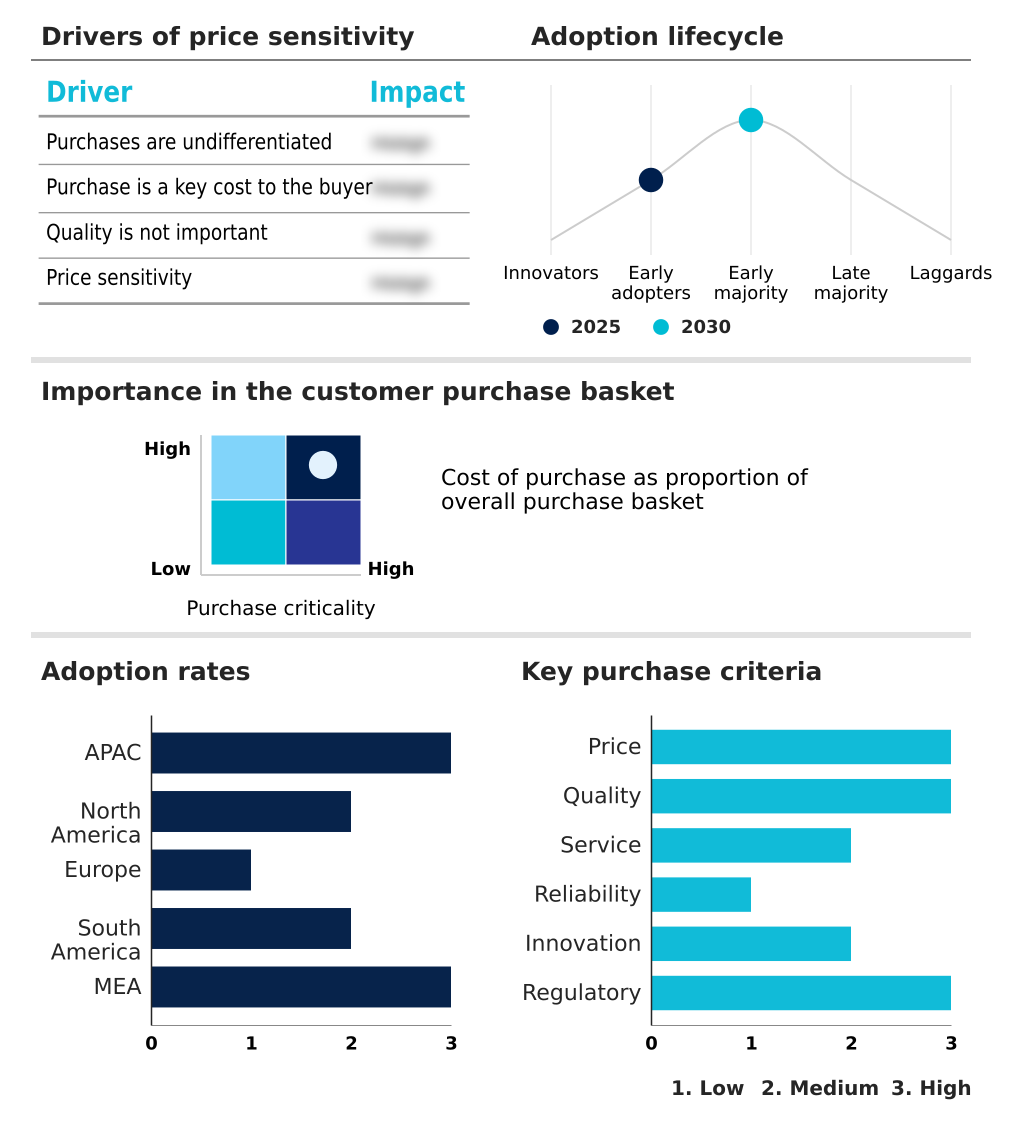
The telecom services market forecasting report includes the adoption lifecycle of the market, covering from the innovator's stage to the laggard's stage. It focuses on adoption rates in different regions based on penetration. Furthermore, the telecom services market report also includes key purchase criteria and drivers of price sensitivity to help companies evaluate and develop their market growth analysis strategies.
Customer Landscape
Key Companies & Market Insights
Companies are implementing various strategies, such as strategic alliances, telecom services market forecast, partnerships, mergers and acquisitions, geographical expansion, and product/service launches, to enhance their presence in the industry.
AT&T - The company specializes in delivering advanced telecommunications services, encompassing internet protocol (IP) and broadband internet solutions. By leveraging cutting-edge technologies, we ensure reliable, high-speed connectivity for our clients.
The industry research and growth report includes detailed analyses of the competitive landscape of the market and information about key companies, including:
- Airtel
- AT&T
- Bell Canada
- BT Group
- China Mobile
- Comcast
- Deutsche Telekom
- Etisalat
- NTT Communications
- Ooredoo
- Orange S.A.
- Reliance Jio
- Rogers Communications
- Saudi Telecom Company
- Singtel
- SoftBank
- Swisscom
- Telecom Italia
- Telefonica
- Telia Company
- Telenor
- Telstra
- Verizon
- Vodafone Group
Qualitative and quantitative analysis of companies has been conducted to help clients understand the wider business environment as well as the strengths and weaknesses of key industry players. Data is qualitatively analyzed to categorize companies as pure play, category-focused, industry-focused, and diversified; it is quantitatively analyzed to categorize companies as dominant, leading, strong, tentative, and weak.
Recent Development and News in Telecom Services Market
- In January 2024, Verizon Communications and AT&T announced their collaboration on a 5G Home Multi-Carrier Hub, aiming to expand 5G coverage and improve network reliability for residential customers (Verizon Communications Inc., 2024).
- In March 2024, Nokia secured a significant deal with Vodafone Group to deploy its AirGile cloud-native core network technology, enabling Vodafone to offer advanced services and improve network performance (Nokia Corporation, 2024).
- In April 2024, Deutsche Telekom and Orange Business Services formed a strategic partnership to expand their joint offering of integrated connectivity, cloud, and IoT services, targeting multinational corporations (Deutsche Telekom AG, 2024).
- In May 2025, T-Mobile US completed its acquisition of Sprint Corporation, creating a larger telecom player with an enhanced 5G network and expanded market presence (T-Mobile US, Inc., 2025).
- These developments reflect the ongoing consolidation and collaboration within the market, with a focus on expanding 5G networks, enhancing network performance, and offering integrated services to attract and retain corporate clients.
Research Analyst Overview
- In the market, performance management plays a crucial role in ensuring network efficiency and reliability. Training services are essential for telecom professionals to stay updated with the latest technologies, such as artificial intelligence (AI) and machine learning, which are increasingly being integrated into network infrastructure. Optical fibers and fiber optic cables form the backbone of modern telecom networks, while wearable devices and mobile devices expand the reach of wireless connectivity. Support services and managed services are in high demand, with network planning and consulting services guiding telecom companies in their digital transformation.
- Network deployment and optimization are key trends, driven by the proliferation of big data and IoT devices. Wireless infrastructure, including wireless routers and wireless access points, are essential components of these networks. Network monitoring and technical support are critical for maintaining network performance and security management. Professional services, including spectrum management and network optimization, help telecom companies maximize their network capabilities. Deep learning and AI are also being applied to network optimization and fault management. Cloud computing and telecom OSS/BSS solutions enable efficient network management and customer support. In summary, the market is characterized by continuous innovation and the integration of advanced technologies, such as AI, machine learning, and cloud computing, to meet evolving consumer demands and business needs.
Dive into Technavio's robust research methodology, blending expert interviews, extensive data synthesis, and validated models for unparalleled Telecom Services Market insights. See full methodology.
|
Market Scope
|
|
Report Coverage
|
Details
|
|
Page number
|
192
|
|
Base year
|
2024
|
|
Historic period
|
2019-2023 |
|
Forecast period
|
2025-2029
|
|
Growth momentum & CAGR
|
Accelerate at a CAGR of 6.2%
|
|
Market growth 2025-2029
|
USD 705.9 billion
|
|
Market structure
|
Fragmented
|
|
YoY growth 2024-2025(%)
|
5.8
|
|
Key countries
|
US, Canada, Germany, UK, Italy, France, China, India, Japan, Brazil, Egypt, UAE, Oman, Argentina, KSA, UAE, Brazil, and Rest of World (ROW)
|
|
Competitive landscape
|
Leading Companies, Market Positioning of Companies, Competitive Strategies, and Industry Risks
|
Request Free Sample
What are the Key Data Covered in this Telecom Services Market Research and Growth Report?
- CAGR of the Telecom Services industry during the forecast period
- Detailed information on factors that will drive the growth and forecasting between 2025 and 2029
- Precise estimation of the size of the market and its contribution of the industry in focus to the parent market
- Accurate predictions about upcoming growth and trends and changes in consumer behaviour
- Growth of the market across APAC, North America, Europe, South America, and Middle East and Africa
- Thorough analysis of the market's competitive landscape and detailed information about companies
- Comprehensive analysis of factors that will challenge the telecom services market growth of industry companies
We can help! Our analysts can customize this telecom services market research report to meet your requirements.
Get in touch
1 Executive Summary
- 1.1 Market overview
- Executive Summary - Chart on Market Overview
- Executive Summary - Data Table on Market Overview
- Executive Summary - Chart on Global Market Characteristics
- Executive Summary - Chart on Market by Geography
- Executive Summary - Chart on Market Segmentation by End-user
- Executive Summary - Chart on Market Segmentation by Type
- Executive Summary - Chart on Incremental Growth
- Executive Summary - Data Table on Incremental Growth
- Executive Summary - Chart on Company Market Positioning
2 Technavio Analysis
- 2.1 Analysis of price sensitivity, lifecycle, customer purchase basket, adoption rates, and purchase criteria
- Analysis of price sensitivity, lifecycle, customer purchase basket, adoption rates, and purchase criteria
- 2.2 Criticality of inputs and Factors of differentiation
- Overview on criticality of inputs and factors of differentiation
- 2.3 Factors of disruption
- Overview on factors of disruption
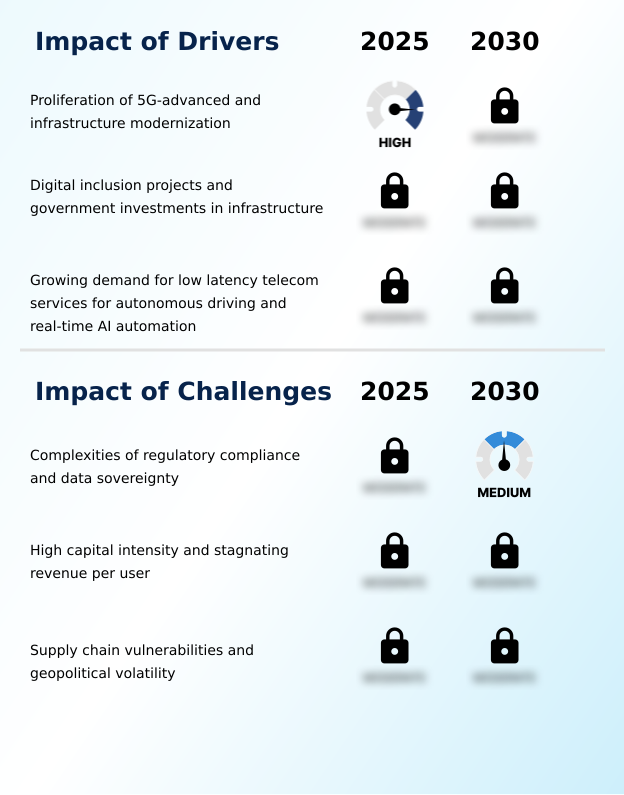
- 2.4 Impact of drivers and challenges
- Impact of drivers and challenges in 2024 and 2029
3 Market Landscape
- 3.1 Market ecosystem
- Parent Market
- Data Table on - Parent Market
- 3.2 Market characteristics
- Market characteristics analysis
4 Market Sizing
- 4.1 Market definition
- Offerings of companies included in the market definition
- 4.2 Market segment analysis
- 4.4 Market outlook: Forecast for 2024-2029
- Chart on Global - Market size and forecast 2024-2029 ($ billion)
- Data Table on Global - Market size and forecast 2024-2029 ($ billion)
- Chart on Global Market: Year-over-year growth 2024-2029 (%)
- Data Table on Global Market: Year-over-year growth 2024-2029 (%)
5 Historic Market Size
- 5.1 Global Telecom Services Market 2019 - 2023
- Historic Market Size - Data Table on Global Telecom Services Market 2019 - 2023 ($ billion)
- 5.2 End-user segment analysis 2019 - 2023
- Historic Market Size - End-user Segment 2019 - 2023 ($ billion)
- 5.3 Type segment analysis 2019 - 2023
- Historic Market Size - Type Segment 2019 - 2023 ($ billion)
- 5.4 Geography segment analysis 2019 - 2023
- Historic Market Size - Geography Segment 2019 - 2023 ($ billion)
- 5.5 Country segment analysis 2019 - 2023
- Historic Market Size - Country Segment 2019 - 2023 ($ billion)
6 Qualitative Analysis
- 6.1 The AI impact on Global Telecom Services Market
7 Five Forces Analysis
- 7.1 Five forces summary
- Five forces analysis - Comparison between 2024 and 2029
- 7.2 Bargaining power of buyers
- Bargaining power of buyers - Impact of key factors 2024 and 2029
- 7.3 Bargaining power of suppliers
- Bargaining power of suppliers - Impact of key factors in 2024 and 2029
- 7.4 Threat of new entrants
- Threat of new entrants - Impact of key factors in 2024 and 2029
- 7.5 Threat of substitutes
- Threat of substitutes - Impact of key factors in 2024 and 2029
- 7.6 Threat of rivalry
- Threat of rivalry - Impact of key factors in 2024 and 2029
- 7.7 Market condition
- Chart on Market condition - Five forces 2024 and 2029
8 Market Segmentation by End-user
- 8.1 Market segments
- Chart on End-user - Market share (2024-2029) (%)
- Data Table on End-user - Market share (2024-2029) (%)
- 8.2 Comparison by End-user
- Chart on Comparison by End-user
- Data Table on Comparison by End-user
- 8.3 Consumer/Residential - Market size and forecast (2024-2029)
- Chart on Consumer/Residential - Market size and forecast (2024-2029) ($ billion)
- Data Table on Consumer/Residential - Market size and forecast (2024-2029) ($ billion)
- Chart on Consumer/Residential - Year-over-year growth (2024-2029) (%)
- Data Table on Consumer/Residential - Year-over-year growth (2024-2029) (%)
- 8.4 Business - Market size and forecast (2024-2029)
- Chart on Business - Market size and forecast (2024-2029) ($ billion)
- Data Table on Business - Market size and forecast (2024-2029) ($ billion)
- Chart on Business - Year-over-year growth (2024-2029) (%)
- Data Table on Business - Year-over-year growth (2024-2029) (%)
- 8.5 Market opportunity by End-user
- Market opportunity by End-user ($ billion)
- Data Table on Market opportunity by End-user ($ billion)
9 Market Segmentation by Type
- 9.1 Market segments
- Chart on Type - Market share (2024-2029) (%)
- Data Table on Type - Market share (2024-2029) (%)
- 9.2 Comparison by Type
- Chart on Comparison by Type
- Data Table on Comparison by Type
- 9.3 Wireless - Market size and forecast (2024-2029)
- Chart on Wireless - Market size and forecast (2024-2029) ($ billion)
- Data Table on Wireless - Market size and forecast (2024-2029) ($ billion)
- Chart on Wireless - Year-over-year growth (2024-2029) (%)
- Data Table on Wireless - Year-over-year growth (2024-2029) (%)
- 9.4 Wireline - Market size and forecast (2024-2029)
- Chart on Wireline - Market size and forecast (2024-2029) ($ billion)
- Data Table on Wireline - Market size and forecast (2024-2029) ($ billion)
- Chart on Wireline - Year-over-year growth (2024-2029) (%)
- Data Table on Wireline - Year-over-year growth (2024-2029) (%)
- 9.5 Market opportunity by Type
- Market opportunity by Type ($ billion)
- Data Table on Market opportunity by Type ($ billion)
10 Market Segmentation by Service Type
- 10.1 Market segments
- Chart on Service Type - Market share (2024-2029) (%)
- Data Table on Service Type - Market share (2024-2029) (%)
- 10.2 Comparison by Service Type
- Chart on Comparison by Service Type
- Data Table on Comparison by Service Type
- 10.3 Fixed Voice Services - Market size and forecast (2024-2029)
- Chart on Fixed Voice Services - Market size and forecast (2024-2029) ($ billion)
- Data Table on Fixed Voice Services - Market size and forecast (2024-2029) ($ billion)
- Chart on Fixed Voice Services - Year-over-year growth (2024-2029) (%)
- Data Table on Fixed Voice Services - Year-over-year growth (2024-2029) (%)
- 10.4 Fixed Internet Access Services - Market size and forecast (2024-2029)
- Chart on Fixed Internet Access Services - Market size and forecast (2024-2029) ($ billion)
- Data Table on Fixed Internet Access Services - Market size and forecast (2024-2029) ($ billion)
- Chart on Fixed Internet Access Services - Year-over-year growth (2024-2029) (%)
- Data Table on Fixed Internet Access Services - Year-over-year growth (2024-2029) (%)
- 10.5 Mobile Voice Services - Market size and forecast (2024-2029)
- Chart on Mobile Voice Services - Market size and forecast (2024-2029) ($ billion)
- Data Table on Mobile Voice Services - Market size and forecast (2024-2029) ($ billion)
- Chart on Mobile Voice Services - Year-over-year growth (2024-2029) (%)
- Data Table on Mobile Voice Services - Year-over-year growth (2024-2029) (%)
- 10.6 Mobile Data Services - Market size and forecast (2024-2029)
- Chart on Mobile Data Services - Market size and forecast (2024-2029) ($ billion)
- Data Table on Mobile Data Services - Market size and forecast (2024-2029) ($ billion)
- Chart on Mobile Data Services - Year-over-year growth (2024-2029) (%)
- Data Table on Mobile Data Services - Year-over-year growth (2024-2029) (%)
- 10.7 Pay TV Services - Market size and forecast (2024-2029)
- Chart on Pay TV Services - Market size and forecast (2024-2029) ($ billion)
- Data Table on Pay TV Services - Market size and forecast (2024-2029) ($ billion)
- Chart on Pay TV Services - Year-over-year growth (2024-2029) (%)
- Data Table on Pay TV Services - Year-over-year growth (2024-2029) (%)
- 10.8 Machine-to-Machine (Mobile IoT) Services - Market size and forecast (2024-2029)
- Chart on Machine-to-Machine (Mobile IoT) Services - Market size and forecast (2024-2029) ($ billion)
- Data Table on Machine-to-Machine (Mobile IoT) Services - Market size and forecast (2024-2029) ($ billion)
- Chart on Machine-to-Machine (Mobile IoT) Services - Year-over-year growth (2024-2029) (%)
- Data Table on Machine-to-Machine (Mobile IoT) Services - Year-over-year growth (2024-2029) (%)
- 10.9 Market opportunity by Service Type
- Market opportunity by Service Type ($ billion)
- Data Table on Market opportunity by Service Type ($ billion)
11 Market Segmentation by Technology
- 11.1 Market segments
- Chart on Technology - Market share (2024-2029) (%)
- Data Table on Technology - Market share (2024-2029) (%)
- 11.2 Comparison by Technology
- Chart on Comparison by Technology
- Data Table on Comparison by Technology
- 5G Networks - Market size and forecast (2024-2029)
- Chart on 5G Networks - Market size and forecast (2024-2029) ($ billion)
- Data Table on 5G Networks - Market size and forecast (2024-2029) ($ billion)
- Chart on 5G Networks - Year-over-year growth (2024-2029) (%)
- Data Table on 5G Networks - Year-over-year growth (2024-2029) (%)
- 11.4 Fiber Optics - Market size and forecast (2024-2029)
- Chart on Fiber Optics - Market size and forecast (2024-2029) ($ billion)
- Data Table on Fiber Optics - Market size and forecast (2024-2029) ($ billion)
- Chart on Fiber Optics - Year-over-year growth (2024-2029) (%)
- Data Table on Fiber Optics - Year-over-year growth (2024-2029) (%)
- 11.5 Satellite Communication - Market size and forecast (2024-2029)
- Chart on Satellite Communication - Market size and forecast (2024-2029) ($ billion)
- Data Table on Satellite Communication - Market size and forecast (2024-2029) ($ billion)
- Chart on Satellite Communication - Year-over-year growth (2024-2029) (%)
- Data Table on Satellite Communication - Year-over-year growth (2024-2029) (%)
- 11.6 Market opportunity by Technology
- Market opportunity by Technology ($ billion)
- Data Table on Market opportunity by Technology ($ billion)
12 Customer Landscape
- 12.1 Customer landscape overview
- Analysis of price sensitivity, lifecycle, customer purchase basket, adoption rates, and purchase criteria
13 Geographic Landscape
- 13.1 Geographic segmentation
- Chart on Market share by geography 2024-2029 (%)
- Data Table on Market share by geography 2024-2029 (%)
- 13.2 Geographic comparison
- Chart on Geographic comparison
- Data Table on Geographic comparison
- 13.3 APAC - Market size and forecast 2024-2029
- Chart on APAC - Market size and forecast 2024-2029 ($ billion)
- Data Table on APAC - Market size and forecast 2024-2029 ($ billion)
- Chart on APAC - Year-over-year growth 2024-2029 (%)
- Data Table on APAC - Year-over-year growth 2024-2029 (%)
- 13.4 North America - Market size and forecast 2024-2029
- Chart on North America - Market size and forecast 2024-2029 ($ billion)
- Data Table on North America - Market size and forecast 2024-2029 ($ billion)
- Chart on North America - Year-over-year growth 2024-2029 (%)
- Data Table on North America - Year-over-year growth 2024-2029 (%)
- 13.5 Europe - Market size and forecast 2024-2029
- Chart on Europe - Market size and forecast 2024-2029 ($ billion)
- Data Table on Europe - Market size and forecast 2024-2029 ($ billion)
- Chart on Europe - Year-over-year growth 2024-2029 (%)
- Data Table on Europe - Year-over-year growth 2024-2029 (%)
- 13.6 South America - Market size and forecast 2024-2029
- Chart on South America - Market size and forecast 2024-2029 ($ billion)
- Data Table on South America - Market size and forecast 2024-2029 ($ billion)
- Chart on South America - Year-over-year growth 2024-2029 (%)
- Data Table on South America - Year-over-year growth 2024-2029 (%)
- 13.7 Middle East and Africa - Market size and forecast 2024-2029
- Chart on Middle East and Africa - Market size and forecast 2024-2029 ($ billion)
- Data Table on Middle East and Africa - Market size and forecast 2024-2029 ($ billion)
- Chart on Middle East and Africa - Year-over-year growth 2024-2029 (%)
- Data Table on Middle East and Africa - Year-over-year growth 2024-2029 (%)
- 13.8 US - Market size and forecast 2024-2029
- Chart on US - Market size and forecast 2024-2029 ($ billion)
- Data Table on US - Market size and forecast 2024-2029 ($ billion)
- Chart on US - Year-over-year growth 2024-2029 (%)
- Data Table on US - Year-over-year growth 2024-2029 (%)
- 13.9 China - Market size and forecast 2024-2029
- Chart on China - Market size and forecast 2024-2029 ($ billion)
- Data Table on China - Market size and forecast 2024-2029 ($ billion)
- Chart on China - Year-over-year growth 2024-2029 (%)
- Data Table on China - Year-over-year growth 2024-2029 (%)
- 13.10 India - Market size and forecast 2024-2029
- Chart on India - Market size and forecast 2024-2029 ($ billion)
- Data Table on India - Market size and forecast 2024-2029 ($ billion)
- Chart on India - Year-over-year growth 2024-2029 (%)
- Data Table on India - Year-over-year growth 2024-2029 (%)
- 13.11 UK - Market size and forecast 2024-2029
- Chart on UK - Market size and forecast 2024-2029 ($ billion)
- Data Table on UK - Market size and forecast 2024-2029 ($ billion)
- Chart on UK - Year-over-year growth 2024-2029 (%)
- Data Table on UK - Year-over-year growth 2024-2029 (%)
- 13.12 Brazil - Market size and forecast 2024-2029
- Chart on Brazil - Market size and forecast 2024-2029 ($ billion)
- Data Table on Brazil - Market size and forecast 2024-2029 ($ billion)
- Chart on Brazil - Year-over-year growth 2024-2029 (%)
- Data Table on Brazil - Year-over-year growth 2024-2029 (%)
- 13.13 Germany - Market size and forecast 2024-2029
- Chart on Germany - Market size and forecast 2024-2029 ($ billion)
- Data Table on Germany - Market size and forecast 2024-2029 ($ billion)
- Chart on Germany - Year-over-year growth 2024-2029 (%)
- Data Table on Germany - Year-over-year growth 2024-2029 (%)
- 13.14 Canada - Market size and forecast 2024-2029
- Chart on Canada - Market size and forecast 2024-2029 ($ billion)
- Data Table on Canada - Market size and forecast 2024-2029 ($ billion)
- Chart on Canada - Year-over-year growth 2024-2029 (%)
- Data Table on Canada - Year-over-year growth 2024-2029 (%)
- 13.15 France - Market size and forecast 2024-2029
- Chart on France - Market size and forecast 2024-2029 ($ billion)
- Data Table on France - Market size and forecast 2024-2029 ($ billion)
- Chart on France - Year-over-year growth 2024-2029 (%)
- Data Table on France - Year-over-year growth 2024-2029 (%)
- 13.16 Italy - Market size and forecast 2024-2029
- Chart on Italy - Market size and forecast 2024-2029 ($ billion)
- Data Table on Italy - Market size and forecast 2024-2029 ($ billion)
- Chart on Italy - Year-over-year growth 2024-2029 (%)
- Data Table on Italy - Year-over-year growth 2024-2029 (%)
- 13.17 Japan - Market size and forecast 2024-2029
- Chart on Japan - Market size and forecast 2024-2029 ($ billion)
- Data Table on Japan - Market size and forecast 2024-2029 ($ billion)
- Chart on Japan - Year-over-year growth 2024-2029 (%)
- Data Table on Japan - Year-over-year growth 2024-2029 (%)
- 13.18 Market opportunity by geography
- Market opportunity by geography ($ billion)
- Data Tables on Market opportunity by geography ($ billion)
- 13.19 Egypt - Market size and forecast (2024-2029)
- Chart on Egypt - Market size and forecast (2024-2029) ($ billion)
- Data Table on Egypt - Market size and forecast (2024-2029) ($ billion)
- Chart on Egypt - Year-over-year growth (2024-2029) (%)
- Data Table on Egypt - Year-over-year growth (2024-2029) (%)
- 13.20 UAE - Market size and forecast (2024-2029)
- Chart on UAE - Market size and forecast (2024-2029) ($ billion)
- Data Table on UAE - Market size and forecast (2024-2029) ($ billion)
- Chart on UAE - Year-over-year growth (2024-2029) (%)
- Data Table on UAE - Year-over-year growth (2024-2029) (%)
- 13.21 Oman - Market size and forecast (2024-2029)
- Chart on Oman - Market size and forecast (2024-2029) ($ billion)
- Data Table on Oman - Market size and forecast (2024-2029) ($ billion)
- Chart on Oman - Year-over-year growth (2024-2029) (%)
- Data Table on Oman - Year-over-year growth (2024-2029) (%)
- 13.22 Argentina - Market size and forecast (2024-2029)
- Chart on Argentina - Market size and forecast (2024-2029) ($ billion)
- Data Table on Argentina - Market size and forecast (2024-2029) ($ billion)
- Chart on Argentina - Year-over-year growth (2024-2029) (%)
- Data Table on Argentina - Year-over-year growth (2024-2029) (%)
- 13.23 KSA - Market size and forecast (2024-2029)
- Chart on KSA - Market size and forecast (2024-2029) ($ billion)
- Data Table on KSA - Market size and forecast (2024-2029) ($ billion)
- Chart on KSA - Year-over-year growth (2024-2029) (%)
- Data Table on KSA - Year-over-year growth (2024-2029) (%)
- 13.24 Rest of World (ROW) - Market size and forecast (2024-2029)
- Chart on Rest of World (ROW) - Market size and forecast (2024-2029) ($ billion)
- Data Table on Rest of World (ROW) - Market size and forecast (2024-2029) ($ billion)
- Chart on Rest of World (ROW) - Year-over-year growth (2024-2029) (%)
- Data Table on Rest of World (ROW) - Year-over-year growth (2024-2029) (%)
14 Drivers, Challenges, and Opportunity/Restraints
- 14.3 Impact of drivers and challenges
- Impact of drivers and challenges in 2024 and 2029
- 14.4 Market opportunities/restraints
15 Competitive Landscape
- 15.2 Competitive Landscape
- Overview on criticality of inputs and factors of differentiation
- 15.3 Landscape disruption
- Overview on factors of disruption
- 15.4 Industry risks
- Impact of key risks on business
16 Competitive Analysis
- 16.2 Market positioning of companies
- Matrix on companies position and classification
- 16.3 AT&T
- AT&T - Overview
- AT&T - Product / Service
- AT&T - Key offerings
- 16.4 Verizon
- Verizon - Overview
- Verizon - Product / Service
- Verizon - Key offerings
- 16.5 China Mobile
- China Mobile - Overview
- China Mobile - Product / Service
- China Mobile - Key offerings
- 16.6 Vodafone Group
- Vodafone Group - Overview
- Vodafone Group - Product / Service
- Vodafone Group - Key offerings
- 16.7 Deutsche Telekom
- Deutsche Telekom - Overview
- Deutsche Telekom - Product / Service
- Deutsche Telekom - Key offerings
- 16.8 NTT Communications
- NTT Communications - Overview
- NTT Communications - Product / Service
- NTT Communications - Key offerings
- 16.9 Orange S.A.
- Orange S.A. - Overview
- Orange S.A. - Product / Service
- Orange S.A. - Key offerings
- 16.10 Telefonica
- Telefonica - Overview
- Telefonica - Product / Service
- Telefonica - Key offerings
- 16.11 BT Group
- BT Group - Overview
- BT Group - Product / Service
- BT Group - Key offerings
- 16.12 Comcast
- Comcast - Overview
- Comcast - Product / Service
- Comcast - Key offerings
- 16.13 Reliance Jio
- Reliance Jio - Overview
- Reliance Jio - Product / Service
- Reliance Jio - Key offerings
- 16.14 SoftBank
- SoftBank - Overview
- SoftBank - Product / Service
- SoftBank - Key offerings
- 16.15 Telenor
- Telenor - Overview
- Telenor - Product / Service
- Telenor - Key offerings
- 16.16 Telstra
- Telstra - Overview
- Telstra - Product / Service
- Telstra - Key offerings
- 16.17 Singtel
- Singtel - Overview
- Singtel - Product / Service
- Singtel - Key offerings
- 16.18 Airtel
- Airtel - Overview
- Airtel - Product / Service
- Airtel - Key offerings
- 16.19 Etisalat
- Etisalat - Overview
- Etisalat - Product / Service
- Etisalat - Key offerings
- 16.20 Telecom Italia
- Telecom Italia - Overview
- Telecom Italia - Product / Service
- Telecom Italia - Key offerings
- 16.21 Bell Canada
- Bell Canada - Overview
- Bell Canada - Product / Service
- Bell Canada - Key offerings
- 16.22 Rogers Communications
- Rogers Communications - Overview
- Rogers Communications - Product / Service
- Rogers Communications - Key offerings
- 16.23 Telia Company
- Telia Company - Overview
- Telia Company - Product / Service
- Telia Company - Key offerings
- 16.24 Swisscom
- Swisscom - Overview
- Swisscom - Product / Service
- Swisscom - Key offerings
- 16.25 Ooredoo
- Ooredoo - Overview
- Ooredoo - Product / Service
- Ooredoo - Key offerings
- 16.26 Saudi Telecom Company
- Saudi Telecom Company - Overview
- Saudi Telecom Company - Product / Service
- Saudi Telecom Company - Key offerings
- 16.27 AT&T Inc.
- AT&T Inc. - Overview
- AT&T Inc. - Product / Service
- AT&T Inc. - Key offerings
- 16.28 Verizon Communications Inc.
- Verizon Communications Inc. - Overview
- Verizon Communications Inc. - Product / Service
- Verizon Communications Inc. - Key offerings
- 16.29 China Mobile Ltd.
- China Mobile Ltd. - Overview
- China Mobile Ltd. - Product / Service
- China Mobile Ltd. - Key offerings
- 16.30 Deutsche Telekom AG
- Deutsche Telekom AG - Overview
- Deutsche Telekom AG - Product / Service
- Deutsche Telekom AG - Key offerings
- 16.31 Vodafone Group Plc
- Vodafone Group Plc - Overview
- Vodafone Group Plc - Product / Service
- Vodafone Group Plc - Key offerings
- 16.32 Nippon Telegraph and Telephone Corp.
- Nippon Telegraph and Telephone Corp. - Overview
- Nippon Telegraph and Telephone Corp. - Product / Service
- Nippon Telegraph and Telephone Corp. - Key offerings
- 16.33 América Móvil
- América Móvil - Overview
- América Móvil - Product / Service
- América Móvil - Key offerings
- 16.34 Telefónica S.A.
- Telefónica S.A. - Overview
- Telefónica S.A. - Product / Service
- Telefónica S.A. - Key offerings
- 16.35 Orange S.A.
- Orange S.A. - Overview
- Orange S.A. - Product / Service
- Orange S.A. - Key offerings
- 16.36 China Telecom Corp. Ltd.
- China Telecom Corp. Ltd. - Overview
- China Telecom Corp. Ltd. - Product / Service
- China Telecom Corp. Ltd. - Key offerings
- 16.37 China Unicom
- China Unicom - Overview
- China Unicom - Product / Service
- China Unicom - Key offerings
- 16.38 BT Group plc (British Telecom)
- BT Group plc (British Telecom) - Overview
- BT Group plc (British Telecom) - Product / Service
- BT Group plc (British Telecom) - Key offerings
- 16.39 Telecom Italia (TIM)
- Telecom Italia (TIM) - Overview
- Telecom Italia (TIM) - Product / Service
- Telecom Italia (TIM) - Key offerings
- 16.40 SK Telecom Co. Ltd.
- SK Telecom Co. Ltd. - Overview
- SK Telecom Co. Ltd. - Product / Service
- SK Telecom Co. Ltd. - Key offerings
- 16.41 KT Corp.
- KT Corp. - Overview
- KT Corp. - Product / Service
- KT Corp. - Key offerings
- 16.42 Rogers Communications Inc.
- Rogers Communications Inc. - Overview
- Rogers Communications Inc. - Product / Service
- Rogers Communications Inc. - Key offerings
- 16.43 Telstra Corp. Ltd.
- Telstra Corp. Ltd. - Overview
- Telstra Corp. Ltd. - Product / Service
- Telstra Corp. Ltd. - Key offerings
- 16.44 Singtel (Singapore Telecommunications)
- Singtel (Singapore Telecommunications) - Overview
- Singtel (Singapore Telecommunications) - Product / Service
- Singtel (Singapore Telecommunications) - Key offerings
- 16.45 Swisscom AG
- Swisscom AG - Overview
- Swisscom AG - Product / Service
- Swisscom AG - Key offerings
- 16.46 Telenor Group
- Telenor Group - Overview
- Telenor Group - Product / Service
- Telenor Group - Key offerings
17 Appendix
- 17.2 Inclusions and exclusions checklist
- Inclusions checklist
- Exclusions checklist
- 17.3 Currency conversion rates for US$
- Currency conversion rates for US$
- 17.4 Research methodology
- 17.7 Validation techniques employed for market sizing
- Validation techniques employed for market sizing
- 17.9 360 degree market analysis
- 360 degree market analysis
- 17.10 List of abbreviations