



Wireless Sensor Network Market Size 2024-2028
The wireless sensor network (WSN) market size is forecast to increase by USD 110.73 billion at a CAGR of 17.71% between 2023 and 2028.
- The market is experiencing significant growth, driven by the increasing adoption of Industry 4.0 and the emergence of wearable technologies. Industry 4.0, also known as the Fourth Industrial Revolution, is characterized by the integration of advanced technologies such as the Internet of Things (IoT) and automation into manufacturing processes. WSNs play a crucial role in this revolution by providing real-time data on various industrial parameters, enabling predictive maintenance and optimizing production processes. Furthermore, the growing trend of wearable technologies is expanding the scope of WSNs beyond industrial applications to healthcare, fitness, and environmental monitoring. However, delivering high-quality WSNs at low cost remains a significant challenge for market players.
- This is due to the complex nature of wireless communication and the need for energy efficiency, which requires advanced technologies and sophisticated design. Companies seeking to capitalize on market opportunities and navigate these challenges effectively should focus on innovation, cost optimization, and strategic partnerships. By staying abreast of the latest technological developments and market trends, they can differentiate themselves and gain a competitive edge.
What will be the Size of the Wireless Sensor Network (WSN) Market during the forecast period?
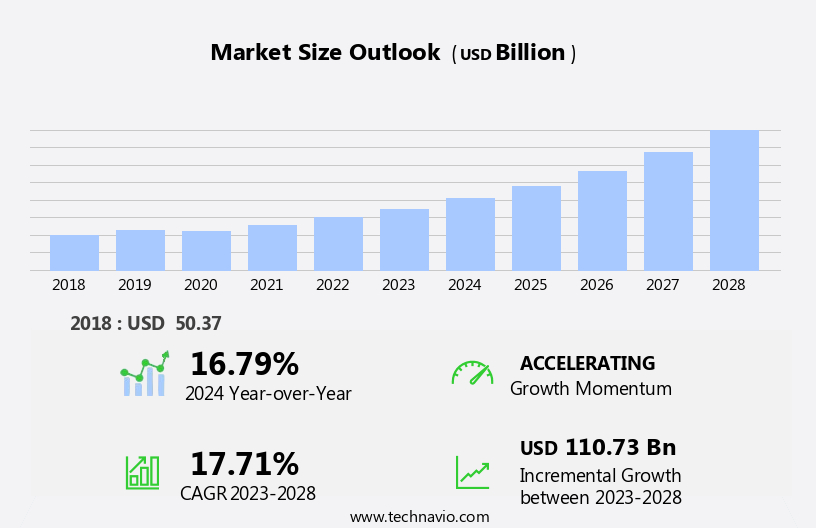
- The market encompasses a range of technologies and applications, including robotics, Internet-of-Things (IoT), smart cities, and autonomous vehicles. This dynamic market is driven by the increasing demand for remote monitoring and real-time data collection from heterogeneous devices. Sensor manufacturers continue to innovate, producing various types such as ambient light, temperature, heart rate, pressure, image, and more. WSNs employ various communication protocols, with Zigbee-based systems gaining popularity. Hardware, software, and services form the market's three primary segments. Applications span from building automation and security systems to access control, video surveillance, and wearable sensors in Body Area Networks.
- Artificial Intelligence (AI) integration enhances WSN capabilities, enabling advanced analytics and predictive maintenance. The market's growth is fueled by the increasing adoption of WSNs in various industries, leading to a significant expansion in size and direction.
How is the Wireless Sensor Network (WSN) Industry segmented?
The industry research report provides comprehensive data (region-wise segment analysis), with forecasts and estimates in "USD billion" for the period 2024-2028, as well as historical data from 2018-2022 for the following segments.
- Component
- Hardware
- Software
- Services
- End-user
- Building automation
- Wearable devices
- Healthcare
- Automotive and transportation
- Others
- Geography
- North America
- US
- APAC
- China
- Japan
- Europe
- Germany
- UK
- South America
- Middle East and Africa
- North America
By Component Insights
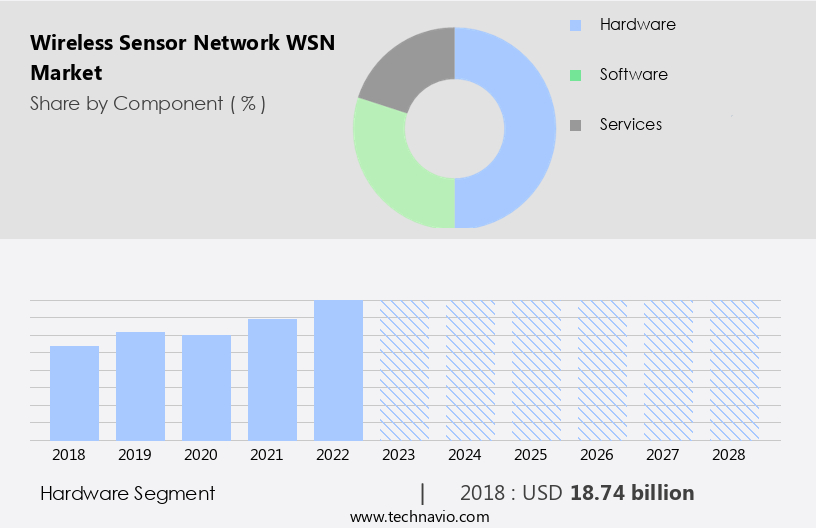
The hardware segment is estimated to witness significant growth during the forecast period. Wireless Sensor Networks (WSNs) are complex systems comprised of microcontrollers or microprocessors, sensor nodes, and various types of sensors, all working in unison to facilitate sensing, data processing, and wireless communication. Sensor nodes, the smallest components, incorporate sensing elements, processing units, and wireless communication modules. Microcontrollers or microprocessors, which house sensor nodes, manage data processing and control functions. WSNs utilize diverse sensor types, such as temperature, humidity, and gas sensors, depending on specific application demands. Power sources include batteries and energy harvesting techniques, like solar panels and kinetic energy harvesting. In the realm of WSN applications, sectors like robotics, IoT, smart cities, autonomous vehicles, and industrial manufacturing significantly benefit from this technology.
Key components include hardware, software, services, and a range of sensor types, including ambient light sensors, temperature sensors, heart rate sensors, and pressure sensors, among others. WSNs employ connectivity technologies like Bluetooth, Wi-Fi, and cellular networks, and platforms support remote monitoring, heterogeneous devices, and M2M connections. Applications span industries like healthcare, automotive and transportation, oil and gas, agriculture, aerospace and defense, energy conservation, and more.
Get a glance at the market report of share of various segments Request Free Sample
The Hardware segment was valued at USD 18.74 billion in 2018 and showed a gradual increase during the forecast period.
Regional Analysis
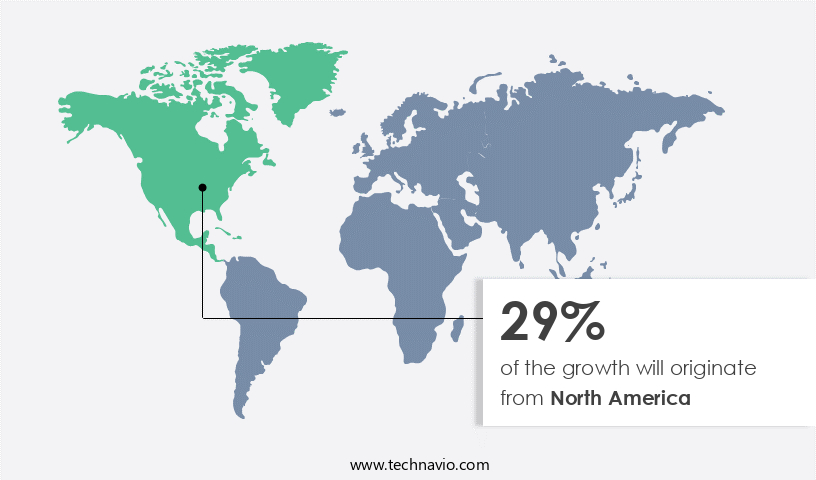
North America is estimated to contribute 29% to the growth of the global market during the forecast period. Technavio's analysts have elaborately explained the regional trends and drivers that shape the market during the forecast period.
For more insights on the market size of various regions, Request Free Sample
The market is a significant segment of the Internet-of-Things (IoT) industry, driven by the integration of WSNs in various applications such as robotics, smart cities, autonomous vehicles, and industrial automation. Key players include sensor manufacturers, technology providers, and system integrators. In North America, the US dominates the market due to its strong industrial sector, with applications in industries like power generation, oil and gas, automotive, food and beverage, and pharmaceutical. The region's market growth is attributed to the reshoring trend, increased demand for smart factories, and the proximity to end-users for customization. WSNs incorporate various sensor types, including ambient light sensors, temperature sensors, heart rate sensors, pressure sensors, accelerometers, and image sensors, among others.
Connectivity technologies like Bluetooth, Wi-Fi, and cellular networks enable seamless data transfer and integration with other systems. Applications span across sectors such as healthcare, automotive and transportation, industrial, oil and gas, agriculture, aerospace and defense, energy conservation, and building automation. AI and machine learning algorithms enhance the functionality of WSNs, enabling predictive maintenance, diagnostics, and remote monitoring.
Market Dynamics
Our researchers analyzed the data with 2023 as the base year, along with the key drivers, trends, and challenges. A holistic analysis of drivers will help companies refine their marketing strategies to gain a competitive advantage.
What are the key market drivers leading to the rise in the adoption of Wireless Sensor Network (WSN) Industry?
- Increasing adoption of Industry 4.0 is the key driver of the market. The global wireless sensor network market is experiencing significant growth due to the increasing adoption of Industry 4.0. This new industrial revolution integrates advanced technologies like IoT, cloud computing, and data analytics to create smart factories. Wireless sensor networks play a vital role in Industry 4.0, enabling real-time monitoring and management of industrial processes. Their benefits, including improved efficiency, reduced downtime, and cost-effectiveness, are essential for the digitalization and automation of various industries. As a result, the wireless sensor network market is poised for continued expansion.
- The integration of artificial intelligence (AI) and machine learning algorithms enhances the capabilities of wireless sensor networks, enabling remote monitoring, predictive maintenance, and real-time decision-making. The market for wireless sensor networks is expected to continue growing due to the increasing demand for real-time data and the need for efficient and cost-effective solutions for various applications.
What are the market trends shaping the Wireless Sensor Network (WSN) Industry?
- The emergence of wearable technologies is the upcoming market trend. Wearable technology, which encompasses devices such as smartwatches, smart glasses, heart rate monitors, and fitness tracking gadgets, is witnessing significant growth due to increasing consumer interest in enhancing daily life activities. Infineon Technologies, a leading magnetic sensor manufacturer, is among those investing in MEMS sensors to support this emerging technology. The adoption of wearable devices is not limited to the consumer market; industries are also exploring their potential.
- The market dynamics are favorable, with several companies experimenting with wearable technologies to offer innovative solutions. The integration of advanced sensors and connectivity options is expected to fuel the growth of this sector. Wearable technology is poised to revolutionize various industries, from healthcare to manufacturing, and its potential is immense.
What challenges does the Wireless Sensor Network (WSN) Industry face during its growth?
- Growing challenges in delivering high-quality wireless sensor networks at low cost is a key challenge affecting the industry growth. The wireless sensor market is witnessing significant growth due to the increasing demand for industrial automation. companies of wireless sensors are focusing on providing easily customizable and cost-effective solutions to cater to this demand. However, customization remains a key factor contributing to the expense of wireless sensors. End-users' businesses facilitate accurate customization and reliable delivery, ensuring the sensors meet specific industrial process control requirements.
- The cost of sensors has decreased over the years, primarily due to the availability of off-the-shelf varieties. However, sensors customized for specific applications will remain more technologically advanced and, consequently, more expensive during the forecast period. Engineers and system developers continue to explore enhanced wireless sensor products to expand their offerings.
Exclusive Customer Landscape
The market forecasting report includes the adoption lifecycle of the market, covering the innovator's stage to the laggard's stage. It focuses on adoption rates in different regions based on penetration. Furthermore, the market report also includes key purchase criteria and drivers of price sensitivity to help companies evaluate and develop their market growth analysis strategies.

Customer Landscape
Key Companies & Market Insights
Companies are implementing various strategies, such as strategic alliances, market forecast, partnerships, mergers and acquisitions, geographical expansion, and product/service launches, to enhance their presence in the industry.
The industry research and growth report includes detailed analyses of the competitive landscape of the market and information about key companies, including:
- ABB Ltd.
- Advantech Co. Ltd.
- Analog Devices Inc.
- Banner Engineering Corp.
- Cisco Systems Inc.
- Dell Technologies Inc.
- Emerson Electric Co.
- Endress Hauser Group Services AG
- Honeywell International Inc.
- Intel Corp.
- International Business Machines Corp.
- Lantronix Inc.
- Microsoft Corp.
- NXP Semiconductors NV
- Schneider Electric SE
- Siemens AG
- STMicroelectronics International N.V.
- TE Connectivity Ltd.
- Texas Instruments Inc.
- Yokogawa Electric Corp.
Qualitative and quantitative analysis of companies has been conducted to help clients understand the wider business environment as well as the strengths and weaknesses of key industry players. Data is qualitatively analyzed to categorize companies as pure play, category-focused, industry-focused, and diversified; it is quantitatively analyzed to categorize companies as dominant, leading, strong, tentative, and weak.
Research Analyst Overview
Wireless Sensor Networks (WSNs) have emerged as a crucial technology in various industries, driving digital transformation and optimizing operational efficiency. These networks enable the collection, transmission, and analysis of data from various sensors in real-time, fostering the growth of the Internet-of-Things (IoT) ecosystem. The WSN market encompasses a wide range of applications, including robotics, smart cities, autonomous vehicles, and industrial automation. In robotics, WSNs facilitate the integration of sensors and actuators, enhancing the capabilities of robotic systems. In smart cities, WSNs contribute to the development of intelligent urban infrastructure, enabling efficient energy management, traffic control, and public safety. WSNs play a significant role in the automotive and transportation sector, enabling real-time vehicle monitoring, predictive maintenance, and traffic management.
Moreover, in the industrial sector, WSNs are utilized in smart factories and intelligent manufacturing processes, ensuring optimal production efficiency and reducing downtime. The freight railroad industry also benefits from WSNs, with applications ranging from track monitoring and predictive maintenance to real-time cargo monitoring and logistics optimization. Wearable sensors and Body Area Networks (BANs) are another key application area for WSNs, with applications in healthcare, fitness, and wellness. The WSN market comprises various components, including hardware, software, and services. Hardware components include sensors, actuators, and communication modules. Sensors come in various types, such as ambient light sensors, temperature sensors, heart rate sensors, pressure sensors, accelerometers, and blood glucose sensors, among others.
Furthermore, software components include middleware, data processing, and analytics tools. Services include installation, integration, and maintenance. WSNs utilize various connectivity technologies, including Bluetooth, Bluetooth Smart, Wi-Fi, Near-Field Communication (NFC), cellular networks, and Bluetooth/Wi-Fi. These networks facilitate seamless data transmission and enable remote monitoring and control of devices. WSNs are also used in building automation, security systems, access control systems, video surveillance, energy efficiency, and M2M connections. In healthcare, WSNs are utilized for remote patient monitoring, diagnostics, and medical research. In agriculture, WSNs enable precision farming and livestock monitoring. In aerospace and defense, WSNs are used for real-time monitoring of aircraft systems and military applications.
|
Market Scope |
|
|
Report Coverage |
Details |
|
Page number |
178 |
|
Base year |
2023 |
|
Historic period |
2018-2022 |
|
Forecast period |
2024-2028 |
|
Growth momentum & CAGR |
Accelerate at a CAGR of 17.71% |
|
Market growth 2024-2028 |
USD 110.73 billion |
|
Market structure |
Fragmented |
|
YoY growth 2023-2024(%) |
16.79 |
|
Key countries |
US, China, Germany, UK, and Japan |
|
Competitive landscape |
Leading Companies, Market Positioning of Companies, Competitive Strategies, and Industry Risks |
What are the Key Data Covered in this Wireless Sensor Network (WSN) Market Research and Growth Report?
- CAGR of the Wireless Sensor Network (WSN) industry during the forecast period
- Detailed information on factors that will drive the market growth and forecasting between 2024 and 2028
- Precise estimation of the size of the market and its contribution of the industry in focus to the parent market
- Accurate predictions about upcoming growth and trends and changes in consumer behaviour
- Growth of the market across North America, APAC, Europe, South America, and Middle East and Africa
- Thorough analysis of the market's competitive landscape and detailed information about companies
- Comprehensive analysis of factors that will challenge the market growth of industry companies
We can help! Our analysts can customize this market research report to meet your requirements.
 RIA -
RIA - 
