

Artificial Intelligence (Ai) In Iot Market Analysis North America, Europe, APAC, South America, Middle East and Africa - US, China, Germany, Japan, UK - Size and Forecast 2024-2028

Artificial Intelligence (Ai) In Iot Market Analysis North America, Europe, APAC, South America, Middle East and Africa - US, China, Germany, Japan, UK - Size and Forecast 2024-2028

Published: Jul 2024 171 Pages SKU: IRTNTR74911

Market Overview at a Glance

$27.08 B
Market Opportunity
30.59%
CAGR
23.51
YoY growth 2023-2024(%)

Artificial Intelligence (AI) In IoT Market Size 2024-2028

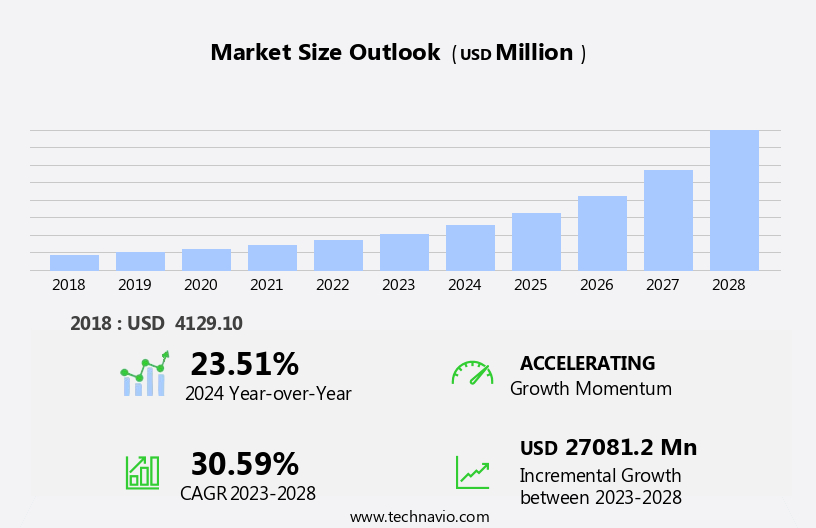
The artificial intelligence (ai) in iot market size is forecast to increase by USD 27.08 billion at a CAGR of 30.59% between 2023 and 2028.

  • Artificial Intelligence (AI) is revolutionizing various industries by enabling advanced automation and analytics capabilities In the Internet of Things (IoT) market. The growth of AI in IoT is being catalyzed by several trends, including the increasing adoption of AI in industrial automation for optimizing manufacturing processes, the expansion of smart cities with AI-powered sensors for public safety and transportation, and the integration of AI in BFSI security, health insurance, and education for anomaly detection and personalized services. Additionally, the rise of Industry 4.0 and the need for deep learning and edge computing are driving the demand for AI in logistics and supply chain management.
  • The market is also witnessing the emergence of AI-powered smart home appliances, such as refrigerators and chatbots, and the development of AI-enabled autonomous vehicles. However, privacy and security concerns are posing challenges to the widespread adoption of AI in IoT, necessitating the need for robust software solutions and regulations. Overall, AI is set to transform the IoT landscape by enabling digital transformation, enhancing operational efficiency, and delivering innovative solutions across various industries.
  • What will be the Size of the Artificial Intelligence (AI) In IoT Market During the Forecast Period?
    Artificial Intelligence (AI) In IoT Market Size

     Request Free Sample

  • The market represents an evolutionary step In the technology sector, integrating advanced algorithms, models, and patterns into interconnected networks of physical devices and processes. This market encompasses a wide range of applications, from agriculture and healthcare to buildings and smart cities, enhancing people's lives and work environments. Narrow AI and general AI components are increasingly being adopted to optimize wireless networks, devices, and corporate strategies. The integration of AI into IoT is transforming various industries, enabling predictive maintenance, real-time analytics, and automated decision-making. As AI continues to advance, it is poised to revolutionize the way we interact with physical elements and improve overall efficiency and productivity across various sectors.
  • How is this Artificial Intelligence (AI) In IoT Industry segmented and which is the largest segment?

    The artificial intelligence (ai) in iot industry research report provides comprehensive data (region-wise segment analysis), with forecasts and estimates in "USD million" for the period 2024-2028, as well as historical data from 2018-2022 for the following segments.

    • End-user
      • BFSI
      • IT and telecom
      • Manufacturing
      • Others
    • Component
      • Software
      • Services
    • Geography
      • North America
        • US
      • Europe
        • Germany
        • UK
      • APAC
        • China
        • Japan
      • South America
        • Middle East and Africa

        By End-user Insights

        • The bfsi segment is estimated to witness significant growth during the forecast period.

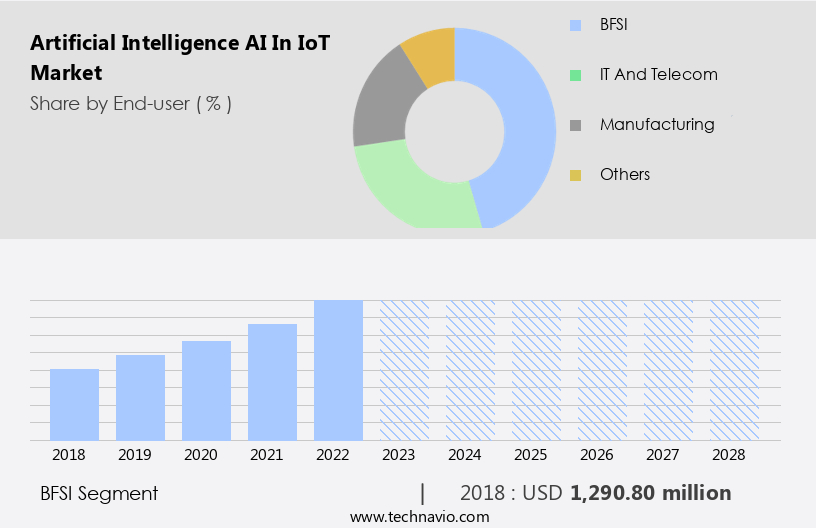
        Artificial Intelligence (AI) integration In the Internet of Things (IoT) market is significantly transforming various sectors, particularly In the Banking, Financial Services, and Insurance (BFSI) industry. AI algorithms and interconnected IoT devices enable real-time data analysis, enhancing fraud detection, risk management, and personalized customer experiences. In the BFSI sector, AI in IoT is revolutionizing operations and customer interactions, especially in developing countries, where smart ATMs and mobile banking apps offer personalized financial services to rural populations. AI-powered IoT systems facilitate real-time data processing and analysis, improving operational efficiencies and security. Machine learning paradigms, including supervised learning, unsupervised learning, and reinforcement learning, are integral to AI in IoT applications.

        In the industrial sector, AI in IoT is driving automation, autonomy, and edge computing in industrial environments. In the transportation sector, AI in IoT is optimizing logistics and fleet management. In the agricultural sector, AI in IoT is enhancing crop yield and livestock management. AI in IoT is also transforming the health sector, enabling real-time patient monitoring and diagnosis. In conclusion, AI in IoT is an evolutionary step In the technology sector, integrating physical elements, wireless networks, and cloud-based platforms to deliver intelligent solutions for various industries and sectors, improving people's lives and corporate strategies.
        Artificial Intelligence (AI) In IoT Market Size

        Get a glance at the Artificial Intelligence (AI) In IoT Industry report of share of various segments Request Free Sample

        The BFSI segment was valued at USD 1.29 billion in 2018 and showed a gradual increase during the forecast period.

        Regional Analysis

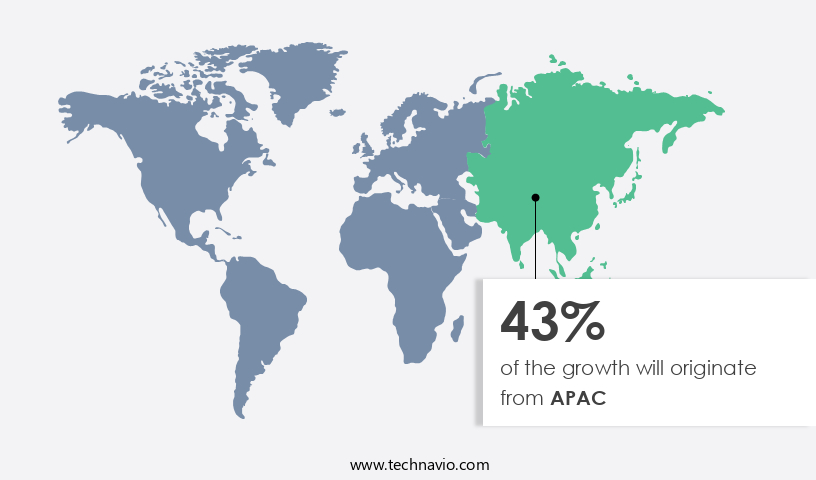
        • APAC is estimated to contribute 43% to the growth of the global market during the forecast period.

        Technavio’s analysts have elaborately explained the regional trends and drivers that shape the market during the forecast period.
        Artificial Intelligence (AI) In IoT Market Share by Geography

        For more insights on the market share of various regions, Request Free Sample

        The North American region dominates the global Artificial Intelligence (AI) in Internet of Things (IoT) market in 2023, driven by advanced economies and significant data generation and consumption. The US leads the North American market, with increasing investment and financing in AI, favoring institutions and startups in healthcare, education, and autonomous driving. AI in IoT market growth is influenced by the interconnected network of physical devices, sensors, and data exchange, facilitated by cloud-based platforms and machine learning paradigms, including supervised learning, unsupervised learning, and reinforcement learning. AI in IoT applications span various sectors, such as smart homes, agriculture, healthcare, buildings, smart cities, and transport and logistics.

        Components like Total Phase's USB, eSPI, host adapters, and protocol analyzers enable seamless data communication. Edge computing and industrial environments further boost AI in IoT adoption.

        Market Dynamics

        Our  researchers analyzed the data with 2023 as the base year, along with the key drivers, trends, and challenges. A holistic analysis of drivers will help companies refine their marketing strategies to gain a competitive advantage.

        What are the key market drivers leading to the rise In the adoption of Artificial Intelligence (AI) In IoT Industry?

        Analyzing IoT data faster is the key driver of the market.

      • Artificial Intelligence (AI) plays a significant role In the Internet of Things (IoT) market, where computer science systems and algorithms help models and patterns emerge from the data generated by interconnected physical devices and sensors. The IoT encompasses various devices, from vehicles to home appliances, which are part of an interconnected network. These devices generate massive amounts of raw data that require efficient processing for real-time insights. AI, with its machine learning and deep learning paradigms, is instrumental in deriving meaningful insights from this data. Machine learning models employ supervised learning, unsupervised learning, and reinforcement learning to identify historical usage patterns and detect anomalies.
      • For instance, in a smart home scenario, AI algorithms can learn from data to optimize energy usage or detect anomalous behavior. Total Phase, an embedded engineering solutions provider, offers various tools like USB, eSPI, host adapters, protocol analyzers, Aardvark I2C, Promira Serial Platform, Beagle I2C, CAN tools, and more to facilitate data exchange between devices. These tools enable seamless data processing and storage, essential for AI implementation in various sectors like agriculture, health, buildings, smart cities, and more. AI's integration into the IoT market is an evolutionary step for the technology sector, transforming industrial environments, transportation, and leisure and tourism industries, among others.
      • Autonomous systems, intelligent solutions, and context adaptation are some of the key functionalities that AI brings to the table. Edge computing further enhances AI's capabilities by enabling data processing closer to the source, reducing latency and improving overall efficiency. In conclusion, AI is a vital component In the IoT market, enabling efficient data processing, real-time insights, and intelligent solutions for various industries. Its integration with IoT devices and networks is revolutionizing work environments, corporate strategies, and people's lives.
      • What are the market trends shaping the Artificial Intelligence (AI) In IoT Industry?

        Growth in industrial automation is the upcoming market trend.

      • Artificial Intelligence (AI) is revolutionizing the Internet of Things (IoT) market in computer science by enabling systems to learn from data and make decisions based on patterns and models. Narrow AI and General AI are two paradigms of machine learning, which include machine learning algorithms such as supervised learning, unsupervised learning, and reinforcement learning. These algorithms analyze historical usage patterns in real-time data from interconnected networks of physical devices, sensors, and wireless networks. AI in IoT is transforming various sectors, including industry, agriculture, health, buildings, smart cities, and people's lives. Industrialization is benefiting from AI's autonomy, machine learning implementation, self-correction, and context adaptation, leading to increased efficiency, safety, and profitability.
      • In the transportation sector, AI is enabling automation and edge computing for industrial environments, logistics, and leisure and tourism. Moreover, AI is enhancing the functionality of various components, such as USB, eSPI, host adapters, protocol analyzers, and various communication protocols like I2C and CAN. Embedded engineers use these tools to analyze data processing, machine learning paradigms, and super-speed USB data. The technology sector is continuously evolving, and AI is an essential component of intelligent solutions for various applications, including smart homes, voice assistants like Siri, and various industrial and consumer applications.
      • What challenges does the Artificial Intelligence (AI) In IoT Industry face during its growth?

        Rise in privacy and security issues is a key challenge affecting the industry growth.

      • Artificial Intelligence (AI) is revolutionizing the Internet of Things (IoT) market by enhancing the functionality and autonomy of interconnected systems. Computer science algorithms and models identify patterns in real-time data from sensors in physical devices, enabling Narrow AI to optimize performance and General AI to learn and adapt. Machine learning paradigms, such as supervised learning, unsupervised learning, and reinforcement learning, are essential components in this evolution. IoT devices, including those In the smart home scenario, agricultural sector, health sector, buildings, and smart cities, rely on data exchange between physical elements and cloud-based platforms. Security is paramount, as vulnerabilities can lead to severe consequences, such as blackouts or data breaches.
      • Total Phase, an embedded engineering solutions provider, offers USB, eSPI, host adapters, protocol analyzers, and other tools to ensure seamless data processing and communication. These components are crucial for implementing machine learning and deep learning in IoT applications, enabling self-correction and context adaptation. Edge Computing, a significant technological advancement, allows for data processing at the source, reducing latency and enhancing the overall performance of AI in IoT systems. This technology is essential for industries such as transport, logistics, banking, insurance, and leisure and tourism, where real-time data processing is crucial. AI in IoT is an industrialization step that transforms various sectors, including transport, automation, and industrial environments, by enabling intelligent solutions and improving corporate strategies.
      • The integration of AI in IoT is an exciting development that has the potential to significantly impact people's lives and work environments.
      • Exclusive Customer Landscape

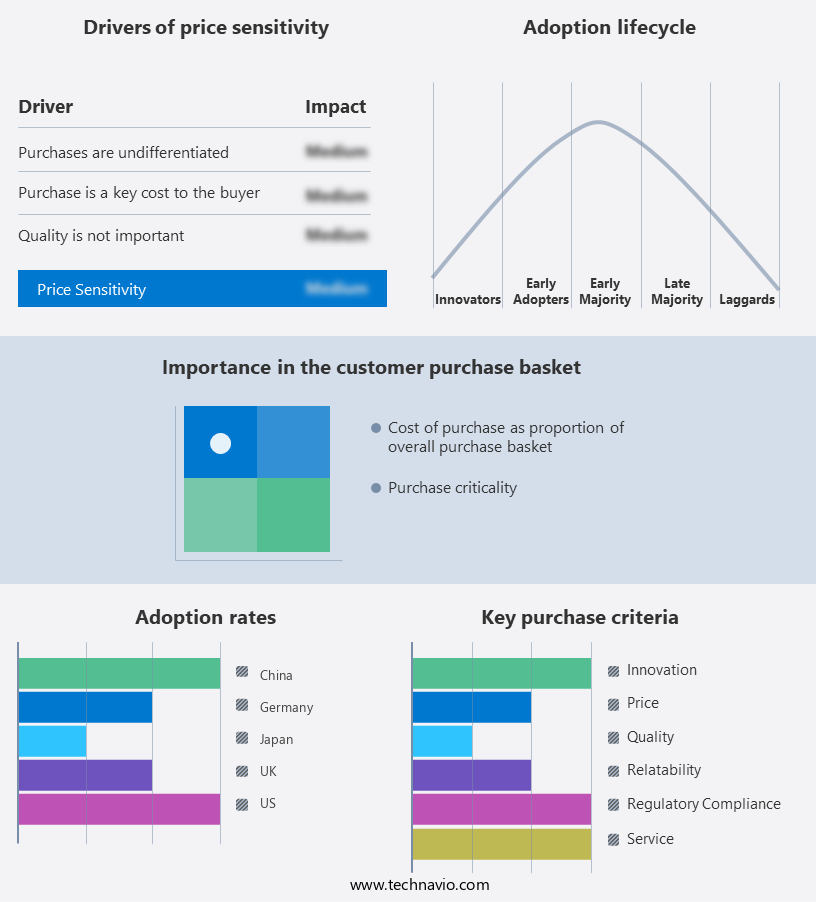
        The artificial intelligence (ai) in iot market forecasting report includes the adoption lifecycle of the market, covering from the innovator’s stage to the laggard’s stage. It focuses on adoption rates in different regions based on penetration. Furthermore, the artificial intelligence (ai) in iot market report also includes key purchase criteria and drivers of price sensitivity to help companies evaluate and develop their market growth analysis strategies.
        Artificial Intelligence (AI) In IoT Market Share by Geography

         Customer Landscape

        Key Companies & Market Insights

        Companies are implementing various strategies, such as strategic alliances, artificial intelligence (ai) in iot market forecast, partnerships, mergers and acquisitions, geographical expansion, and product/service launches, to enhance their presence In the industry.

        AIKairos Pvt. Ltd. - Artificial Intelligence (AI) plays a pivotal role In the Internet of Things (IoT) market through advanced solutions such as AI-powered web applications and multiplatform multi-sensor data fusion. These AI-driven offerings enhance IoT systems by enabling intelligent data analysis, predictive maintenance, and automated decision-making. By integrating AI technologies, IoT solutions optimize operational efficiency, improve performance, and deliver valuable insights to businesses across industries.

        The industry research and growth report includes detailed analyses of the competitive landscape of the market and information about key companies, including:

        • AIKairos Pvt. Ltd.
        • Alphabet Inc.
        • Amazon.com Inc.
        • Arundo Analytics Inc.
        • Autoplant System India Pvt. Ltd.
        • Avnet Inc.
        • C3.ai Inc
        • General Electric Co.
        • Hitachi Ltd.
        • Imagimob AB
        • International Business Machines Corp.
        • Microsoft Corp.
        • Oracle Corp.
        • PTC Inc.
        • Renesas Electronics Corp.
        • Salesforce Inc.
        • SAP SE
        • SAS Institute Inc.
        • Thingstel Tech Solutions India Pvt. Ltd.
        • Uptake Technologies Inc.

        Qualitative and quantitative analysis of companies has been conducted to help clients understand the wider business environment as well as the strengths and weaknesses of key industry players. Data is qualitatively analyzed to categorize companies as pure play, category-focused, industry-focused, and diversified; it is quantitatively analyzed to categorize companies as dominant, leading, strong, tentative, and weak.

        Research Analyst Overview

        Artificial Intelligence (AI) is revolutionizing various sectors by enabling interconnected systems of physical devices and sensors to exchange and process real-time data. This interconnected network of devices, often referred to as the Internet of Things (IoT), is transforming industries and enhancing people's lives in numerous ways. At the core of this transformation are advanced AI models, algorithms, and patterns. These systems employ various machine learning paradigms, including supervised learning, unsupervised learning, and reinforcement learning, to derive insights from raw data. Machine learning algorithms analyze historical usage patterns to detect anomalies and adapt to new contexts. Computer systems and algorithms have evolved significantly, with AI systems now capable of narrow and general intelligence.

        Narrow AI is designed to perform specific tasks, such as voice recognition or image analysis, while general AI can learn and adapt to various tasks. In the realm of IoT, AI's role is essential for data processing and storage in cloud-based platforms. Edge computing, which processes data closer to the source, is an evolutionary step in this field. AI's ability to self-correct and contextually adapt makes it an intelligent solution for various industries. The technology sector is witnessing rapid industrialization, with AI playing a pivotal role in automation and autonomy. In the industrial environments, AI is being employed for anomaly detection and predictive maintenance, ensuring optimal functionality and reducing downtime.

        The agricultural sector is benefiting from AI's ability to analyze real-time data from sensors and weather patterns to optimize crop yields and reduce water usage. In the health sector, AI is revolutionizing diagnostics and treatment plans, while In the transport sector, it's being used for route optimization and predictive maintenance. Smart homes and buildings are becoming more commonplace, with AI-enabled systems controlling various processes and activities. In the leisure and tourism industry, AI-powered voice assistants like Siri are enhancing the user experience. AI is also making inroads into corporate strategies, with self-correction and context adaptation being key features.

        In the banking and insurance sectors, AI is being used for fraud detection and risk assessment, while In the transport and logistics sector, it's being used for route optimization and predictive maintenance. In conclusion, AI's integration into the IoT is transforming various industries and enhancing people's lives. Its ability to process and analyze real-time data, learn from historical usage patterns, and adapt to new contexts makes it an essential component of the future technology landscape.

        Market Scope

        Report Coverage

        Details

        Page number

        171

        Base year

        2023

        Historic period

        2018-2022

        Forecast period

        2024-2028

        Growth momentum & CAGR

        Accelerate at a CAGR of 30.59%

        Market growth 2024-2028

        USD 27081.2 million

        Market structure

        Fragmented

        YoY growth 2023-2024(%)

        23.51

        Key countries

        US, China, Germany, Japan, and UK

        Competitive landscape

        Leading Companies, Market Positioning of Companies, Competitive Strategies, and Industry Risks

        Request Free Sample

        What are the Key Data Covered in this Artificial Intelligence (AI) In IoT Market Research and Growth Report?

        • CAGR of the Artificial Intelligence (AI) In IoT industry during the forecast period
        • Detailed information on factors that will drive the growth and forecasting between 2024 and 2028
        • Precise estimation of the size of the market and its contribution of the industry in focus to the parent market
        • Accurate predictions about upcoming growth and trends and changes in consumer behaviour
        • Growth of the market across North America, Europe, APAC, South America, and Middle East and Africa
        • Thorough analysis of the market’s competitive landscape and detailed information about companies
        • Comprehensive analysis of factors that will challenge the artificial intelligence (ai) in iot market growth of industry companies

        We can help! Our analysts can customize this artificial intelligence (ai) in iot market research report to meet your requirements.

        Get in touch


        Table of Contents not available.

        Research Methodology

        Technavio presents a detailed picture of the market by way of study, synthesis, and summation of data from multiple sources. The analysts have presented the various facets of the market with a particular focus on identifying the key industry influencers. The data thus presented is comprehensive, reliable, and the result of extensive research, both primary and secondary.

        INFORMATION SOURCES

        Primary sources

        • Manufacturers and suppliers
        • Channel partners
        • Industry experts
        • Strategic decision makers

        Secondary sources

        • Industry journals and periodicals
        • Government data
        • Financial reports of key industry players
        • Historical data
        • Press releases

        DATA ANALYSIS

        Data Synthesis

        • Collation of data
        • Estimation of key figures
        • Analysis of derived insights

        Data Validation

        • Triangulation with data models
        • Reference against proprietary databases
        • Corroboration with industry experts

        REPORT WRITING

        Qualitative

        • Market drivers
        • Market challenges
        • Market trends
        • Five forces analysis

        Quantitative

        • Market size and forecast
        • Market segmentation
        • Geographical insights
        • Competitive landscape

        Interested in this report?

        Get your sample now to see our research methodology and insights!

        Download Now

        Frequently Asked Questions

        Artificial Intelligence (AI) In IoT market growth will increase by $ 27081.2 mn during 2024-2028.

        The Artificial Intelligence (AI) In IoT market is expected to grow at a CAGR of 30.59% during 2024-2028.

        Artificial Intelligence (AI) In IoT market is segmented by End-user( BFSI, IT and telecom, Manufacturing, Others) Component( Software, Services)

        AIKairos Pvt. Ltd., Alphabet Inc., Amazon.com Inc., Arundo Analytics Inc., Autoplant System India Pvt. Ltd., Avnet Inc., C3.ai Inc, General Electric Co., Hitachi Ltd., Imagimob AB, International Business Machines Corp., Microsoft Corp., Oracle Corp., PTC Inc., Renesas Electronics Corp., Salesforce Inc., SAP SE, SAS Institute Inc., Thingstel Tech Solutions India Pvt. Ltd., Uptake Technologies Inc. are a few of the key vendors in the Artificial Intelligence (AI) In IoT market.

        APAC will register the highest growth rate of 43% among the other regions. Therefore, the Artificial Intelligence (AI) In IoT market in APAC is expected to garner significant business opportunities for the vendors during the forecast period.

        US, China, Germany, Japan, UK

        • Analyzing IoT data fasterThe IoT is the network of various devices is the driving factor this market.
        • such as vehicles and home appliances is the driving factor this market.
        • which contain electronics is the driving factor this market.
        • software is the driving factor this market.
        • sensors is the driving factor this market.
        • actuators is the driving factor this market.
        • and connectivity. The technology allows these devices to connect is the driving factor this market.
        • interact is the driving factor this market.
        • and exchange data. The IoT involves the extending of Internet connectivity beyond standard devices is the driving factor this market.
        • such as desktops is the driving factor this market.
        • laptops is the driving factor this market.
        • smartphones is the driving factor this market.
        • and tablets is the driving factor this market.
        • to any range of standalone or non-connected physical devices and everyday objects. IoT devices generate vast amounts of data. The traditional methods are not efficient enough to process the huge amounts of data coming from IoT devices. AI is particularly useful in this context as it can help in quickly deriving insights from IoT data. It can help in understanding flaws in a particular sensor or device so that it can be repaired or replaced on time. Sensors generate extensive information on temperature is the driving factor this market.
        • humidity is the driving factor this market.
        • air quality is the driving factor this market.
        • vibration is the driving factor this market.
        • and sound. Machine learning can automatically identify patterns and detect anomalies in the data generated by IoT devices. Traditional business intelligence tools can only monitor these devices to determine if they cross any numeric thresholds. Machine learning can help in predicting issues up to 20 times faster and with higher accuracy. Major vendors of the AI in IoT solutions are now offering integrated AI capabilities such as machine learning-based analytics. is the driving factor this market.

        The Artificial Intelligence (AI) In IoT market vendors should focus on grabbing business opportunities from the BFSI segment as it accounted for the largest market share in the base year.
