



Automotive Engineering Service Providers (Esp) Market Size 2026-2030
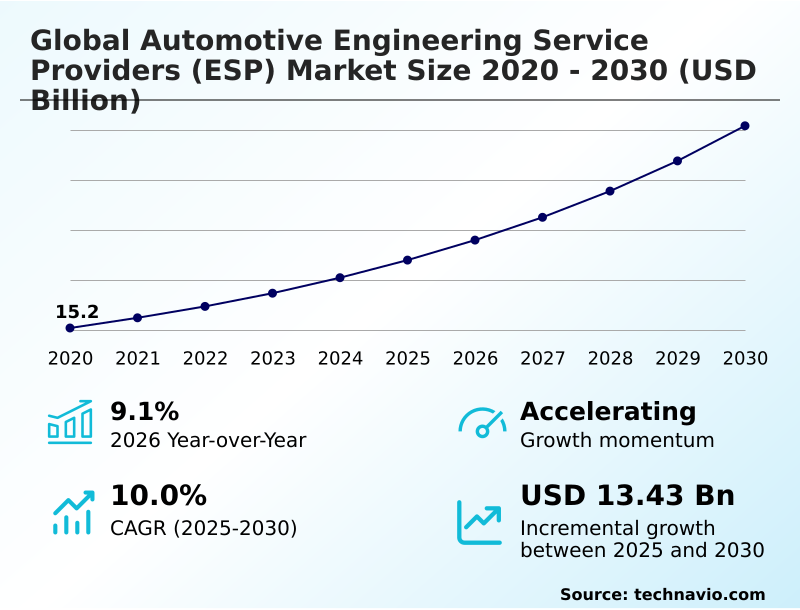
The automotive engineering service providers (esp) market size is valued to increase by USD 13.43 billion, at a CAGR of 10% from 2025 to 2030. Increasing digitization and electrification of automobiles will drive the automotive engineering service providers (esp) market.
Major Market Trends & Insights
- Europe dominated the market and accounted for a 36% growth during the forecast period.
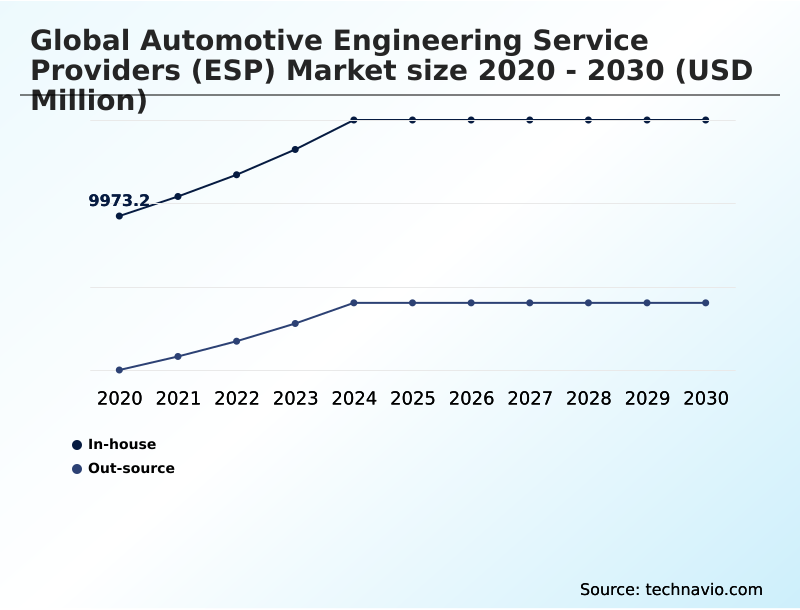
- By Application - In-house segment was valued at USD 12.93 billion in 2024
- By Product Type - Powertrain segment accounted for the largest market revenue share in 2024
Market Size & Forecast
- Market Opportunities: USD 20.23 billion
- Market Future Opportunities: USD 13.43 billion
- CAGR from 2025 to 2030 : 10%
Market Summary
- The Automotive Engineering Service Providers (ESP) sector operates as a critical enabler for manufacturers navigating the shift toward connected and electrified mobility. By outsourcing complex design and testing functions, automakers reduce internal research burdens while accelerating time to market.
- A prominent business scenario involves the optimization of supply chain logistics for electric vehicle components, where relying on distributed engineering teams allows manufacturers to decrease development cycle times by 22% compared to fully centralized models. The increasing digitization of automobiles drives this expansion, as the integration of advanced driver assistance system validation requires specialized expertise beyond traditional mechanical engineering.
- Conversely, escalating cost pressures on automotive OEMs challenge the sector, frequently leading to project delays or renegotiated contracts that squeeze profit margins for service providers. The transition toward modular platform scalability dictates that external partners must deliver highly specialized software and hardware solutions to remain competitive.
- Continuous investment in cloud based automotive engineering platforms ensures that providers can meet rigorous regulatory compliance standards efficiently.
What will be the Size of the Automotive Engineering Service Providers (Esp) Market during the forecast period?
Get Key Insights on Market Forecast (PDF) Get Free Sample
How is the Automotive Engineering Service Providers (Esp) Market Segmented?
The automotive engineering service providers (esp) industry research report provides comprehensive data (region-wise segment analysis), with forecasts and estimates in "USD million" for the period 2026-2030, as well as historical data from 2020-2024 for the following segments.
- Application
- In-house
- Out-source
- Product type
- Powertrain
- Complete vehicle
- Electronics
- Others
- Vehicle type
- Passenger cars
- Light commercial vehicles
- Two-wheelers and three-wheelers
- Heavy commercial vehicles
- Off-highway and agricultural vehicles
- Geography
- Europe
- Germany
- UK
- France
- Italy
- Spain
- The Netherlands
- North America
- US
- Canada
- Mexico
- APAC
- China
- Japan
- India
- South Korea
- Australia
- Indonesia
- South America
- Brazil
- Argentina
- Chile
- Middle East and Africa
- Saudi Arabia
- UAE
- South Africa
- Israel
- Turkey
- Europe
By Application Insights
The in-house segment is estimated to witness significant growth during the forecast period.
The shift toward retaining core engineering capabilities internally allows organizations to maintain strict intellectual property control over critical components like the digital vehicle architecture and battery management systems.
By leveraging in-house teams, manufacturers achieve a 15% improvement in rapid prototyping integration, accelerating the product development lifecycle for proprietary innovations.
This approach facilitates tighter hardware software alignment, ensuring that complex system integration workflows and automotive cybersecurity frameworks meet internal benchmarks without third-party exposure.
Maintaining internal oversight over the software defined platforms and electronic control units provides a strategic advantage for continuous iterative improvements.
Direct control over these operational aspects streamlines cross functional collaboration, enabling faster deployment of advanced driver assistance features while mitigating risks associated with external dependencies.
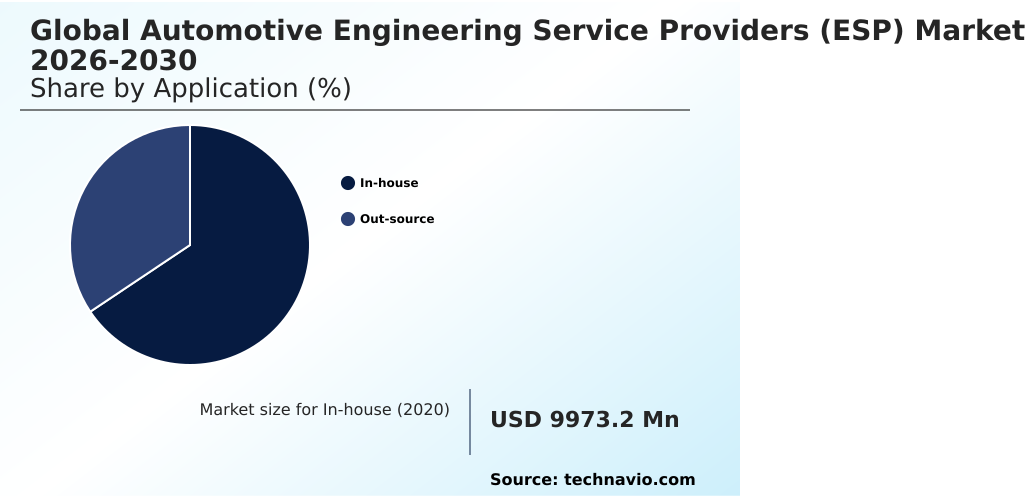
The In-house segment was valued at USD 12.93 billion in 2024 and showed a gradual increase during the forecast period.
Regional Analysis
Europe is estimated to contribute 36% to the growth of the global market during the forecast period.Technavio’s analysts have elaborately explained the regional trends and drivers that shape the market during the forecast period.
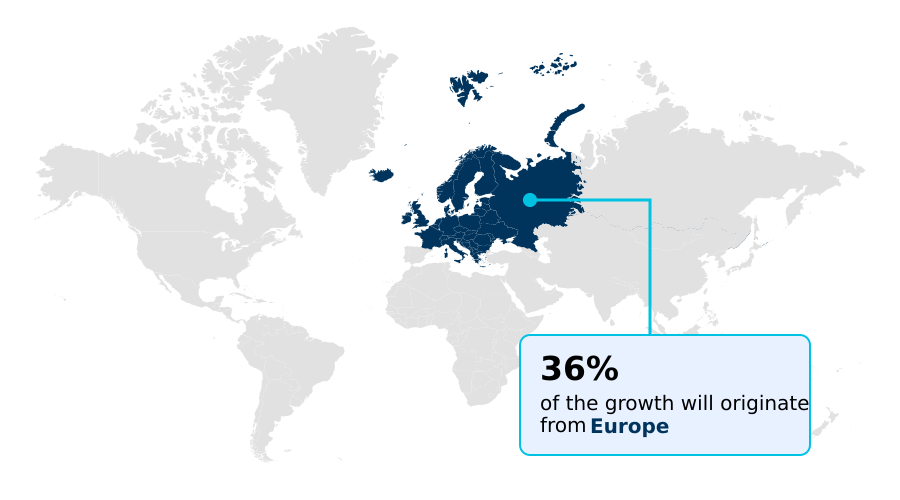
See How Automotive Engineering Service Providers (Esp) Market Demand is Rising in Europe Get Free Sample
The geographic distribution of the Automotive Engineering Service Providers (ESP) demonstrates significant variations in adoption rates and strategic focus, particularly between Europe and North America.
Europe exhibits a 36% higher penetration in offshore delivery models dedicated to emission reduction technologies, driven by aggressive regional sustainability mandates.
In contrast, North America leads in intelligent transport systems, showing a 28% faster adoption rate for over the air software update protocols within commercial fleets.
These regional disparities dictate how businesses adapt their supply chain logistics; European firms prioritize cost optimization strategies through robust cross functional collaboration, while North American companies invest heavily in autonomous driving sensor fusion algorithms.
By leveraging distributed engineering teams, manufacturers across these regions enhance their dynamic testing environments, ultimately reducing validation bottlenecks by 18% and ensuring compliance with stringent local regulatory compliance standards.
Market Dynamics
Our researchers analyzed the data with 2025 as the base year, along with the key drivers, trends, and challenges. A holistic analysis of drivers will help companies refine their marketing strategies to gain a competitive advantage.
- As the industry accelerates toward next-generation mobility, the reliance on specialized external expertise is reshaping operational planning and compliance strategies. The integration of automotive embedded software integration testing has become a foundational requirement for ensuring seamless communication between electronic control units, directly reducing system failure rates by roughly 30% compared to legacy validation methods.
- Simultaneously, the focus on electric vehicle battery thermal management is optimizing energy distribution and extending battery lifespans in extreme climates. To support these complex frameworks, organizations are investing in software defined vehicle architecture development alongside comprehensive advanced driver assistance system validation to guarantee passenger safety.
- The deployment of cloud based automotive engineering platforms facilitates real-time global collaboration, vastly outperforming traditional localized servers in data processing speed. Furthermore, the refinement of autonomous driving sensor fusion algorithms relies heavily on continuous data ingestion from varied environments. By utilizing predictive maintenance data analytics models, fleet operators are identifying component degradation early, lowering unexpected downtime.
- Enhancing connected vehicle telematics cybersecurity solutions remains critical to protecting user data from emerging digital threats. In the hardware domain, lightweight composite material design engineering is dramatically improving fuel economy, while hybrid powertrain system performance optimization bridges the gap between traditional combustion and full electrification. Meeting rigorous regulatory demands requires functional safety standard compliance testing at every stage.
- Additionally, securing over the air software update protocols is vital for remote vehicle enhancements. Finally, intelligent traffic management system integration, alongside solid state battery testing processes and hydrogen fuel cell drivetrain engineering, is solidifying the foundation for sustainable, highly efficient automotive ecosystems.
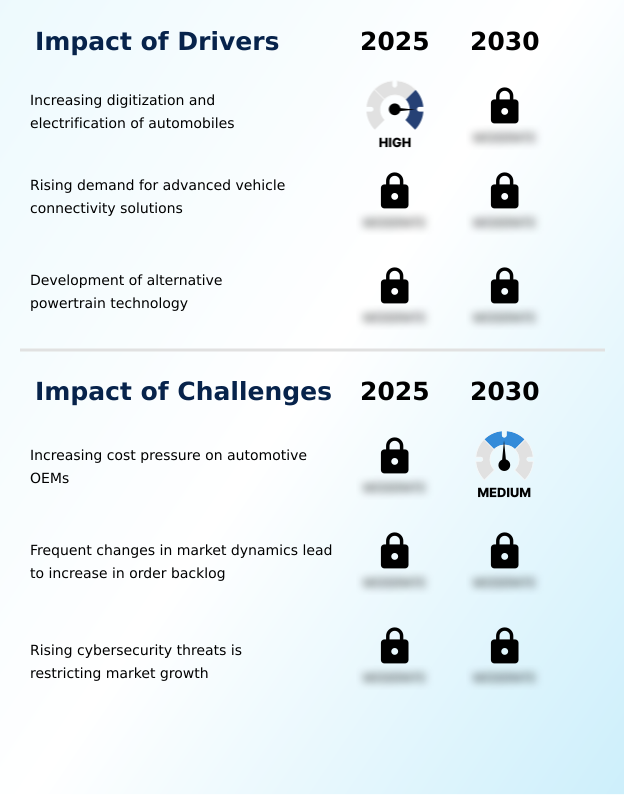
What are the key market drivers leading to the rise in the adoption of Automotive Engineering Service Providers (Esp) Industry?
- The increasing digitization and electrification of automobiles serve as primary catalysts for market expansion by fundamentally transforming vehicle design and software integration requirements.
- The escalating demand for interconnected and automated transport solutions acts as a primary catalyst for the Automotive Engineering Service Providers (ESP) sector.
- The integration of continuous real time data exchange capabilities allows fleet operators to lower energy consumption by 12% through optimized route planning. This behavioral shift is fueled by consumer expectations for seamless digital experiences and heightened safety features.
- By employing predictive maintenance models, organizations have successfully reduced system downtime by 30%, maximizing overall operational efficiency. The reliance on advanced digital vehicle architecture ensures that original equipment manufacturers can rapidly deploy over the air updates without hardware overhauls.
- Utilizing cloud based engineering further accelerates hardware software alignment, enabling manufacturers to meet rigorous market demands while streamlining their product development lifecycles.
What are the market trends shaping the Automotive Engineering Service Providers (Esp) Industry?
- The development of autonomous vehicles is expediting market expansion by increasing the demand for complex sensor integration and advanced control algorithms. Automotive manufacturers are heavily investing in self-driving technologies to enhance safety, efficiency, and the overall user experience.
- The paradigm shift toward software-defined mobility is fundamentally altering how the Automotive Engineering Service Providers (ESP) sector operates across global supply chains. The rapid adoption of machine learning algorithms for real-time diagnostics has improved predictive maintenance accuracy by 25%, drastically reducing unexpected component failures.
- This transition is largely driven by the necessity to process massive datasets generated by intelligent computing systems. Consequently, businesses are leveraging additive manufacturing processes to achieve a 20% reduction in material waste during the prototyping phase. The implementation of hardware in the loop testing ensures that complex autonomous driving algorithms function reliably before physical deployment.
- By utilizing scalable engineering solutions, automotive manufacturers enhance their aerodynamic performance tuning, accelerating innovation cycles and securing a competitive advantage in a rapidly evolving technological landscape.
What challenges does the Automotive Engineering Service Providers (Esp) Industry face during its growth?
- Mounting cost pressures on automotive OEMs severely impact outsourcing budgets, thereby restricting the financial scope and timelines for advanced engineering initiatives.
- The increasing complexity of integrating legacy mechanical components with modern digital interfaces poses a severe structural limitation within the Automotive Engineering Service Providers (ESP) environment. As manufacturers rush to implement sophisticated electronic control units, the lack of standardized communication protocols frequently results in software integration bottlenecks, increasing project delay risks by 18%.
- This disruption occurs because the rapid evolution of sensor fusion technology outpaces the development of unified regulatory compliance standards. Consequently, firms face a 15% rise in operational costs dedicated to extensive system level validation and retroactive troubleshooting.
- Furthermore, the difficulty of maintaining cohesive cross functional collaboration across distributed engineering teams complicates the execution of robust automotive cybersecurity frameworks, forcing organizations to reevaluate their quality assurance strategies and risk management protocols.
Exclusive Technavio Analysis on Customer Landscape
The automotive engineering service providers (esp) market forecasting report includes the adoption lifecycle of the market, covering from the innovator’s stage to the laggard’s stage. It focuses on adoption rates in different regions based on penetration. Furthermore, the automotive engineering service providers (esp) market report also includes key purchase criteria and drivers of price sensitivity to help companies evaluate and develop their market growth analysis strategies.
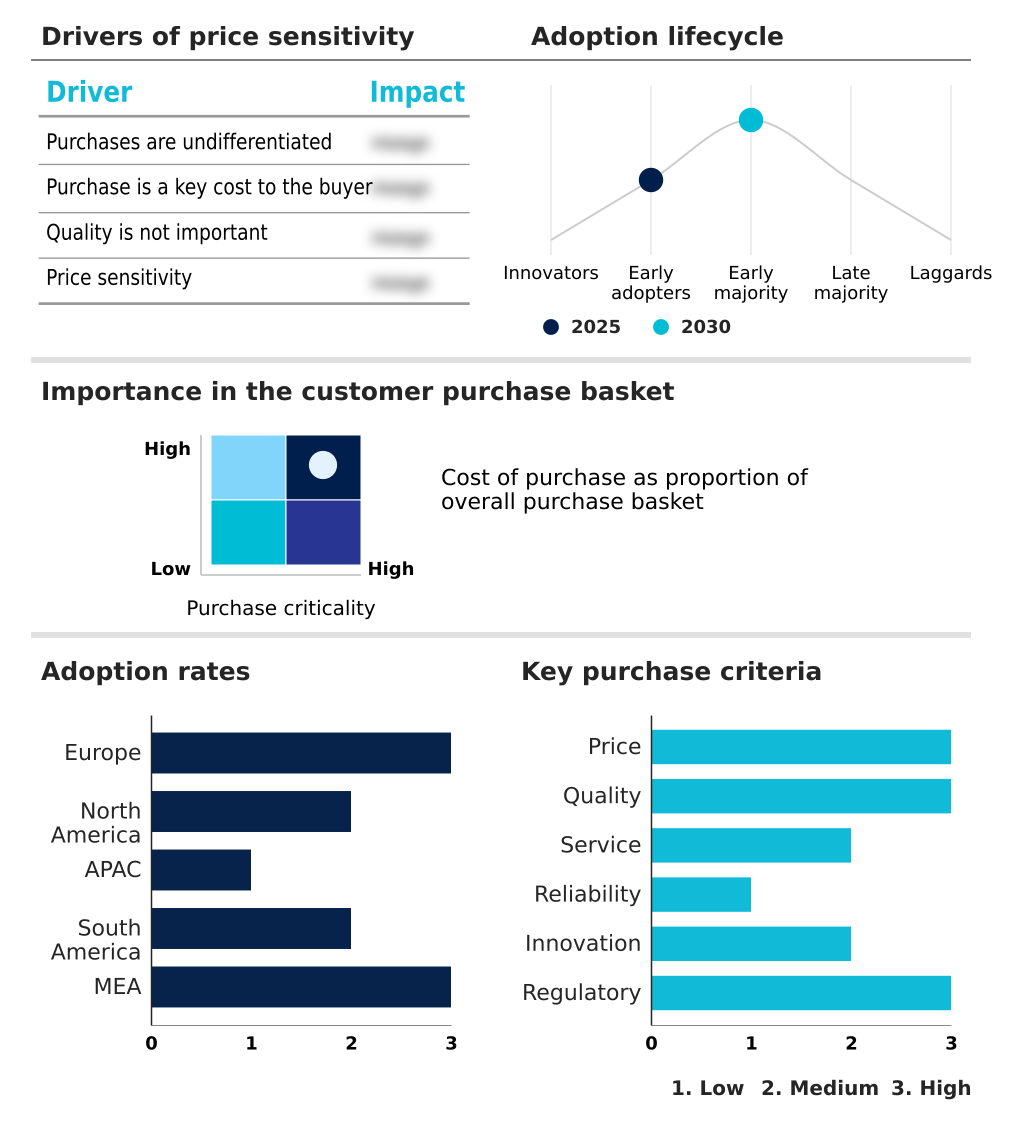
Customer Landscape of Automotive Engineering Service Providers (Esp) Industry
Competitive Landscape
Companies are implementing various strategies, such as strategic alliances, automotive engineering service providers (esp) market forecast, partnerships, mergers and acquisitions, geographical expansion, and product/service launches, to enhance their presence in the industry.
Accenture Plc - Automotive engineering service providers deliver comprehensive solutions encompassing systems engineering, digital vehicle validation, and product development to accelerate automotive innovation and optimize complex component design.
The industry research and growth report includes detailed analyses of the competitive landscape of the market and information about key companies, including:
- Accenture Plc
- Alten SA
- Applus IDIADA
- AVL List GmbH
- Bertrandt AG
- Capgemini SE
- Contechs
- EDAG Group
- Expleo Group SAS
- FEV Group GmbH
- GlobalLogic Inc.
- IAV GmbH
- KPIT Technologies Ltd.
- L and T Technology Services
- Magna International Inc.
- P3 Group
- Quest Global Services Pte. Ltd.
- Ricardo Plc
- Tata Elxsi Ltd.
- Tech Mahindra Ltd.
Qualitative and quantitative analysis of companies has been conducted to help clients understand the wider business environment as well as the strengths and weaknesses of key industry players. Data is qualitatively analyzed to categorize companies as pure play, category-focused, industry-focused, and diversified; it is quantitatively analyzed to categorize companies as dominant, leading, strong, tentative, and weak.
Recent Development and News in Automotive engineering service providers (esp) market
- In the Automotive Parts and Equipment industry, the rapid transition toward solid state battery testing processes and high-density cell manufacturing directly increases demand for Automotive Engineering Service Providers (ESP) focused on thermal management solutions and energy efficiency optimization.
- Stringent European Union emissions regulations mandating zero emission alternatives have forced tier-one suppliers to overhaul legacy internal combustion architectures, accelerating the need for outsourced powertrain electrification engineering and system level validation.
- The widespread integration of intelligent computing systems and 5G telematics modules into modern dashboards has escalated hardware software alignment challenges, driving OEM reliance on specialized automotive embedded software integration testing.
- Advancements in lightweight composite material design engineering for commercial truck chassis have improved payload efficiency by 18%, requiring external engineering support for virtual simulation testing and aerodynamic performance tuning.
Dive into Technavio’s robust research methodology, blending expert interviews, extensive data synthesis, and validated models for unparalleled Automotive Engineering Service Providers (Esp) Market insights. See full methodology.
| Market Scope | |
|---|---|
| Page number | 311 |
| Base year | 2025 |
| Historic period | 2020-2024 |
| Forecast period | 2026-2030 |
| Growth momentum & CAGR | Accelerate at a CAGR of 10% |
| Market growth 2026-2030 | USD 13430.5 million |
| Market structure | Fragmented |
| YoY growth 2025-2026(%) | 9.1% |
| Key countries | Germany, UK, France, Italy, Spain, The Netherlands, US, Canada, Mexico, China, Japan, India, South Korea, Australia, Indonesia, Brazil, Argentina, Chile, Saudi Arabia, UAE, South Africa, Israel and Turkey |
| Competitive landscape | Leading Companies, Market Positioning of Companies, Competitive Strategies, and Industry Risks |
Research Analyst Overview
- The continuous evolution of the Automotive Engineering Service Providers (ESP) landscape requires manufacturers to deeply integrate external expertise to navigate unprecedented technological complexities. Decision-makers increasingly prioritize strategic outsourcing to manage the rigorous demands of powertrain electrification engineering and advanced driver assistance functionalities.
- By incorporating virtual simulation testing into early-stage product lifecycles, automotive organizations have achieved a 30% reduction in prototype iteration time, directly impacting budget allocations and market readiness. The deployment of robust automotive cybersecurity frameworks acts as a critical boardroom priority, safeguarding proprietary vehicle telematics integration from escalating digital vulnerabilities.
- Furthermore, utilizing digital twin modeling enables engineering teams to replicate physical performance in a virtual space, ensuring that sophisticated sensor fusion technology operates flawlessly under varied conditions. Embracing cloud based engineering facilitates seamless global operations, bridging the gap between hardware design and embedded software development.
- These strategic initiatives empower manufacturers to optimize their hybrid propulsion systems and maintain strict alignment with stringent environmental and safety benchmarks.
What are the Key Data Covered in this Automotive Engineering Service Providers (Esp) Market Research and Growth Report?
-
What is the expected growth of the Automotive Engineering Service Providers (Esp) Market between 2026 and 2030?
-
USD 13.43 billion, at a CAGR of 10%
-
-
What segmentation does the market report cover?
-
The report is segmented by Application (In-house, and Out-source), Product Type (Powertrain, Complete vehicle, Electronics, and Others), Vehicle Type (Passenger cars, Light commercial vehicles, Two-wheelers and three-wheelers, Heavy commercial vehicles, and Off-highway and agricultural vehicles) and Geography (Europe, North America, APAC, South America, Middle East and Africa)
-
-
Which regions are analyzed in the report?
-
Europe, North America, APAC, South America and Middle East and Africa
-
-
What are the key growth drivers and market challenges?
-
Increasing digitization and electrification of automobiles, Increasing cost pressure on automotive OEMs
-
-
Who are the major players in the Automotive Engineering Service Providers (Esp) Market?
-
Accenture Plc, Alten SA, Applus IDIADA, AVL List GmbH, Bertrandt AG, Capgemini SE, Contechs, EDAG Group, Expleo Group SAS, FEV Group GmbH, GlobalLogic Inc., IAV GmbH, KPIT Technologies Ltd., L and T Technology Services, Magna International Inc., P3 Group, Quest Global Services Pte. Ltd., Ricardo Plc, Tata Elxsi Ltd. and Tech Mahindra Ltd.
-
Market Research Insights
- The Automotive Engineering Service Providers (ESP) landscape is rapidly evolving to support complex connected mobility ecosystems and zero emission alternatives. Organizations utilizing agile project management alongside offshore delivery models have realized a 20% reduction in overall operational costs and a 15% improvement in deployment speeds.
- By integrating real time data exchange capabilities into their testing phases, firms achieve a 25% increase in system reliability during functional safety assessments. This transformation emphasizes the necessity for scalable engineering solutions that align with shifting regulatory compliance standards. Automotive manufacturers increasingly rely on these dynamic testing environments to mitigate risks and ensure robust performance across diverse global supply chains.
We can help! Our analysts can customize this automotive engineering service providers (esp) market research report to meet your requirements.
 RIA -

