


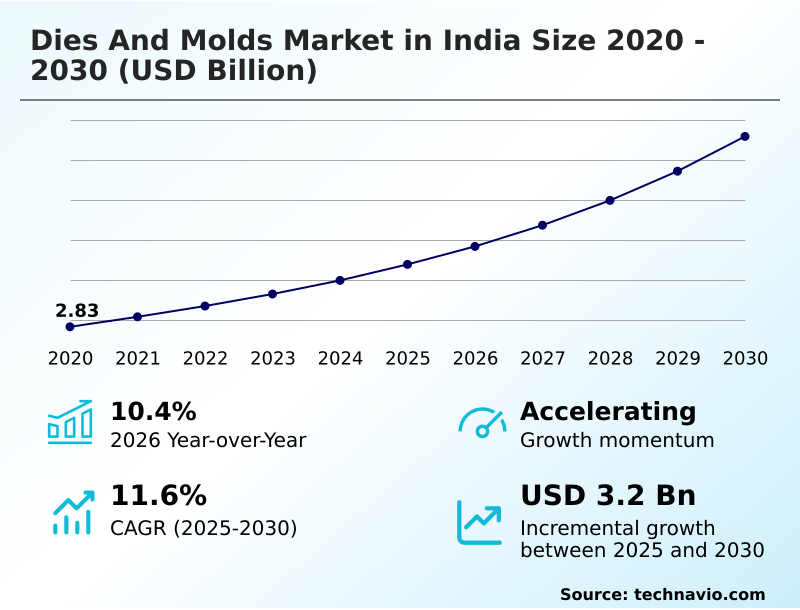
India Dies And Molds Market Size 2026-2030
The India Dies And Molds Market size was valued at USD 4.39 billion in 2025, growing at a CAGR of 11.6% during the forecast period 2026-2030.
Major Market Trends & Insights
- By Application - Casting segment was valued at USD 1.59 billion in 2024
- By End-user - Automotive segment accounted for the largest market revenue share in 2024
Market Size & Forecast
- Historic Market Opportunities 2020-2024: USD 4.76 billion
- Market Future Opportunities 2025-2030: USD 3.20 billion
- CAGR from 2025 to 2030 : 11.6%
Market Summary
- The dies and molds market in India is characterized by a high degree of fragmentation, with over 70% of production concentrated in small and medium-sized enterprises (SMEs). This structure impacts supply chain dynamics, where larger OEMs often manage multiple localized suppliers to mitigate risks, a strategy that has proven to reduce component sourcing lead times by up to 15%.
- A key driver is the automation in die casting, which enhances productivity and consistency for high-volume industries like automotive. However, a significant challenge is the persistent lack of skilled labor, creating a gap between the theoretical knowledge from vocational training and the high-precision requirements of modern tool rooms. This talent shortage can increase error rates and development timelines.
- Consequently, many firms are investing in in-house training programs and digital tools like CAD/CAM software to bridge this skill deficit and maintain competitiveness in a market increasingly focused on precision engineering and rapid product cycles.
What will be the Size of the India Dies And Molds Market during the forecast period?
Get Key Insights on Market Forecast (PDF) Request Free Sample
How is the India Dies And Molds Market Segmented?
The india dies and molds industry research report provides comprehensive data (region-wise segment analysis), with forecasts and analysis for the period 2026-2030, as well as historical data from 2020-2024 for the following segments.
- Application
- Casting
- Forging
- Injection molding
- End-user
- Automotive
- Construction
- Electronics
- Machine tools
- Others
- Material
- Metal
- Plastic
- Geography
- APAC
- India
- APAC
How is the India Dies And Molds Market Segmented by Application?
The casting segment is estimated to witness significant growth during the forecast period.
The casting segment represents a substantial portion of the dies and molds market in India, with its growth directly tied to the automotive sector's demand for lightweight components, which has risen by 25% in recent years.
This segment is dominated by high-pressure and low-pressure die casting dies, which are critical for producing complex metal parts like engine blocks and transmission cases with high dimensional accuracy.
The increasing adoption of flow simulation software has improved first-time-right rates by over 15%, reducing the need for costly rework.
Innovations in tool steel and surface treatment technology are enabling the creation of more durable die casting dies that can withstand extreme thermal fatigue.
As India's manufacturing ecosystem evolves, particularly with the push toward electric vehicles, the demand for advanced casting dies for components like battery housings is set to accelerate.
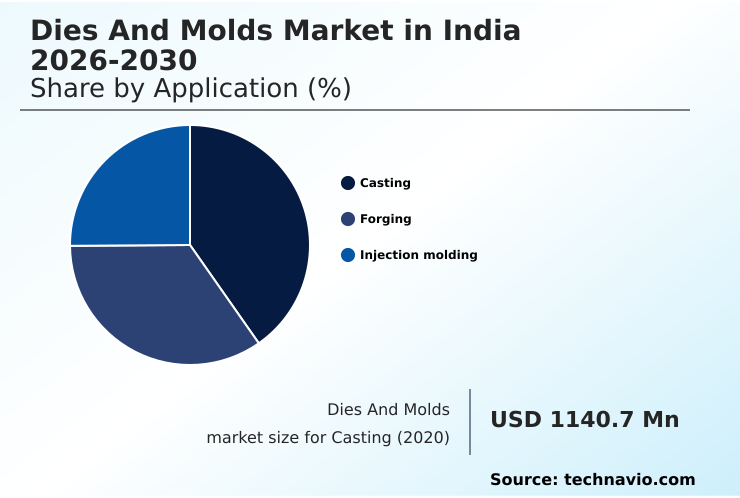
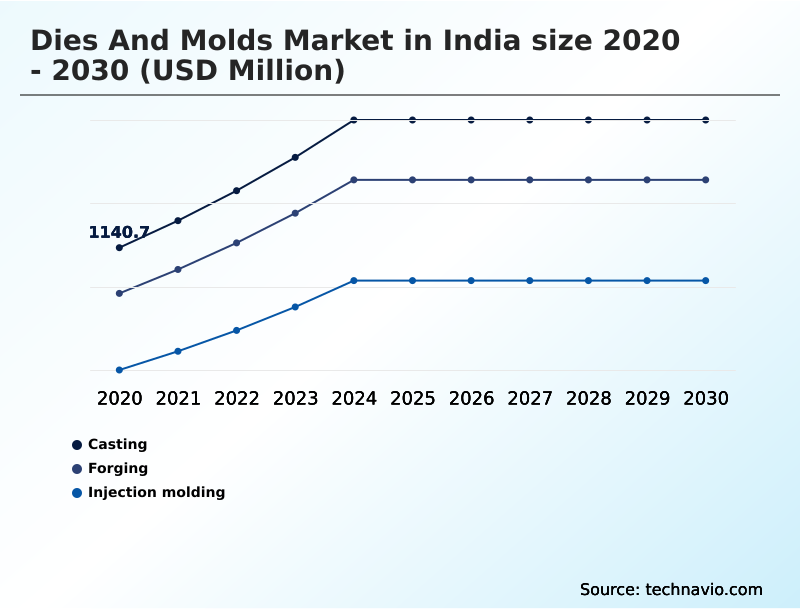
The Casting segment was valued at USD 1.59 billion in 2024 and showed a gradual increase during the forecast period.
What are the key Drivers, Trends, and Challenges in the India Dies And Molds Market?
Our researchers analyzed the data with 2025 as the base year, along with the key drivers, trends, and challenges. A holistic analysis of drivers will help companies refine their marketing strategies to gain a competitive advantage.
- Understanding the nuances of the dies and molds market in India requires a deep dive into its core technological shifts and operational challenges.
- A key area of innovation is the exploration of an all in one 3d printing casting forging technique, which offers unprecedented design freedom for complex mold inserts, potentially reducing cycle times by up to 20% compared to conventional methods. Concurrently, the widespread adoption of simulation technology in casting process workflows is becoming standard practice.
- This allows engineers to virtually validate designs, a process that has been shown to cut material waste from prototyping by nearly 25%, thereby improving cost-efficiency. On the operational side, examining the automation in die casting process benefits reveals significant gains in productivity and part consistency, addressing demands from high-volume sectors.
- However, the industry grapples with a significant skilled labor shortage in manufacturing sector, which can inflate project timelines and compromise quality. This human capital gap, combined with growing environmental concerns in mold manufacturing related to waste and energy use, creates a complex landscape where technological advancement must be balanced with workforce development and sustainable practices to ensure long-term, profitable growth.
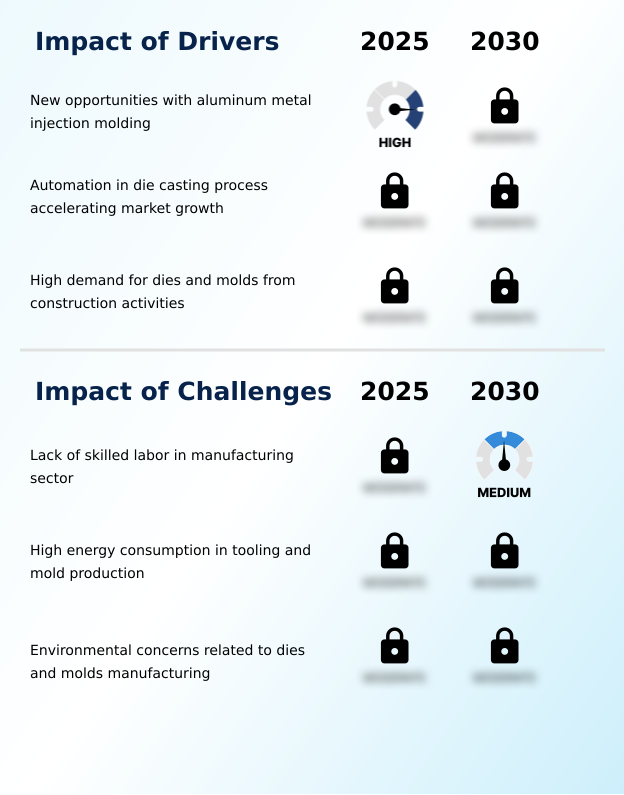
What are the key market drivers leading to the rise in the adoption of India Dies And Molds Industry?
- New opportunities with aluminum metal injection molding are a key driver, enabling the production of small, complex parts that were previously difficult to manufacture.
- New opportunities in aluminum metal injection molding (MIM) are a significant driver for the dies and molds market in India, enabling the production of small, complex parts with a 25% reduction in weight compared to traditional steel components.
- This process, which combines the design flexibility of plastic injection molding with the durability of metal, is crucial for the automotive and electronics sectors. The demand from these industries is accelerating investments in high-precision molds and micro-machining equipment.
- Additionally, the increasing automation in the die casting process, incorporating robotics for tasks like part extraction and die spraying, is boosting productivity and has been proven to increase output by over 20% in some foundries.
- This push toward smart manufacturing drives demand for sophisticated, sensor-integrated tooling designed for continuous, high-speed operation.
What are the market trends shaping the India Dies And Molds Industry?
- The incorporation of simulation technology in the casting process is a significant trend. It enhances the efficiency and accuracy of tool making.
- A primary trend reshaping the dies and molds market in India is the adoption of simulation technology in the casting process, which has been shown to reduce development times for complex parts by up to 30%. This digital-first approach minimizes material waste from failed prototypes, contributing to cost savings of 15-20% on high-value tool steel.
- By virtually testing metal flow and solidification, manufacturers can optimize gating system design and prevent defects before any physical manufacturing begins. This shift toward data-driven design is enabling Indian tool rooms to produce higher-quality, world-class dies.
- Furthermore, the development of hybrid manufacturing techniques combining additive manufacturing with traditional casting and forging is creating opportunities for producing complex mold inserts with conformal cooling channels, enhancing production efficiency.
What challenges does the India Dies And Molds Industry face during its growth?
- The lack of skilled labor in the manufacturing sector is a key challenge, as the industry requires a workforce proficient in both traditional craftsmanship and advanced digital engineering.
- A major challenge constraining growth in the dies and molds market in India is the high energy consumption during production, which can account for up to 20% of the total operational cost for some tool rooms. Energy-intensive processes like heat treatment and electrical discharge machining, coupled with fluctuating power tariffs, directly impact profitability and pricing competitiveness.
- This challenge is compounded by a persistent lack of skilled labor, with an estimated 30% gap between industry demand for high-precision skills and the available workforce.
- This shortage of talent proficient in modern CAD/CAM software and CNC machining leads to longer lead times and higher error rates, hindering the ability of manufacturers, especially SMEs, to scale production and adopt more advanced, energy-efficient technologies.
Exclusive Technavio Analysis on Customer Landscape
The india dies and molds market forecasting report includes the adoption lifecycle of the market, covering from the innovator’s stage to the laggard’s stage. It focuses on adoption rates in different regions based on penetration. Furthermore, the india dies and molds market report also includes key purchase criteria and drivers of price sensitivity to help companies evaluate and develop their market growth analysis strategies.
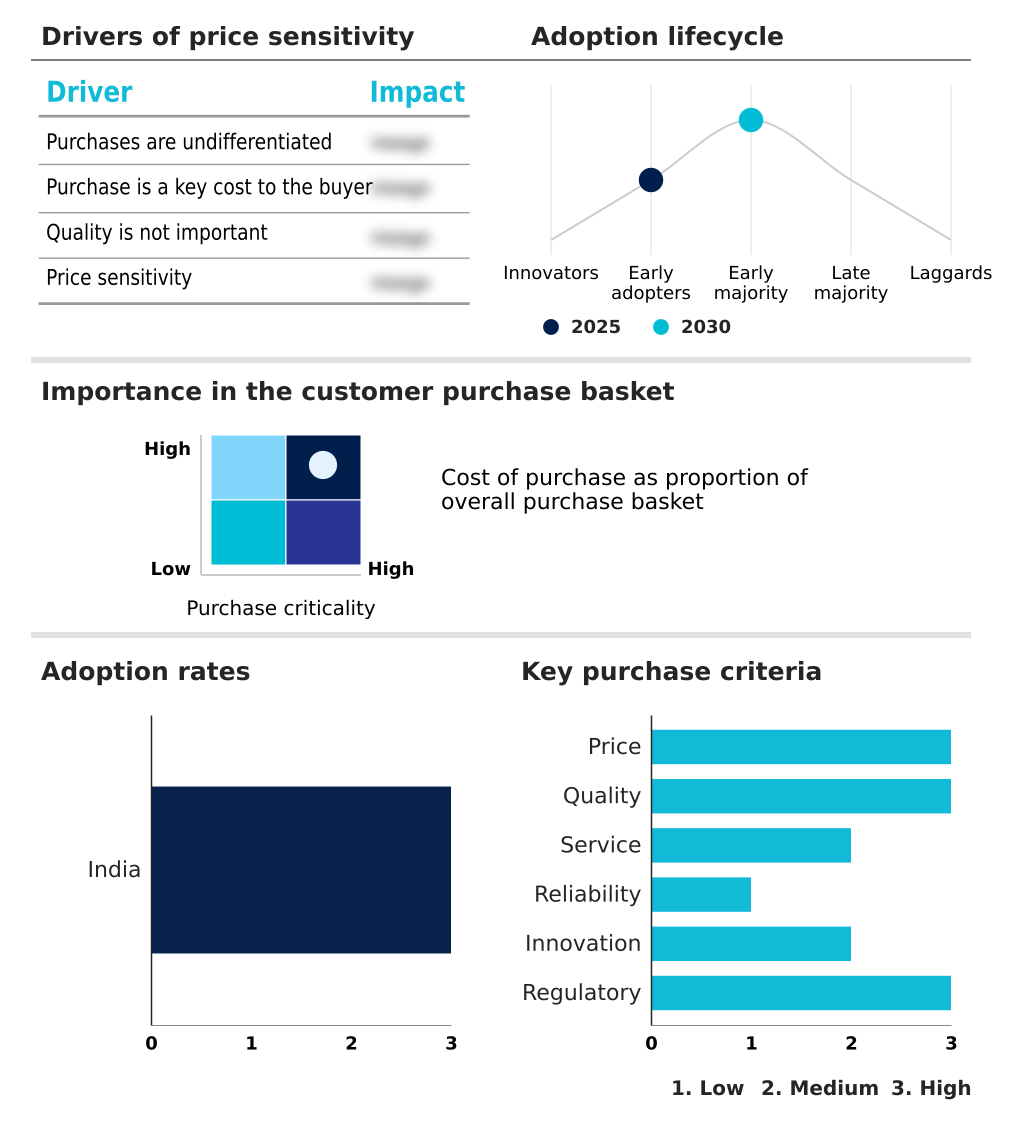
Customer Landscape of India Dies And Molds Industry
Competitive Landscape
Companies are implementing various strategies, such as strategic alliances, india dies and molds market forecast, partnerships, mergers and acquisitions, geographical expansion, and product/service launches, to enhance their presence in the industry.
Anand Engineering - Specializes in high-precision metal parts and custom industrial tooling, providing advanced fabrication and engineering solutions for automotive and industrial sectors.
The industry research and growth report includes detailed analyses of the competitive landscape of the market and information about key companies, including:
- Anand Engineering
- Bharat Forge Ltd.
- Craftsman Automation Ltd
- Endurance Technologies Ltd.
- Godrej and Boyce Manufacturing
- HNTI Ltd
- Jyoti CNC Automation Ltd.
- Micromatic Machine Tools Ltd
- Minda Corp. Ltd.
- Nelcast Ltd.
- Precision Moulds and Dies
- Pricol Ltd.
- Ramkrishna Forgings Ltd.
- Rico Auto Industries Ltd.
- Sandhar Technologies Ltd.
- Sansera Engineering Ltd.
- Shriram Pistons and Rings Ltd.
- Suprajit Engineering Ltd.
- Tooltech Moulds Pvt Ltd
- Uno Minda Ltd.
Qualitative and quantitative analysis of companies has been conducted to help clients understand the wider business environment as well as the strengths and weaknesses of key industry players. Data is qualitatively analyzed to categorize companies as pure play, category-focused, industry-focused, and diversified; it is quantitatively analyzed to categorize companies as dominant, leading, strong, tentative, and weak.
Market Intelligence Radar: High-Impact Developments & Growth Signals
- In the Industrial Machinery and Supplies and Components industry, the adoption of digital twin technology for machinery modeling has accelerated product development cycles by over 20%. This directly impacts the dies and molds market in India by demanding more sophisticated, sensor-integrated mold bases and tooling compatible with smart manufacturing ecosystems, driving innovation in precision tooling.
- The implementation of autonomous robotics in industrial manufacturing has improved production line efficiency by up to 30%. This shift requires dies and molds to be designed with standardized mounting points and integrated communication protocols for seamless robotic automation, particularly for high-speed machining and part extraction.
- A growing focus on lightweighting in end-user sectors has spurred innovation in high strength steel and advanced aluminum alloys. For the dies and molds market, this necessitates the development of more durable forging dies and precision tooling capable of handling the increased stress and unique forming properties of these materials, impacting tool steel selection.
- Stricter environmental regulations, such as those targeting industrial waste and energy consumption, are pushing for green manufacturing practices, with a target to reduce energy usage by 15% across the sector. This affects the dies and molds industry by increasing demand for energy-efficient production processes and molds designed for use with sustainable polymers and recycled materials, influencing material waste minimization strategies.
Dive into Technavio’s robust research methodology, blending expert interviews, extensive data synthesis, and validated models for unparalleled India Dies And Molds Market insights. See full methodology.
| Market Scope | |
|---|---|
| Page number | 188 |
| Base year | 2025 |
| Historic period | 2020-2024 |
| Forecast period | 2026-2030 |
| Growth momentum & CAGR | Accelerate at a CAGR of 11.6% |
| Market growth 2026-2030 | USD 3202.6 million |
| Market structure | Fragmented |
| YoY growth 2025-2026(%) | 10.4% |
| Key countries | India |
| Competitive landscape | Leading Companies, Market Positioning of Companies, Competitive Strategies, and Industry Risks |
Research Analyst Overview
- The dies and molds market ecosystem in India is a complex value chain where over 80% of raw materials, primarily high-grade tool steel, are sourced from a concentrated group of specialized suppliers. This reliance creates pricing volatility that can affect production costs by as much as 10-15% annually.
- Manufacturers, ranging from large integrated players to numerous small-scale tool rooms, utilize these materials to produce precision tooling with technologies like CNC machining. These tools are supplied to major end-user industries, with the automotive sector being the largest consumer. Distribution channels are often direct, with manufacturers working closely with clients to meet custom specifications.
- Regulatory bodies influence the industry through environmental standards, while technology providers of CAD/CAM software and simulation tools are crucial enablers, driving efficiency and innovation throughout the production cycle.
What are the Key Data Covered in this India Dies And Molds Market Research and Growth Report?
-
What is the expected growth of the India Dies And Molds Market between 2026 and 2030?
-
The India Dies And Molds Market is expected to grow by USD 3.20 billion during 2026-2030, registering a CAGR of 11.6%. Year-over-year growth in 2026 is estimated at 10.4%%. This acceleration is shaped by new opportunities with aluminum metal injection molding, which is intensifying demand across multiple end-use verticals covered in the report.
-
-
What segmentation does the market report cover?
-
The report is segmented by Application (Casting, Forging, and Injection molding), End-user (Automotive, Construction, Electronics, Machine tools, and Others), Material (Metal, and Plastic) and Geography (APAC). Among these, the Casting segment is estimated to witness significant growth during the forecast period, driven by rising adoption across key application areas. Each segment includes detailed qualitative and quantitative analysis, along with historical data from 2020-2024 and forecasts through 2030 with year-over-year growth rates.
-
-
Which regions are analyzed in the report?
-
The report covers APAC. Country-level analysis includes India, with dedicated market size tables and year-over-year growth for each.
-
-
What are the key growth drivers and market challenges?
-
The primary driver is new opportunities with aluminum metal injection molding, which is accelerating investment and industry demand. The main challenge is lack of skilled labor in manufacturing sector, creating operational barriers for key market participants. The report quantifies the impact of each driver and challenge across 2026 and 2030 with comparative analysis.
-
-
Who are the major players in the India Dies And Molds Market?
-
Key vendors include Anand Engineering, Bharat Forge Ltd., Craftsman Automation Ltd, Endurance Technologies Ltd., Godrej and Boyce Manufacturing, HNTI Ltd, Jyoti CNC Automation Ltd., Micromatic Machine Tools Ltd, Minda Corp. Ltd., Nelcast Ltd., Precision Moulds and Dies, Pricol Ltd., Ramkrishna Forgings Ltd., Rico Auto Industries Ltd., Sandhar Technologies Ltd., Sansera Engineering Ltd., Shriram Pistons and Rings Ltd., Suprajit Engineering Ltd., Tooltech Moulds Pvt Ltd and Uno Minda Ltd.. The report provides qualitative and quantitative analysis categorizing companies as dominant, leading, strong, tentative, and weak based on their market positioning. Company profiles include business segment analysis, SWOT assessment, key offerings, and recent strategic developments.
-
Market Research Insights
- The competitive landscape for dies and molds in India is moderately fragmented, with the top ten players accounting for less than 40% of the market share.
- Recent strategic moves underscore a push toward higher-value capabilities; for instance, Godrej Tooling's new production line for extra-large die casting dies aims to support the EV sector, where component precision can improve battery efficiency by 5-8%. Similarly, automotive leaders are collaborating with domestic tool rooms to localize the supply chain for next-generation vehicle platforms, aiming to reduce reliance on imports.
- This focus on supply chain localization is a direct response to global disruptions and the government's 'Make in India' initiative. A primary challenge remains the high capital expenditure required for advanced machinery, which can be a barrier for smaller enterprises trying to compete on technology.
We can help! Our analysts can customize this india dies and molds market research report to meet your requirements.
 RIA -
RIA - 
