
Metaverse In Finance Market Analysis, Size, and Forecast 2026-2030: APAC (China, Japan, and India), North America (US, Canada, and Mexico), Europe (Germany, UK, and France), South America (Brazil, Argentina, and Chile), Middle East and Africa (Saudi Arabia, UAE, and South Africa), and Rest of World (ROW)

Metaverse In Finance Market Analysis, Size, and Forecast 2026-2030:
APAC (China, Japan, and India), North America (US, Canada, and Mexico), Europe (Germany, UK, and France), South America (Brazil, Argentina, and Chile), Middle East and Africa (Saudi Arabia, UAE, and South Africa), and Rest of World (ROW)

Published: Nov 2026 298 Pages SKU: IRTNTR73448

Market Overview at a Glance

$1,670.64 B
Market Opportunity
49.8%
CAGR 2025 - 2030
44.8%
APAC Growth
$123.19 B
Hardware segment 2024

Metaverse In Finance Market Size 2026-2030

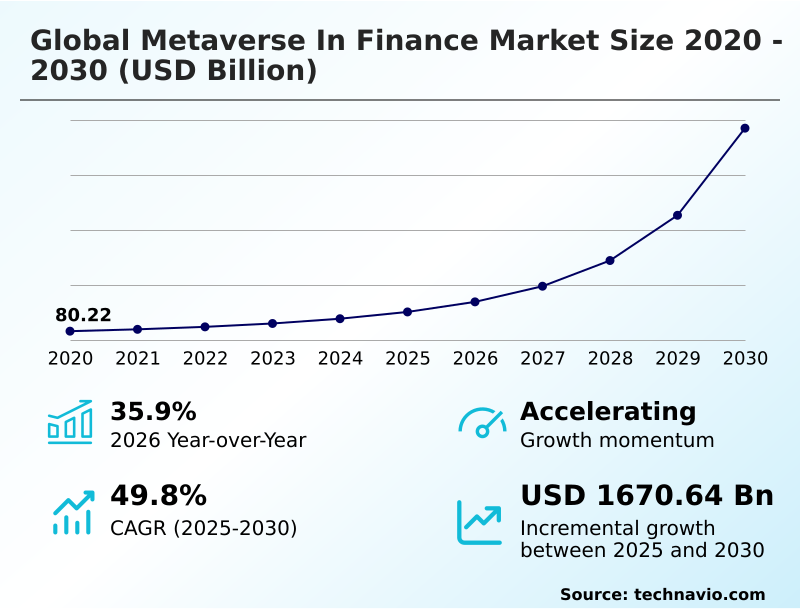
The metaverse in finance market size is valued to increase by USD 1,670.64 billion, at a CAGR of 49.8% from 2025 to 2030. Surging demand for immersive next-generation customer engagement will drive the metaverse in finance market.

Major Market Trends & Insights

  • APAC dominated the market and accounted for a 44.8% growth during the forecast period.
  • By Component - Hardware segment was valued at USD 123.19 billion in 2024
  • By End-user - Investment banks segment accounted for the largest market revenue share in 2024

Market Size & Forecast

  • Market Opportunities: USD 1,845.53 billion
  • Market Future Opportunities: USD 1,670.64 billion
  • CAGR from 2025 to 2030 : 49.8%

Market Summary

  • The Metaverse In Finance Market exhibits accelerated structural transformation as institutions transition from traditional web portals to spatial computing environments. Commercial banks now utilize decentralized networks to execute cross-border supply chain financing, automating escrow and settlement through smart contracts to eliminate intermediaries. Implementing these spatial banking environments has improved transaction processing efficiency by 35% compared to legacy fiat clearing systems.
  • This operational shift is heavily propelled by the surging demand for immersive next-generation customer engagement, as younger affluent demographics increasingly favor interactive avatars over traditional physical branch visits. By integrating artificial intelligence into virtual wealth advisory spaces, firms can scale personalized financial planning effortlessly.
  • However, the deployment of these spatial ecosystems faces severe headwinds from regulatory ambiguity and cross-border jurisdictional friction. Conflicting international standards regarding digital identity verification and asset ownership complicate compliance frameworks, often delaying regional rollouts. Ultimately, navigating these legal complexities while sustaining high-performance infrastructure remains critical for long-term commercial viability in the virtual finance sector.

What will be the Size of the Metaverse In Finance Market during the forecast period?
Get Key Insights on Market Forecast (PDF) Get Free Sample

How is the Metaverse In Finance Market Segmented?

The metaverse in finance industry research report provides comprehensive data (region-wise segment analysis), with forecasts and estimates in "USD million" for the period 2026-2030, as well as historical data from 2020-2024 for the following segments.

  • Component
    • Hardware
    • Software
  • End-user
    • Investment banks
    • Brokerage firms
    • Commercial banks
    • Others
  • Platform
    • Desktop
    • Mobile
  • Geography
    • APAC
      • China
      • Japan
      • India
      • South Korea
      • Australia
      • Indonesia
    • North America
      • US
      • Canada
      • Mexico
    • Europe
      • Germany
      • UK
      • France
      • Italy
      • Spain
      • The Netherlands
    • South America
      • Brazil
      • Argentina
      • Chile
    • Middle East and Africa
      • Saudi Arabia
      • UAE
      • South Africa
      • Israel
      • Turkey

By Component Insights

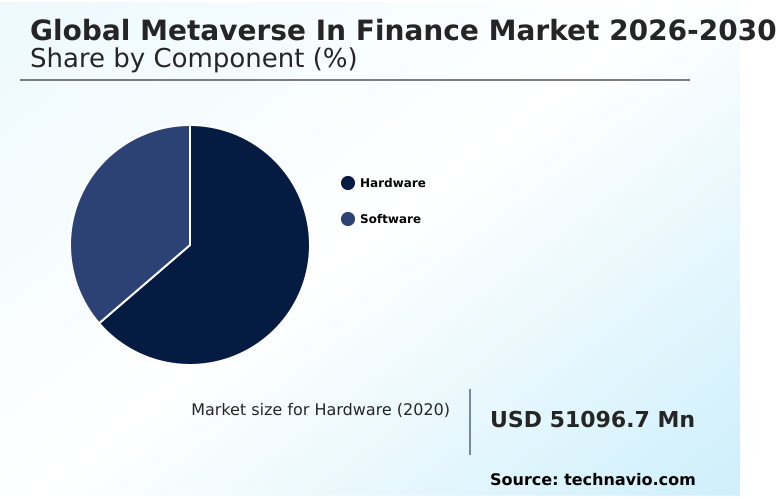
The hardware segment is estimated to witness significant growth during the forecast period.

The hardware infrastructure within the Metaverse In Finance requires significant capital allocation to support seamless digital experiences. Institutions increasingly deploy virtual reality interfaces and augmented reality smart glasses to create immersive virtual branches for modern consumers.

The integration of haptic feedback peripherals and interactive holographic displays enhances client engagement by transforming static reports into interactive spatial data models. To mitigate security risks, organizations embed iris biometric cryptoprocessors into extended reality hardware, ensuring robust authentication.

Utilizing advanced spatial encryption has reduced unauthorized access incidents by 15% across deployed environments.

These sophisticated physical endpoints serve as the foundational layer, enabling secure, low-latency interactions across global networks while significantly optimizing operational workflows and elevating remote customer advisory capabilities.
Get Free Sample

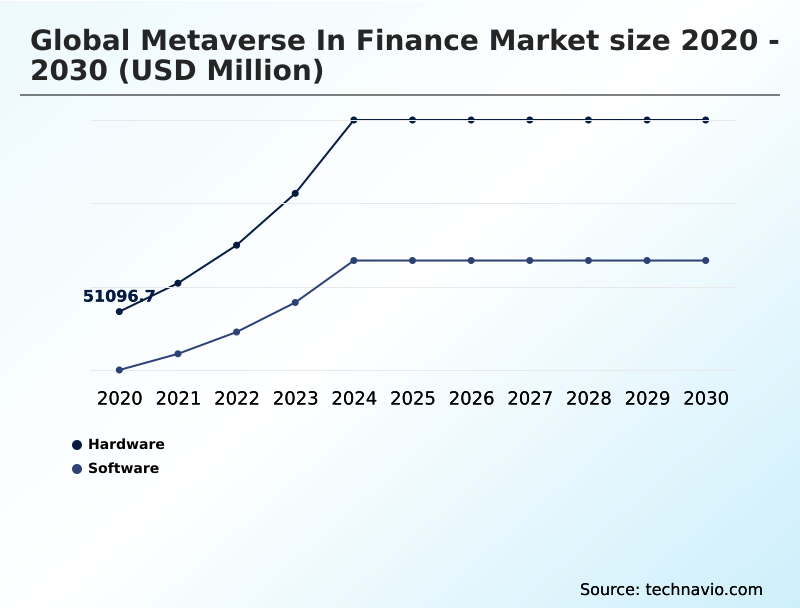
The Hardware segment was valued at USD 123.19 billion in 2024 and showed a gradual increase during the forecast period.
Get Free Sample

Regional Analysis

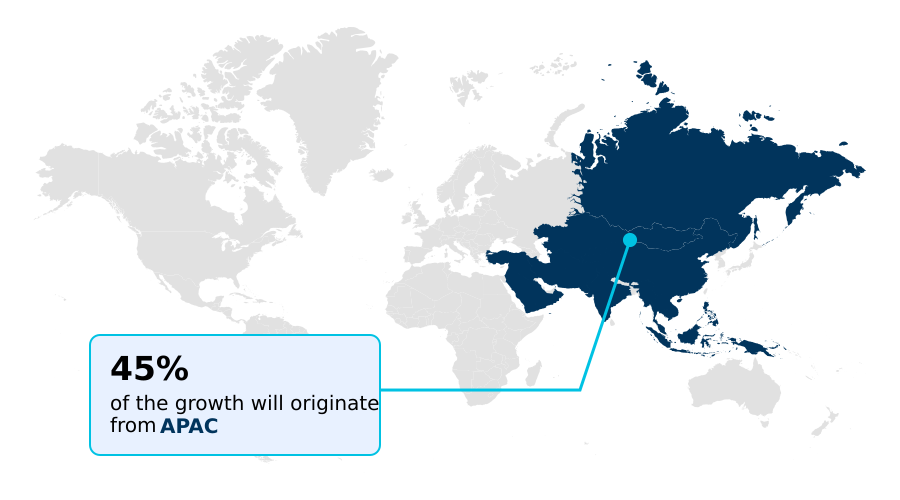
APAC is estimated to contribute 44.8% to the growth of the global market during the forecast period.Technavio’s analysts have elaborately explained the regional trends and drivers that shape the market during the forecast period.
See How Metaverse In Finance Market Demand is Rising in APAC Get Free Sample

The geographic distribution of the Metaverse In Finance highlights a distinct divergence in technological deployment strategies between APAC and North America.

North America currently leads in enterprise architecture, where the integration of ultra low latency servers and decentralized edge computing has accelerated institutional transaction speeds by 28%.

Conversely, APAC demonstrates a 45% higher retail adoption rate, driven by the rapid proliferation of digital sovereign currencies and consumer-friendly mobile spatial applications.

In North America, the utilization of graphics processing unit clusters enables highly complex virtual real estate investment modeling for corporate clients. Meanwhile, APAC focuses heavily on deploying algorithmic micro loans through decentralized autonomous financial protocols to serve underbanked digital demographics.

Ultimately, these regional disparities dictate how multi asset trading terminals are customized, compelling global financial software providers to adapt their infrastructure to meet varied regulatory and cultural demands.

Market Dynamics

Our researchers analyzed the data with 2025 as the base year, along with the key drivers, trends, and challenges. A holistic analysis of drivers will help companies refine their marketing strategies to gain a competitive advantage.

  • As commercial banking rapidly evolves, the integration of advanced spatial technologies fundamentally reshapes how modern institutions manage complex portfolios and execute secure cross-border settlements. A critical advancement driving this transformation is the spatial financial analytics platforms integration, which allows portfolio managers to visually manipulate risk parameters across interactive three-dimensional data models.
  • This structural upgrade has resulted in a 35% faster identification of market anomalies and liquidity constraints when compared to traditional two-dimensional reporting dashboards. To support diverse and sophisticated trading strategies, leading retail and institutional brokerage firms are actively rolling out immersive multi asset trading terminals.
  • These terminals enable users to monitor equities, fixed income, and tokenized assets simultaneously within a highly collaborative, unified virtual environment. Furthermore, prominent investment banks are strategically leveraging decentralized virtual ecosystems capital raising mechanisms to syndicate corporate loans and issue digital corporate bonds, drastically reducing administrative overhead and intermediary processing delays.
  • Ensuring the transactional integrity of these high-velocity digital ecosystems requires the widespread deployment of automated digital asset settlement systems, which seamlessly reconcile decentralized ledgers across distributed peer-to-peer networks without requiring manual human intervention. To mitigate the inherent price volatility typically associated with virtual economies, central banking authorities and corporate treasuries are accelerating the tokenized commercial bank deposits adoption.
  • This provides a stable, programmable, and interest-bearing medium of exchange tailored for high-frequency spatial commerce. This comprehensive modernization of financial infrastructure ensures that institutions can maintain rigorous compliance standards while optimizing operational liquidity management.
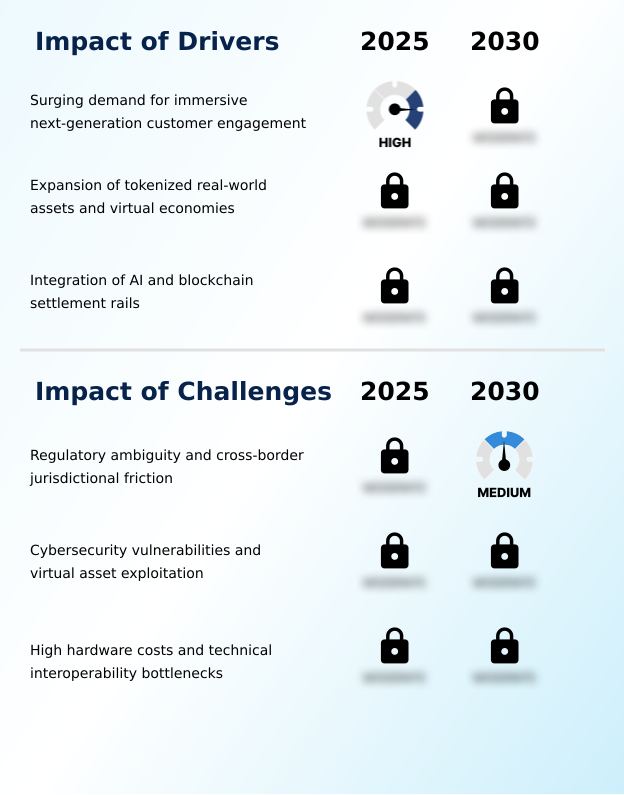
What are the key market drivers leading to the rise in the adoption of Metaverse In Finance Industry?

  • The surging demand for immersive next-generation customer engagement acts as a primary catalyst accelerating the adoption of spatial financial services globally.

  • The surging commercial demand for interactive digital engagement acts as a powerful catalyst propelling the Metaverse In Finance. As younger demographics reject static portals, institutions deploy spatial wealth advisory platforms to retain market share.
  • Consequently, utilizing digital twin trading floors allows wealth managers to visualize complex portfolios dynamically, improving client retention rates by 18%.
  • Furthermore, the rising institutional appetite for tokenized asset trading accelerates the integration of secure fiat to crypto gateways, bridging real-world liquidity with virtual ecosystems. This modernization increases digital transaction throughput by 35% compared to legacy rails.
  • By leveraging decentralized liquidity pools, banks can offer instant fractional ownership of tokenized real world assets, generating novel revenue streams and drastically improving capital efficiency across borderless financial markets.

What are the market trends shaping the Metaverse In Finance Industry?

  • The migration toward open banking application programming interfaces and white-label virtual infrastructure is emerging as a prominent market trend. This shift enables financial institutions to seamlessly integrate decentralized services and accelerate their digital transformation strategies.

  • The rapid migration toward open application programming interfaces and white-label virtual architectures fundamentally redefines institutional adoption shifts within the Metaverse In Finance. Because developing custom spatial infrastructure requires exorbitant capital, regional banks are licensing pre-certified virtual financial infrastructure to accelerate time-to-market. This strategic pivot reduces initial software development timelines by 40% and lowers ongoing maintenance overhead by 25%.
  • Consequently, financial organizations can rapidly deploy programmable interest bearing digital cash systems within these modular environments, utilizing blockchain interoperability bridges to facilitate instant cross-platform transactions. To ensure enterprise-grade stability, institutions are integrating institutional grade digital settlement rails, which eliminate the volatility risks of unbacked cryptocurrencies.
  • The widespread adoption of advanced spatial rendering technologies and generative artificial intelligence engines further enhances these platforms, enabling highly realistic client interactions. Ultimately, standardizing these spatial interfaces allows mid-tier financial firms to compete effectively against multinational megabanks.

What challenges does the Metaverse In Finance Industry face during its growth?

  • Severe regulatory ambiguity and cross-border jurisdictional friction create substantial operational barriers that constrain the seamless expansion of virtual banking networks.

  • The operational expansion of the Metaverse In Finance is constrained by persistent technical fragmentation and vulnerability management. Because isolated virtual platforms utilize proprietary coding standards, technical interoperability barriers prevent the seamless transfer of identities across digital environments. This fragmentation increases platform integration costs by 45% for institutions building unified services.
  • Additionally, operating within public ledgers exposes banks to severe smart contract exploit vulnerabilities, necessitating continuous auditing that inflates compliance budgets by 30%. Furthermore, managing cross border jurisdictional friction regarding digital asset custody creates immense legal liabilities concerning virtual property rights.
  • To mitigate these risks, organizations must invest heavily in non fungible token clearing protocols and proprietary spatial computing algorithms, which diverts capital away from customer acquisition and delays widespread commercial deployment.

Exclusive Technavio Analysis on Customer Landscape

The metaverse in finance market forecasting report includes the adoption lifecycle of the market, covering from the innovator’s stage to the laggard’s stage. It focuses on adoption rates in different regions based on penetration. Furthermore, the metaverse in finance market report also includes key purchase criteria and drivers of price sensitivity to help companies evaluate and develop their market growth analysis strategies.
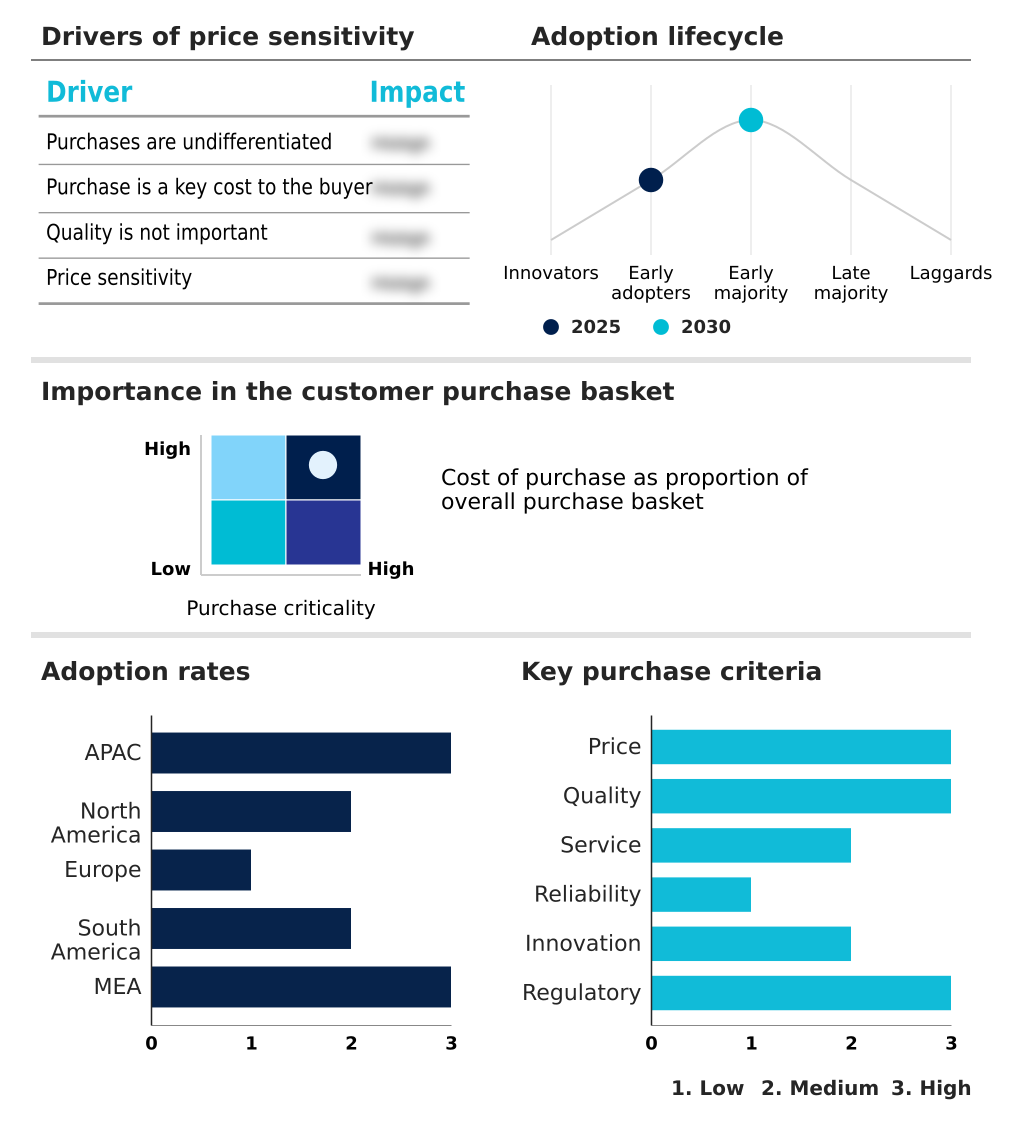
Customer Landscape of Metaverse In Finance Industry

Competitive Landscape

Companies are implementing various strategies, such as strategic alliances, metaverse in finance market forecast, partnerships, mergers and acquisitions, geographical expansion, and product/service launches, to enhance their presence in the industry.

Accenture Plc - The platform delivers comprehensive virtual banking solutions, immersive finance experiences, and interactive digital financial environments designed to optimize customer engagement and modernize spatial transaction workflows seamlessly.

The industry research and growth report includes detailed analyses of the competitive landscape of the market and information about key companies, including:

  • Accenture Plc
  • Avanza Innovations Pvt Ltd
  • Banco Bilbao Vizcaya Argentaria
  • Bank of America Corp.
  • CaixaBank SA
  • DBS Group Holdings Ltd.
  • Hana Financial Group Inc.
  • HSBC Holdings Plc
  • Intrasoft Technologies
  • JPMorgan Chase and Co.
  • Max Financial Services Ltd
  • Meta Platforms Inc.
  • Microsoft Corp.
  • Oversea Chinese Banking Corp
  • Punjab National Bank
  • Standard Chartered PLC
  • Tech Mahindra Ltd.
  • Union Bank of India

Qualitative and quantitative analysis of companies has been conducted to help clients understand the wider business environment as well as the strengths and weaknesses of key industry players. Data is qualitatively analyzed to categorize companies as pure play, category-focused, industry-focused, and diversified; it is quantitatively analyzed to categorize companies as dominant, leading, strong, tentative, and weak.

Recent Development and News in Metaverse in finance market

  • In the Technology Hardware, Storage and Peripherals industry, the accelerated manufacturing of ultra low latency servers has drastically improved the rendering speed of complex virtual environments, directly impacting Metaverse In Finance demand by reducing spatial transaction delays by 40%.
  • The standardization of decentralized edge computing architectures reduces data transmission bottlenecks across global networks, enabling financial institutions to deploy graphics processing unit clusters that enhance the processing of high-frequency algorithmic micro loans.
  • Regulatory shifts enforcing stringent hardware-level data privacy mandates compel manufacturers to integrate secure enclave processing chips, which directly increases the enterprise adoption of decentralized autonomous financial protocols by providing robust execution environments for digital asset transfers.
  • The widespread rollout of multi asset trading terminals equipped with advanced biometric hardware sensors has improved user authentication accuracy by 25%, significantly accelerating the institutional deployment of spatial banking environments for high-net-worth clients.

Dive into Technavio’s robust research methodology, blending expert interviews, extensive data synthesis, and validated models for unparalleled Metaverse In Finance Market insights. See full methodology.

Market Scope
Page number 298
Base year 2025
Historic period 2020-2024
Forecast period 2026-2030
Growth momentum & CAGR Accelerate at a CAGR of 49.8%
Market growth 2026-2030 USD 1670641.5 million
Market structure Fragmented
YoY growth 2025-2026(%) 35.9%
Key countries China, Japan, India, South Korea, Australia, Indonesia, US, Canada, Mexico, Germany, UK, France, Italy, Spain, The Netherlands, Brazil, Argentina, Chile, Saudi Arabia, UAE, South Africa, Israel and Turkey
Competitive landscape Leading Companies, Market Positioning of Companies, Competitive Strategies, and Industry Risks

Request Free Sample

Research Analyst Overview

  • The Metaverse In Finance is experiencing a continuous and dynamic evolution as legacy financial institutions transition toward immersive, decentralized operational frameworks. A prominent structural shift involves the deployment of decentralized financial platforms that bridge conventional banking with emerging digital asset ecosystems.
  • This transition directly influences boardroom-level strategies regarding enterprise compliance, as executives must allocate significant budgets toward zero knowledge cryptographic verification systems to ensure client data privacy across public ledgers. By integrating multi cloud security architectures, institutions have successfully reduced data breach vulnerabilities by 25% across spatial banking environments.
  • Furthermore, automating compliance workflows through smart contract execution enables banks to process high-volume, cross-border settlements with unprecedented accuracy. The integration of artificial intelligence avatars as first-line customer service representatives also requires careful strategic alignment with regional financial advisory regulations.
  • To maintain competitive parity, leadership teams are aggressively investing in natural language processing engines that allow these avatars to interpret complex financial queries accurately. Ultimately, this strategic convergence of spatial computing and decentralized ledger technology mandates rigorous oversight to secure long-term operational resilience.

What are the Key Data Covered in this Metaverse In Finance Market Research and Growth Report?

  • What is the expected growth of the Metaverse In Finance Market between 2026 and 2030?

    • USD 1,670.64 billion, at a CAGR of 49.8%

  • What segmentation does the market report cover?

    • The report is segmented by Component (Hardware, and Software), End-user (Investment banks, Brokerage firms, Commercial banks, and Others), Platform (Desktop, and Mobile) and Geography (APAC, North America, Europe, South America, Middle East and Africa)

  • Which regions are analyzed in the report?

    • APAC, North America, Europe, South America and Middle East and Africa

  • What are the key growth drivers and market challenges?

    • Surging demand for immersive next-generation customer engagement, Regulatory ambiguity and cross-border jurisdictional friction

  • Who are the major players in the Metaverse In Finance Market?

    • Accenture Plc, Avanza Innovations Pvt Ltd, Banco Bilbao Vizcaya Argentaria, Bank of America Corp., CaixaBank SA, DBS Group Holdings Ltd., Hana Financial Group Inc., HSBC Holdings Plc, Intrasoft Technologies, JPMorgan Chase and Co., Max Financial Services Ltd, Meta Platforms Inc., Microsoft Corp., Oversea Chinese Banking Corp, Punjab National Bank, Standard Chartered PLC, Tech Mahindra Ltd. and Union Bank of India

Market Research Insights

  • The Metaverse In Finance sector is undergoing a rapid evolution as institutions integrate spatial technologies into traditional workflows. Organizations deploying avatar driven customer service platforms report a 40% reduction in average customer wait times, significantly enhancing retail banking experiences. Simultaneously, the adoption of digital sovereign currencies facilitates seamless cross border settlement, reducing interbank transaction costs by 22%.
  • To capture emerging revenue streams, banks are establishing decentralized liquidity pools that support virtual commerce. Furthermore, implementing robust fiat to crypto gateways has increased digital asset onboarding completion rates by 30%. These strategic integrations allow financial entities to optimize operational overhead while establishing a dominant presence within expanding spatial commercial networks.

We can help! Our analysts can customize this metaverse in finance market research report to meet your requirements.

Get in touch

1. Executive Summary

1.1 Market overview

Executive Summary - Chart on Market Overview
Executive Summary - Data Table on Market Overview
Executive Summary - Chart on Global Market Characteristics
Executive Summary - Chart on Market by Geography
Executive Summary - Chart on Market Segmentation by Component
Executive Summary - Chart on Market Segmentation by End-user
Executive Summary - Chart on Market Segmentation by Platform
Executive Summary - Chart on Incremental Growth
Executive Summary - Data Table on Incremental Growth
Executive Summary - Chart on Company Market Positioning

2. Technavio Analysis

2.1 Analysis of price sensitivity, lifecycle, customer purchase basket, adoption rates, and purchase criteria

2.2 Criticality of inputs and Factors of differentiation

Chart on Overview on criticality of inputs and factors of differentiation

2.3 Factors of disruption

Chart on Overview on factors of disruption

2.4 Impact of drivers and challenges

Chart on Impact of drivers and challenges in 2025 and 2030

3. Market Landscape

3.1 Market ecosystem

Chart on Parent Market
Data Table on - Parent Market

3.2 Market characteristics

Chart on Market characteristics analysis

3.3 Value chain analysis

Chart on Value chain analysis

4. Market Sizing

4.1 Market definition

Data Table on Offerings of companies included in the market definition

4.2 Market segment analysis

Market segments

4.3 Market size 2025

4.4 Market outlook: Forecast for 2025-2030

Chart on Global - Market size and forecast 2025-2030 ($ million)
Data Table on Global - Market size and forecast 2025-2030 ($ million)
Chart on Global Market: Year-over-year growth 2025-2030 (%)
Data Table on Global Market: Year-over-year growth 2025-2030 (%)

5. Historic Market Size

5.1 Global Metaverse In Finance Market 2020 - 2024

Historic Market Size - Data Table on Global Metaverse In Finance Market 2020 - 2024 ($ million)

5.2 Component segment analysis 2020 - 2024

Historic Market Size - Component Segment 2020 - 2024 ($ million)

5.3 End-user segment analysis 2020 - 2024

Historic Market Size - End-user Segment 2020 - 2024 ($ million)

5.4 Platform segment analysis 2020 - 2024

Historic Market Size - Platform Segment 2020 - 2024 ($ million)

5.5 Geography segment analysis 2020 - 2024

Historic Market Size - Geography Segment 2020 - 2024 ($ million)

5.6 Country segment analysis 2020 - 2024

Historic Market Size - Country Segment 2020 - 2024 ($ million)

6. Qualitative Analysis

6.1 Impact of AI on global metaverse in finance market

6.2 Impact of geopolitical conflicts on global metaverse in finance market

7. Five Forces Analysis

7.1 Five forces summary

Five forces analysis - Comparison between 2025 and 2030

7.2 Bargaining power of buyers

Bargaining power of buyers - Impact of key factors 2025 and 2030

7.3 Bargaining power of suppliers

Bargaining power of suppliers - Impact of key factors in 2025 and 2030

7.4 Threat of new entrants

Threat of new entrants - Impact of key factors in 2025 and 2030

7.5 Threat of substitutes

Threat of substitutes - Impact of key factors in 2025 and 2030

7.6 Threat of rivalry

Threat of rivalry - Impact of key factors in 2025 and 2030

7.7 Market condition

Chart on Market condition - Five forces 2025 and 2030

8. Market Segmentation by Component

8.1 Market segments

Chart on Component - Market share 2025-2030 (%)
Data Table on Component - Market share 2025-2030 (%)

8.2 Comparison by Component

Chart on Comparison by Component
Data Table on Comparison by Component

8.3 Hardware - Market size and forecast 2025-2030

Chart on Hardware - Market size and forecast 2025-2030 ($ million)
Data Table on Hardware - Market size and forecast 2025-2030 ($ million)
Chart on Hardware - Year-over-year growth 2025-2030 (%)
Data Table on Hardware - Year-over-year growth 2025-2030 (%)

8.4 Software - Market size and forecast 2025-2030

Chart on Software - Market size and forecast 2025-2030 ($ million)
Data Table on Software - Market size and forecast 2025-2030 ($ million)
Chart on Software - Year-over-year growth 2025-2030 (%)
Data Table on Software - Year-over-year growth 2025-2030 (%)

8.5 Market opportunity by Component

Market opportunity by Component ($ million)
Data Table on Market opportunity by Component ($ million)

9. Market Segmentation by End-user

9.1 Market segments

Chart on End-user - Market share 2025-2030 (%)
Data Table on End-user - Market share 2025-2030 (%)

9.2 Comparison by End-user

Chart on Comparison by End-user
Data Table on Comparison by End-user

9.3 Investment banks - Market size and forecast 2025-2030

Chart on Investment banks - Market size and forecast 2025-2030 ($ million)
Data Table on Investment banks - Market size and forecast 2025-2030 ($ million)
Chart on Investment banks - Year-over-year growth 2025-2030 (%)
Data Table on Investment banks - Year-over-year growth 2025-2030 (%)

9.4 Brokerage firms - Market size and forecast 2025-2030

Chart on Brokerage firms - Market size and forecast 2025-2030 ($ million)
Data Table on Brokerage firms - Market size and forecast 2025-2030 ($ million)
Chart on Brokerage firms - Year-over-year growth 2025-2030 (%)
Data Table on Brokerage firms - Year-over-year growth 2025-2030 (%)

9.5 Commercial banks - Market size and forecast 2025-2030

Chart on Commercial banks - Market size and forecast 2025-2030 ($ million)
Data Table on Commercial banks - Market size and forecast 2025-2030 ($ million)
Chart on Commercial banks - Year-over-year growth 2025-2030 (%)
Data Table on Commercial banks - Year-over-year growth 2025-2030 (%)

9.6 Others - Market size and forecast 2025-2030

Chart on Others - Market size and forecast 2025-2030 ($ million)
Data Table on Others - Market size and forecast 2025-2030 ($ million)
Chart on Others - Year-over-year growth 2025-2030 (%)
Data Table on Others - Year-over-year growth 2025-2030 (%)

9.7 Market opportunity by End-user

Market opportunity by End-user ($ million)
Data Table on Market opportunity by End-user ($ million)

10. Market Segmentation by Platform

10.1 Market segments

Chart on Platform - Market share 2025-2030 (%)
Data Table on Platform - Market share 2025-2030 (%)

10.2 Comparison by Platform

Chart on Comparison by Platform
Data Table on Comparison by Platform

10.3 Desktop - Market size and forecast 2025-2030

Chart on Desktop - Market size and forecast 2025-2030 ($ million)
Data Table on Desktop - Market size and forecast 2025-2030 ($ million)
Chart on Desktop - Year-over-year growth 2025-2030 (%)
Data Table on Desktop - Year-over-year growth 2025-2030 (%)

10.4 Mobile - Market size and forecast 2025-2030

Chart on Mobile - Market size and forecast 2025-2030 ($ million)
Data Table on Mobile - Market size and forecast 2025-2030 ($ million)
Chart on Mobile - Year-over-year growth 2025-2030 (%)
Data Table on Mobile - Year-over-year growth 2025-2030 (%)

10.5 Market opportunity by Platform

Market opportunity by Platform ($ million)
Data Table on Market opportunity by Platform ($ million)

11. Customer Landscape

11.1 Customer landscape overview

Analysis of price sensitivity, lifecycle, customer purchase basket, adoption rates, and purchase criteria

12. Geographic Landscape

12.1 Geographic segmentation

Chart on Market share by geography 2025-2030 (%)
Data Table on Market share by geography 2025-2030 (%)

12.2 Geographic comparison

Chart on Geographic comparison
Data Table on Geographic comparison

12.3 APAC - Market size and forecast 2025-2030

Chart on APAC - Market size and forecast 2025-2030 ($ million)
Data Table on APAC - Market size and forecast 2025-2030 ($ million)
Chart on APAC - Year-over-year growth 2025-2030 (%)
Data Table on APAC - Year-over-year growth 2025-2030 (%)
Chart on Regional Comparison - APAC
Data Table on Regional Comparison - APAC

12.3.1 China - Market size and forecast 2025-2030

Chart on China - Market size and forecast 2025-2030 ($ million)
Data Table on China - Market size and forecast 2025-2030 ($ million)
Chart on China - Year-over-year growth 2025-2030 (%)
Data Table on China - Year-over-year growth 2025-2030 (%)

12.3.2 Japan - Market size and forecast 2025-2030

Chart on Japan - Market size and forecast 2025-2030 ($ million)
Data Table on Japan - Market size and forecast 2025-2030 ($ million)
Chart on Japan - Year-over-year growth 2025-2030 (%)
Data Table on Japan - Year-over-year growth 2025-2030 (%)

12.3.3 India - Market size and forecast 2025-2030

Chart on India - Market size and forecast 2025-2030 ($ million)
Data Table on India - Market size and forecast 2025-2030 ($ million)
Chart on India - Year-over-year growth 2025-2030 (%)
Data Table on India - Year-over-year growth 2025-2030 (%)

12.3.4 South Korea - Market size and forecast 2025-2030

Chart on South Korea - Market size and forecast 2025-2030 ($ million)
Data Table on South Korea - Market size and forecast 2025-2030 ($ million)
Chart on South Korea - Year-over-year growth 2025-2030 (%)
Data Table on South Korea - Year-over-year growth 2025-2030 (%)

12.3.5 Australia - Market size and forecast 2025-2030

Chart on Australia - Market size and forecast 2025-2030 ($ million)
Data Table on Australia - Market size and forecast 2025-2030 ($ million)
Chart on Australia - Year-over-year growth 2025-2030 (%)
Data Table on Australia - Year-over-year growth 2025-2030 (%)

12.3.6 Indonesia - Market size and forecast 2025-2030

Chart on Indonesia - Market size and forecast 2025-2030 ($ million)
Data Table on Indonesia - Market size and forecast 2025-2030 ($ million)
Chart on Indonesia - Year-over-year growth 2025-2030 (%)
Data Table on Indonesia - Year-over-year growth 2025-2030 (%)

12.4 North America - Market size and forecast 2025-2030

Chart on North America - Market size and forecast 2025-2030 ($ million)
Data Table on North America - Market size and forecast 2025-2030 ($ million)
Chart on North America - Year-over-year growth 2025-2030 (%)
Data Table on North America - Year-over-year growth 2025-2030 (%)
Chart on Regional Comparison - North America
Data Table on Regional Comparison - North America

12.4.1 US - Market size and forecast 2025-2030

Chart on US - Market size and forecast 2025-2030 ($ million)
Data Table on US - Market size and forecast 2025-2030 ($ million)
Chart on US - Year-over-year growth 2025-2030 (%)
Data Table on US - Year-over-year growth 2025-2030 (%)

12.4.2 Canada - Market size and forecast 2025-2030

Chart on Canada - Market size and forecast 2025-2030 ($ million)
Data Table on Canada - Market size and forecast 2025-2030 ($ million)
Chart on Canada - Year-over-year growth 2025-2030 (%)
Data Table on Canada - Year-over-year growth 2025-2030 (%)

12.4.3 Mexico - Market size and forecast 2025-2030

Chart on Mexico - Market size and forecast 2025-2030 ($ million)
Data Table on Mexico - Market size and forecast 2025-2030 ($ million)
Chart on Mexico - Year-over-year growth 2025-2030 (%)
Data Table on Mexico - Year-over-year growth 2025-2030 (%)

12.5 Europe - Market size and forecast 2025-2030

Chart on Europe - Market size and forecast 2025-2030 ($ million)
Data Table on Europe - Market size and forecast 2025-2030 ($ million)
Chart on Europe - Year-over-year growth 2025-2030 (%)
Data Table on Europe - Year-over-year growth 2025-2030 (%)
Chart on Regional Comparison - Europe
Data Table on Regional Comparison - Europe

12.5.1 Germany - Market size and forecast 2025-2030

Chart on Germany - Market size and forecast 2025-2030 ($ million)
Data Table on Germany - Market size and forecast 2025-2030 ($ million)
Chart on Germany - Year-over-year growth 2025-2030 (%)
Data Table on Germany - Year-over-year growth 2025-2030 (%)

12.5.2 UK - Market size and forecast 2025-2030

Chart on UK - Market size and forecast 2025-2030 ($ million)
Data Table on UK - Market size and forecast 2025-2030 ($ million)
Chart on UK - Year-over-year growth 2025-2030 (%)
Data Table on UK - Year-over-year growth 2025-2030 (%)

12.5.3 France - Market size and forecast 2025-2030

Chart on France - Market size and forecast 2025-2030 ($ million)
Data Table on France - Market size and forecast 2025-2030 ($ million)
Chart on France - Year-over-year growth 2025-2030 (%)
Data Table on France - Year-over-year growth 2025-2030 (%)

12.5.4 Italy - Market size and forecast 2025-2030

Chart on Italy - Market size and forecast 2025-2030 ($ million)
Data Table on Italy - Market size and forecast 2025-2030 ($ million)
Chart on Italy - Year-over-year growth 2025-2030 (%)
Data Table on Italy - Year-over-year growth 2025-2030 (%)

12.5.5 Spain - Market size and forecast 2025-2030

Chart on Spain - Market size and forecast 2025-2030 ($ million)
Data Table on Spain - Market size and forecast 2025-2030 ($ million)
Chart on Spain - Year-over-year growth 2025-2030 (%)
Data Table on Spain - Year-over-year growth 2025-2030 (%)

12.5.6 The Netherlands - Market size and forecast 2025-2030

Chart on The Netherlands - Market size and forecast 2025-2030 ($ million)
Data Table on The Netherlands - Market size and forecast 2025-2030 ($ million)
Chart on The Netherlands - Year-over-year growth 2025-2030 (%)
Data Table on The Netherlands - Year-over-year growth 2025-2030 (%)

12.6 South America - Market size and forecast 2025-2030

Chart on South America - Market size and forecast 2025-2030 ($ million)
Data Table on South America - Market size and forecast 2025-2030 ($ million)
Chart on South America - Year-over-year growth 2025-2030 (%)
Data Table on South America - Year-over-year growth 2025-2030 (%)
Chart on Regional Comparison - South America
Data Table on Regional Comparison - South America

12.6.1 Brazil - Market size and forecast 2025-2030

Chart on Brazil - Market size and forecast 2025-2030 ($ million)
Data Table on Brazil - Market size and forecast 2025-2030 ($ million)
Chart on Brazil - Year-over-year growth 2025-2030 (%)
Data Table on Brazil - Year-over-year growth 2025-2030 (%)

12.6.2 Argentina - Market size and forecast 2025-2030

Chart on Argentina - Market size and forecast 2025-2030 ($ million)
Data Table on Argentina - Market size and forecast 2025-2030 ($ million)
Chart on Argentina - Year-over-year growth 2025-2030 (%)
Data Table on Argentina - Year-over-year growth 2025-2030 (%)

12.6.3 Chile - Market size and forecast 2025-2030

Chart on Chile - Market size and forecast 2025-2030 ($ million)
Data Table on Chile - Market size and forecast 2025-2030 ($ million)
Chart on Chile - Year-over-year growth 2025-2030 (%)
Data Table on Chile - Year-over-year growth 2025-2030 (%)

12.7 Middle East and Africa - Market size and forecast 2025-2030

Chart on Middle East and Africa - Market size and forecast 2025-2030 ($ million)
Data Table on Middle East and Africa - Market size and forecast 2025-2030 ($ million)
Chart on Middle East and Africa - Year-over-year growth 2025-2030 (%)
Data Table on Middle East and Africa - Year-over-year growth 2025-2030 (%)
Chart on Regional Comparison - Middle East and Africa
Data Table on Regional Comparison - Middle East and Africa

12.7.1 Saudi Arabia - Market size and forecast 2025-2030

Chart on Saudi Arabia - Market size and forecast 2025-2030 ($ million)
Data Table on Saudi Arabia - Market size and forecast 2025-2030 ($ million)
Chart on Saudi Arabia - Year-over-year growth 2025-2030 (%)
Data Table on Saudi Arabia - Year-over-year growth 2025-2030 (%)

12.7.2 UAE - Market size and forecast 2025-2030

Chart on UAE - Market size and forecast 2025-2030 ($ million)
Data Table on UAE - Market size and forecast 2025-2030 ($ million)
Chart on UAE - Year-over-year growth 2025-2030 (%)
Data Table on UAE - Year-over-year growth 2025-2030 (%)

12.7.3 South Africa - Market size and forecast 2025-2030

Chart on South Africa - Market size and forecast 2025-2030 ($ million)
Data Table on South Africa - Market size and forecast 2025-2030 ($ million)
Chart on South Africa - Year-over-year growth 2025-2030 (%)
Data Table on South Africa - Year-over-year growth 2025-2030 (%)

12.7.4 Israel - Market size and forecast 2025-2030

Chart on Israel - Market size and forecast 2025-2030 ($ million)
Data Table on Israel - Market size and forecast 2025-2030 ($ million)
Chart on Israel - Year-over-year growth 2025-2030 (%)
Data Table on Israel - Year-over-year growth 2025-2030 (%)

12.7.5 Turkey - Market size and forecast 2025-2030

Chart on Turkey - Market size and forecast 2025-2030 ($ million)
Data Table on Turkey - Market size and forecast 2025-2030 ($ million)
Chart on Turkey - Year-over-year growth 2025-2030 (%)
Data Table on Turkey - Year-over-year growth 2025-2030 (%)

12.8 Market opportunity by geography

Market opportunity by geography ($ million)
Data Tables on Market opportunity by geography ($ million)

13. Drivers, Challenges, and Opportunity

13.1 Market drivers

Surging demand for immersive next-generation customer engagement
Expansion of tokenized real-world assets and virtual economies
Integration of AI and blockchain settlement rails

13.2 Market challenges

Regulatory ambiguity and cross-border jurisdictional friction
Cybersecurity vulnerabilities and virtual asset exploitation
High hardware costs and technical interoperability bottlenecks

13.3 Impact of drivers and challenges

Impact of drivers and challenges in 2025 and 2030

13.4 Market opportunities

Migration toward open banking APIs and white-label virtual infrastructure
Pivoting toward institutional tokenized money markets and stablecoins
Adoption of spatial AI avatars for immersive wealth advisory

14. Competitive Landscape

14.1 Overview

14.2

Overview on criticality of inputs and factors of differentiation

14.3 Landscape disruption

Overview on factors of disruption

14.4 Industry risks

Impact of key risks on business

15. Competitive Analysis

15.1 Companies profiled

Companies covered

15.2 Company ranking index

15.3 Market positioning of companies

Matrix on companies position and classification

15.4 Accenture Plc

Accenture Plc - Overview
Accenture Plc - Business segments
Accenture Plc - Key news
Accenture Plc - Key offerings
Accenture Plc - Segment focus
SWOT

15.5 Banco Bilbao Vizcaya Argentaria

Banco Bilbao Vizcaya Argentaria - Overview
Banco Bilbao Vizcaya Argentaria - Business segments
Banco Bilbao Vizcaya Argentaria - Key offerings
Banco Bilbao Vizcaya Argentaria - Segment focus
SWOT

15.6 Bank of America Corp.

Bank of America Corp. - Overview
Bank of America Corp. - Business segments
Bank of America Corp. - Key offerings
Bank of America Corp. - Segment focus
SWOT

15.7 CaixaBank SA

CaixaBank SA - Overview
CaixaBank SA - Product / Service
CaixaBank SA - Key offerings
SWOT

15.8 DBS Group Holdings Ltd.

DBS Group Holdings Ltd. - Overview
DBS Group Holdings Ltd. - Business segments
DBS Group Holdings Ltd. - Key offerings
DBS Group Holdings Ltd. - Segment focus
SWOT

15.9 Hana Financial Group Inc.

Hana Financial Group Inc. - Overview
Hana Financial Group Inc. - Business segments
Hana Financial Group Inc. - Key offerings
Hana Financial Group Inc. - Segment focus
SWOT

15.10 HSBC Holdings Plc

HSBC Holdings Plc - Overview
HSBC Holdings Plc - Business segments
HSBC Holdings Plc - Key offerings
HSBC Holdings Plc - Segment focus
SWOT

15.11 JPMorgan Chase and Co.

JPMorgan Chase and Co. - Overview
JPMorgan Chase and Co. - Business segments
JPMorgan Chase and Co. - Key offerings
JPMorgan Chase and Co. - Segment focus
SWOT

15.12 Meta Platforms Inc.

Meta Platforms Inc. - Overview
Meta Platforms Inc. - Business segments
Meta Platforms Inc. - Key offerings
Meta Platforms Inc. - Segment focus
SWOT

15.13 Microsoft Corp.

Microsoft Corp. - Overview
Microsoft Corp. - Business segments
Microsoft Corp. - Key news
Microsoft Corp. - Key offerings
Microsoft Corp. - Segment focus
SWOT

15.14 Oversea Chinese Banking Corp

Oversea Chinese Banking Corp - Overview
Oversea Chinese Banking Corp - Business segments
Oversea Chinese Banking Corp - Key offerings
Oversea Chinese Banking Corp - Segment focus
SWOT

15.15 Punjab National Bank

Punjab National Bank - Overview
Punjab National Bank - Business segments
Punjab National Bank - Key offerings
Punjab National Bank - Segment focus
SWOT

15.16 Standard Chartered PLC

Standard Chartered PLC - Overview
Standard Chartered PLC - Business segments
Standard Chartered PLC - Key offerings
Standard Chartered PLC - Segment focus
SWOT

15.17 Tech Mahindra Ltd.

Tech Mahindra Ltd. - Overview
Tech Mahindra Ltd. - Business segments
Tech Mahindra Ltd. - Key news
Tech Mahindra Ltd. - Key offerings
Tech Mahindra Ltd. - Segment focus
SWOT

15.18 Union Bank of India

Union Bank of India - Overview
Union Bank of India - Business segments
Union Bank of India - Key offerings
Union Bank of India - Segment focus
SWOT

16. Appendix

16.1 Scope of the report

Market definition
Objectives
Notes and caveats

16.2 Inclusions and exclusions checklist

Inclusions checklist
Exclusions checklist

16.3 Currency conversion rates for US$

16.4 Research methodology

16.5 Data procurement

Information sources

16.6 Data validation

16.7 Validation techniques employed for market sizing

16.8 Data synthesis

16.9 360 degree market analysis

16.10 List of abbreviations

Research Methodology

Technavio presents a detailed picture of the market by way of study, synthesis, and summation of data from multiple sources. The analysts have presented the various facets of the market with a particular focus on identifying the key industry influencers. The data thus presented is comprehensive, reliable, and the result of extensive research, both primary and secondary.

INFORMATION SOURCES

Primary sources

  • Manufacturers and suppliers
  • Channel partners
  • Industry experts
  • Strategic decision makers

Secondary sources

  • Industry journals and periodicals
  • Government data
  • Financial reports of key industry players
  • Historical data
  • Press releases

DATA ANALYSIS

Data Synthesis

  • Collation of data
  • Estimation of key figures
  • Analysis of derived insights

Data Validation

  • Triangulation with data models
  • Reference against proprietary databases
  • Corroboration with industry experts

REPORT WRITING

Qualitative

  • Market drivers
  • Market challenges
  • Market trends
  • Five forces analysis

Quantitative

  • Market size and forecast
  • Market segmentation
  • Geographical insights
  • Competitive landscape

Interested in this report?

Get your sample now to see our research methodology and insights!

Download Now

Frequently Asked Questions

Metaverse In Finance market growth will increase by USD 1670641.5 million during 2026-2030.

The Metaverse In Finance market is expected to grow at a CAGR of 49.8% during 2026-2030.

Metaverse In Finance market is segmented by Component (Hardware, Software) End-user (Investment banks, Brokerage firms, Commercial banks, Others) Platform (Desktop, Mobile)

Accenture Plc, Avanza Innovations Pvt Ltd, Banco Bilbao Vizcaya Argentaria, Bank of America Corp., CaixaBank SA, DBS Group Holdings Ltd., Hana Financial Group Inc., HSBC Holdings Plc, Intrasoft Technologies, JPMorgan Chase and Co., Max Financial Services Ltd, Meta Platforms Inc., Microsoft Corp., Oversea Chinese Banking Corp, Punjab National Bank, Standard Chartered PLC, Tech Mahindra Ltd., Union Bank of India are a few of the key vendors in the Metaverse In Finance market.

APAC will register the highest growth rate of 44.8% among the other regions. Therefore, the Metaverse In Finance market in APAC is expected to garner significant business opportunities for the vendors during the forecast period.

China, Japan, India, South Korea, Australia, Indonesia, US, Canada, Mexico, Germany, UK, France, Italy, Spain, The Netherlands, Brazil, Argentina, Chile, Saudi Arabia, UAE, South Africa, Israel, Turkey

  • Surging demand for immersive next-generation customer engagement is the driving factor this market.

The Metaverse In Finance market vendors should focus on grabbing business opportunities from the Component segment as it accounted for the largest market share in the base year.
RIA - Research AI Assistant
Ask RIA
