


Augmented Intelligence Market Size 2024-2028
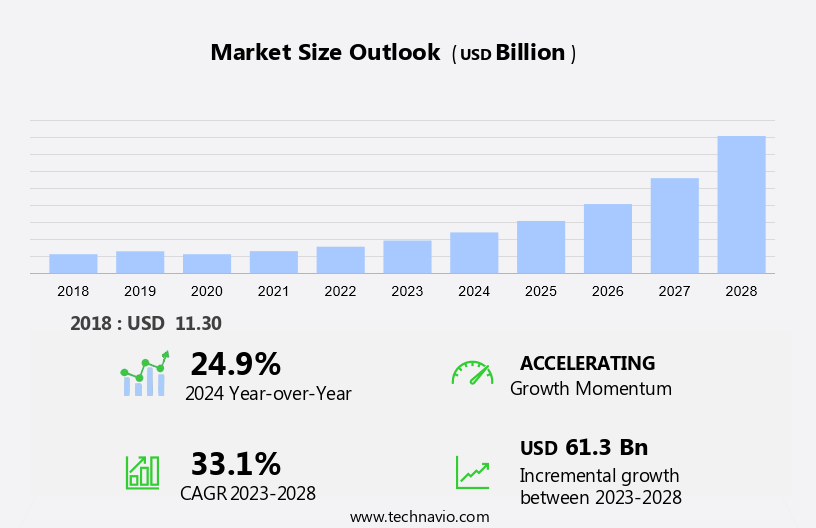
The augmented intelligence market size is forecast to increase by USD 61.3 billion at a CAGR of 33.1% between 2023 and 2028.
- Augmented Intelligence (IA) is revolutionizing business operations by amplifying human intelligence with advanced technologies such as Machine Learning (ML), Deep Learning, Natural Language Processing (NLP), and Virtual Assistants. IA is increasingly being adopted by enterprises to enhance decision-making capabilities and improve business outcomes. The implementation of IA in Business Intelligence (BI) tools is a significant trend, enabling organizations to derive insights from Big Data and perform predictive analytics.
- However, the shortage of IA experts poses a challenge to the widespread adoption of these technologies. ML and DL algorithms are integral to IA, enabling systems to learn and make decisions autonomously. NLP is used to understand human language and interact with virtual assistants, while Big Data and Data Analytics provide the foundation for IA applications. Predictive analytics is a key benefit of IA, enabling organizations to anticipate future trends and make informed decisions. IA is transforming various industries, including healthcare, finance, and retail, by augmenting human intelligence and automating routine tasks.
What will be the Size of the Market During the Forecast Period?
- Augmented Intelligence (IA), also known as Intelligence Amplification, refers to the use of advanced technologies such as machine learning (ML), deep learning (DL), and natural language processing (NLP) to support and enhance human intelligence. IA systems are designed to process vast amounts of data and provide insights that would be difficult or impossible for humans to identify on their own. Machine Learning and Deep Learning are at the core of IA systems. ML algorithms learn from data and improve their performance over time, while DL algorithms can identify complex patterns and relationships within data.
- Additionally, NLP enables computers to understand human language, enabling more effective communication between humans and machines. IA is being adopted across various industries, including streaming video services, factory automation, political think tanks, medical analysis, and more. In factory automation, IA systems are used to optimize production processes and improve quality control. In medical analysis, IA is used to analyze patient data and provide doctors with accurate diagnoses and treatment recommendations. In political think tanks, IA is used to analyze large datasets and identify trends and patterns. IA systems rely on big data and data analytics to function effectively.
- However, predictive analytics is a key application of IA, allowing organizations to make informed decisions based on data trends and patterns. Data scientists are essential in developing and implementing IA systems, ensuring that they are accurate, unbiased, and free from fatigue or distraction. Decision-making: IA systems are designed to augment human decision-making by providing accurate and relevant information in real-time. Autonomous systems and reactive machines are examples of IA applications that can make decisions based on data and environmental inputs. However, it is important to note that IA systems are not infallible and have an error rate that must be considered in decision-making.
- In conclusion, cybernetics, the study of communication and control in machines and living beings, plays a crucial role in IA development. Algorithms are used to process data and provide insights, and IA systems are designed to learn and adapt over time, improving their performance and accuracy. Limitations: IA systems are not without limitations. Bias in data can lead to inaccurate or unfair outcomes, and user viewing habits can influence the performance of recommendation systems. It is essential to address these limitations and ensure that IA systems are designed to augment human intelligence in a symbiotic relationship, rather than replacing it.
How is this market segmented and which is the largest segment?
The market research report provides comprehensive data (region-wise segment analysis), with forecasts and estimates in "USD billion" for the period 2024-2028, as well as historical data from 2018-2022 for the following segments.
- Technology
- Machine learning
- NLP
- Computer vision
- Others
- Geography
- North America
- US
- Europe
- UK
- APAC
- China
- India
- Japan
- South America
- Middle East and Africa
- North America
By Technology Insights
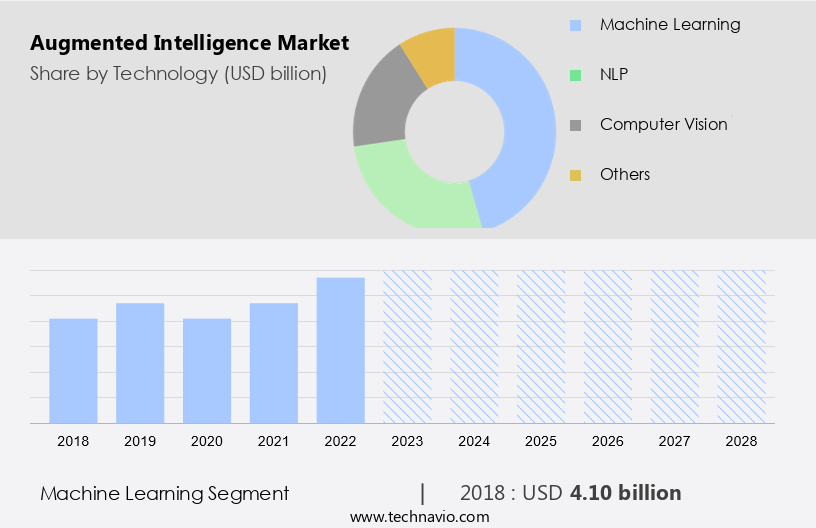
- The machine learning segment is estimated to witness significant growth during the forecast period.
Augmented Intelligence, also known as Intelligence Amplification, is a technology that enhances human intelligence by integrating Machine Learning (ML), Deep Learning, Natural Language Processing, and other advanced technologies. ML is a subset of this technology, which enables computers to learn from data using specific algorithms. These programs can adapt and improve their performance without human intervention. In today's data-driven business environment, the need for intelligent approaches to data analysis is crucial. Decision-makers require systems that can process vast amounts of data and provide valuable insights to inform decision-making. ML algorithms are trained on big data to perform specific tasks, such as predictive analytics and data analytics.
Additionally, Virtual Assistants, powered by Augmented Intelligence, can help businesses make sense of complex data by asking the right questions and providing insights that support informed decision-making. ML algorithms can analyze data from various sources, including social media, customer feedback, and market trends, to provide valuable insights. Data Scientists play a critical role in implementing Augmented Intelligence solutions. They use their expertise to develop and implement ML models that can analyze data and provide insights. These insights can be used to optimize business processes, improve customer experiences, and gain a competitive edge. Autonomous systems, such as self-driving cars and drones, are another application of Augmented Intelligence.
In conclusion, these systems use ML algorithms to analyze data from sensors and make decisions based on that data. This enables them to operate autonomously and improve their performance over time. In conclusion, Augmented Intelligence is a game-changer in the field of data analysis. It enables businesses to make sense of vast amounts of data and gain valuable insights that can inform decision-making. ML algorithms are a key component of this technology, and they can be trained on big data to perform specific tasks. Virtual Assistants, Autonomous systems, and Data Scientists all play a critical role in leveraging the power of Augmented Intelligence to drive business success.
Get a glance at the market report of share of various segments Request Free Sample
The machine learning segment was valued at USD 4.10 billion in 2018 and showed a gradual increase during the forecast period.
Regional Analysis
- North America is estimated to contribute 56% to the growth of the global market during the forecast period.
Technavio's analysts have elaborately explained the regional trends and drivers that shape the market during the forecast period.

For more insights on the market share of various regions Request Free Sample
Augmented Intelligence technology is gaining significant traction in North America, particularly in sectors such as banking, e-commerce and retail, IT and telecom, and more. The increasing demand for data-driven decisions with minimal human intervention is fueling the growth of this technology. Key market players like Microsoft Corporation, Alphabet (Google), and International Business Machines Corporation are leading the way with their investments. The US, in particular, is a major contributor to the global filing of augmented intelligence-related patents. This technology allows machines to execute tasks, perform analysis, and make decisions with human oversight. Error rates are minimized through the symbiotic relationship between technology and human ability.
Additionally, clinical studies have shown that this approach leads to more accurate and efficient decision-making. As data patterns become increasingly complex, augmented intelligence becomes an essential tool for businesses to stay competitive. With a strong focus on innovation and technological advancement, North American businesses are poised to benefit significantly from this technology. In conclusion, the adoption of augmented intelligence technology in North America is on the rise, driven by the need for automated decision-making and investments from major players. The US, in particular, is a leading innovator in this field, with a strong focus on data-driven insights and human oversight. This technology is essential for businesses looking to stay competitive in today's complex data landscape.
Market Dynamics
Our researchers analyzed the data with 2023 as the base year, along with the key drivers, trends, and challenges. A holistic analysis of drivers will help companies refine their marketing strategies to gain a competitive advantage.
What are the key market drivers leading to the rise in adoption of Augmented Intelligence Market?
The rise in the adoption of augmented intelligence by enterprises to gain the best outcome is the key driver of the market.
- Augmented intelligence, a technology that enhances human intelligence by automating tasks and providing real-time assistance, continues to gain traction in various industries, including retail, healthcare, e-commerce, finance, manufacturing, IT, and telecom. This technology has become increasingly important for businesses seeking to streamline processes, boost productivity, and minimize human error. One of the primary ways augmented intelligence supports businesses is through automating workflows and enhancing workplace productivity. Administrative and routine tasks that consume significant time and resources can be efficiently handled using augmented intelligence, enabling employees to focus on more complex tasks. By integrating AI applications into enterprise software, businesses can write code and perform math calculations more accurately and efficiently than humans. Autonomous AI, a subset of augmented intelligence, can even replace human intelligence in certain tasks, freeing up human resources for more strategic initiatives.
- However, it is essential to contrast the capabilities of autonomous AI with human intelligence and understand their respective strengths and limitations. By implementing augmented intelligence, businesses can gain a competitive edge and remain at the forefront of technological innovation. Search terms: Augmented Intelligence, Math calculations, Enterprise software, Workflow automation, Workplace productivity, Administrative tasks, Routine tasks, Autonomous AI, Human intelligence, AI applications, Business processes, Productivity enhancement, Streamlining, Efficiency, Error reduction.
What are the market trends shaping the Augmented Intelligence Market?
Implementation of augmenting analytics in business intelligence tools is the upcoming trend in the market.
- Augmented analytics represents the next wave of disruption in the data and analytics market, enhancing data analytics, data sharing, and business intelligence. Data and analytics professionals integrate AI components into their existing business models using augmented analytics platforms. This integration streamlines processes such as data understanding, insight discovery, data ingestion, and platform interaction, making them more powerful in a self-service environment. Natural language processing and AI elements are incorporated into the business intelligence process through augmented analytics, improving the user experience. User interfaces of AI systems become more intuitive, enabling users to develop data, identify new insights, and effortlessly share them with colleagues.
- Additionally, control rooms, self-driving cars, and autonomous vehicles are just a few examples of industries that can benefit from augmented analytics. However, it's crucial to manage risks and provide oversight as AI systems become more integrated into business processes. By incorporating AI into business intelligence, organizations can make data-driven decisions more efficiently and effectively, ultimately driving growth and success.
What challenges does Augmented Intelligence Market face during the growth?
The shortage of augmented intelligence experts is a key challenge affecting the market growth.
- Augmented Intelligence is a technology that enhances human capabilities by providing context-aware suggestions and insights. Unlike Artificial Intelligence, which aims to replicate human intelligence, Augmented Intelligence is designed to complement and improve human decision-making. However, implementing this technology comes with challenges. Machine learning and simulation tools require substantial investments in data management, infrastructure, and processing power. Finding a team of experts with the necessary skills to implement and manage these systems is also a challenge.
- Before scaling up, companies must carefully consider the use-cases and contexts where Augmented Intelligence can add the most value. The competition for top talent in this field is intense, making recruitment a significant hurdle. In summary, the high costs and expertise requirements make it difficult for many companies to fully leverage Augmented Intelligence, limiting its widespread adoption. For businesses seeking to implement this technology, it is crucial to plan carefully and invest wisely to maximize the benefits of Augmented Intelligence.
Exclusive Customer Landscape
The market forecasting report includes the adoption lifecycle of the market, covering from the innovator's stage to the laggard's stage. It focuses on adoption rates in different regions based on penetration. Furthermore, the market report also includes key purchase criteria and drivers of price sensitivity to help companies evaluate and develop their market growth analysis strategies.

Customer Landscape
Key Companies & Market Insights
Companies are implementing various strategies, such as strategic alliances, market forecast, partnerships, mergers and acquisitions, geographical expansion, and product/service launches, to enhance their presence in the market.
The market research and growth report includes detailed analyses of the competitive landscape of the market and information about key companies, including:
- Alibaba Cloud
- Alphabet Inc.
- Amazon.com Inc.
- Baidu Inc.
- Cisco Systems Inc.
- Meta Platforms Inc.
- General Vision Inc.
- Graphcore Ltd.
- Hewlett Packard Enterprise Co.
- Huawei Technologies Co. Ltd.
- iFLYTEK Co. Ltd.
- Intel Corp.
- International Business Machines Corp.
- Microsoft Corp.
- NVIDIA Corp.
- Oracle Corp.
- Salesforce Inc.
- Samsung Electronics Co. Ltd.
- SAP SE
- SAS Institute Inc.
- Siemens AG
Qualitative and quantitative analysis of companies has been conducted to help clients understand the wider business environment as well as the strengths and weaknesses of key market players. Data is qualitatively analyzed to categorize companies as pure play, category-focused, industry-focused, and diversified; it is quantitatively analyzed to categorize companies as dominant, leading, strong, tentative, and weak.
Research Analyst Overview
Augmented Intelligence (IA) is revolutionizing the way machines and humans collaborate in processing and analyzing data. IA goes beyond traditional Artificial Intelligence (AI) by amplifying human intelligence through machine learning, deep learning, natural language processing, and predictive analytics. IA systems learn from data and provide insights, enabling data scientists to make more informed decisions. IA is not about replacing human intelligence but rather enhancing it. It complements human ability by executing tasks, performing analysis, and making decisions. Machine learning algorithms, with their ability to learn from data, improve accuracy and safety in various industries such as factory automation, political think tanks, and medical analysis.
In summary, IA systems are not limited to data processing but also include virtual assistants and autonomous systems. They learn from user viewing habits, bias, fatigue, and distraction to provide a symbiotic relationship. IA is used in enterprise software to streamline business processes, manage data, and manage risks. It is also used in self-driving cars, autonomous vehicles, and control rooms to manage unforeseen issues. IA systems are different from AI systems as they focus on improving human decision-making and executing tasks, while AI systems aim to replace human roles. IA tools think, learn, and adapt, enabling human oversight and managing risks. IA systems are essential in a world where data-driven decisions are increasingly common.
|
Market Scope |
|
|
Report Coverage |
Details |
|
Page number |
146 |
|
Base year |
2023 |
|
Historic period |
2018-2022 |
|
Forecast period |
2024-2028 |
|
Growth momentum & CAGR |
Accelerate at a CAGR of 33.1% |
|
Market growth 2024-2028 |
USD 61.3 billion |
|
Market structure |
Fragmented |
|
YoY growth 2023-2024(%) |
24.9 |
|
Key countries |
US, UK, China, Japan, and India |
|
Competitive landscape |
Leading Companies, Market Positioning of Companies, Competitive Strategies, and Industry Risks |
What are the Key Data Covered in this Market Research and Growth Report?
- CAGR of the market during the forecast period
- Detailed information on factors that will drive the market growth and forecasting between 2024 and 2028
- Precise estimation of the size of the market and its contribution of the market in focus to the parent market
- Accurate predictions about upcoming market growth and trends and changes in consumer behaviour
- Growth of the market across North America, Europe, APAC, South America, and Middle East and Africa
- Thorough analysis of the market's competitive landscape and detailed information about companies
- Comprehensive analysis of factors that will challenge the growth of market companies
We can help! Our analysts can customize this market research report to meet your requirements. Get in touch
 RIA -
RIA - 
